
What if the therapy you’re hoping will finally change your partner is actually being used as a tool to keep you small? I know how exhausting it is to feel like you’re the only one holding the relationship together. You’ve likely spent years walking on eggshells, wondering if just one more session or the right therapist might finally make them see the impact of their actions.
As a therapist at Female Focused Therapy, I often hear women, especially those navigating complex relationships here in Singapore, ask one crucial question: can therapy help a narcissist? I understand that desperate hope for change. This article will help you understand the complex realities of therapy for narcissistic traits and, more importantly, how to protect your own mental health in the process.
We’ll explore why traditional talk therapy often fails in these situations and how you can give yourself permission to stop trying to fix a foundation that you didn’t break. It’s time to refocus on your own restoration and find the clarity you’ve been missing.
Key Takeaways
- I’ll help you see that while your hope is valid, therapy only works when someone is truly willing to look inward.
- We’ll explore the honest answer to the question, can therapy help a narcissist, and why traditional methods often hit a brick wall.
- Learn how to recognise “weaponised therapy,” where therapeutic language is used as a tool for further manipulation at home.
- I’ll show you how to shift your energy away from monitoring their progress and back toward your own internal restoration.
- Discover how a gentle, mind-body approach can help you rebuild the self-trust and intuition that you’ve been missing.
Understanding the hope that brings you to therapy
I see the hope you’re carrying, and I want you to know how much I respect it. You’ve likely spent months, or even years, researching ways to make things better. You want to believe that if they just sat across from a professional, they would finally understand the impact of their actions and the depth of your pain.
One of the most frequent questions I’m asked in my practice is, can therapy help a narcissist? It’s a question born out of love and a deep, exhausting desire for peace. However, we have to look at what therapy actually is. It isn’t a passive process where someone is “fixed” by an expert; it’s a rigorous journey of self-examination.
For someone with Narcissistic Personality Disorder, that internal look is exactly what their psyche is designed to avoid. There is a world of difference between a partner who is simply having a hard time and someone with deep-seated patterns that prevent them from seeing your reality as valid.
The ‘fixer’ dynamic in your relationship
I work with so many intelligent, high-functioning women who are natural problem solvers. If a project at work is failing, you find a solution. If a friend is in trouble, you’re there to help. It’s only natural that you’ve taken on the burden of “saving” your relationship by trying to guide your partner toward relationship trauma recovery.
This hope can sometimes keep you stuck in a cycle of disappointment. You might find yourself waiting for a breakthrough that never comes, or celebrating tiny moments of kindness that don’t lead to lasting change. I want you to know that your love is not at fault for their lack of progress, and you are not responsible for their mental health.
What ‘success’ in therapy actually looks like
We need to be honest about what we’re looking for when we ask, can therapy help a narcissist? Real success isn’t a sudden personality transplant. For someone with these traits, change is incredibly slow. It requires them to acknowledge their own vulnerability without lashing out, which is a massive hurdle for them to clear.
It’s important to understand that a “quick fix” is never an option for personality-based traits. Change, if it happens at all, is incremental and takes years of dedicated effort. Success requires them to accept that they are the ones who need to change, rather than just going through the motions to keep you from leaving.
Why narcissistic traits make traditional therapy a challenge
I often see partners hoping that a professional setting will provide the breakthrough they’ve been praying for. But when we ask, can therapy help a narcissist, we have to look at what happens behind the closed door of the therapy room. For someone with these traits, the space isn’t a sanctuary; it’s a battlefield.
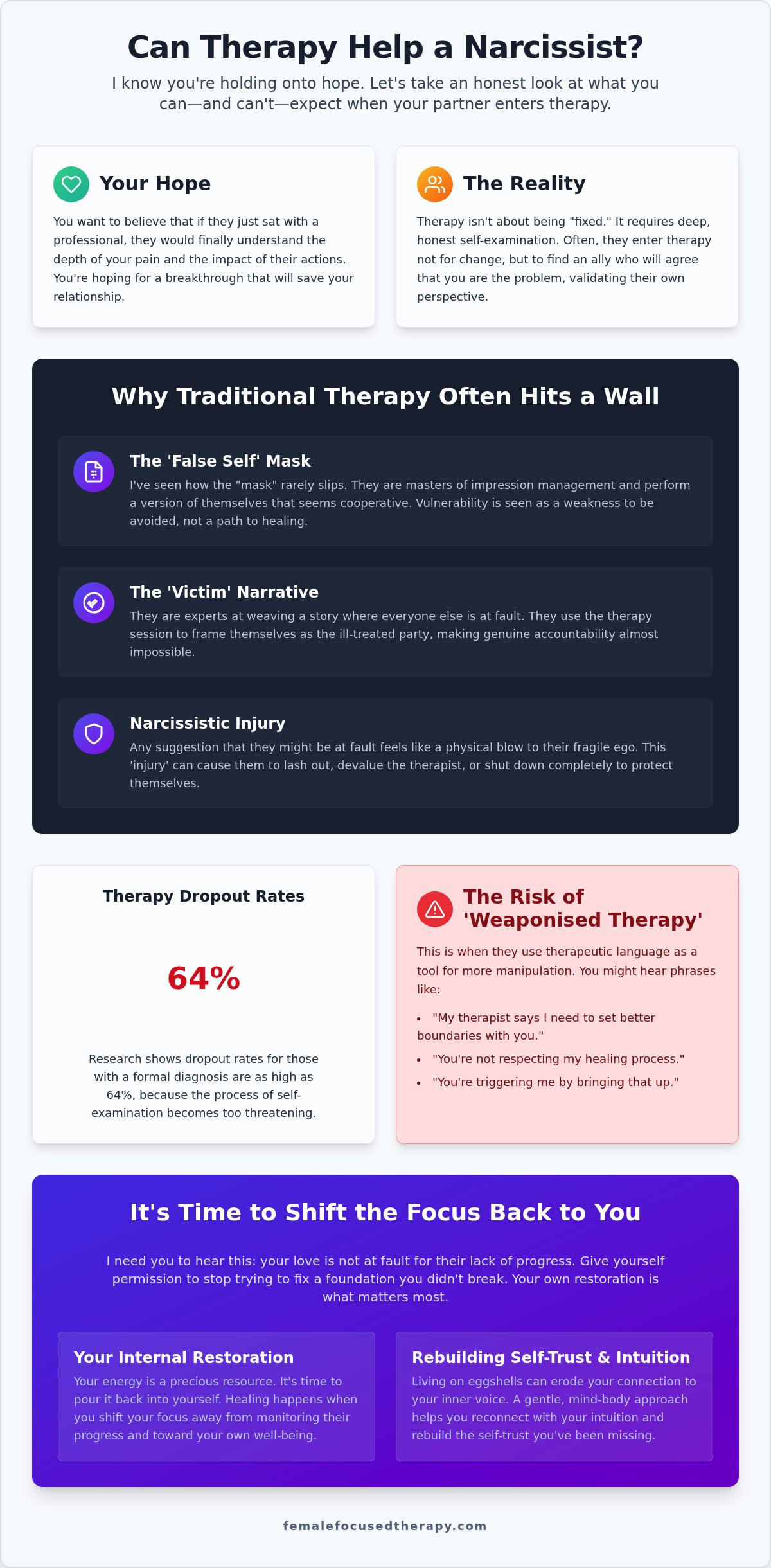
Any suggestion that they might be at fault triggers a “narcissistic injury,” which feels like a physical blow to their fragile ego. They don’t enter therapy looking for change; they often enter looking for an ally. They want a professional to validate their greatness or agree that you are the problem.
Finding a therapist who truly understands the nuances of narcissistic manipulation is a significant challenge, as many practitioners are trained to believe everyone is inherently capable of empathy. You can read more about the clinical Diagnosis and treatment of NPD to see how complex this process is.
Research shows that dropout rates for those with a formal diagnosis are as high as 63% to 64%, often because the process of self-examination becomes too threatening. This constant need for external validation blocks the internal self-reflection required for real growth, which is why traditional talk therapy often hits a wall.
The barrier of the ‘false self’
I’ve seen how the “mask” rarely slips, even in private sessions. They are masters of impression management and will perform a version of themselves that seems cooperative. If a therapist is highly skilled and starts to see behind the facade, the narcissist will often “fire” them or claim the therapist is incompetent.
Vulnerability isn’t seen as a path to healing; it’s viewed as a dangerous weakness to be avoided at all costs. When you’re wondering, can therapy help a narcissist, it’s vital to recognise that they may be using the session to perform a role rather than engage in honest work.
The ‘victim’ narrative in the chair
Perhaps the most difficult part is how they use the session to frame themselves as the ill-treated party. They are experts at weaving a narrative where everything is someone else’s fault. This makes taking accountability almost impossible, as their psyche is protected by a layer of denial.
In traditional couples settings, this can be particularly counterproductive or even unsafe. They might use what you share in confidence as ammunition to gaslight you later at home. This is why I always prioritise your emotional safety and internal restoration above all else.
If you’re feeling exhausted by this cycle, remember that your recovery doesn’t have to wait for their progress. You can start your own healing journey today, focusing entirely on your own needs, stability, and peace of mind.
Recognising the risks of ‘weaponised therapy’
I’ve seen a painful pattern where therapy doesn’t just fail to help; it becomes a new way to cause harm. When we ask, can therapy help a narcissist, we have to consider the risk of “weaponised therapy.” This happens when someone with narcissistic traits learns the language of healing and uses it to further their own agenda at home.
It’s incredibly disorienting to hear the person who hurt you using terms like “boundaries” or “emotional safety” to justify their own hurtful behaviour. They may return from a session and tell you that their therapist “agrees” you are the one who needs to change. This is often a manipulation of the therapeutic process, designed to alienate you and make you doubt your own reality.
Some individuals are exceptionally charming in a professional setting. They can win over a therapist who isn’t specifically trained in narcissistic abuse, creating a dynamic where the therapist becomes an unwitting ally in your partner’s narrative. If you feel like your intuition is screaming that something is wrong, even if they claim they’re having “breakthroughs,” please trust yourself.
When jargon becomes a tool for control
I want to help you spot the difference between healthy growth and “therapy speak” used as a weapon. A healthy boundary is about what a person will or won’t do; a weaponised boundary is often an ultimatum designed to control your actions. You might hear phrases like:
- “My therapist says your reaction is a sign of your own unhealed trauma.”
- “I’m setting a boundary that I won’t talk to you if you’re being ‘negative’ (meaning, expressing your hurt).”
- “You’re gaslighting me by bringing up the past.”
When these terms are used to shut down your voice rather than open up a dialogue, therapy isn’t helping the relationship. It’s simply giving the narcissist a more sophisticated set of tools to maintain power. Protecting your reality is essential when your partner starts using the therapist’s office as a shield for their behaviour.
The danger of ‘couples therapy’ in abusive dynamics
I’m often asked why I don’t recommend joint sessions when narcissistic patterns are present. In a standard couples session, the therapist assumes both parties are acting in good faith and are capable of empathy. However, in an abusive dynamic, revealing your vulnerabilities in front of a narcissist gives them leverage to use against you later.
Joint sessions can inadvertently provide a platform for them to perform the “perfect partner” role while painting you as the unstable one. This is why I work with women on relationship trauma through individual support. It’s a space where your safety is the only priority, and you don’t have to worry about your words being used as ammunition when you get home.
Shifting the focus to your internal restoration
I want you to take a deep breath and feel the weight of that question: can therapy help a narcissist? It’s a heavy burden to carry. You’ve likely spent months or years monitoring their moods, analysing their progress, and hoping for a breakthrough that would finally bring you peace. There is an incredible sense of relief that comes when you realise you can stop being their “accountability partner” and start being your own advocate.
Your energy is a finite resource. When you spend it all trying to understand why they act the way they do, there’s nothing left for your own joy or growth. Rebuilding your self-trust after years of emotional intensity is a slow, gentle process. It starts with giving yourself permission to stop fixing someone else and focusing instead on your own internal restoration.
Listening to your body’s wisdom
Healing isn’t just a mental process; your body remembers the stress of the relationship even when your mind tries to move on. Chronic stress often manifests as physical tension, digestive issues, or a sense of “ADHD-like” overwhelm where you can’t seem to focus on anything. This is your nervous system stuck in a state of high alert, constantly scanning for the next conflict.
I use a multidisciplinary approach to help you settle that internal noise. Using breath and gentle movement can help you feel grounded in your own skin again. Reconnecting with your physical self is a vital part of somatic movement and yoga for women’s healing. It allows you to process the trauma that talk therapy alone might not reach, moving the stress out of your tissues and restoring a sense of calm.
Reconnecting with your own needs
Think about what you’ve sacrificed just to keep the peace. Perhaps you’ve stopped seeing certain friends, let go of hobbies you loved, or learned to ignore your own gut feelings because expressing them caused conflict. Reclaiming your space means learning to trust that “gut feeling” again without needing their validation or permission to feel what you feel.
You can create a safety plan for your emotional wellbeing that doesn’t depend on their behaviour. This might include setting firm boundaries around your time, seeking individual support, or simply carving out moments of absolute stillness in your day. Your peace of mind is worth protecting, regardless of whether they ever choose to engage in the hard work of change. If you’re ready to stop waiting for them and start moving toward your own restoration, I’m here to guide you. You can book your individual psychotherapy session to begin reclaiming your life and your internal stability.
How I support your journey forward
I want you to know that you don’t have to carry this confusion alone. For too long, you’ve been the one holding everything together, trying to manage a relationship that feels like it’s constantly shifting under your feet. My approach is designed to provide a steady, grounded space where your experiences are validated without question.
We move past the academic definitions and focus on the lived reality of your life. While we have explored the complex question, can therapy help a narcissist, our work together shifts that lens entirely. We focus on your restoration and your future, helping you move out of the “freeze” response that often follows years of emotional intensity.
By integrating mind and body, I help you process the stress that has likely settled in your nervous system. It’s about more than just talking; it’s about helping you feel safe in your own skin again. I’m here to hold that space for you while you find your way back to the person you were before the chaos took over.
A trauma-informed space just for you
In our sessions, we work to untangle the layers of gaslighting that may have eroded your self-trust. I provide a trauma-informed environment where you can finally speak your truth without fear of being judged. It’s a profound shift to move from the exhausting question of “how do I fix him?” to the empowering focus of “how do I heal me?”
My work is deeply personal and integrative. I combine evidence-based psychotherapy with somatic practices to help you reconnect with your body’s intuition. You can learn more about my integrative approach to therapy and how I support women in reclaiming their internal stability and self-reliance.
Taking your first step toward clarity
Booking a consultation isn’t just a clinical appointment; it’s a genuine act of self-kindness. It’s the moment you decide that your peace of mind is worth more than the cycle of disappointment you’ve been living in. When we work together, we’ll look at these patterns with compassion and clarity, helping you find your footing again.
You deserve a life that feels calm, supportive, and safe. You’ve spent enough time walking on eggshells and monitoring someone else’s progress. Now, it’s your turn to be supported. I’m here to help you untangle these patterns and move forward with a renewed sense of self-assurance and grace.
Reclaiming your peace and moving forward
I know how much energy you’ve spent trying to find a solution for someone else. While the question “can therapy help a narcissist?” is a natural one to ask, the most empowering answer is the one that leads you back to yourself. We’ve looked at the risks of weaponised jargon and why your healing cannot depend on their willingness to change.
You deserve a life where you feel safe, heard, and grounded in your own reality. As a specialist in narcissistic abuse recovery, I offer an integrative, trauma-informed approach that helps you move out of the freeze response and back into your own life. I provide a safe, confidential space for women to process these experiences and find their footing again.
I’m here to support you in rebuilding the self-trust that has been eroded over time. You don’t have to face this journey alone; I’m here to hold that space for you. If you’re ready to prioritise your own restoration, you can book your initial consultation with me here. Peace is possible, and it starts with you.
Common questions about therapy and narcissistic traits
Is it possible for a narcissist to change if they really want to?
Change is possible but exceptionally rare because it requires a level of self-reflection that their psyche is designed to avoid. It takes years of consistent, specialised work to move past the “false self” and accept true vulnerability. Because dropout rates for this diagnosis are as high as 64%, lasting change only happens when they take full accountability without blaming others.
Why does my partner seem to get worse after starting therapy?
This often happens when the therapeutic process triggers a “narcissistic injury,” making them feel attacked. Instead of looking inward, they might use “therapy speak” to justify their behaviour or gaslight you more effectively. If they are using their sessions to gather new ways to control the narrative, they are resisting the actual work of healing.
How do I know if the therapist is being manipulated by my partner?
You might notice that your partner returns home claiming the therapist “agrees” that you are the problem. Charming individuals are masters of impression management in professional settings. If you feel your reality is being dismissed or the feedback you hear is consistently one-sided, the therapist may not have spotted the patterns of manipulation yet.
Can couples therapy work if one person has narcissistic traits?
I generally advise against joint sessions because they require both people to act in good faith and have a capacity for empathy. When one person lacks these traits, they often use your shared vulnerabilities as ammunition against you later. When women ask me, can therapy help a narcissist, I explain that individual support is usually much safer and more effective.
What should I do if my partner refuses to go to therapy?
Their refusal is a clear piece of information that tells you where they stand regarding change. You cannot force someone to look at themselves if they aren’t ready. My advice is to stop spending your energy on convincing them and start investing it in your own restoration. You deserve support regardless of whether they choose to seek it.
How can I tell the difference between narcissistic traits and just being ‘difficult’?
The main difference is the capacity for genuine empathy and taking real responsibility. A difficult person might be stubborn or argumentative, but they can eventually feel sorry for hurting you and try to make amends. Someone with deep narcissistic patterns will almost always frame themselves as the victim and will consistently lack the ability to see your perspective.
How long does it take to heal from narcissistic abuse?
There is no fixed timeline for healing as it’s a deeply personal journey of restoration. It involves untangling years of gaslighting and calming a nervous system stuck in high alert. Most women I work with find that with consistent, trauma-informed support, they begin to feel a renewed sense of self-trust and internal stability within a few months.
Is it my fault if the therapy doesn’t work for them?
It is never your fault if therapy fails to help another person. You are not responsible for their mental health or their willingness to be honest with their practitioner. When exploring the question, can therapy help a narcissist, remember that the work belongs entirely to them. You have already done enough by trying to hold the relationship together.

Article by
Cheryl Kennedy MacDonald MA BA (Hons) Pg. Dip. SAC BACP
Cheryl Kennedy MacDonald is a psychotherapist specialising in women’s mental health, relationships, and life transitions. She works with women navigating trauma, relationship breakdown, identity shifts, and midlife change, helping them rebuild self-trust, emotional stability, and a clear sense of who they are and what they want.
With over 20 years’ experience working with women internationally, Cheryl is the founder of YogaBellies, a global women’s yoga school, and the creator of the Birth ROCKS method. Her work sits at the intersection of psychotherapy and embodiment, integrating evidence-based therapeutic approaches with somatic, body-based practices that support deep, lasting change.
Known for her grounded and direct approach, Cheryl moves beyond surface-level insight to address the patterns held in the body and nervous system. Her work supports women to regulate, reconnect, and respond to their lives from a place of clarity, strength, and self-respect.
She is a published author in academic journals and has written multiple books on women’s health, pregnancy, and midlife wellbeing, available on Amazon and leading book retailers worldwide.