
Do you ever feel like a walking contradiction? One moment, your brain craves new ideas, spontaneous plans, and the thrill of the unknown. The next, you feel a deep, almost physical need for quiet, predictability, and a routine so solid that nothing can disrupt it. If this constant internal tug-of-war feels exhausting and familiar, I want you to know that you are not alone, and you are not broken.
As a result, many of us grew up internalising our struggles. We blamed our character for what was actually our neurotype. We called ourselves “lazy” for our executive dysfunction, “dramatic” for our sensory sensitivities, and “weird” for our deep, passionate interests. For many women, finally receiving a diagnosis is a moment of profound relief—a name for a lifetime of struggle and a chance to finally let go of the self-blame. Seeking guidance from specialized providers like Friedman Psychiatry can be a transformative step toward achieving this clarity and self-acceptance.
This feeling of being pulled in two opposing directions is an experience I see so often in my work with intelligent, high-achieving women. It’s a pattern that can leave you feeling chronically overwhelmed and questioning your own abilities, despite all evidence of your success. What you may be navigating is the complex, often misunderstood experience of AuDHD in adult women.
The Quiet Conflict: Why AuDHD in Women Often Stays Hidden
Before we go any further, I want to validate that feeling of being pulled apart. It’s real, it’s exhausting, and it makes perfect sense. AuDHD is the term used to describe the co-occurrence of Autism and ADHD in a single, brilliant brain. In my therapy practice here in Singapore, I work with so many women who have spent their lives feeling like they don’t quite fit, and this dual profile is often the missing piece of their puzzle.
For women, this combination is so often missed because of our incredible capacity to observe, adapt, and perform “competence.” We learn from a young age to hide our struggles, pushing through discomfort to meet the expectations placed upon us, leaving our internal world in turmoil.
According to comorbidity of autism and ADHD, this is a well-documented area of ongoing research and practical application.
The Mask We Wear to Survive
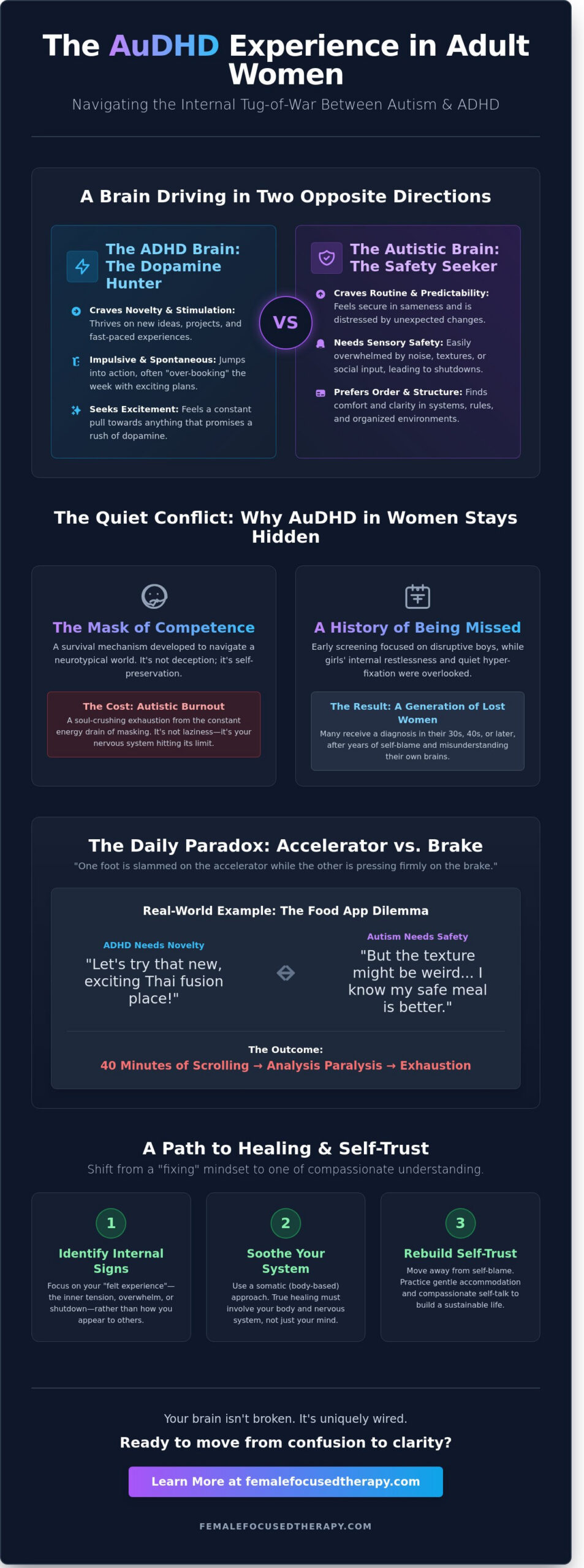
Masking, or camouflaging, is the process of hiding your neurodivergent traits to fit in with neurotypical social standards. So many of my clients describe it as running a constant, complex social software in the background of their minds. This immense effort is not a choice; it is a survival mechanism developed over years of feeling “too much” or “not enough.”
The social cost is enormous. It often leads to a profound state of exhaustion known as autistic burnout, which many women mistake for depression or anxiety for years. They come to therapy believing they are failing, when in fact, they have been over-functioning to the point of collapse.
Why Late Diagnosis is a Female Epidemic
The path to understanding AuDHD in adult women is often long and complicated. For decades, diagnostic criteria were based on studies of young, hyperactive boys. Girls, who tend to present with more internalised symptoms, were overlooked. We weren’t disruptive, so we were considered fine.
As a result, many of us grew up internalising our struggles. We blamed our character for what was actually our neurotype. We called ourselves “lazy” for our executive dysfunction, “dramatic” for our sensory sensitivities, and “weird” for our deep, passionate interests. For many women, finally receiving a diagnosis is a moment of profound relief—a name for a lifetime of struggle and a chance to finally let go of the self-blame.
The Paradox of Choice: Balancing the Need for Novelty and Sameness
The core of the AuDHD experience is often the “tug of war” between the ADHD brain’s need for dopamine and the Autistic brain’s need for safety and predictability. The women I work with describe this as feeling like they have one foot on the accelerator and one on the brake, all the time.
This conflict shows up in everyday life, from struggling to decide what to eat for dinner to making major career moves. The ADHD part wants to leap into a new and exciting venture, while the Autistic part craves the security of the known. When these two powerful needs collide, it can lead to “AuDHD paralysis”—a state of being completely stuck, unable to move forward.
Dopamine Seeking vs. Sensory Safety
The ADHD brain is a novelty-seeking engine. It thrives on new information, new experiences, and new people. However, for the Autistic side of the brain, this constant influx of newness can trigger intense sensory overwhelm. The lights feel too bright, the sounds are too loud, and the social energy is utterly draining.
This often creates a cycle of over-booking and then total isolation. A woman might have a wonderfully stimulating week filled with social events and new projects, only to spend the entire weekend in a dark, quiet room, unable to speak to anyone. It’s not a character flaw; it’s her nervous system desperately trying to find balance.
The Executive Function Minefield
Standard productivity hacks rarely work for the AuDHD woman. Time-blocking can feel rigid and suffocating to the ADHD brain, while a lack of structure can send the Autistic brain into a state of overwhelm. The simple act of transitioning from one task to another can feel like a monumental effort, draining precious energy.
If you have ever stared at a simple to-do list and felt completely incapable of starting, please know this: You aren’t lazy; you’re navigating a complex internal landscape. Your brain is not broken; it simply operates on a different system.
Beyond the Mask: Recognising the Internal Signs of AuDHD
Because so many women with AuDHD are masters of masking, the true signs are often internal, a “felt experience” rather than an observable behaviour. It’s about understanding what’s happening on the inside, behind the competent exterior.
- Sensory Processing: This isn’t just a dislike for loud noises. It’s the low hum of a refrigerator feeling like physical pain, or the texture of a certain fabric being unbearable against your skin.
- Social Exhaustion: Many AuDHD women are incredibly skilled socially—empathetic, engaging, and witty. But this “peopling” comes at a high cost, often requiring days of quiet solitude to recover.
- Rejection Sensitivity Dysphoria (RSD): This is an intense, painful emotional response to perceived rejection or criticism. It’s a common feature of ADHD and can make navigating relationships feel like walking on eggshells.
The Emotional Intensity of AuDHD
The women I support often describe their emotions as “all or nothing.” There is no dimmer switch; there is only on or off. This intensity can be beautiful, leading to deep passion, empathy, and creativity. But it can also be overwhelming, especially when it comes to relationships.
To avoid the profound pain of perceived rejection, many over-function in their relationships, becoming chronic people-pleasers. This pattern can make them vulnerable, and it is a topic we often explore when healing from relationship trauma and narcissistic abuse.
Hyperfocus and the “Socially Acceptable” Passion
One of the most beautiful aspects of the neurodivergent mind is its capacity for a “deep dive.” AuDHD women often have intense, specialised interests that they can focus on for hours, losing all track of time. This is the state of hyperfocus.
As adults, we often learn to channel these passions into “socially acceptable” pursuits that look like ambition or a dedicated hobby. While this can be a source of great joy and success, it can also be draining when the brain doesn’t know how to turn off. Learning to honour this gift without letting it lead to burnout is a key part of the journey.
Soothing the System: A Somatic Approach to AuDHD Overwhelm
For a brain that feels everything so deeply, healing cannot just happen in the mind. It must also happen in the body. Traditional talk therapies like CBT can sometimes feel invalidating for a neurodivergent brain, as if you’re being told to simply think your way out of a physiological reality.
That is why I integrate a “bottom-up” approach in my work, starting with the nervous system. We have to create a sense of safety in the body first. This is where my background in somatic work becomes so important, as we use gentle, body-based practices to help regulate an overwhelmed system.
Finding Safety in Movement and Breath
Soothing an AuDHD nervous system doesn’t always look like traditional meditation. For many, stillness can feel agitating. Instead, safety can be found in gentle, repetitive movement. This might look like:
- Gentle Swaying: Standing and slowly, gently rocking from side to side can be incredibly calming.
- Humming or Chanting: The vibration created by humming can have a direct regulatory effect on the vagus nerve.
- Applying Weighted Pressure: Using a weighted blanket or even just firmly placing your hands on your thighs can provide grounding sensory input.
For an AuDHD brain, “rest” might be active. It might be stimming, walking, or engaging in gentle, flowing movements. You can learn more about how I use somatic movement and yoga for women to support this process.
Creating a Neuro-Affirming Environment
A huge part of soothing the system is reducing the demands of your environment, especially when you are close to burnout. This involves giving yourself permission to honour your own needs, rather than pushing through to meet neurotypical expectations.
This could mean wearing noise-cancelling headphones in the supermarket, saying “no” to a social event that you know will drain your battery, or creating a quiet, low-light space in your home where you can retreat. It’s about learning to trust your body’s signals and responding with compassion.
Rebuilding Self-Trust: How We Can Navigate Your Journey Together
Living with undiagnosed AuDHD can profoundly erode your self-trust. After years of feeling like you’re getting it “wrong,” it can be hard to believe in your own perceptions and needs. The goal of therapy is not to “fix” you, but to help you understand and accommodate your unique brain.
In our sessions, we work together to untangle the years of self-blame and shame. We explore who you are beneath the mask and begin to build a life that actually fits you, rather than one you feel you have to constantly fight to maintain. The ultimate aim is to move toward clarity, confidence, and a deep, unshakable sense of self.
A Safe Space for Your True Self
It is so important to work with a therapist who truly “gets” the neurodivergent experience. I provide a warm, boundaried, and confidential space for you to explore all parts of yourself without judgment. My approach to ADHD-focused therapy is always trauma-informed and person-centred.
Whether you are in Singapore or anywhere else in the world, I offer online therapy to ensure you can access support that feels right for you. My role is to be a compassionate guide as you reconnect with your own inner wisdom.
Your Next Realistic Step
If this article resonates with you, please know you don’t have to figure everything out today. The journey of self-understanding is a gentle one, taken one step at a time. A simple, realistic next step might be to just notice, without judgment, one moment this week where you feel that internal tug-of-war.
When you are ready to stop fighting your brain and start working with it, I invite you to book a session with me here. It would be a privilege to support you.

Article by
Cheryl Kennedy MacDonald MA BA (Hons) Pg. Dip. SAC BACP
Cheryl Kennedy MacDonald is a psychotherapist specialising in women’s mental health, relationships, and life transitions. She works with women navigating trauma, relationship breakdown, identity shifts, and midlife change, helping them rebuild self-trust, emotional stability, and a clear sense of who they are and what they want.
With over 20 years’ experience working with women internationally, Cheryl is the founder of YogaBellies, a global women’s yoga school, and the creator of the Birth ROCKS method. Her work sits at the intersection of psychotherapy and embodiment, integrating evidence-based therapeutic approaches with somatic, body-based practices that support deep, lasting change.
Known for her grounded and direct approach, Cheryl moves beyond surface-level insight to address the patterns held in the body and nervous system. Her work supports women to regulate, reconnect, and respond to their lives from a place of clarity, strength, and self-respect.
She is a published author in academic journals and has written multiple books on women’s health, pregnancy, and midlife wellbeing, available on Amazon and leading book retailers worldwide.