
You hang up the phone and feel that familiar, heavy tightness in your chest. Even though you’re a capable adult, a five-minute conversation with your parent can leave you feeling like a small, misunderstood child again. When we navigate Difficult Parent Relationships: Healing as an Adult Daughter, it’s common to feel emotionally exhausted and gaslighted when trying to discuss the past.
I understand how deeply you want to move past the “good daughter” syndrome and the persistent guilt that follows every interaction. I want you to know that the path forward isn’t about waiting for them to change. It’s about restoring your own sense of safety through a collaborative journey of rebuilding self-trust.
I’ll help you understand the roots of these painful dynamics and show you how to reclaim your internal stability. Using a gentle, mind-body approach to healing, I’ll guide you toward building clearer boundaries without the crushing weight of guilt. We’ll explore how to find a sense of peace that finally belongs to you, regardless of your parent’s behaviour.
Key Takeaways
- I’ll help you recognise the quiet exhaustion of subtle control and see how early attachments shaped your current emotional landscape.
- You’ll find a path through Difficult Parent Relationships: Healing as an Adult Daughter by learning to listen to the signals your nervous system is sending you.
- I’ll explain why you don’t need to offer forgiveness to achieve restoration; your healing journey is entirely your own.
- We’ll look at how to release the physical weight of the past from your body, focusing on areas where you might be holding onto stress.
- You’ll learn how to take that first brave step toward reclaiming your self-trust within a safe and supportive therapeutic relationship.
Recognising the Weight of a Difficult Parent Relationship
I want to start by acknowledging the quiet, persistent exhaustion you might be carrying. It’s a weight that doesn’t always have a name, especially when your childhood looked “fine” on the surface. You might have had a roof over your head and food on the table, yet you still feel a profound sense of emotional depletion after every interaction.
When we talk about Difficult Parent Relationships: Healing as an Adult Daughter, it’s vital to understand that “difficult” doesn’t always mean loud arguments or obvious neglect. Sometimes, it’s found in the heavy silences, the subtle guilt-trips, or the feeling that you must constantly perform to be worthy of love. These Dysfunctional family dynamics can leave you feeling stuck in a role you never chose.
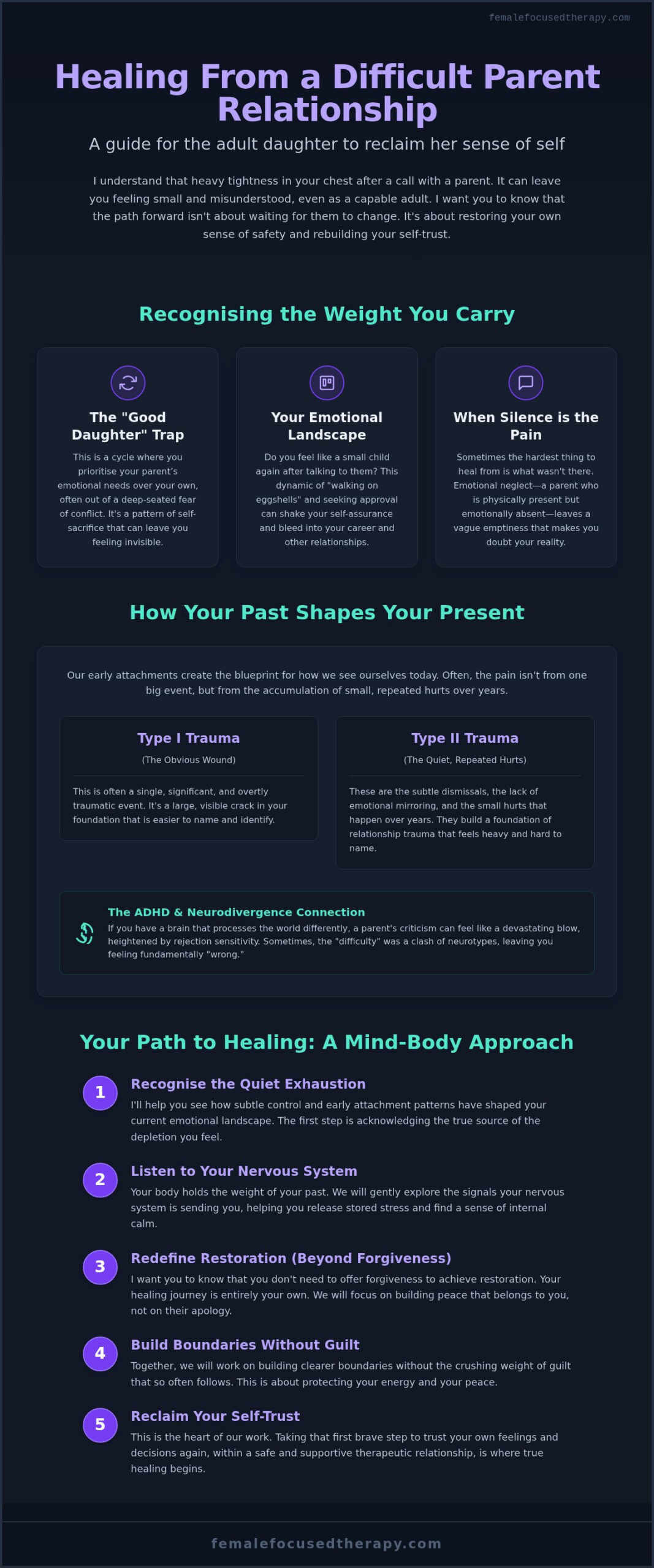
Many women I work with are caught in the “Good Daughter” trap. This is a cycle where you prioritise your parent’s emotional needs over your own, often out of a deep-seated fear of conflict or a sense of obligation. It’s a pattern of self-sacrifice that leaves you feeling invisible. You might find yourself apologising for things that aren’t your fault, just to keep the peace.
I want to validate that your feelings of hurt are real. Even if your parent provided for your physical needs, the absence of emotional safety is a significant loss. You aren’t being “sensitive” or “ungrateful” for noticing the gap where warmth and understanding should have been.
The Emotional Landscape of the Adult Daughter
I often see incredibly high-functioning, successful women who suddenly feel like a small, uncertain child the moment they speak to their parents. You might find yourself seeking approval for decisions you’ve already made or “walking on eggshells” to avoid triggering a parent’s mood. It’s a jarring shift that can shake your sense of self-assurance.
This dynamic doesn’t just stay within the family home. It often bleeds into your career confidence and your other connections. If you’ve spent years managing a parent’s emotions, you might find yourself over-functioning in your job or struggling with relationship trauma in your personal life. You’ve been trained to scan for danger, which makes true relaxation feel impossible.
When Silence is the Source of Pain
Sometimes the hardest thing to heal from is what wasn’t there. Emotional neglect happens when a parent is physically present but emotionally unavailable. It leaves a vague emptiness that’s hard to justify to others because there are no obvious scars to show. This emptiness can make you doubt your own reality, especially if others see your parent as “nice.”
I believe it is okay to grieve the relationship you wished you had. You aren’t being dramatic; you’re acknowledging a genuine lack of connection. Recognising this gap is a necessary step in Difficult Parent Relationships: Healing as an Adult Daughter, allowing you to finally stop waiting for a parent to give you the validation they may never be capable of providing.
How Your Past and Your Brain Shape the Present
I believe our early attachments create the blueprint for how we see ourselves today. These early bonds shape our internal narrative, influencing how we trust others and how we trust ourselves. When we look at Difficult Parent Relationships: Healing as an Adult Daughter, we often find that our current anxieties are echoes of these initial blueprints.
It isn’t always about one single, traumatic event. Often, it’s the accumulation of what I call Type II trauma. These are the small, repeated hurts that happen over years, like subtle dismissals or a lack of emotional mirroring. Over time, these moments build a foundation of relationship trauma that feels heavy and hard to name.
I find it helpful to use concepts like the “mother wound” or “father wound” to find understanding, not to assign blame. By naming the specific ways your needs weren’t met, you can begin to separate your parent’s limitations from your own worth. This is a core part of how I work with women in Singapore and through online therapy to rebuild self-trust.
The ADHD Connection in Family Dynamics
As a therapist with ADHD, I know how neurodivergence can heighten the sensitivity to parental criticism. If you have a brain that processes the world differently, a parent’s feedback can feel like a devastating blow. This is often tied to rejection sensitivity, which makes the emotional stakes in Difficult Parent Relationships: Healing as an Adult Daughter feel incredibly high.
Sometimes, the “difficulty” in the relationship was actually a clash of neurotypes. If your parent didn’t understand or support your unique brain, you may have grown up feeling fundamentally “wrong.” Understanding this ADHD connection allows you to stop internalising their lack of support as a personal failure.
Intergenerational Patterns and the Cycle of Trauma
I often look at the “why” behind a parent’s behaviour to find context rather than to excuse it. Perhaps they were raised in an environment where emotions were suppressed or where love was conditional. This perspective helps us see a path to reconciliation, even if that peace is found entirely within yourself.
Trauma is often passed down through generations like an unasked-for inheritance. It’s a cycle of behaviours and coping mechanisms that parents simply learn from their own families. You have the profound power to be the one who stops this cycle. By choosing to heal, you ensure these patterns don’t continue through you.
If you feel ready to explore these patterns in a safe, grounded space, we can work together through individual psychotherapy sessions to unpack these layers at your own pace.
The Truth About Forgiveness and Boundaries
I want to clear up a common myth: you don’t have to forgive to heal. Society often pushes the idea that forgiveness is the only way to find closure, but when dealing with Difficult Parent Relationships: Healing as an Adult Daughter, this pressure can feel like another burden. Forgiveness is a personal choice, not a therapeutic requirement for your restoration.
Healing is about your internal landscape, not the parent’s redemption. I believe that shifting the focus from “fixing” the parent to protecting your own internal peace is where true change begins. Boundaries are an act of self-love, even if they feel like a betrayal at first. You aren’t being “bad”; you’re simply making yourself safe.
Setting Boundaries That Actually Stick
I teach my clients that boundaries are about your actions, not the parent’s compliance. You cannot control how they react, but you can control your own presence and what you are willing to tolerate. Practical examples of these boundaries might include:
- Limiting phone calls to twenty minutes on a specific day of the week.
- Steering conversations away from “trigger” topics that lead to gaslighting.
- Choosing to leave the room or end a call if the tone becomes disrespectful.
- Physical distance, such as deciding not to stay in their home during visits.
Managing the “guilt-tripping” that follows is often the hardest part of this process. When you start saying no, the family system might push back to maintain the old status quo. I remind my clients that their guilt is often a sign that they are breaking a cycle, rather than a sign that they’ve done something wrong.
Acceptance vs. Reconciliation
I find that acceptance, which is seeing the parent exactly as they are without the filter of who you wish they were, is far more powerful than forced reconciliation. Acceptance means you stop spending your emotional currency trying to “buy” a version of them that doesn’t exist. It’s the difference between “giving up” and finally “letting go” of the exhausting hope that they will suddenly change.
For many women, “no contact” feels too extreme or isn’t a safe option for their specific family dynamic. In these cases, you can maintain a “low contact” relationship by keeping interactions brief and superficial. This approach allows you to stay connected to other family members while prioritising your own relationship recovery. It’s about building a life where your peace isn’t dependent on their behaviour.
Reclaiming Your Self Through Mind and Body
I believe that healing happens in both the mind and the body. We cannot just talk our way out of trauma, especially as you work through Difficult Parent Relationships: Healing as an Adult Daughter. Your body remembers the tension even when your mind tries to rationalise a painful interaction.
Often, family stress stores itself deep within your nervous system. You might notice a perpetually tight jaw, a fluttering in your gut, or a heavy pressure in your chest before you even pick up the phone. These are physical echoes of the “fight or flight” response that have become a baseline for your body.
I advocate for a sense of “radical softness” for the daughter who has spent years performing and over-functioning. You’ve likely spent a lifetime being the “strong” one or the “fixer” in the family. Rest is not a luxury; it is a vital part of your restoration and a way to signal to your body that the war is over.
Somatic Tools for Emotional Regulation
I often suggest simple breathwork to anchor yourself before or after a parent interaction. Taking a few intentional, slow breaths helps signal to your brain that you are safe in the present moment. It’s a way to de-escalate the internal alarm system that usually rings during these visits.
When you feel gaslighted or dismissed, your body can feel “frozen” or stuck. I find that gentle, rhythmic movement can help process this stagnant energy and release the “fight or flight” adrenaline. You might find comfort in exploring somatic movement and yoga for women to help release what the mind cannot yet articulate.
Rebuilding Internal Self-Trust
My goal is to help you hear your own voice again, clear and steady. For many women, the loudest voice in their head is actually the internalised criticism of a parent. We work together to identify these scripts and replace them with your own authentic truth.
By using practical mindfulness exercises, we can begin to separate your inherent worth from your parent’s limited opinion. Creating a “safe space” within yourself is essential for long-term peace. This is an internal sanctuary that no one else can touch, judge, or diminish, regardless of their behaviour.
As you rebuild this self-trust, you’ll find that your internal stability no longer depends on whether a parent approves of your life choices. If you are ready to start this collaborative journey of restoration, you can book an individual psychotherapy session to begin your work in a safe, boundaried space.
Taking Your First Step Toward Healing
I know that starting this journey feels daunting. You’ve spent years managing someone else’s emotions, and the idea of focusing entirely on your own needs can feel like a huge, even slightly frightening shift. You don’t have to walk this path alone.
In my work with Difficult Parent Relationships: Healing as an Adult Daughter, I provide a boundaried, safe space where you can finally unpack these layers of guilt and expectation. Individual psychotherapy isn’t about blaming; it’s about understanding the blueprint of your past so you can build a different, more authentic future.
When you work with me, you can expect a partnership that is collaborative, empathetic, and entirely non-judgmental. My role is to hold space for your difficult emotions while guiding you toward your own internal restoration. I believe that your healing is possible, regardless of whether your parent ever chooses to change or acknowledge the past.
Your peace is your own. It doesn’t require their permission or their participation to become a reality. We’ll work together at a pace that feels manageable for you, ensuring you feel supported as you rebuild your sense of self-assurance.
Is Therapy the Right Step for You?
I work with women who are ready to stop the exhausting cycle of people-pleasing and start living for themselves. If you’re tired of living for someone else’s approval, relationship trauma and narcissistic abuse therapy can help you reclaim your own voice.
Seeking help isn’t a sign of weakness. It’s actually a profound act of strength and self-awareness to admit that you deserve a life that feels lighter. You are allowed to prioritise your wellbeing, even if you’ve been taught that doing so is “selfish.”
A Small, Realistic Next Step
I invite you to take one deep breath right now. Acknowledge that you are doing your best with the emotional tools you were given. You’ve already taken a significant step by reading this and honouring your own experience today.
If you aren’t quite ready for a full session, you might find comfort in exploring my free therapy resources. They offer a gentle starting point to help you begin naming your feelings and understanding your needs without any pressure.
When you feel ready to move from simply surviving your family dynamics to truly thriving, I encourage you to book a consultation. We can explore how to restore your self-trust and find the internal stability you’ve been searching for through a collaborative journey of healing.
Your Path to Lasting Peace
I know that navigating Difficult Parent Relationships: Healing as an Adult Daughter can feel like a heavy, lonely road. But I want you to remember that your restoration isn’t dependent on your parent’s ability to change. It’s about reclaiming your own voice, trusting your intuition, and finally releasing the physical weight of the past from your body.
We’ve explored how boundaries are an act of self-love and how a mind-body approach can help you find safety within yourself. As a Registered Integrative Psychotherapist and a specialist in trauma, I’ve seen how powerful it is when a woman finally chooses her own peace over the cycle of people-pleasing. You have the strength to be the one who stops the cycle.
If you feel ready to start this collaborative journey in a safe and supportive space, I am here to walk beside you. You can book your consultation with me here to take that first step toward a life that feels lighter and more authentically yours. You deserve to feel safe in your own skin.
Frequently Asked Questions
Can I heal from a difficult parent relationship if they refuse to acknowledge the past?
Yes, you absolutely can heal even if your parent never admits to their mistakes. I believe that your restoration is an internal journey that doesn’t require their permission or participation. While an apology would be validating, waiting for one often keeps you stuck in the past.
In our work together, we focus on validating your own reality and building a sense of internal safety. This allows your peace to finally depend on your own self-trust rather than their acknowledgement.
What is the difference between a difficult parent and a narcissistic one?
I see “difficult” as a broad term for parents who might be critical, moody, or emotionally distant. A narcissistic pattern is more specific, involving a profound lack of empathy and a need for constant admiration. While I don’t diagnose parents, I help you recognise the behaviours that leave you feeling diminished.
Understanding these specific patterns is a key part of Difficult Parent Relationships: Healing as an Adult Daughter. It helps you stop internalising their behaviour as a personal failure.
Is it ever okay for a daughter to go ‘no contact’ with her parents?
It is absolutely okay to choose “no contact” if that is what you need to feel safe and stable. For many women, this is a heart-wrenching last resort after years of trying every other option. I view this decision as a profound act of self-preservation rather than a punishment.
If a relationship is consistently damaging to your mental health, you have the right to step away. My goal is to support you in whatever boundary feels most restorative for your life.
How do I deal with the guilt of setting boundaries with an ageing parent?
Setting boundaries with an ageing parent is incredibly tough, but their age doesn’t give them a “pass” to be hurtful. I find that this guilt often lives in the body as a tightness in the chest or a knot in the stomach. We use somatic tools to help you process these sensations.
Remember, you can ensure their physical needs are met without sacrificing your own emotional safety. You aren’t “bad” for protecting your peace.
Why do I still feel like a child when I visit my parents as a successful adult?
This is a natural response called regression, where your brain slides back into old survival patterns from childhood. Even as a successful adult, being in your parent’s presence can trigger the “small child” part of you that once needed their approval to survive.
I use mindfulness and grounding exercises to help you stay anchored in your adult self. This allows you to respond from a place of current strength rather than past fear.
How can therapy help me if my parent is the one who needs to change?
Therapy isn’t about fixing your parent; it’s about changing your relationship with the pain they’ve caused. I work with you to build your own resilience, self-trust, and clear boundaries. We can’t control their behaviour, but we can control how much access they have to your emotional life.
By focusing on your own growth, you stop being a victim of their choices. You start becoming the architect of your own internal peace.
What should I do if my siblings don’t see our parent the same way I do?
It is very common for siblings to have completely different experiences of the same parent. Family roles, like the “golden child” or the “scapegoat,” mean your siblings might have seen a totally different side of the dynamic. Your experience is valid even if no one else shares it.
I help you trust your own memory and feelings. You don’t need a family consensus to begin your own journey of healing and restoration.
Can neurodivergence like ADHD make parent-child conflicts worse?
Yes, neurodivergence like ADHD can significantly intensify these dynamics. If you struggle with rejection sensitivity, a parent’s criticism can feel like a devastating physical blow. I’ve found that many Difficult Parent Relationships: Healing as an Adult Daughter are complicated by a lack of support for the daughter’s unique brain.
Understanding your ADHD allows us to separate your neurological traits from the negative labels your parent might have placed on you. This is a vital step in rebuilding self-trust.

Article by
Cheryl Kennedy MacDonald MA BA (Hons) Pg. Dip. SAC BACP
Cheryl Kennedy MacDonald is a psychotherapist specialising in women’s mental health, relationships, and life transitions. She works with women navigating trauma, relationship breakdown, identity shifts, and midlife change, helping them rebuild self-trust, emotional stability, and a clear sense of who they are and what they want.
With over 20 years’ experience working with women internationally, Cheryl is the founder of YogaBellies, a global women’s yoga school, and the creator of the Birth ROCKS method. Her work sits at the intersection of psychotherapy and embodiment, integrating evidence-based therapeutic approaches with somatic, body-based practices that support deep, lasting change.
Known for her grounded and direct approach, Cheryl moves beyond surface-level insight to address the patterns held in the body and nervous system. Her work supports women to regulate, reconnect, and respond to their lives from a place of clarity, strength, and self-respect.
She is a published author in academic journals and has written multiple books on women’s health, pregnancy, and midlife wellbeing, available on Amazon and leading book retailers worldwide.