
Have you ever sat across from a new partner and felt a strange, sinking sense of “here we go again”? It’s that unsettling feeling that, despite the different face and name, you’ve stepped right back into the same exhausting dynamic you promised yourself you’d never touch again. You might find yourself asking, “Why do I keep repeating the same relationship patterns?” even when you’re intelligent, self-aware, and doing the internal work to grow.
I know how heavy that cycle feels, especially the shame that comes from “knowing better” but feeling powerless to stop it. It is incredibly frustrating when your intuition feels like a broken compass and your nervous system seems to pull you toward what is familiar rather than what is healthy. You aren’t broken, and you certainly aren’t choosing this because you’re weak. Your body and mind are often just looking for a way to resolve old wounds that haven’t yet been held.
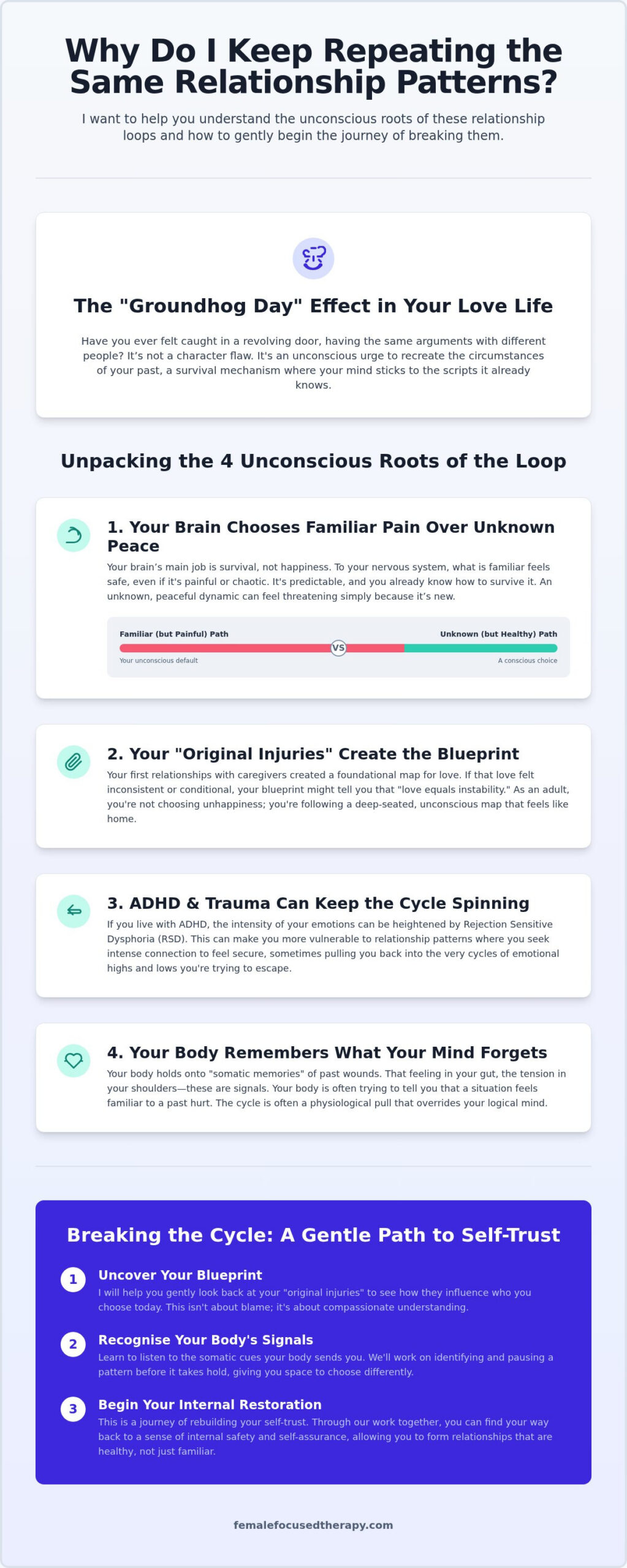
I want to help you understand the unconscious roots of these relationship loops and how to gently begin the journey of breaking them. We will explore how early wounds and even neurodivergence like ADHD can shape your choices. I will also share practical ways to recognise these patterns in real-time so you can find your way back to a sense of internal restoration and self-assurance.
Key Takeaways
- I will help you uncover why your mind often chooses what is familiar over what is healthy and how this “repetition compulsion” shapes your current choices.
- We will explore the answer to the question, “Why do I keep repeating the same relationship patterns?” by looking at your earliest blueprints for love.
- I’ll explain how ADHD and Rejection Sensitive Dysphoria can intensify your emotional responses and keep you stuck in cycles that feel overwhelming.
- Learn how to recognise your body’s somatic signals so you can identify and pause a pattern before it takes hold.
- I will guide you through a gentle journey of internal restoration that focuses on rebuilding your self-trust through a compassionate, mind-body approach.
Understanding why the familiar feels like home
I often work with women who feel like they are caught in a revolving door. You might be highly successful in your career and deeply self-aware, yet your dating life feels like a repetitive loop. It is a confusing and often exhausting place to be. You find yourself asking, “Why do I keep repeating the same relationship patterns?” even after you have promised yourself things would be different this time.
Our brains are wired for survival; they aren’t always concerned with our long-term happiness. Your brain seeks out what it knows because the familiar feels safe to your primal nervous system. Even if that familiar environment is painful, chaotic, or lonely, it is predictable. To your body, predictability means you know how to survive, which feels safer than the perceived threat of an unknown peace.
When we are in this loop, we aren’t looking for pain. We are looking for the comfort of the “known.” I see this often in my relationship trauma sessions, where women realise their bodies are actually craving the high-stress environments they grew up with. It is a physiological pull that often overrides our logical mind.
The Groundhog Day effect in your love life
I want you to recognise right now that this isn’t a lack of intelligence or a character flaw. Many of the women I support are brilliant, capable leaders who manage complex lives with ease. Yet, in their private lives, they find themselves having the same arguments with different people. It is as if a script has already been written, and you are simply playing out the lead role once again.
This phenomenon is formally known as Repetition Compulsion. It is the unconscious urge to recreate the circumstances of our past. I view this as a sophisticated survival mechanism where your mind tries to protect you by sticking to the scripts you already know. It is like your internal compass is locked onto a familiar frequency, even if that frequency is tuned to distress.
Why your brain chooses ‘known’ pain over ‘unknown’ peace
To our primal brain, the “unknown” represents a significant threat. If you grew up in a high-conflict or emotionally distant home, a peaceful relationship can actually feel quite boring or even dangerous. We subconsciously choose the pain we know over the peace we don’t because we already have the tools to navigate that specific type of hurt.
There is also a quiet, persistent hope that this time, we can finally change the ending. We subconsciously seek out partners who mirror our past because we want to “win” or be “chosen” in a way we weren’t in our younger years. This is an attempt to master a situation where we once felt powerless, trying to find a sense of restoration that has always felt just out of reach.
The blueprint of your early relationship wounds
Our first relationships with our caregivers act as a foundational map for our lives. They create the internal blueprint for how we expect to be treated and how we show up for others. I often look at these as “original injuries.” These are the deep wounds that occurred before we even had the vocabulary to describe our pain.
If you experienced love that felt inconsistent, hot and cold, or conditional, your nervous system might have learned that “love” equals “instability.” As an adult, you might find yourself subconsciously asking, “Why do I keep repeating the same relationship patterns?” It isn’t because you want to be unhappy. It is because your blueprint tells you this is what love looks like.
Recognising your unique relationship blueprint
I invite you to look back at your earliest memories of being truly “seen” or heard. Was love something you were given freely, or was it something you had to earn through achievement or good behaviour? Did you feel you had to perform to get attention?
These blueprints are incredibly persistent, but they aren’t permanent. They are simply the first draft of your story. When we bring these “original injuries” into the light, we can begin to see how they influence who we choose to love today. Understanding this is a vital part of answering why do I keep repeating the same relationship patterns?
How we project the past onto our present partners
We often cast our current partners in roles they never actually auditioned for. In my practice, I see how often we take unresolved feelings from our past and project them onto the person standing in front of us. This is what we call transference in the therapy room.
Research suggests that unprocessed experiences from your childhood may haunt your adult relationships by distorting how you perceive your partner’s actions. You might react to a partner’s simple request with the same defensive intensity you used with a critical parent.
I help you see where your partner ends and where your past begins. By unpicking these projections, we create a safe, boundaried space for you to build a relationship based on the present moment. If you feel ready to explore your own blueprint, you might find it helpful to start a conversation about your journey.
When ADHD and trauma keep the cycle spinning
For my neurodivergent clients, the cycle of questioning “Why do I keep repeating the same relationship patterns?” often feels much more intense. As an adult woman with ADHD myself, I understand that our brains process connection and conflict differently. We aren’t just dealing with emotional habits; we are managing a nervous system that is wired for high stimulation and deep sensitivity.
This intensity can lead us to stay in unhealthy relationships far longer than we should. Sometimes, our brains even mistake the “chaos” of an unstable partner for a necessary hit of dopamine. It is a physiological trap where the drama of a relationship feels like the only thing keeping us engaged, making a healthy, stable connection feel almost under-stimulating by comparison.
Narcissistic abuse often preys on this specific neurodivergent desire to be deeply understood. When someone finally seems to “get” your fast-moving mind, the dopamine rush is incredible. However, when that same person begins to withdraw or criticise, the crash is devastating. It creates a powerful bond that is difficult to break without professional support and a lot of self-compassion.
The role of Rejection Sensitive Dysphoria
Rejection Sensitive Dysphoria (RSD) is a common experience for many women with ADHD. It makes the thought of a breakup, or even a small criticism from a partner, feel physically painful. I understand how this visceral fear can keep you trapped in a loop. You might choose the pain of a known, difficult relationship over the perceived agony of being rejected or left alone.
RSD is not just “being sensitive.” It is an intense emotional response that can make you feel like your world is ending when a partner is distant. In my practice, we work on managing ADHD overwhelm alongside relationship healing. This helps you distinguish between a real threat to your relationship and an RSD flare-up, allowing you to answer “Why do I keep repeating the same relationship patterns?” with clarity rather than fear.
Why neurodivergent women are often ‘over-givers’
We often try to “fix” a relationship to avoid the heavy feeling of failure that frequently haunts neurodivergent women. If you have spent your life feeling like you are “too much” or “not enough,” you might over-compensate in your love life. I see this as a beautiful but exhausting trait that desperately needs boundaries to prevent burnout and further trauma.
Recognising your tendency to over-give is the first step toward reclaiming your energy. When you finally see that your “fixing” is a survival strategy, you can start to let it go. This isn’t about becoming cold; it is about becoming boundaried and finding restoration. You deserve a relationship where your energy is reciprocated and your fast-moving mind is cherished, not exploited.
Somatic memory and the body’s role in the loop
Your mind is excellent at rationalising your choices. You might tell yourself that this person is different or that you’ve finally learned your lesson. But your body doesn’t always believe those stories. It stores the history of every high-conflict argument and every moment of emotional neglect deep within your tissues.
This is often the missing piece of the puzzle. When you ask, “Why do I keep repeating the same relationship patterns?” the answer is frequently found in your nervous system’s muscle memory. Your body becomes habituated to a specific level of stress or excitement. It remembers the physical sensation of being on edge, and it can feel like a familiar home even when it’s a painful one.
True healing happens when we involve both the mind and the body. We can’t simply think our way out of a loop that is physically living in our cells. This is why I integrate somatic movement and yoga into my work. It helps you release these physical memories and rebuild a sense of safety from the inside out.
Listening to your body’s ‘early warning system’
I want you to start noticing how you feel in your skin when you are with a partner. Does your breath shorten? Do your shoulders move toward your ears? Maybe you feel a familiar flutter in your stomach that you’ve always called “butterflies,” but it actually feels more like anxiety.
These are your somatic clues. Your body is often a much faster “early warning system” than your conscious mind. If you find yourself physically bracing or holding your breath, it’s a sign that you are entering a familiar pattern. Learning to listen to these signals is a vital step in reclaiming your intuition.
Using breath and rest to break the emotional charge
Simple breathwork can help you stay grounded when a pattern triggers. When you feel that “tight chest” or “racing heart,” taking a few intentional, slow breaths tells your brain that you are safe in this moment. It breaks the immediate emotional charge and allows you to respond rather than react.
I also believe that rest is a radical act of relationship recovery. When we are perpetually exhausted, our nervous system is easily dysregulated, making us more likely to fall back into old habits. A calm, well-rested nervous system is far more capable of making clear and healthy choices.
If you’re ready to stop the cycle and listen to what your body is telling you, you can book an individual session to start your restoration journey.
Breaking the cycle and rebuilding your self-trust
Breaking a long-standing pattern is a journey of restoration. It isn’t a quick fix or a simple checklist. It is a process of slowly unlearning the survival strategies that no longer serve you. I provide a safe, confidential space where we can explore these loops together without any pressure to perform.
We focus on rebuilding the trust you have in your own intuition. After years of questioning your choices, it is natural to feel disconnected from your inner voice. Understanding the roots of why do I keep repeating the same relationship patterns? is a vital step toward reclaiming your power. My goal is to help you hear that voice clearly again.
You don’t have to do this alone. Support is always available when the weight of these cycles feels too heavy to carry. One realistic step you can take today is simply noticing the pattern when it arises. Try to observe it with curiosity rather than judgment; this small pause is where your healing begins.
Reclaiming your internal sense of safety
In our work together, we focus on creating a “secure base” within yourself. This means learning how to soothe your own nervous system and find stability from within. When you feel safe in your own skin, you become less dependent on the shifting validation of a partner.
A calm nervous system creates the space you need to make choices that align with your values rather than your fears. I help you move from being “high-functioning” to truly thriving. Many women are experts at managing the external world while feeling internally overwhelmed. Restoration happens when your internal state matches your external success.
Your next step toward a different story
Every new choice you make is a victory over the old pattern. It might be a small choice, like choosing an evening of rest over a chaotic date. Or it might be a larger one, like setting a firm boundary. These moments of self-assurance build the foundation for your new story.
I invite you to book a consultation when you feel ready to explore your journey more deeply. If you aren’t quite there yet, you can also explore my free therapy resources for a gentle start. Your path to restoration is unique, and I am here to walk it with you at a pace that feels right.
Your journey toward internal restoration
Asking yourself “Why do I keep repeating the same relationship patterns?” is a brave first step toward change. We have explored how your early blueprints and somatic memories can keep you stuck in loops that feel impossible to break. It’s not about being flawed; it’s about your nervous system seeking a familiar home, even when that home is painful.
As a Registered Integrative Psychotherapist in the UK and Singapore, I specialise in helping women through relationship trauma and narcissistic abuse recovery. I use an integrative mind-body approach to help you release these patterns from both your thoughts and your physical being. Healing is a steady, gentle process of reclaiming your intuition and building a secure base within yourself.
You deserve to feel safe, seen, and stable in your connections. When you feel ready to step out of the loop and into a different story, I am here to support you in a warm, boundaried space. Please book your private consultation with me today to begin your path toward lasting change.
Frequently Asked Questions
Why do I keep attracting the same kind of toxic partners?
It’s often about your nervous system’s familiarity with high-stress dynamics. If chaos felt like home as a child, your body might mistake it for excitement or “chemistry” now. You aren’t doing this on purpose; your brain is simply choosing the “known” over the unknown. I help women unpick these somatic responses to find a new sense of safety and predictability in their love lives.
Is repetition compulsion a sign that I am broken?
Absolutely not. Repetition compulsion is actually an unconscious attempt at mastery. Your mind seeks out similar situations hoping that this time, you can change the ending and finally heal the original wound. It is a survival strategy that has become a loop. I see it as a signal from your body that there is an old injury still asking for your kind, professional attention.
How can ADHD affect my relationship patterns?
ADHD can make relationship cycles feel much more intense due to Rejection Sensitive Dysphoria (RSD) and a constant need for dopamine. You might mistake the “spark” of an unstable partner for a much-needed hit of brain stimulation. As someone with ADHD, I understand how the fear of rejection can keep you trapped in a loop, asking yourself, “Why do I keep repeating the same relationship patterns?”
What is the first step to breaking a relationship loop?
The first step is noticing the pattern without judgment. When you can observe your choices with curiosity rather than shame, you create a small gap for a different response. I often suggest checking in with your body; if your chest feels tight or your breath is shallow, your somatic memory is trying to tell you something. Awareness is the foundation of your gentle restoration journey.
How does childhood trauma influence who I date as an adult?
Your earliest relationships with caregivers create a blueprint for love. If love was conditional or inconsistent back then, you might subconsciously seek out partners who require you to “earn” their affection now. Research shows that unprocessed childhood experiences can haunt your adult relationships. I work with you to unpick these blueprints so you can choose partners based on your needs in the present moment.
Can therapy really help me change my ‘type’?
Yes, by shifting what your nervous system finds attractive. Through integrative therapy, we work on regulating your nervous system so that “boring” stability starts to feel like the safe, nurturing peace it actually is. We move from being drawn to high-conflict “chemistry” toward a partner who offers genuine consistency. This isn’t about changing your personality; it’s about rebuilding your internal confidence and self-reliance.
What is the difference between a pattern and just bad luck?
Bad luck is a one-off event, but a pattern is a recurring theme that follows you across different partners. If you find yourself having the same arguments or feeling the same specific type of loneliness in every relationship, it’s likely an internal loop. Recognising this shift from “luck” to “pattern” is empowering. While you can’t change luck, you can certainly heal a pattern and answer why do I keep repeating the same relationship patterns?
How do I know if I am in a trauma bond?
A trauma bond often feels like an addictive cycle of intense highs and devastating lows. You might feel a deep sense of loyalty to someone who treats you poorly or find it impossible to leave despite knowing the relationship is harmful. It’s a powerful physiological connection born out of shared distress. I provide a safe, confidential space to help you untangle these bonds and rebuild your self-trust.

Article by
Cheryl Kennedy MacDonald MA BA (Hons) Pg. Dip. SAC BACP
Cheryl Kennedy MacDonald is a psychotherapist specialising in women’s mental health, relationships, and life transitions. She works with women navigating trauma, relationship breakdown, identity shifts, and midlife change, helping them rebuild self-trust, emotional stability, and a clear sense of who they are and what they want.
With over 20 years’ experience working with women internationally, Cheryl is the founder of YogaBellies, a global women’s yoga school, and the creator of the Birth ROCKS method. Her work sits at the intersection of psychotherapy and embodiment, integrating evidence-based therapeutic approaches with somatic, body-based practices that support deep, lasting change.
Known for her grounded and direct approach, Cheryl moves beyond surface-level insight to address the patterns held in the body and nervous system. Her work supports women to regulate, reconnect, and respond to their lives from a place of clarity, strength, and self-respect.
She is a published author in academic journals and has written multiple books on women’s health, pregnancy, and midlife wellbeing, available on Amazon and leading book retailers worldwide.