
What if trying to think your way out of emotional overwhelm is the very thing keeping you trapped inside it? When you’re running on empty, your chest tightens, simple decisions feel impossible, and your mind spins in circles trying to fix how you feel. You might even carry a heavy layer of guilt for not managing daily demands better. In my therapy practice, I see how exhausting this tug-of-war between mental effort and physical distress really is. The truth is, lasting relief doesn’t begin in your thoughts; it begins when you take gentle coping steps that speak to your body first.
You’ll discover practical, body-first coping steps designed to calm emotional overwhelm and gently restore your inner balance. I’ll walk you through a realistic, bite-sized routine to de-escalate acute stress in the moment, helping you soften physical tension and rebuild quiet trust in your own ability to care for yourself.
Key Takeaways
- Understand why acute emotional overwhelm is an honest nervous system response rather than a personal failing or lack of discipline.
- Learn five gentle somatic coping steps to release physical tension and calm your survival response in real time.
- Discover why trying to force positive thinking or quick fixes often deepens fatigue, and what your body truly needs instead.
- Gain clarity on moving from crisis survival to a sustainable daily rhythm that supports your nervous system over time.
- Recognise when seeking a boundaried, supportive therapy space is the most nurturing next step for your wellbeing.
What Coping Steps Really Mean When You Feel Overwhelmed
When you look up how to cope with stress, you often find clinical lists advising you to organise your calendar, challenge negative thoughts, or practice gratitude. While psychological research categorises various coping mechanisms into problem-focused or emotion-focused strategies, textbook solutions often fall flat when you are genuinely drowning. When emotional exhaustion takes hold, your brain is simply not in a state to analyse spreadsheets or reframe beliefs.
Real coping steps are not about forcing immediate optimism or pretending everything is fine. Instead, they are small, intentional moments of grounding that soothe an overstimulated nervous system. Overwhelm is rarely a lack of mental willpower; it is an honest, physical response to carrying sustained emotional weight for too long. Your body always registers distress before your conscious mind finds words for it.
Recognising the Early Physical Whispers of Overwhelm
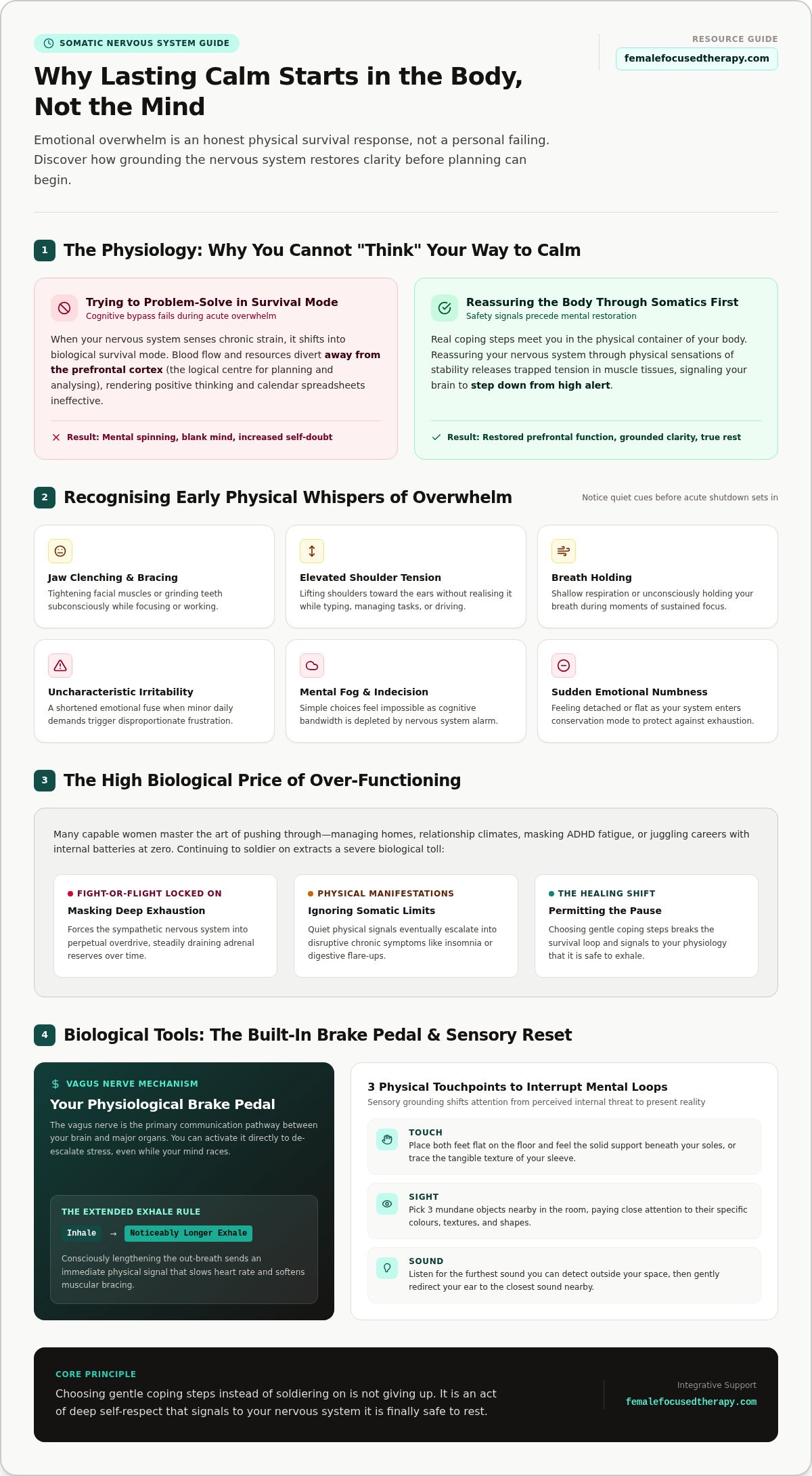
Before you feel completely shut down, your physical body sends subtle signals. You might notice yourself clenching your teeth, holding your breath, or lifting your shoulders toward your ears while typing an email. For many women, exhaustion first shows up as uncharacteristic irritability, brain fog, or sudden emotional numbness. Paying attention to these quiet physical cues allows you to pause and ground yourself long before acute panic sets in.
Why Toughing It Out Stops Working for Women
Most of the capable, self-aware women I work with in my integrative psychotherapy practice have spent years perfecting the art of pushing through. You manage the household, carry the emotional climate of your relationships, mask ADHD fatigue, or juggle career pressures without breaking stride. Yet, continuing to over-function while your internal battery sits at zero comes at a high biological price.
- Masking deep exhaustion keeps your fight-or-flight response locked on, draining your adrenal reserves over time.
- Ignoring somatic limits eventually turns quiet physical whispers into loud physical symptoms like insomnia or digestive flare-ups.
- Permitting yourself to pause breaks the cycle of survival, creating the inner safety needed to genuinely rest.
Choosing gentle coping steps instead of soldiering on is not giving up. It is an act of deep self-respect that tells your nervous system it is finally safe to exhale.
Why Your Body Needs Grounding Before Your Mind Can Plan
Have you ever sat down with a blank piece of paper, desperately trying to map out a solution to your exhaustion, only to find your mind completely blank? There is a physiological reason for this. When your nervous system senses chronic strain, it shifts into biological survival mode. In this state, blood flow and resources move away from your prefrontal cortex, the logical centre that organises thoughts and makes decisions. You cannot think your way into calm when your body believes it is under threat.
This is why somatic grounding matters so deeply. To regain clarity, you must first reassure your nervous system through physical sensations of stability. Integrating gentle practices such as somatic movement and therapy helps release trapped tension in your tissues, giving your brain the green light to step down from high alert. Somatic coping steps meet you in the physical container of your body before asking anything of your mind.
The Vagus Nerve and Your Built-In Brake Pedal
Your vagus nerve is the primary communication pathway between your brain and major organs, acting like an internal brake pedal. When you consciously slow your breath and ensure your exhale is noticeably longer than your inhale, you activate this nerve directly. This physical action slows your heart rate and softens muscular bracing. The beauty of this biological mechanism is that it works even if your thoughts are still racing.
Reconnecting to Your Five Physical Senses
Sensory grounding anchors your attention back to the immediate room, interrupting repetitive mental loops. When you feel disconnected or flooded, try these simple touchpoints:
- Touch: Place both feet flat on the floor and notice the solid support beneath your soles, or trace the texture of your sleeve.
- Sight: Pick three mundane objects nearby, noticing their specific colours and shapes.
- Sound: Listen for the furthest sound you can detect outside your space, then the closest sound.
Practising these sensory coping steps shifts your focus from perceived internal danger to present physical reality. If your system feels too activated to settle alone, you can book an initial therapy session to unpack these patterns in a calm, held space.
Five Gentle Coping Steps to Regain Your Calm Today
When you are drowning in daily demands, complicated multi-step advice only creates more pressure. If you have an active neurodivergent mind or run a busy life, you do not need an elaborate routine. You need small, practical touchpoints that require almost no mental energy to execute. These five gentle coping steps offer an accessible path back to your centre without demanding perfection.
Treat this sequence as an open invitation rather than a rigid chore. Practising these movements regularly trains your body to remember that safety is available in the present moment.
Step 1 and Step 2: The Physical Pause and Extended Breath
Start by letting your physical weight sink completely into whatever is holding you, whether that is a desk chair, a sofa, or your bed. Intentionally unclench your jaw, drop your shoulders away from your ears, and let your tongue rest away from the roof of your mouth. Once you have released that initial grip, shift your attention to your breathing.
- Inhale gently through your nose for a quiet count of three.
- Softly exhale through your mouth for an extended count of five or six.
- Notice the quiet softening across your collarbones as the air leaves your lungs.
Step 3 and Step 4: Sensory Orientation and Soft Naming
Now, let your eyes drift around your physical space. Look away from screens and gently spot three neutral objects, such as a ceramic mug, a wooden tabletop, or a plant leaf. Let your mind take in their shapes and textures without analysing them.
Next, softly name your emotional state without judging yourself for having it. You might whisper inside, I am feeling deeply overwhelmed right now, and that makes complete sense. Labelling your distress with gentle compassion reminds your body that having intense emotions does not mean you are in physical danger.
Step 5: Choosing Just One Manageable Next Action
Finally, shrink your immediate world down to the single next physical step. Forget about sorting next week’s schedule, answering every message, or fixing emotional hurdles. Pick one tiny, concrete action that takes less than two minutes:
- Drinking a glass of cool water.
- Walking to the kitchen to stretch your legs.
- Closing your laptop and lying down in a quiet room for ten minutes.
Remember that resting is often the most productive next action you can choose. By taking these restorative coping steps one breath at a time, you gently rebuild trust in your capacity to support yourself calmly.
Why Quick Coping Fixes Often Backfire for Women
When you feel completely drained, reaching for a fast distraction is completely natural. You might collapse onto the sofa and scroll through social media for an hour, or force yourself to write a gratitude list while fighting back tears. Conventional mental health culture frequently urges you to reframe your thoughts immediately, but slapping a positive label onto deep depletion usually backfires. Forcing gratitude over real exhaustion only breeds shame, leaving you feeling defective for struggling in the first place.
Women carry an enormous amount of silent over-responsibility for everyone else’s comfort. Between anticipating the emotional needs of partners, caring for children, managing demanding roles, or masking late-diagnosed neurodivergence through specialised ADHD support, your energy reserves take a beating. When wellness advice turns self-care into another rigid checklist, even honest coping steps start feeling like performance chores.
Distinguishing Restorative Soothing from Emotional Numbing
There is a quiet, vital difference between resting your body and simply tuning out. Scrolling through newsfeeds might offer immediate escape, but it continuously feeds sensory data into an already overstimulated system. You put your phone down feeling just as restless and foggy as when you started.
Restorative soothing, by contrast, gives your sensory organs a true break. It looks like curling up under a heavy blanket, sipping warm herbal tea without reading, or lying on the floor in absolute silence. Gently ask yourself after an activity: Does my body feel softer and more grounded, or do I feel disconnected and heavy?
Releasing the Trap of Perfectionist Self-Care
True healing is rarely neat, aesthetic, or candlelit. You do not need a pristine morning routine or a five-step journaling ritual to regulate your nervous system. In reality, authentic coping is deeply permission-based:
- Saying “no” to a weekend social gathering without offering an elaborate excuse.
- Leaving the clean laundry in the basket because sleep matters infinitely more tonight.
- Admitting to someone you trust that you are currently running on empty.
Often, setting an unapologetic boundary is the most effective coping step you can ever take. If you find yourself repeatedly carrying the weight of the room at your own expense, you can book a therapy consultation to explore these relational patterns in a supportive space.
Building Sustainable Resilience and Knowing When to Seek Support
De-escalating an acute moment of panic is essential, but genuine healing means stepping off the rollercoaster altogether. You shouldn’t have to spend your days ricocheting from one high-stress crisis to the next. Sustainable resilience isn’t about bracing yourself to withstand heavier burdens; it is about creating a tender daily baseline where your body feels safe enough to rest, soften, and recharge naturally.
Sometimes, individual coping steps are not quite enough on their own. When emotional flooding becomes your default state, reaching out for clinical guidance is not an admission of defeat. It is a wise, self-respecting choice to invest in your long-term emotional stability through Female Focused Therapy.
Creating a Personal Daily Calm Rhythm
Instead of waiting until your system crashes, you can weave micro-moments of stillness into ordinary daily transitions. These quiet touchpoints help maintain regulation throughout your working hours:
- Take three long exhales before opening your inbox in the morning.
- Pause with both feet flat on the floor for sixty seconds between meetings.
- Leave a ten-minute quiet buffer at the end of the day without picking up your phone.
These gentle micro-rest periods prevent stress from compounding, protecting your energy reserves across the week.
How Professional Psychotherapy Deepens Your Healing
Dedicated one-to-one therapy provides something individual exercises cannot: a boundaried, safe space where you don’t have to manage anyone else’s expectations. Working with me allows you to gently unpack why certain interactions trigger overwhelming alarm in your body. My goal is to offer the steady containment you need to untangle old survival habits, people-pleasing tendencies, or relationship trauma that keep your nervous system permanently on guard.
In my therapy room, I combine emotional processing with somatic awareness so your mind and body heal in tandem. Practising grounded coping steps in everyday life alongside this focused, confidential support helps you rebuild quiet trust in your intuition. You don’t have to carry the emotional weight of your world entirely alone.
Returning to Yourself, One Gentle Breath at a Time
Emotional overwhelm is not a personal failing; it is your nervous system asking for safety and softness. Lasting balance doesn’t come from forcing positive thoughts or powering through exhaustion. It begins when you meet your physical body with compassion, practising grounded coping steps that give you permission to pause.
With over two decades of therapeutic experience supporting women, my integrative approach brings together evidence-based psychotherapy and gentle somatic awareness. Whether you are seeking compassionate in-person support here in Singapore or connecting globally through online therapy, you don’t have to carry this weight alone. When you are ready for a boundaried space dedicated entirely to your restoration, you can book your gentle therapy consultation with Cheryl.
Take things slowly today. Your calm is waiting for you, one breath at a time.
If you’d like to find out more about working with Cheryl Kennedy MacDonald, you can email her at cheryl@femalefocusedtherapy.com or go ahead and book an appointment here: https://www.femalefocusedtherapy.com/book-now/ or lifestyle and yoga progammes, visit YogaBellies on www.yogabellies.com
Frequently Asked Questions
What are the most effective coping steps for sudden emotional overwhelm?
The fastest way to de-escalate acute flooding is to lower your physical centre of gravity and lengthen your breath. Sit down firmly, drop your shoulders, and exhale through your mouth twice as long as you inhale. Then, orient your vision by identifying three neutral, solid objects in the room. These immediate somatic coping steps interrupt panic signals before your brain spirals into mental catastrophic loops.
How do coping steps differ between acute stress and chronic burnout?
Acute stress requires immediate nervous system braking, such as sensory orientation and elongated exhales to dissolve adrenaline surges. Chronic burnout, however, demands sustained boundary protection and permission to rest over weeks and months. While in-the-moment tools prevent sudden panic spikes, recovering from deep exhaustion means dismantling ongoing over-functioning and removing yourself from emotional over-responsibility.
Can physical somatic exercises help calm racing thoughts during panic?
Yes, somatic exercises bypass your busy analytical thoughts entirely by speaking directly to your nervous system. When you place your feet flat on the floor or relax your tongue, your vagus nerve sends calming signals straight to your brain stem. Once your body physically confirms it is safe, your prefrontal cortex comes back online and racing thoughts begin to quieten down naturally.
Why do traditional deep breathing exercises sometimes make my anxiety feel worse?
Taking large, forceful inhales can accidentally trigger hyperventilation, tricking your brain into thinking it is running away from danger. When anxiety is already running high, forced chest breathing increases physical tension. The secret is to ignore big gulps of air and focus entirely on a slow, soft, unforced exhale, which naturally lowers your heart rate without sparking internal alarm.
What should I do if my usual coping strategies stop working?
If your trusted tools suddenly fail, your nervous system has likely moved past high activation into a frozen shutdown response. Forcing productivity or aggressive breathwork will only increase internal resistance. Give yourself explicit permission to do absolutely nothing for a short while. Rest your body under a heavy blanket, reduce sensory input, and treat yourself with radical gentleness until your capacity gently returns.
Is it normal to feel exhausted after practicing somatic grounding techniques?
Feeling deeply tired after grounding is an entirely normal biological reaction. When you have spent hours or days in fight-or-flight mode, adrenaline artificially props up your energy levels. Once somatic grounding steps safely power down that defensive activation, your system finally feels the true debt of your underlying fatigue. Let that tiredness be an invitation to rest rather than another problem to solve.
How can professional therapy help when self-help coping steps are not enough?
Self-help practices offer vital real-time relief, but they cannot untangle the complex roots of long-standing relational strain, unmasked neurodivergence, or trauma. Professional psychotherapy provides a secure, confidential environment to unpack why your alarm system stays locked on. Through individual psychotherapy sessions, I help you gently explore those protective patterns so you can restore lasting internal safety and steady confidence.

Article by
Cheryl Kennedy MacDonald MA BA (Hons) Pg. Dip. SAC BACP
Cheryl Kennedy MacDonald is a psychotherapist specialising in women’s mental health, relationships, and life transitions. She works with women navigating trauma, relationship breakdown, identity shifts, and midlife change, helping them rebuild self-trust, emotional stability, and a clear sense of who they are and what they want.
With over 20 years’ experience working with women internationally, Cheryl is the founder of YogaBellies, a global women’s yoga school, and the creator of the Birth ROCKS method. Her work sits at the intersection of psychotherapy and embodiment, integrating evidence-based therapeutic approaches with somatic, body-based practices that support deep, lasting change.
Known for her grounded and direct approach, Cheryl moves beyond surface-level insight to address the patterns held in the body and nervous system. Her work supports women to regulate, reconnect, and respond to their lives from a place of clarity, strength, and self-respect.
She is a published author in academic journals and has written multiple books on women’s health, pregnancy, and midlife wellbeing, available on Amazon and leading book retailers worldwide.