
What if the deep exhaustion you feel right now isn’t proof that you are demanding too much, but a natural bodily response to feeling invisible? When you spend years trying to explain your emotional distress only to be met with polite detachment or told you are overreacting, you begin to doubt your own mind. In therapeutic spaces, this painful relational dynamic is often referred to as cassandra syndromet.
I know how lonely it is to sit in the same room with someone and realise your emotional reality simply isn’t registering. Your nervous system stays on high alert, your gut knots up, and your confidence slowly erodes while outsiders insist that everything looks perfectly fine from the outside.
You don’t need a clinical label or diagnostic debate to validate what you are living through. In this guide, you will discover why your relational fatigue makes total sense, understand the psychology behind feeling chronically disbelieved, and learn gentle ways to rebuild self-trust. I will show you how to step out of constant self-doubt and use simple somatic practices to restore your inner calm.
Key Takeaways
- Understand the origins of feeling invisible, and why cassandra syndromet describes a painful relational dynamic rather than a personal failing.
- Recognise the subtle signs of chronic invalidation so you can stop second-guessing your lived experience and rebuild self-trust.
- Explore how communication mismatches develop across different processing styles without placing blame or diagnosing your partner.
- Learn gentle, body-centred practices to calm an overwhelmed nervous system and release the urge to constantly explain yourself.
- Discover the quiet reassurance of individual therapy that holds space for your truth and helps you return to yourself.
What Is Cassandra Syndromet: When Your Reality Feels Completely Unseen
There is a specific kind of quiet agony in knowing something is deeply amiss, speaking it out loud, and having it gently swept away. You try to explain the emotional void between you and your partner, yet you are met with blank stares, detached logic, or accusations of being too sensitive. Over time, that persistent disconnect makes you question your own senses.
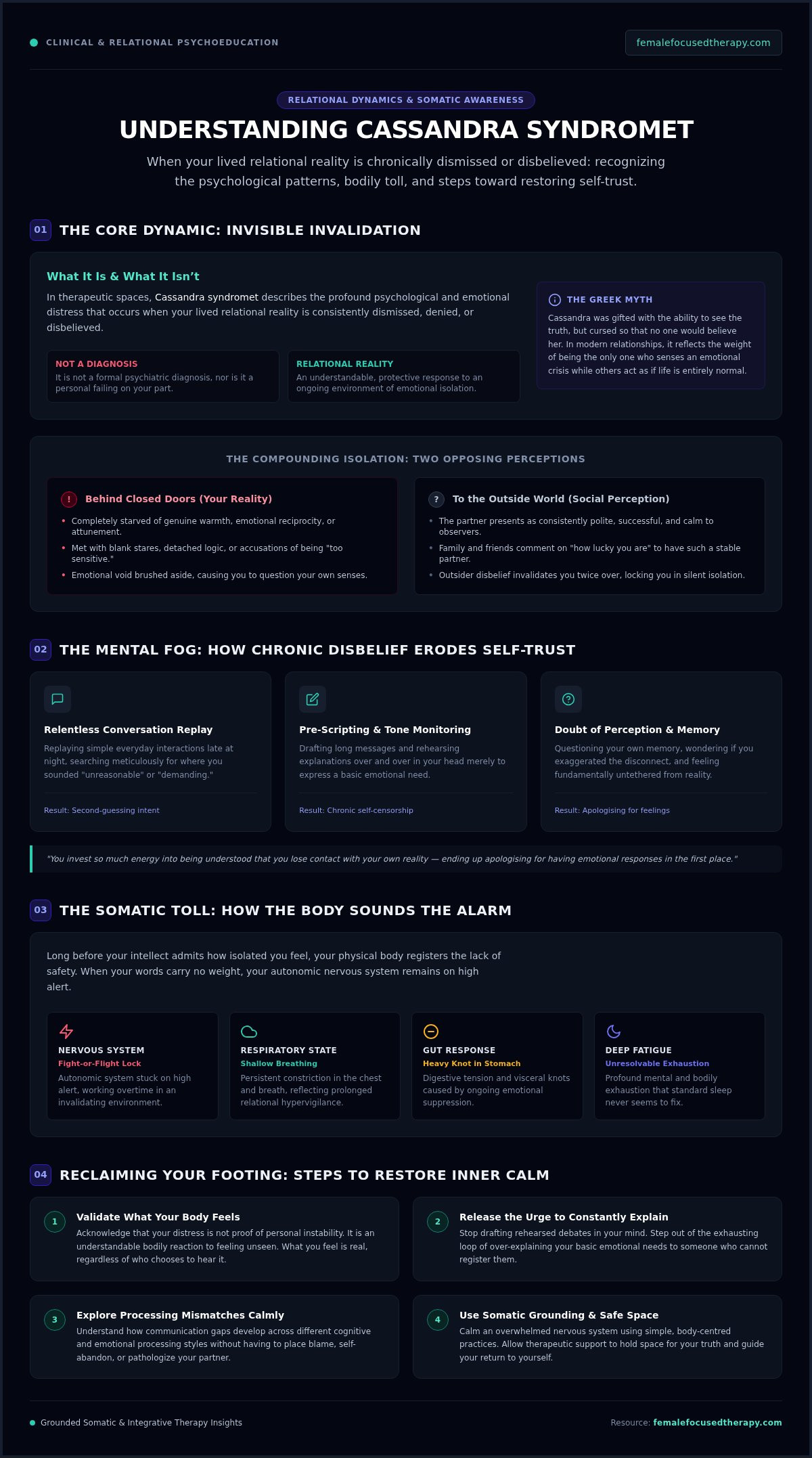
In my therapeutic practice, I often discuss cassandra syndromet to describe this exact dynamic. It is not a formal psychiatric diagnosis, nor is it a personal failing on your part. Instead, it names the profound psychological and emotional distress that occurs when your lived relational reality is consistently dismissed, denied, or disbelieved.
The Story Behind the Name and Why It Matters
The name comes directly from ancient Greek mythology. Cassandra was gifted with the ability to see the truth, but cursed so that no one would ever believe her prophecies. In modern psychology, the Cassandra metaphor captures the heavy burden of being the only person in a room who perceives an emotional crisis while everyone else acts as though life is entirely normal.
In my work supporting women, I see how often this ancient story mirrors modern relationships. You might feel completely starved of warmth or reciprocity behind closed doors. Yet because your partner presents as polite, successful, and calm to outsiders, family and friends tell you how lucky you are. That outside disbelief compounds the problem, making you feel doubly isolated.
Why Your Exhaustion and Pain Are Not Imaginary
Living within this pattern takes a severe somatic toll. When your attempts to connect are constantly flattened, your nervous system stays locked in fight-or-flight mode. You may notice shallow breathing, a heavy knot in your stomach, or an overwhelming mental fatigue that sleep never seems to fix. Your body is working overtime, trying to make sense of an environment where your words carry no weight.
Slowly, that chronic invalidation erodes your self-trust. You begin drafting conversations in your head before speaking, monitoring your tone, and wondering if you really are expecting too much. I want to reassure you that your distress is not proof of personal instability. It is an understandable, protective response to feeling invisible. Reclaiming your footing after this kind of relationship trauma begins by trusting that what you feel in your body is real, regardless of who chooses to hear it.
Recognising the Warning Signs: How Chronic Disbelief Erodes Self-Trust
Living with persistent invalidation rarely starts with a dramatic crisis. It arrives quietly, through tiny everyday omissions and conversations that leave you feeling hollow. You might find yourself smiling warmly at family gatherings while carrying an ache inside, knowing the person sitting next to you cannot see your internal world. When clinicians examine Cassandra syndrome, they often focus on communication breakdowns, yet they miss this crushing private loneliness.
Over time, the chronic absence of empathy changes how you view yourself. You shift from a woman who trusts her instincts to someone who constantly questions her perceptions. It is a slow, disorienting unraveling that leaves you feeling fundamentally untethered.
The Mental Fog of Constant Self-Doubt
When your emotional responses are repeatedly met with cold indifference or labelled as irrational, your inner compass begins to waver. You might notice distinct patterns taking hold in your daily thoughts:
- Replaying simple conversations late at night, searching for where you sounded unreasonable.
- Drafting long messages or rehearsing explanations just to express a basic emotional need.
- Second-guessing your own memory and wondering if you imagined the tension entirely.
This relentless self-editing is mentally draining. In the quiet confusion of cassandra syndromet, you invest so much energy into being understood that you lose contact with your own reality. You end up apologising for having feelings in the first place.
What Your Body Carries When Your Voice Isn’t Heard
Long before your intellect admits how isolated you feel, your physical body sounds the alarm. Living in a home where your emotional truth is continuously dismissed keeps your autonomic nervous system on high alert. You are essentially living in a quiet state of fight-or-flight, bracing for the next cold interaction.
You may carry tight shoulders that never quite drop, a persistent knot in your stomach, or shallow breathing that stops at your collarbones. These somatic symptoms are not random aches or signs of an underlying deficiency in you. They are the physiological markers of prolonged relational strain, holding the tension your words could not resolve.
If you are feeling completely depleted by this ongoing cycle, you do not have to carry it alone. Taking time to book a quiet, supportive therapy session can give you a safe, grounded space where your lived experience is met with genuine belief and validation.
Understanding the Relational Dynamic Without Blaming or Pathologising
When relationship strain reaches a breaking point, it is tempting to look for a villain. You might spend late nights searching online for psychological labels to explain why your partner feels so emotionally distant. In my therapeutic work with women, I find it far more grounding to step away from armchair diagnoses and examine the relational dance itself. What I often describe as cassandra syndromet is best understood as a profound interpersonal mismatch, not a personal character flaw.
It is also helpful to separate unintentional emotional blindness from deliberate manipulation. Emotional abuse involves intentional control and punishment. In contrast, many painful partnerships simply suffer from a persistent, devastating absence of emotional attunement. Your hurt is completely real, even if no one set out to hurt you.
Communication Gaps in Neurodiverse Relationships
Often, this dynamic takes root when two partners navigate life from different neurological worlds. In my relational practice, I look at this through the lens of the double empathy problem, which explains how miscommunication occurs when two distinct processing styles collide.
You may need soft eye contact, emotional mirroring, and intuitive shared presence to feel connected. Your partner, however, might express connection through practical tasks, shared facts, or straightforward routine. Neither way of being is broken. Yet when your call for emotional intimacy is met with analytical problem-solving, it leaves you feeling deeply alone.
When Others Don’t See What You Live With Daily
The heaviest burden of this dynamic often comes from outside your home. A partner who struggles with emotional reciprocity behind closed doors may still present as charming, generous, and reliable to mutual acquaintances.
When you confide your quiet exhaustion to family or friends, they might brush it off. Hearing “he seems so lovely, are you sure you aren’t overthinking things?” creates a secondary trauma. This external disbelief deepens the isolation, trapping you between an emotionally barren private reality and a social circle that cannot see your grief.
Gentle Steps to Restore Your Ground and Reclaim Your Inner Voice
Healing from the deep isolation of cassandra syndromet begins when you decide to stop arguing for your own reality. For months or even years, you may have channelled enormous energy into finding the perfect words, hoping the right explanation would finally bring a breakthrough. Reclaiming yourself requires a gentle shift of focus. You do not need someone else to agree with you to know that your lived experience is real.
When you stop treating your emotional needs as a debate to be won, you can redirect that precious energy back into your own recovery. It starts with small, daily anchors of self-trust and somatic grounding.
Rebuilding Trust in Your Own Perception
When your feelings have been repeatedly questioned, self-belief feels fragile. You can quietly begin rebuilding it through simple practices that need no outside approval:
- Keep a private journal where you record your emotions and experiences without editing them for anyone else.
- Pause before entering a circular conversation and remind yourself: “I know what I felt, and I don’t need to prove it.”
- Notice your intuitive gut instincts throughout the day, honouring them in small everyday choices.
Reminding yourself of your internal truth breaks the habit of second-guessing every thought you have.
Calming the Overwhelmed Nervous System
Because the body and mind are completely intertwined, relational invalidation directly dysregulates your physical state. In the grip of cassandra syndromet, your system stays braced for the next dismissal, leaving you in chronic fight-or-flight.
You cannot think your way out of that tension; you have to soothe the body first. When a conversation becomes circular, give yourself permission to step away. Drop your shoulders and take slow, steady breaths, making sure your exhale is longer than your inhale. Feel the floor beneath your feet, place a warm hand over your chest, and let your nervous system register safety in the present moment.
Untangling years of relational distress takes time, patience, and a dedicated space where your perspective is fully honoured. If you are ready to reclaim your self-belief with compassionate, one-on-one guidance, you can book an individual therapy session with me to begin your healing journey.
Moving Forward: Reconnecting with Support That Truly Listens
When relationship strain reaches this point, the instinct is often to rush straight into couples counselling. Yet if your emotional reality is already being flattened at home, joint therapy can sometimes feel re-traumatising. You end up having to defend your feelings in front of another person, wondering if the therapist will see through the surface charm. It is completely normal, and often far healthier, to seek individual therapy first.
Stepping out of the fog of cassandra syndromet requires a dedicated space where nobody questions your baseline perceptions. You need an environment where your grief is held without conditions and your lived experience is met with belief.
The Transformative Power of Being Truly Believed
There is an immediate somatic shift that happens when an attuned therapist simply listens and says, “I hear you, and that makes total sense.” Your shoulders drop. Your breath reaches deep into your belly. Your nervous system finally receives the biological signal that it is safe to set its heavy armor down.
In a grounded, empathetic space, we gently untangle the knot of chronic self-doubt. You begin to separate what belongs to an incompatible relational dynamic from who you are at your core. As your self-trust returns, you stop looking outside yourself for permission to feel hurt or tired. That restored inner stability clarifies your choices, helping you decide what you truly need from your life moving forward.
Taking the Next Gentle Step for Yourself
Reaching out for support is not an admission of defeat. It is an act of deep self-preservation. Overcoming the quiet weariness of cassandra syndromet takes time, but emotional ease returns the moment you stop trying to convince people who cannot meet you where you are.
Through my private practice at Female Focused Therapy, I offer an unhurried, compassionate space designed specifically for women navigating relationship trauma, burnout, and emotional invalidation. You do not have to figure this out alone, and you never have to justify your reality here. Whenever you feel ready, a calmer, more grounded way of living is waiting for you.
Reclaiming Your Ground and Trusting Your Truth
Living through the quiet exhaustion of cassandra syndromet can make you feel completely detached from your own intuition. Yet healing does not require you to win another circular debate or wait for outside permission to feel hurt. Peace begins when you decide to trust your own senses, soothe your nervous system, and stop arguing for your reality.
As a Registered Integrative Psychotherapist with over 20 years dedicated to women’s emotional wellbeing and relationship trauma, I know how life-changing it is to simply be heard. Whether we meet in person here in Singapore or connect online internationally, I offer a calm, non-judgmental space to help you untangle self-doubt. When you feel ready, you can book a confidential therapy session to take that first gentle step. You have carried this invisible weight for long enough, and your truth is worthy of belief.
Frequently Asked Questions
Is Cassandra syndromet an official psychiatric diagnosis?
No, cassandra syndromet is not an official mental health diagnosis in clinical manuals like the DSM-5-TR or ICD-11. In psychotherapy, we use the term to describe an informal relational dynamic where one partner experiences chronic emotional invalidation and disbelief. Not having a formal medical code does not make your emotional distress any less real. It simply means our focus stays on your lived experience rather than clinical labels.
What causes Cassandra syndromet in intimate relationships?
It usually develops from an ongoing mismatch in how two partners perceive, process, and express emotional connection. One person often seeks intuitive, reciprocal empathy, while the other relies on concrete logic or practical tasks. Over time, this communication divide leaves one partner feeling deeply lonely. When friends or family fail to see the private disconnect behind closed doors, self-doubt settles in deeply.
Can Cassandra syndromet happen outside of neurodiverse partnerships?
Yes, this dynamic can unfold in any relationship where persistent emotional deprivation and social disbelief occur together. While commonly discussed in neurodiverse partnerships, I often see the same pattern in relationships marked by severe emotional avoidance. If your partner shuts down your feelings at home while showing a warm, polished persona to friends and colleagues, you can easily end up in this exhausting cycle.
How does living with Cassandra syndromet affect physical health?
Prolonged invalidation keeps your autonomic nervous system locked in chronic fight-or-flight, leading to genuine somatic fatigue. In my therapeutic practice, women regularly share struggles with shallow breathing, persistent gut tension, sleep disruption, and autoimmune flare-ups. Because the body holds what words cannot resolve, chronic relationship stress takes a measurable physical toll that ordinary rest alone rarely fixes.
What is the difference between gaslighting and Cassandra syndromet?
Gaslighting is a conscious, manipulative tactic used to control someone by actively denying facts and reality. Cassandra dynamics, on the other hand, frequently stem from genuine emotional blindness rather than malicious intent. Your partner may simply lack the capacity to process your emotional language. Yet the internal impact on you feels similar: you still end up doubting your memory, your feelings, and your sanity.
Can a relationship recover after one partner experiences Cassandra syndromet?
Recovery is possible, but it requires both partners to acknowledge the emotional gulf without slipping into defensiveness. The less attuned partner must be willing to learn practical relational skills, while the exhausted partner rebuilds self-worth. If your partner refuses to acknowledge your pain, true repair is difficult. In that case, your energy is best spent protecting your own wellbeing.
How can individual therapy help if my partner will not attend?
Individual therapy provides a safe, confidential space where your perspective is believed without question. You do not need your partner present to start feeling grounded again. In my one-on-one sessions, we focus on soothing your nervous system, dismantling chronic self-doubt, and rebuilding your self-trust. That clarity helps you make calm, informed choices about what you need for your own future.

Article by
Cheryl Kennedy MacDonald MA BA (Hons) Pg. Dip. SAC BACP
Cheryl Kennedy MacDonald is a psychotherapist specialising in women’s mental health, relationships, and life transitions. She works with women navigating trauma, relationship breakdown, identity shifts, and midlife change, helping them rebuild self-trust, emotional stability, and a clear sense of who they are and what they want.
With over 20 years’ experience working with women internationally, Cheryl is the founder of YogaBellies, a global women’s yoga school, and the creator of the Birth ROCKS method. Her work sits at the intersection of psychotherapy and embodiment, integrating evidence-based therapeutic approaches with somatic, body-based practices that support deep, lasting change.
Known for her grounded and direct approach, Cheryl moves beyond surface-level insight to address the patterns held in the body and nervous system. Her work supports women to regulate, reconnect, and respond to their lives from a place of clarity, strength, and self-respect.
She is a published author in academic journals and has written multiple books on women’s health, pregnancy, and midlife wellbeing, available on Amazon and leading book retailers worldwide.