
You can’t think your way out of a physical state that feels genuinely unsafe. If you are exhausted from trying to talk yourself out of tension while juggling work, family, or hormonal shifts, finding the right anxiety therapist is not about collecting more worksheets. It is about connecting with someone who understands that your body is holding what your mind cannot simply reason away, and who knows that anxiety therapy works best when your nervous system feels heard, not managed.
I know how discouraging it is to sit across from a well-meaning professional who offers sterile logic while your chest remains tight and your thoughts stay hypervigilant. You deserve a space where you don’t have to mask your overwhelm. In this guide, you will discover how to find an anxiety therapist who truly understands women’s nervous systems and supports lasting calm. I’ll walk you through the practical signs to look for, the questions to ask, and how to choose care that helps you rebuild genuine safety from the inside out.
Key Takeaways
- Understand why high-functioning anxiety keeps your body in chronic survival mode, even when your mind rationalises that everything is fine.
- Discover the key qualities to look for in an anxiety therapist who specialises in women’s emotional health, hormonal transitions, and nervous system care.
- Learn why standard cognitive exercises often fall short on their own, and how integrative mind-body support creates genuine physiological calm.
- Explore practical, empowering questions to ask prospective practitioners so you can evaluate safety, approach, and mutual fit before booking.
- Gain clarity on how gentle, collaborative therapy helps you rebuild self-trust and steady regulation from within.
Why Finding the Right Anxiety Therapist Matters for Women
Therapy is rarely about sitting on a stiff couch while someone analyses you from across the room. At its heart, working with an anxiety therapist is a collaborative partnership designed to calm an overstimulated nervous system. When you spend months operating on pure adrenaline, your body forgets how to downshift. Real healing begins when you feel seen, emotionally safe, and met with deep relational attunement rather than detached clinical judgement.
For high-functioning women, seeking help often brings hidden hesitation. You manage households, hit boardroom targets, and support everyone around you. Beneath that smooth surface, an internal engine hums at full speed without a pause. An experienced therapist helps unravel the perfectionism and relentless self-doubt driving that engine. Through evidence-informed psychotherapy, you begin trading survival strategies for genuine, grounded peace.
Recognising High-Functioning Anxiety in Daily Life
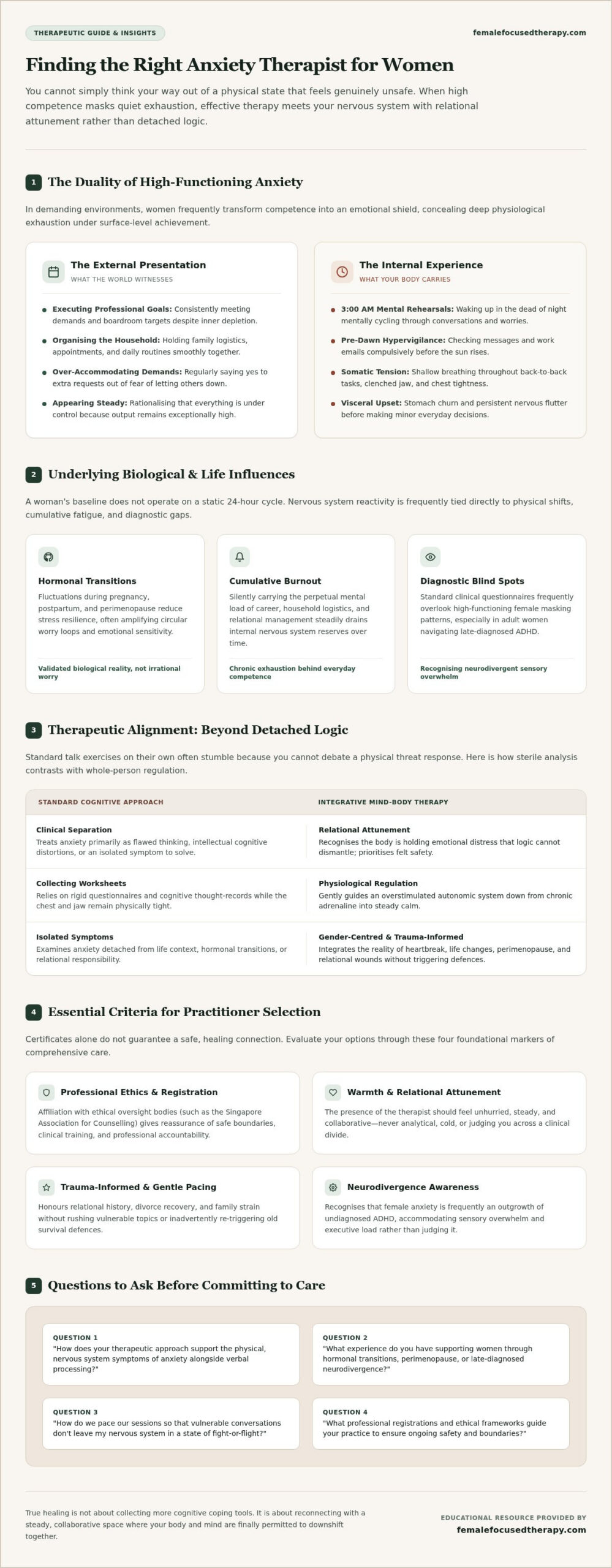
High competence often masks quiet exhaustion. You might wake up at 3:00 AM mentally rehearsing conversations, check emails compulsively before dawn, or say yes to extra demands out of fear of letting anyone down. In busy urban environments like Singapore, this pressure is easily brushed off as normal ambition.
Notice the physical toll this pattern takes. You might find yourself breathing shallowly through back-to-back meetings, carrying tension in your jaw, or feeling your stomach churn before minor decisions. High functioning often masks deep exhaustion, turning competence into a shield against vulnerability. Naming this struggle without shame is the very first step toward change.
The Female Nervous System and Hormonal Influences
Women’s bodies do not exist on a static, twenty-four-hour timeline. Our emotional baselines shift across life transitions, meaning your anxiety is deeply tied to physical shifts:
- Hormonal transitions: Fluctuations during perimenopause, pregnancy, or post-partum can lower stress resilience, amplifying existing worry loops.
- Cumulative burnout: Carrying the mental load of home and career drains nervous system reserves over time.
- Diagnostic blind spots: Standard questionnaires frequently miss female masking patterns, especially for adult women with undiagnosed ADHD.
Your physical reactivity is not an imagined personal flaw. Working alongside an empathetic anxiety therapist who understands women’s biological realities ensures your physical symptoms are validated, rather than dismissed as irrational overthinking.
What to Look For: Essential Criteria in an Anxiety Therapist
Credentials matter, but clinical certificates alone do not guarantee a healing connection. When searching for an anxiety therapist, you need someone who balances professional competence with genuine warmth and relational attunement. In regions like Singapore, where voluntary bodies like the Singapore Association for Counselling guide ethical practice, verifying professional registration gives you peace of mind regarding safety and boundaries.
Beyond formal qualifications, notice how you feel when reading a practitioner’s words or speaking during an enquiry. Does their presence feel steady and collaborative, or does it feel sterile and distant? A skilled practitioner will never treat you like a collection of symptoms to solve. They will take time to understand the different approaches to psychotherapy that best suit your temperament, offering an environment where you can finally stop holding everything together.
Trauma-Informed and Gender-Centred Care
An effective therapist understands that anxiety in women rarely occurs in a vacuum. It is often tangled with relational wounds, painful breakups, divorce recovery, or years of carrying emotional responsibility for an entire household. A trauma-informed therapist works gently at your pace, ensuring vulnerable conversations do not inadvertently trigger old nervous system defences.
You can discover more about who I work with in my own practice to see how gender-centred support creates space for real life transitions. When you are ready to explore this kind of aligned care, you can book an initial session with an open, unhurried conversation.
Understanding Neurodivergence and Late-Diagnosed ADHD
For many women, chronic anxiety is actually a secondary symptom of unidentified neurodivergence. Living with late-diagnosed ADHD means sensory overload, executive fatigue, and emotional intensity often feel like personal inadequacies rather than differences in brain wiring.
Standard anxiety advice, like rigid planners or strict routines, can make neurodivergent women feel broken when those systems inevitably fail. A knowledgeable anxiety therapist will help you recognise your unique baseline, helping you tailor your days around sensory soothing and focus rather than exhausting self-criticism.
- Clear boundaries: Transparent discussion around confidentiality, scheduling, and pacing.
- Attuned listening: A practitioner who tracks your physical cues when you become flooded.
- Intuitive fit: A felt sense that you can drop your mask without being judged.
Comparing Therapy Approaches: Beyond Traditional Talk Therapy
Traditional talk therapy often leans heavily on cognitive restructuring. You are asked to catch catastrophic thoughts, write them down, and replace them with logical counterarguments. While intellectual understanding has its place, it rarely touches the root of panic. You cannot simply think your way out of a physiological threat response. When your nervous system senses danger, blood rushes to your limbs and your heart pounds; your prefrontal cortex effectively goes offline. If you want to explore how body-based modalities address these physiological patterns, you can learn more about TouchStudio and its specialized somatic therapy offerings.
Reasoning with a racing pulse rarely works because the alarm is sounding in your body, not just your intellect. An integrative anxiety therapist combines cognitive clarity with physiological release. Instead of merely analysing your worries, we work together to help your body rediscover what safety actually feels like from the inside out.
Why the Body Holds What the Mind Cannot Say
A persistent tightness in your chest, a clenched jaw, or a sudden lump in your throat are not random inconveniences. They are ancient, protective reflexes designed to shield you when life demands too much. When demands remain constant, that tension stays locked in your tissues.
Simple nervous system tools can shift this state faster than logic. When you make your exhale longer than your inhale, you send an unmistakable physical signal to your brain that the immediate crisis has passed. Through gentle exploration, such as my work with somatic movement and integrative wellbeing, we learn to release the physical holding patterns that keep you feeling constantly bracing for impact.
Integrating Mindfulness and Cognitive Insights
True restoration does not discard thinking; it deepens it. Mindful noticing teaches you to observe your internal weather without jumping in to fix it. Instead of berating yourself for feeling jittery before a client presentation or family gathering, you learn to greet the sensation with neutral curiosity.
From that grounded baseline, cognitive tools become deeply effective. You can challenge catastrophic scenarios without gaslighting your genuine instincts. Integrative therapy acts as a steady bridge between conscious thought and bodily sensation, helping both halves of you arrive safely in the present moment. Experiential modalities emphasize this present-moment awareness and relational grounding, principles cultivated in accredited practitioner education at Gestalt Therapy Brisbane.
Choosing an anxiety therapist who embraces both somatic awareness and cognitive insight means you gain tools for both your mind and your body, restoring calm where it counts most.
Questions to Ask Before Booking an Anxiety Therapist
Choosing someone to walk alongside you during vulnerable moments is a two-way street. You aren’t auditioning to be accepted as a client. Instead, you are evaluating whether this professional has the training, warmth, and presence to make you feel secure. An initial enquiry is your opportunity to test the emotional waters before committing your time and energy.
Consider bringing practical questions to your first exchange. You might ask how they tailor their approach to women’s nervous systems, how they address physical tension, or how comfortable they are supporting hormonal life transitions. If their answers feel generic or rushed, pay attention. Finding the right anxiety therapist means feeling comfortable enough to let your guard down without fearing criticism.
Assessing Rapport, Safety, and Communication Style
Notice how a practitioner communicates before you ever book an appointment. Do their written emails or initial phone chats feel calm and empathetic, or do they lean into clinical detachment? You want someone who speaks directly and warmly, offering thoughtful boundaries alongside genuine kindness.
- How do you handle nervous system overwhelm during a session? (Look for practitioners who slow things down rather than pushing through distress.)
- What is your experience supporting high-functioning women or late-diagnosed ADHD? (You want validation of your lived reality, not generic time-management tips.)
- How do we measure progress together? (A collaborative therapist asks what calm and ease mean to you personally.)
Trust your instincts. If a dynamic feels misaligned after a few sessions, switching practitioners is completely acceptable and never a personal failure.
In-Person Sessions in Singapore Versus Online Therapy
Deciding between meeting face-to-face or working remotely comes down to what supports your nervous system best. An in-person session in a dedicated, tranquil space offers a physical threshold away from daily chaos. You step out of your domestic or corporate roles and enter an environment solely dedicated to your restoration.
Conversely, online therapy offers deep flexibility. You can curl up on your own sofa with a warm tea, eliminating commute stress across a busy city. If you live outside the region or balance complex schedules, virtual sessions maintain steady therapeutic momentum without added friction. You can explore my practical advice on finding a therapist in Singapore for deeper local insights.
Ready to see what supported healing feels like? You can book a consultation today to ask these questions directly and take your next gentle step forward.
Taking the Next Step: Working with Cheryl Kennedy MacDonald
Reaching out for therapeutic support is rarely easy, especially when you are used to managing everything on your own. It is not an admission of failure. It is a gentle, decisive act of self-care. When you work with an experienced anxiety therapist, you don’t have to arrive with tidy explanations or curated summaries of your past. You simply arrive as you are, tired edges and all.
For more than twenty years, I have supported women through major life shifts, relationship unravellings, sensory overload, and the quiet loss of self that often accompanies high-pressure living. My sessions offer an unhurried, warm space where you can finally stop performing. I take the time to help you untangle chronic stress patterns, giving your breath room to deepen and your shoulders space to drop away from your ears.
My Integrative, Woman-Focused Approach
My therapeutic framework bridges evidence-based psychotherapy with grounding somatic principles. Because true healing engages both the mind and the body, I attend to your emotional stories while helping you listen closely to your physical cues. Moving between Glasgow, Singapore, and Bali over the past eleven years has given me an adaptable, culturally responsive perspective that honours the distinct complexities of expatriate life, international transitions, and high-demand corporate settings.
I also bring my own lived experience as a woman with adult ADHD to my work. You can read more personal background about me and how this integrated philosophy shapes my practice. When you understand how female physiology, neurodiversity, and emotional conditioning intertwine, the path to calm becomes much clearer.
How to Begin Your Journey to Calm
Starting does not require complex preparation. I establish a predictable, grounded space where you can speak without filtering yourself for anyone else’s comfort. In session, I focus on supporting you through steady, sustainable shifts:
- Decompressing survival responses: Learning practical somatic cues to dial down acute bodily panic.
- Untangling perfectionism: Softening the harsh internal critic that demands constant vigilance.
- Reclaiming self-trust: Developing deep confidence in your capacity to navigate life transitions with steady ease.
You can book your individual psychotherapy session whenever you feel ready to pause, breathe, and begin your journey toward genuine relief.
Reclaiming Your Steady Inner Ground
Living in a state of quiet, chronic overwhelm is exhausting, but you do not have to carry it on your own. Lasting calm rarely comes from forcing positive thoughts or following rigid worksheets. It takes root when you choose an anxiety therapist who understands how your nervous system actually functions, honouring your hormonal rhythms, neurodivergence, and the emotional weight of your daily life.
With over twenty years dedicated to women’s wellbeing, I blend integrative psychotherapy with gentle somatic awareness to help you rebuild genuine safety from within. Whether you meet with me in Singapore or connect online globally, the work moves entirely at your pace. When you feel ready to lay down the pressure of holding everything together, you can book a therapy consultation with Cheryl. Real ease is waiting for you, one calm breath at a time.
If you’d like to find out more about working with Cheryl Kennedy MacDonald, you can email her at cheryl@femalefocusedtherapy.com or go ahead and book an appointment here: https://www.femalefocusedtherapy.com/book-now/ or lifestyle and yoga progammes, visit YogaBellies on www.yogabellies.com
Frequently Asked Questions
How do I know if I need an anxiety therapist rather than managing alone?
If your daily coping strategies leave you feeling chronically drained, tight in your chest, or waking with early morning dread, working with a therapist who understands women’s nervous systems can make a profound difference. You don’t have to wait for a breaking point to seek help. Therapy offers you a confidential space to untangle the quiet overwhelm that self-help books and sheer willpower cannot shift alone.
What happens during a first anxiety therapy session with you?
Your first session is an unhurried, gentle conversation where I invite you to share what has been bringing you to your limit. There is no expectation for you to recount every painful memory right away. I look at your current life pressures, how stress shows up in your body, and what feeling grounded truly looks like for you, setting a steady pace that always feels emotionally safe.
Can anxiety therapy help if I also suspect I have adult ADHD?
Yes, absolutely. Many women spend decades masking ADHD traits, mistaking their chronic sensory overload, executive fatigue, or emotional swings for a personal failing. As a practitioner who also navigates adult ADHD, I help you untangle which parts of your distress stem from nervous system burnout and which come from neurodivergence, offering strategies that honour your brain rather than fighting against it.
How is integrative psychotherapy different from traditional CBT talk therapy?
Traditional CBT primarily targets thinking patterns through thought logs and cognitive restructuring. Integrative psychotherapy goes deeper by acknowledging that your mind and body are not separate. In my practice, I explore your emotional history alongside physical sensations, using breath and somatic awareness alongside cognitive insight so your nervous system can genuinely soften rather than just intellectually debating intrusive thoughts.
Do you offer anxiety therapy online as well as in Singapore?
Yes, I offer both private in-person sessions in Singapore and secure online therapy for women globally. Virtual sessions allow you to receive thoughtful, focused care from the comfort of your own living room or private space. This flexibility eliminates travel stress across the city while maintaining the exact same warmth, confidentiality, and relational attunement found in face-to-face appointments.
How many therapy sessions will I need before I begin feeling calmer?
Healing is never a rigid, linear timeline. You might feel a distinct sense of relief after just two or three sessions simply by naming your exhaustion without judgement. Deeper shifts in boundary setting, nervous system soothing, and identity recovery usually unfold over several months of steady practice. I review your progress with you regularly, ensuring your care matches your changing emotional capacity.
What should I do if talking about my anxiety makes me feel more panicky?
If a conversation triggers physical panic, tell me immediately so I can help you pause and regulate. I never ask you to push through distress. Instead, I help you set the story aside and focus on grounding your body, using simple breath techniques or gentle orienting exercises to help you feel safe in the room. Your nervous system regulation always comes before clinical discussion.

Article by
Cheryl Kennedy MacDonald MA BA (Hons) Pg. Dip. SAC BACP
Cheryl Kennedy MacDonald is a psychotherapist specialising in women’s mental health, relationships, and life transitions. She works with women navigating trauma, relationship breakdown, identity shifts, and midlife change, helping them rebuild self-trust, emotional stability, and a clear sense of who they are and what they want.
With over 20 years’ experience working with women internationally, Cheryl is the founder of YogaBellies, a global women’s yoga school, and the creator of the Birth ROCKS method. Her work sits at the intersection of psychotherapy and embodiment, integrating evidence-based therapeutic approaches with somatic, body-based practices that support deep, lasting change.
Known for her grounded and direct approach, Cheryl moves beyond surface-level insight to address the patterns held in the body and nervous system. Her work supports women to regulate, reconnect, and respond to their lives from a place of clarity, strength, and self-respect.
She is a published author in academic journals and has written multiple books on women’s health, pregnancy, and midlife wellbeing, available on Amazon and leading book retailers worldwide.