
You’re standing in your kitchen at 6:30 PM, staring at a half-finished email on your phone while the sound of the television feels like it’s vibrating through your teeth. It’s that familiar, sharp prickle of sensory overload that often comes after a long day of juggling professional deadlines with the relentless needs of a Singapore household. If you feel like an overwhelmed working mum, you aren’t failing; you’re simply carrying a load that was never meant for one person to bear alone.
In addition to therapy, many find that targeted 1:1 ADHD Coaching provides the practical strategies needed to manage daily tasks and rebuild that essential scaffolding.
I know how heavy the “mum guilt” feels when it’s paired with the fear that you’re underperforming at your desk. It’s a cycle of productivity shame that leaves you feeling reactive and disconnected from the woman you used to be before life became a series of checklists. I want to help you understand why this weight feels so crushing right now and, more importantly, how we can begin to rebuild your sense of self beyond your roles as a parent or employee.
In this post, we’ll explore practical ways to lower that internal pressure and find a path back to a version of yourself that feels calm, grounded, and whole. We will look at why being an overwhelmed working mum is often a reflection of your environment rather than your character, and how to start feeling less angry and more like yourself again.
Key Takeaways
- Understand why your exhaustion goes beyond a need for sleep and how being high-functioning often masks the reality that you are struggling.
- Identify the invisible mental load and emotional over-functioning that contributes to feeling like an overwhelmed working mum.
- Explore the link between modern motherhood and late-diagnosed ADHD, helping you make sense of why certain demands feel so much heavier.
- Learn to rebuild self-trust by embracing “good enough” and choosing true nourishment over self-care that feels like another item on your to-do list.
- Discover how professional, trauma-informed therapy can help you navigate perfectionism and the relentless pressures of your daily life.
The Heavy Weight of Being an Overwhelmed Working Mum Today
I know that feeling where the tiredness isn’t just in your eyes, but in your very bones. It is a heavy, persistent weight that a Sunday lie-in or a quick coffee at a cafe in Tiong Bahru simply cannot fix. When you are an overwhelmed working mum, the exhaustion feels permanent, like a low-frequency hum in the background of your life that you can’t switch off.
Many of the women I work with in my practice are incredibly high-functioning. You are likely the person everyone else turns to because you appear to “have it all together” at the office and at home. This is often the most difficult part. Because you are so skilled at managing the logistics of a busy life, you are frequently the last person to realise you are actually drowning under the surface.
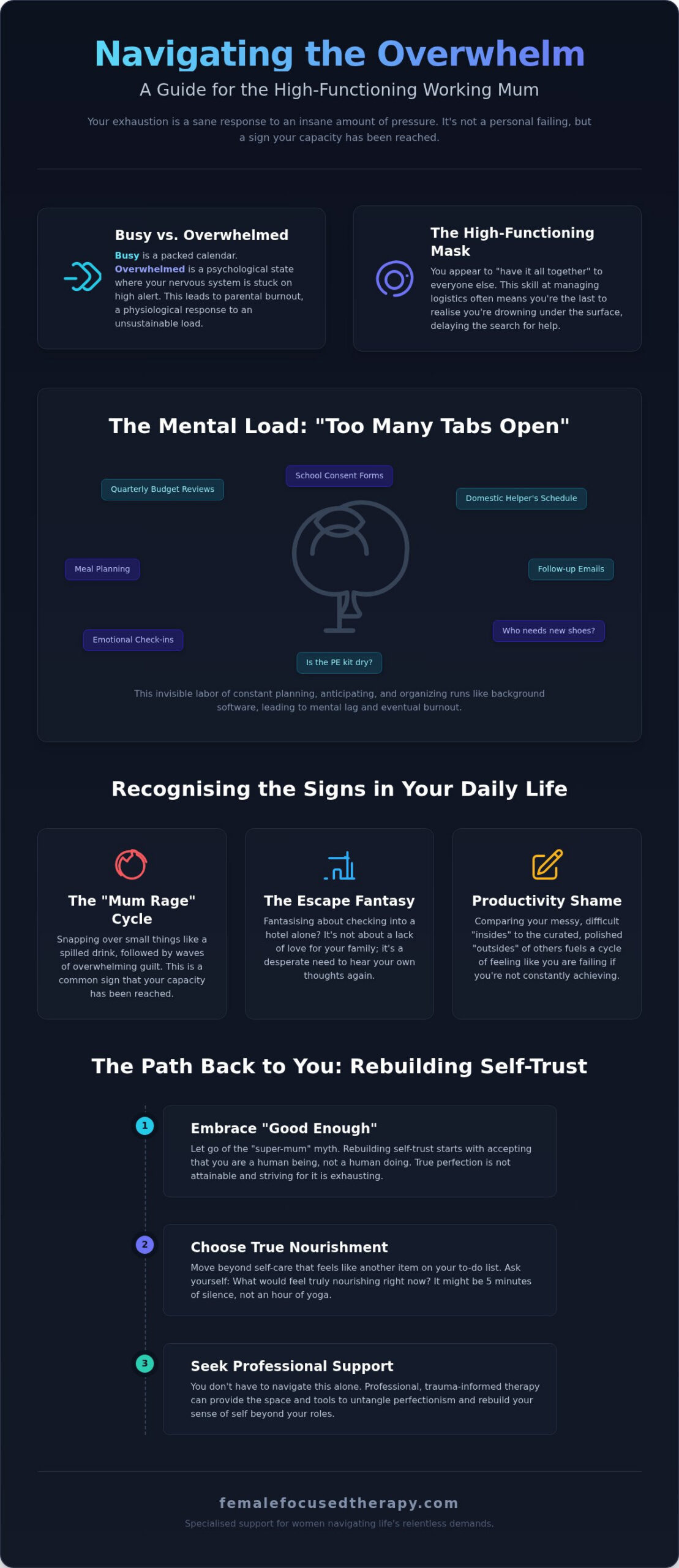
It is helpful to distinguish between being busy and being truly overwhelmed. Busy is a packed calendar; it is a temporary state of doing. Overwhelmed is a psychological state where your nervous system is stuck on high alert. Research into parental burnout indicates that this isn’t a personal flaw. It is a physiological response to an unsustainable load, and your feelings are a sane response to an insane amount of pressure.
Recognising the Signs in Your Daily Life
You might recognise the “too many tabs open” feeling in your brain. It feels like a web browser that is about to crash because you are tracking school consent forms, quarterly budget reviews, and the domestic helper’s schedule all at once. This constant buzzing makes it nearly impossible to focus on one task without your mind drifting to the next three things on your list.
This mental load often leads to what many call the “mum rage” cycle. You might find yourself snapping at your partner or children over something small, like a spilled drink or a pair of shoes left in the hallway. The guilt that follows can be overwhelming. You might even find yourself fantasising about checking into a hotel alone for 48 hours. This isn’t because you don’t love your family, but because you desperately need to hear your own thoughts again in a space where no one needs anything from you.
Moving Past the Shame of ‘Not Coping’
In Singapore, the cultural pressure to be a “super-mum” is particularly intense. We often compare our messy, difficult “insides” to the curated, polished “outsides” of other mothers we see on social media. This fuels a cycle of internalised productivity shame, where we feel that if we aren’t constantly achieving, we are somehow failing. The myth of the “perfect working mum” suggests we should be able to do it all without showing the strain.
I want to remind you that you are allowed to be a human being, not just a human doing. Feeling like an overwhelmed working mum is a sign that your capacity has been reached, not that you are inadequate. You can find more about how I support women through these transitions on my homepage as we work together to rebuild that sense of self-trust.
If you’d like to find out more about working with Cheryl Kennedy MacDonald, you can email her at cheryl@femalefocusedtherapy.com or go ahead and book an appointment here: https://www.femalefocusedtherapy.com/book-now/
Why the Mental Load Feels So Heavy in Your Mind
I often sit with women who feel they are failing, despite doing the work of three people. As an overwhelmed working mum, the exhaustion you feel isn’t just physical. It is the result of carrying a mental load that never quite switches off, even when you are sleeping.
This load is the invisible labour of motherhood. It is the constant planning, the emotional checking-in, and the endless logistics that run like background software on a computer. When this software never closes, your internal system eventually starts to lag and overheat.
Research into postpartum maternal mental health highlights how our workplace environments and home lives are deeply linked. When we are expected to perform at 100 percent in the office and 100 percent at home, something has to give. Often, that something is our own peace of mind.
The Invisible Labour of the Mind
It is rarely the big life events that break our spirit. It is the cumulative weight of remembering that it is PE day and the kit needs to be dry. It is knowing which child needs new shoes and which colleague needs a follow-up email before the 5pm deadline.
This “background noise” is why you might find it so hard to be present. You are physically at the dinner table, but your mind is three days ahead, planning the weekend logistics. This is a common experience for the women who I work with in my practice.
In my experience supporting women in Singapore, I see how the pressure to “have it all” creates a cognitive cup that is always overflowing. When your cup is full, a small task like a missing school sock feels monumental. It isn’t about the sock; it is about the lack of space left to process even one more tiny demand.
Reclaiming Your Internal Space
We often take on “emotional over-functioning,” where we feel responsible for everyone else’s moods. This often stems from childhood patterns of being the “good girl” who kept everyone happy. You may have learned early on that your value came from being helpful and low-maintenance.
I want you to imagine your responsibilities as balls you are juggling. Some are made of glass, and some are made of plastic. If you drop a glass ball, like your core health, it shatters. If you drop a plastic ball, like a tidy living room, it simply bounces.
Learning to drop the plastic balls is essential for any overwhelmed working mum. It requires “boundaried empathy,” where you support your family without losing your own identity in their needs. You can care for them without carrying the entire weight of their world. You can find more support for these transitions at Female Focused Therapy.
Try this small reflection today. Take a moment to look at your mental list. What is one thing you can stop “holding” today? Perhaps it is the guilt over a messy kitchen or the need to answer a non-urgent message immediately. Give yourself permission to let that one ball bounce.
When Overwhelm Is More Than Just a Busy Schedule
Sometimes, the exhaustion you feel isn’t just about a long to-do list. It’s deeper than that. For many women I work with in Singapore, the struggle of being an overwhelmed working mum often masks something else: a brain that processes the world differently. We live in a society that expects us to perform like we don’t have children and parent like we don’t have a career. This pressure is heavy.
According to research from the University of Georgia, the constant conflict between these roles significantly impacts a mother’s mental health. When you’re neurodivergent, this impact is amplified. You aren’t just tired; your nervous system is reaching its limit. Recognizing this is the first step toward reclaiming your peace.
ADHD and the Working Mum
Many women aren’t diagnosed with ADHD until they have children. Before kids, you might have used “coping scaffolding” to stay organised. You worked late, used digital planners, or relied on hyper-focus to get things done. But the sheer volume of executive function required to manage a household, a career, and a child’s schedule can cause that scaffolding to collapse. It’s a direct hit to your brain’s processing style.
It’s important to move away from labels like “lazy” or “disorganised.” Your brain is simply being asked to do the one thing it finds hardest, every single minute of the day. Exploring ADHD therapy for women can be a vital step in moving away from self-blame. It helps you rebuild your self-trust and understand that your brain is different, not broken.
Managing Sensory and Emotional Overload
Motherhood is incredibly loud and tactile. Sticky fingers on your clothes, the constant hum of electronic toys, and the “touched out” feeling are real neurological experiences. When you’re an overwhelmed working mum, your nervous system is often stuck in a state of high alert. By the time you sit down to work, your sensory tank is already empty.
This depletion can spill into your professional life through something called Rejection Sensitive Dysphoria (RSD). It’s a common experience where a minor piece of feedback from a manager feels like a devastating personal catastrophe. It happens because your emotional reserves are at zero. You can’t filter the feedback logically when you’re already in survival mode. Knowing your brain type allows you to create boundaries that actually work for you.
If you’d like to find out more about working with Cheryl Kennedy MacDonald, you can email her at cheryl@femalefocusedtherapy.com or go ahead and book an appointment here: https://www.femalefocusedtherapy.com/book-now/
Rebuilding Your Self-Trust One Small Breath at a Time
When you’re an overwhelmed working mum, it’s easy to feel like you’re failing at every single task. I want to tell you that lowering the bar isn’t a sign of defeat. It’s an act of radical kindness toward yourself. In my practice, I often see women who believe “good enough” is a compromise, but in reality, it’s the gold standard for a sustainable life.
We need to move away from “self-care” that feels like another exhausting item on your to-do list. If a 5 am workout or a strict meal prep routine feels like a chore, it isn’t nourishing you. It’s just another way to perform. True nourishment might look like an extra twenty minutes of sleep or choosing a quiet cup of tea over a loud social event.
I’ve noticed that many women in Singapore feel they must always be “on.” Breaking this cycle starts with listening to your body’s signals before you hit a complete breaking point. It’s about small, realistic next steps rather than a total life overhaul that only adds more pressure to your plate.
Gentle Shifts in Your Daily Rhythm
I encourage you to create a “bare minimum” checklist for those days when you’re running on fumes. This might mean the laundry stays in the basket for another night, or you grab a S$6 hawker meal instead of cooking. It’s about deciding what truly matters in the next hour, not the next month.
Learning to say “no” is a skill that protects your precious energy. You don’t need to provide a paragraph of justification or deal with a mountain of guilt. A simple, “I can’t take that on right now,” is a complete sentence. Try to find one tiny pocket of time that belongs only to you. Even five minutes sitting in your car before you head into the house can be a sacred space for an overwhelmed working mum to just breathe.
Nurturing Your Mind-Body Connection
Your body often speaks before your mind is ready to listen. Those persistent headaches, the tight tension in your shoulders, or digestive issues aren’t just physical inconveniences. They are messages worth hearing. When you feel a shame spiral or panic rising, try a simple grounding technique. Notice three things you can see and two things you can feel right now.
I like to bring a bit of my Scottish warmth into our work to help you be a kind friend to yourself. Your internal dialogue should be as gentle as the way you’d speak to a dear friend who is struggling. This isn’t about perfection. It’s about rebuilding self-trust, one small, intentional choice at a time.
How Therapy Helps You Navigate the Relentless Demands of Motherhood
I often hear from women who feel they should be able to handle everything themselves. They believe that if they just tried harder or stayed more organised, they wouldn’t feel so burnt out. But being an overwhelmed working mum isn’t a personal failing; it’s a natural response to a culture that asks us to work as if we don’t have children and parent as if we don’t have jobs. While venting to a friend over coffee can provide temporary relief, therapy offers something deeper and more sustainable.
In our sessions, I provide a professional, boundaried space where the focus is entirely on you. Unlike a friendship, our relationship is one-way. This means you don’t have to worry about taking up too much space or ‘returning the favour’. We use this time to look at the ‘why’ behind your exhaustion. I use a trauma-informed approach to help you understand the roots of your need to be perfect. Often, this drive comes from early experiences where worth was tied to productivity or being ‘the good girl’.
By addressing these deep-seated emotional blocks, we work together to rebuild your sense of self-trust. You’ll learn to distinguish between your own genuine needs and the external pressures you’ve internalised. This process helps you regain your agency, allowing you to make choices that align with your values rather than just reacting to the next crisis on your to-do list.
A Safe Space Just for You
In therapy, you don’t have to be the ‘strong one’ or the ‘capable one’ who has it all figured out. You can just be. I use an integrative approach that blends traditional talk therapy with somatic and mindfulness practices. This helps you process both the practical stresses of daily life and the heavier emotional weights you’ve been carrying. You can learn more about this way of working at the Female Focused Therapy home page.
This holistic perspective is vital because stress isn’t just in your head; it’s in your body too. We work at a pace that feels safe for you, ensuring you never feel rushed or pressured. It’s about creating a quiet sanctuary in the middle of your busy Singapore life where your voice is the only one that matters.
Taking That First Gentle Step
Reaching out for support is an act of profound strength, not a sign that you’ve failed as a mum. In fact, research from 2023 indicates that online therapy has seen a 42 percent increase in uptake among working mothers in urban hubs like Singapore. This is largely because it removes the added stress of a commute, making it easier to fit self-care into a packed schedule.
When we work together, you can expect a warm, non-judgmental environment where your feelings are validated. Whether we meet online or in person, the goal is the same: to help you feel lighter and more confident. You don’t have to carry this weight alone anymore. I am here to hold that space for you, helping you find your way back to the woman you were before the overwhelm took over.
If you’d like to find out more about working with Cheryl Kennedy MacDonald, you can email her at cheryl@femalefocusedtherapy.com or go ahead and book an appointment here: https://www.femalefocusedtherapy.com/book-now/
Beginning Your Journey Toward Clarity
You don’t have to carry the weight of every expectation alone. We’ve looked at how the mental load impacts your well-being and why reclaiming small moments for yourself is the first step in rebuilding self-trust. Being an overwhelmed working mum in a high-pressure environment like Singapore often means your own needs are pushed to the very bottom of the list. I’ve supported hundreds of women over my 15 years as a Registered Psychotherapist, helping them navigate these exact feelings of exhaustion and self-doubt.
My integrative approach combines CBT, psychodynamic, and somatic practices to help you feel grounded in your body again. I specialise in ADHD and trauma-informed care, ensuring our sessions are a safe space for your specific lived experience. You can learn more about my background on the Female Focused Therapy homepage or see how therapy for women can provide the clarity you’ve been looking for. Change happens at a pace that feels sustainable for you, and it’s always okay to start small. If you’re ready to prioritise your wellbeing, you can book a consultation today.
If you’d like to find out more about working with Cheryl Kennedy MacDonald, you can email her at cheryl@femalefocusedtherapy.com or go ahead and book an appointment here: https://www.femalefocusedtherapy.com/book-now/
Frequently Asked Questions
Why do I feel so angry at my kids when I’m overwhelmed?
You feel angry because your nervous system has reached its absolute limit. I see this often in my practice when a mother is operating at 95% capacity every single day. A small trigger, like a child’s tantrum or a spilled drink, flicks your “fight or flight” switch because you have no emotional margin left. This rage is a physiological signal that you’re an overwhelmed working mum who needs more support and less on her plate.
Is it burnout or am I just a ‘bad’ mum?
You are experiencing burnout, which is a state of physical and emotional exhaustion, not a character flaw. In a 2023 survey by Telus Health, 74% of workers in Singapore reported feeling burnt out, and for mothers, this is often compounded by the unpaid labour at home. A “bad” mum wouldn’t worry about her impact on her children. Your guilt is actually proof of how much you care about them.
How can I stop feeling guilty for working when my children are small?
I encourage you to look at the stability and role modelling you’re providing rather than focusing on the hours you’re away. In a city like Singapore where the cost of living rose by 4.8% in 2023, your work provides essential security for your family’s future. Research shows that children of working mothers often grow up to be highly independent. You can find more about balancing these feelings on the Female Focused Therapy homepage.
What exactly is the ‘mental load’ of motherhood everyone talks about?
The mental load is the invisible, non-stop cognitive labour of managing a household. It’s the “project management” of life, like remembering school dental appointments or noticing the milk is low before it runs out. For an overwhelmed working mum, this constant stream of mental data is more draining than the physical tasks. It’s the reason you feel exhausted even on days when you haven’t done much physical exercise.
Can therapy actually help me manage my to-do list?
Therapy helps by addressing the emotional drivers behind your to-do list, such as perfectionism or the fear of letting people down. While I don’t just hand out planners, we look at why you feel you must do everything alone. By rebuilding self-trust, you can begin to delegate tasks or let go of expectations that don’t serve your wellbeing. This creates a sustainable rhythm that feels much lighter than a simple checklist.
How do I know if I have ADHD or if I’m just a stressed working mum?
It is difficult to distinguish between the two because chronic stress mimics ADHD symptoms like forgetfulness and emotional dysregulation. Since 2021, I’ve seen a 30% increase in Singaporean women seeking clarity on neurodivergence. Whether it’s ADHD or extreme stress, the first step is acknowledging that your current pace isn’t working for your brain. We can explore these feelings together in a calm, non-diagnostic space to help you find clarity.
I feel ‘touched out’ and don’t want my partner to touch me—is this normal?
Feeling “touched out” is a completely normal sensory response to being physically overstimulated by children all day. When your body has been climbed on or used as a pillow for 12 hours straight, your nervous system interprets any further touch as a demand rather than a comfort. It’s a common experience I hear about in my sessions. Communicating this to your partner as a sensory need, rather than a rejection, can help reduce the pressure.
What is the first step I should take when I feel completely stuck?
The first step is to pause and acknowledge that you’re struggling without judging yourself for it. I often suggest taking just 5 minutes of quiet, away from screens and demands, to simply breathe and check in with your body. From there, we can look at small, sustainable changes to help you find your way back. If you’re ready to talk, you can book an appointment here to start that journey.
If you’d like to find out more about working with Cheryl Kennedy MacDonald, you can email her at cheryl@femalefocusedtherapy.com or go ahead and book an appointment here: https://www.femalefocusedtherapy.com/book-now/

Article by
Cheryl Kennedy MacDonald MA BA (Hons) Pg. Dip. SAC BACP
Cheryl Kennedy MacDonald is a psychotherapist specialising in women’s mental health, relationships, and life transitions. She works with women navigating trauma, relationship breakdown, identity shifts, and midlife change, helping them rebuild self-trust, emotional stability, and a clear sense of who they are and what they want.
With over 20 years’ experience working with women internationally, Cheryl is the founder of YogaBellies, a global women’s yoga school, and the creator of the Birth ROCKS method. Her work sits at the intersection of psychotherapy and embodiment, integrating evidence-based therapeutic approaches with somatic, body-based practices that support deep, lasting change.
Known for her grounded and direct approach, Cheryl moves beyond surface-level insight to address the patterns held in the body and nervous system. Her work supports women to regulate, reconnect, and respond to their lives from a place of clarity, strength, and self-respect.
She is a published author in academic journals and has written multiple books on women’s health, pregnancy, and midlife wellbeing, available on Amazon and leading book retailers worldwide.