
What if the heavy weight of guilt you’re carrying isn’t proof that you’re failing, but evidence of how much you deeply care? I know that quiet, late-night voice well. It’s the one that lists every mistake you made today, from the sharp tone used during breakfast to the forgotten school form. You’re likely exhausted from constantly feeling like a bad mother while trying to keep everyone else afloat. It’s a heavy, lonely burden to carry when you’re already operating at maximum capacity.
You might find yourself scrolling through social media at 11:00 PM, comparing your real, messy life to someone else’s polished highlight reel. This constant comparison only fuels the “not enough” narrative that many high-functioning women struggle with daily. I see you, and I want you to know that your struggle is a result of deep overwhelm, not a character flaw. You deserve to feel at peace in your own home and, more importantly, in your own mind.
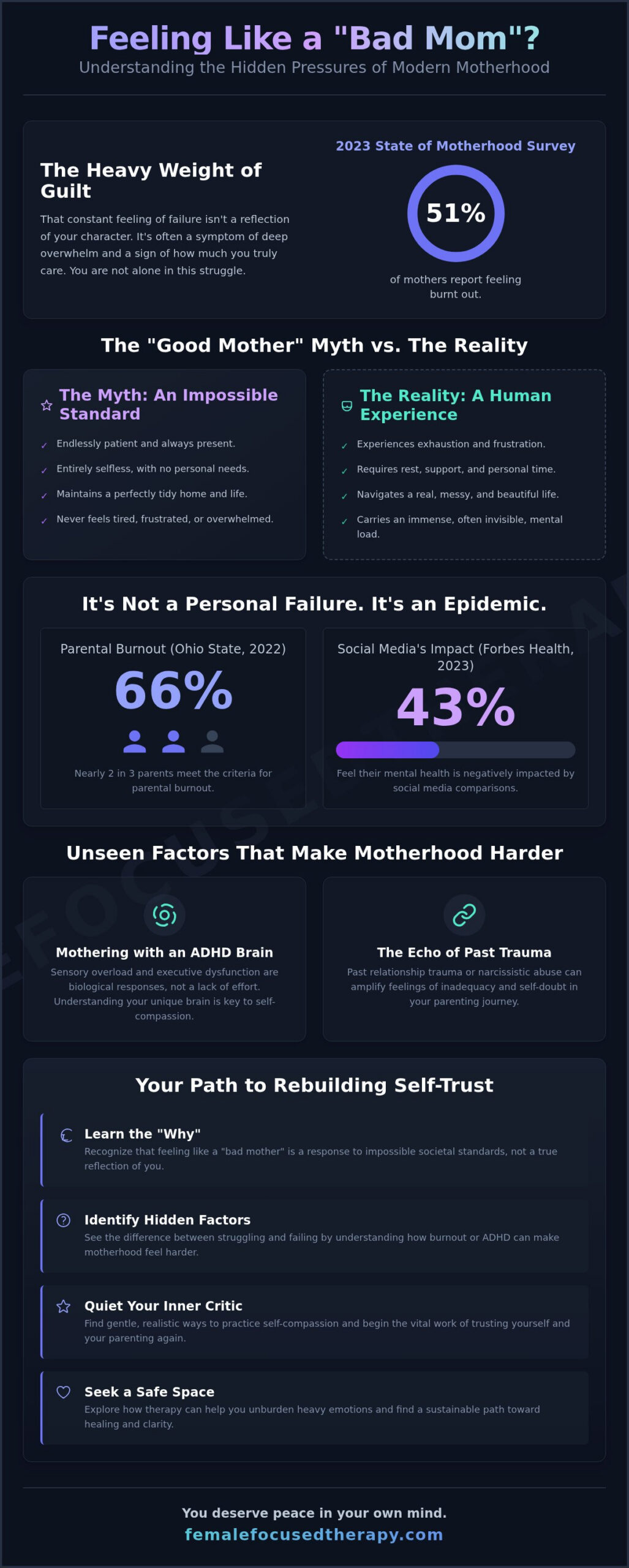
I want to offer you a gentle, reflective space to help you understand the roots of this maternal guilt and begin the journey back to self-trust. Data from the 2023 State of Motherhood survey shows that 51% of mothers feel burnt out, yet we still treat our exhaustion as a personal failure. We’ll look at how to manage your inner critic and find a path toward self-compassion that feels realistic. This is a look at why you feel this way and how we can start to rebuild your confidence together.
Key Takeaways
- Learn why the weight of feeling like a bad mother is often a response to impossible societal standards rather than a reflection of your character.
- Discover how hidden factors like burnout or unsupported ADHD can make motherhood feel harder, helping you see the difference between struggling and failing.
- Identify the subtle signs of emotional exhaustion so you can stop blaming yourself for what is actually a need for rest and support.
- Find gentle, realistic ways to quiet your inner critic and begin the vital work of rebuilding trust in yourself and your parenting.
- Explore how a safe, therapeutic space can help you unburden these heavy emotions and find a sustainable path toward healing and clarity.
Understanding the weight of that “bad mother” narrative
I want to start by acknowledging how heavy this feels for you right now. It is a quiet, suffocating weight that often sits on your chest when the house is finally still. You are likely reading this because that persistent thought of feeling like a bad mother has become a constant companion. I want you to know, right here and now, that this feeling is not a fact. It is a complex emotional response to a set of impossible standards that no human could ever realistically meet.
Maternal guilt is often born from the “good mother” myth. This is a powerful, invisible script telling us we should be endlessly patient, always present, and entirely selfless. When we inevitably feel tired or frustrated, we don’t blame the unrealistic script. We blame ourselves. This sets us up for a cycle of chronic self-doubt that can feel impossible to break. When you are stuck in the loop of feeling like a bad mother, it is hard to see the truth of your own efforts.
Please take a moment to breathe. You are not alone in this quiet struggle. In my work at Female Focused Therapy, I sit with women every day who feel exactly this way. It is a shared experience that we often keep hidden out of shame, but bringing it into the light is the first step toward healing.
The pressure of being a high-functioning woman
You probably spend your days holding everything together with remarkable precision. Many women I support are experts at wearing a mask of competence, hiding their deep exhaustion behind a smile. This is often a result of emotional over-functioning. You take on the emotional labour for everyone in your orbit, often leaving nothing for yourself.
Being “fine” on the outside is a survival strategy. It doesn’t mean you aren’t drowning on the inside. A 2022 study by Ohio State University found that 66% of parents meet the criteria for parental burnout. This isn’t a personal failure; it’s a sign that the load you’re carrying is physically and mentally unsustainable. Sometimes, these feelings are intensified by clinical factors like Postpartum depression, which affects approximately 1 in 10 women within a year of giving birth.
When comparison steals your peace
Social media has created a distorted lens through which we view our own lives. You are likely comparing your raw “behind-the-scenes” footage with everyone else’s polished highlight reel. It’s an unfair fight. A 2023 survey by Forbes Health noted that 43% of people feel their mental health is negatively impacted by social media comparisons.
Your worth as a parent isn’t measured by a curated image or a tidy kitchen. I work with many women in my who I work with section who struggle with this exact digital-age pressure. You deserve to be seen in your wholeness, including the messy parts that don’t make it to the grid. Real life is found in the quiet, unrecorded moments of care, not in the performance of perfection.
If you’d like to find out more about working with Cheryl Kennedy MacDonald, you can email her at cheryl@femalefocusedtherapy.com or go ahead and book an appointment here: https://www.femalefocusedtherapy.com/book-now/
The unseen factors that make motherhood feel impossibly hard
I often sit with women in my practice who are convinced they are failing. They look at their daily struggles and see a personal flaw rather than a biological or historical reality. It is very common to mistake a natural nervous system response for a character defect. When you’re constantly feeling like a bad mother, it is usually because you’re trying to manage a level of internal pressure that most people simply don’t see.
Mothering with an ADHD brain
If you have undiagnosed or unsupported ADHD, the sensory input of motherhood can be physically painful. The sound of a crying baby or the constant mental list of school dates can lead to total shutdown. This is executive dysfunction, not a lack of effort. Understanding how your unique brain works through ADHD therapy for women can help you replace self-blame with self-compassion.
The echo of relationship trauma and narcissistic abuse
If you are in a relationship with a narcissistic partner, or have a history of relationship trauma, your instincts have likely been under fire for years. Gaslighting is incredibly effective at making you feel like you are the problem. When a partner constantly criticises your parenting, it’s natural to start second-guessing yourself. You might find you’re over-functioning to compensate, which only leads to deeper exhaustion.
I also see how life transitions like perimenopause or menopause change the landscape of motherhood. Data from the Fawcett Society in 2022 showed that 44% of women feel their menopause symptoms significantly impact their ability to manage daily stress. The drop in oestrogen can make your emotions feel much more intense and your fuse much shorter than it used to be.
If you’re also carrying the weight of past parental neglect, these transitions can cause old wounds to resurface. You might find yourself reacting to your children in ways that remind you of your own parents, which triggers a fresh wave of guilt. It is helpful to look at these factors as pieces of a puzzle rather than reasons to be hard on yourself. You can learn more about how I support women through these shifts on my homepage.
If you are struggling with the constant thought of feeling like a bad mother, please know that these feelings are often an invitation to look closer at what your body and history are trying to tell you. We can work together to unpick these layers at a pace that feels safe for you.
Distinguishing between struggling and being a “bad” mother
I want to help you see the difference between a difficult season and a character flaw. When you’re in the middle of a hard day, it’s easy to mistake your exhaustion for a lack of love. Your inner critic is a loud, persistent voice that takes a single difficult afternoon and turns it into a permanent label. It distorts your reality, making you believe that because you’re struggling, you’re failing at the most important job you have.
Signs of maternal burnout
It’s vital to recognise when your body is simply running on empty. These aren’t indicators of your worth, but signals that you need more support. Common signs include:
- Chronic physical and emotional fatigue that sleep doesn’t touch.
- Increasing irritability or a “short fuse” over small accidents.
- Feeling “checked out” or emotionally distant from your children.
- A sense of dread or heavy limbs when starting your daily routine.
These feelings are often a result of systemic issues, like the lack of a “village” or the pressure to do it all alone. Research from the University of Louvain in 2018 suggests that parental burnout is closely linked to an imbalance between risks and resources. It’s a sign you need help, not a reason for shame. Burnout is a systemic failure of our current social structures, not a personal failure of your heart.
This is especially true when a child is struggling with their own mental health, a situation that can amplify a mother’s feelings of guilt and inadequacy. Finding the right professional support for them is not a sign of failure, but a proactive step towards the whole family’s well-being. For families exploring options, providers like Handspring Health offer specialized, evidence-based therapy for children and teens that can help alleviate this strain.
Reframing your “failures” as moments of humanity
Let’s look at a common “bad mum” moment. Perhaps you lost your temper and shouted because someone spilled their juice for the third time that morning. In that moment, feeling like a bad mother can feel like an absolute truth. I want to offer you a different perspective. I see a human being whose nervous system is overstimulated and whose needs have been ignored for too long.
In my work at Female Focused Therapy, I often talk about the concept of “good enough parenting.” This therapeutic idea, developed by Donald Winnicott, suggests that children don’t actually benefit from perfect mothers. They need present, human ones who make mistakes. When you mess up, you have the chance to show them how to take responsibility. Repair is the most important part of the parent-child bond; it’s the act of coming back together after a rupture that builds true security.
If you feel like you’ve lost your way, you can read more about who I work with to see how we can rebuild that self-trust together. You’re allowed to be a person while also being a parent. Reclaiming your humanity is the first step toward feeling like a bad mother less often and feeling like yourself again.
If you’d like to find out more about working with Cheryl Kennedy MacDonald, you can email her at cheryl@femalefocusedtherapy.com or go ahead and book an appointment here: https://www.femalefocusedtherapy.com/book-now/
Practical ways to quiet the inner critic and find peace
I believe that rebuilding self-trust is the cornerstone of your healing journey. When you are stuck in a cycle of feeling like a bad mother, you often lose touch with your own intuition. You start looking outward for validation or following rigid rules because you no longer trust your own heart to lead the way.
Finding peace isn’t about becoming a perfect parent. It’s about learning to quiet the noise of the inner critic so you can hear your own voice again. This process takes time, but it starts with small, intentional shifts in how you treat yourself during the difficult hours of the day.
Rebuilding your self-trust
When you’re overwhelmed, your brain often switches into a survival state. In this mode, your natural instincts are clouded by exhaustion and stress. You might find yourself doubting every decision, from how you handle a tantrum to what you’re providing for dinner. This disconnect happens because your internal resources are depleted.
To begin reconnecting, I suggest a simple “internal check-in” exercise. Once a day, place a hand on your chest and take three slow breaths. Ask yourself, “What do I actually need in this moment?” Don’t judge the answer. Whether it’s five minutes of silence or a glass of water, honoring that small need helps you start trusting yourself again. I see this struggle often in the diverse range of women I work with, who all share this deep desire to feel grounded again.
Creating a “safety plan” for overwhelmed moments
When the “bad mother” narrative starts to feel loud, you need a practical way to interrupt the spiral. I encourage you to use a “pause” technique. When you feel the heat of shame rising, physically move to a different room or step outside for sixty seconds. This small physical shift can break the emotional circuit and give you enough space to breathe.
Setting boundaries is also a vital part of this plan. This might mean saying no to extra school commitments or telling your partner you need thirty minutes of uninterrupted time after work. Remember, looking at your own needs with the same kindness you give others isn’t selfish. It’s a necessary part of your wellbeing. If you’re finding it hard to hold these boundaries, seeking a safe space to process these feelings can be incredibly transformative.
Asking for help or delegating tasks is an act of strength for your family, not a sign of weakness. It shows your children that everyone in the family deserves care, including you. If you feel ready to explore these feelings further, you can book a session with me here to begin your journey toward self-compassion.

Article by
Cheryl Kennedy MacDonald MA BA (Hons) Pg. Dip. SAC BACP
Cheryl Kennedy MacDonald is a psychotherapist specialising in women’s mental health, relationships, and life transitions. She works with women navigating trauma, relationship breakdown, identity shifts, and midlife change, helping them rebuild self-trust, emotional stability, and a clear sense of who they are and what they want.
With over 20 years’ experience working with women internationally, Cheryl is the founder of YogaBellies, a global women’s yoga school, and the creator of the Birth ROCKS method. Her work sits at the intersection of psychotherapy and embodiment, integrating evidence-based therapeutic approaches with somatic, body-based practices that support deep, lasting change.
Known for her grounded and direct approach, Cheryl moves beyond surface-level insight to address the patterns held in the body and nervous system. Her work supports women to regulate, reconnect, and respond to their lives from a place of clarity, strength, and self-respect.
She is a published author in academic journals and has written multiple books on women’s health, pregnancy, and midlife wellbeing, available on Amazon and leading book retailers worldwide.