
It’s 8:00 PM on a Tuesday evening, and while the house is finally quiet, your mind is still running at full speed. You’re mentally ticking off tomorrow’s school lunch list while simultaneously drafting a work email in your head, all while feeling a heavy knot of guilt because you snapped at your partner earlier. You aren’t alone in this. Research from the 2023 Modern Family Index shows that 74% of mothers feel they are solely responsible for the mental load of the household.
You likely agree that managing stress as a working mother feels less like a balance and more like a constant, high stakes juggling act. It is draining to feel like a “drill sergeant” in your own home, where you can’t even sit down for ten minutes without a nagging sense of guilt or a list of chores pulling at your sleeve. You deserve a space where you can breathe without an agenda.
I want to help you understand why this overwhelm feels so heavy and show you how to gently reclaim your emotional space. We will explore the roots of your exhaustion and look at practical ways to start rebuilding your self-trust and finding your way back to a sense of calm.
Key Takeaways
- Understand that the “invisible weight” you carry is real cognitive labour, explaining why you feel exhausted even when you’re masking it well.
- Discover how your nervous system and childhood patterns, like people-pleasing, contribute to the feeling that your brain never stops.
- Learn gentle, somatic strategies for managing stress as a working mother that help you regulate your body in small, manageable moments.
- Deconstruct the myth of the “perfect mother” and let go of the guilt that tells you your worth depends on your productivity.
- Explore how therapy provides a confidential space to move beyond daily crisis management and begin rebuilding your self-trust.
The invisible weight of the mental load
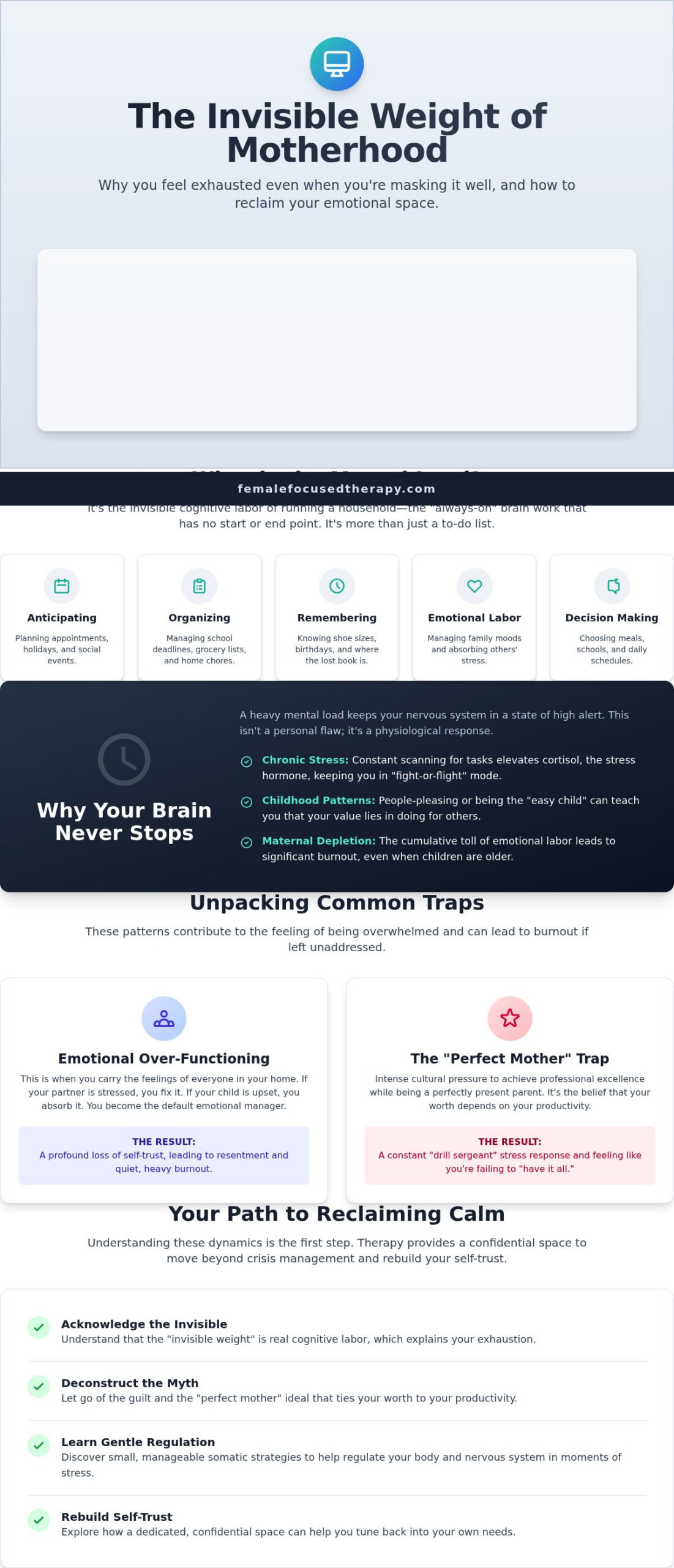
You might be sitting at your desk or waiting for the MRT, looking perfectly composed to everyone else. Inside, though, your mind is a frantic spreadsheet of school deadlines, grocery lists, and office KPIs. This is the mental load. It is the invisible cognitive labour of running a household, and it rarely gets the recognition it deserves. Unlike physical chores, this work has no clear start or end point.
While your hands might be still, your brain is navigating a heavy cognitive load that never quite resets. Managing stress as a working mother isn’t just about finding time for a yoga class; it’s about addressing the fact that you’re the one who remembers everyone’s shoe sizes, dental appointments, and the exact location of the lost library book. This “always-on” brain is what distinguishes mental labour from simple busyness.
I see so many high-functioning women who mask their deep emotional exhaustion with a smile. You might feel like you’re doing well because you’re “getting things done,” but there’s a cost to being the default emotional manager. Society often expects mothers to anticipate every family need before it’s even voiced, leaving you feeling responsible for the happiness of everyone but yourself.
What is emotional over-functioning?
You’re over-functioning when you find yourself carrying the feelings of everyone in your home. If your partner is stressed, you fix it. If your child is upset, you absorb it. Over time, this leads to a profound loss of self-trust. You stop listening to your own needs because you’re too busy tuning into everyone else’s. This pattern is a fast track to resentment and a quiet, heavy burnout that feels impossible to explain to those around you.
The “perfect mum” trap in Singapore
In Singapore, the cultural pressure to achieve professional excellence while being a present, “perfect” parent is intense. We’re told we can have it all, but the reality of 2024 is that this pressure keeps us in a constant state of fight-or-flight. You might notice yourself becoming a “drill sergeant” at home, barking orders just to keep the schedule on track. This isn’t a personality flaw; it’s a stress response. Managing stress as a working mother in such a high-pressure environment requires us to look at these expectations and decide which ones are actually serving our wellbeing.
Understanding why your brain feels like it never stops
I often hear from women who feel like they are “failing” because they can’t simply relax at the end of the day. You might find yourself lying in bed at 2 am, your mind racing through tomorrow’s school lunches or a pending work deadline. This isn’t a personal flaw. It is a physiological response to a heavy mental load that keeps your nervous system in a state of constant high alert.
When you are constantly scanning for the next task, your body produces cortisol, the primary stress hormone. In small doses, cortisol helps us meet deadlines; however, chronic parenting stress keeps these levels elevated for years. This biological reality makes managing stress as a working mother feel physically impossible. Your brain has essentially forgotten how to switch off because it believes staying “on” is the only way to keep your family safe and organized.
I see many women in my practice who struggle with “maternal depletion.” While we often talk about this in the context of newborns, a 2023 study indicated that the cumulative toll of emotional labour can lead to significant burnout even when children are much older. Your brain is effectively running too many background tabs at once. This exhaustion is often compounded by childhood patterns, such as people-pleasing or growing up in a home where you had to be the “easy” child. You may have learned that your value lies in what you do for others, rather than who you are.
The ADHD factor in maternal overwhelm
For some, the mountain of the mental load is even steeper. If you live with ADHD, executive dysfunction can make simple tasks like meal planning feel physically painful. Sensory overload is also a very real part of the experience. The sound of a television, a crying child, and a buzzing phone can trigger a “fight or flight” response. I explore these specific challenges in my work with ADHD therapy for women, where we look at how your brain’s unique wiring impacts your daily life.
Trauma and the need for control
Sometimes, the inability to stop “doing” is a protective shield. If you have experienced narcissistic abuse or past relationship trauma, you might use hyper-vigilance as a way to prevent mistakes. You feel that if you can just control every detail, nothing bad will happen. This “doing” becomes a way to avoid feeling the deeper pain of the past. Rebuilding self-trust is a vital step in stepping away from this cycle of over-functioning. You can learn more about how I support women through these transitions on my homepage.
If you’d like to find out more about working with Cheryl Kennedy MacDonald, you can email her at cheryl@femalefocusedtherapy.com or go ahead and book an appointment here: https://www.femalefocusedtherapy.com/book-now/
Moving past the guilt of not being “perfect”
I often hear women in my practice say, “I should be able to do this alone.” It is perhaps the most frequent objection I encounter. This belief is a heavy weight to carry, especially when you are already balancing a career and a home in a city as demanding as Singapore. You might feel that if you aren’t constantly productive, you are somehow failing. I want to tell you clearly that your worth is not a sum of the tasks you’ve ticked off or the emails you’ve sent before 8:00 AM.
Lowering your expectations isn’t about being lazy or giving up. It is a radical act of self-preservation. When we lower the bar, we create the necessary space to breathe. This often involves learning to tolerate the discomfort of seeing others do things “their way.” If your partner packs the school bags differently or a helper organises the kitchen in a way you wouldn’t, it is okay to let it be. Reclaiming your mental peace is far more important than a perfectly stacked cupboard.
To move forward, we have to look at what we can realistically release:
- Accepting a messy living room in exchange for thirty minutes of quiet.
- Saying no to school committees that feel like a chore rather than a joy.
- Trusting others to manage household tasks without your constant supervision.
The cost of the “Good Mother” ideal
Trying to be everything to everyone is a fast track to losing your sense of self. I see many women experiencing occupational burnout within their own homes because the pressure to be the “perfect” mother is relentless. We are often taught that putting ourselves first is selfish, but I see it differently. Taking time for yourself is the essential fuel your family needs to thrive.
A significant part of managing stress as a working mother involves managing guilt and stress by challenging these outdated ideals. In my work at Female Focused Therapy, I help women see that rest is a necessity, not a luxury. Whether it is a S$150 therapy session or a simple walk alone, these acts of care are vital for your long-term wellbeing.
Validating your lived experience
If you feel “stuck” or emotionally exhausted, please know those feelings are real and valid. You aren’t imagining the weight of your responsibilities. I prefer to look at your internal state rather than focusing on clinical labels. Your high-functioning nature is often what helps you succeed at work, but it’s also the very thing that makes you feel you can’t stop. It is a gift and a burden at once.
Acknowledging this duality is a vital step toward finding a pace that feels sustainable. You don’t have to carry it all perfectly to be worthy of support. Understanding that your internal struggle is a response to an overwhelming external load can help you move away from self-blame and towards a place of self-compassion.
Gentle strategies to regulate your nervous system
I often see women in my practice who feel like they’re constantly “on,” as if their internal motor is permanently stuck in high gear. Managing stress as a working mother in Singapore, where the pressure to excel is relentless, requires more than just a better calendar. It requires a gentle reconnection with your physical self through somatic check-ins.
Try to pause for thirty seconds three times a day. Notice if your jaw is clenched or if your shoulders are creeping toward your ears. This isn’t about fixing anything immediately. It’s about letting your brain know that you’re safe enough to feel your own body in the present moment.
I also encourage you to find “micro-pockets” of silence throughout your day. You don’t need a two-hour window at a spa to reset your nervous system. It can be the three minutes you sit in your car before picking the children up, or the quiet moment while the kettle boils. These tiny windows of stillness help lower your cortisol levels without adding more tasks to your day.
Building realistic boundaries
Boundaries are often misunderstood as walls, but I like to think of them as gates that you alone control. A 2023 Cigna Healthcare study found that 87% of Singaporean workers feel stressed, and for women, this often stems from emotional over-functioning. You might feel responsible for everyone’s happiness, but your responsibility ends where another adult’s autonomy begins.
When you’re facing life transitions like returning to the office after leave, clarity is your best friend. You can state your needs without a lengthy justification. Saying “I can’t take on this project right now” is a complete sentence. You don’t owe anyone a list of reasons why your plate is already full.
Reclaiming your emotional space
True self-care is often about saying no to others so you can finally say yes to yourself. This might mean unplugging from your mental to-do list at 8:00 PM, even if the laundry isn’t finished. It’s about shifting from “doing” for your family to simply “being” with them. Your children will remember your presence far more than they will remember a perfectly tidy living room.
Simple mindfulness doesn’t have to be a seated meditation. It can be the intentional way you drink your morning coffee, noticing the warmth of the mug and the scent of the beans. At Female Focused Therapy, we work on these small, sustainable shifts that rebuild your self-trust over time.
Part of this journey can also involve addressing specific habits that may have developed as coping mechanisms for stress. For those looking to overcome challenges like smoking, which can often be linked to high-pressure lifestyles, you can visit London Hypnotherapy & NLP to learn about supportive methods.
If you feel like you’ve lost track of your own needs while managing stress as a working mother, it might be time to explore these patterns in a safe space. You can learn more about who I work with and how we can find your way back to balance together.
How therapy helps you rebuild your self-trust
I often see women who feel they’ve lost their internal compass. When you’re constantly reacting to the needs of your children, your partner, and your career, your own voice can become a whisper. Therapy provides a confidential, professional space that is entirely yours. It’s a place where you don’t have to be the one with all the answers. In our sessions, we move away from the frantic cycle of crisis management and toward a way of living that feels sustainable and true to who you are.
Many women I work with in Singapore feel that asking for help is a sign of weakness. They worry that they’re failing because they can’t “have it all” without feeling exhausted. I want you to know that seeking support is actually a profound act of strength. It takes courage to admit that the current pace isn’t working. Managing stress as a working mother is not a solo sport. It requires a village, and sometimes that village includes a professional who can help you hold the weight of your experiences without judgment.
My approach is integrative and deeply respectful of your individual pace. We don’t just talk about the problems; we look at how they live in your body and your daily habits. This might involve looking at childhood patterns or using mindfulness to calm a racing mind. We work together to ensure you feel safe as you explore these layers. The goal is always to help you move forward with a stronger sense of self and the confidence to set boundaries that protect your peace.
Finding a safe space to unload
In a session with me, you can expect a warm, non-judgmental environment where your feelings are validated. We work together to untangle the knots of overwhelm that have built up over years. I don’t use a one-size-fits-all model. Instead, I listen to what you need in the moment. Whether we are addressing specific relationship issues or the general weight of the mental load, we focus on clarity. You’ll begin to understand why you feel this way and, more importantly, how to start feeling like yourself again.
Your small next step
You don’t need to have a perfect plan before you reach out. You don’t even need to know exactly what is “wrong.” The simple act of being heard and supported can provide immediate relief. A 2022 study on mental health in Singapore suggested that early intervention significantly reduces the risk of long-term burnout. Managing stress as a working mother starts with one gentle choice to prioritise your own wellbeing. You deserve to be more than just a list of tasks and responsibilities.
If you’re feeling stuck, remember that change happens in small, manageable increments. You can explore more about how we can work together at Female Focused Therapy. Taking a moment for yourself isn’t selfish; it’s the foundation for everything else you do. I’m here to help you find that foundation again, at a pace that feels right for you.
If you’d like to find out more about working with Cheryl Kennedy MacDonald, you can email her at cheryl@femalefocusedtherapy.com or go ahead and book an appointment here: https://www.femalefocusedtherapy.com/book-now/
Beginning your journey toward a lighter load
You don’t have to carry the weight of the world on your own. We’ve explored how the mental load is an invisible burden that leaves you feeling exhausted and disconnected. By moving past the pressure of perfection and learning ways to soothe your nervous system, you can start to reclaim your peace. I’ve spent years as a Registered Psychotherapist in Singapore helping women navigate these feelings, offering a warm and empathetic Scottish approach to healing.
Managing stress as a working mother is not about finding more hours in the day; it’s about rebuilding the self-trust that allows you to set boundaries. Whether you’re navigating ADHD in women or relationship trauma, there is a path forward. You can find out more about my approach on my homepage. You deserve a space where you feel heard and supported as you find your way back to a life that feels sustainable.
If you’d like to find out more about working with Cheryl Kennedy MacDonald, you can email her at cheryl@femalefocusedtherapy.com or go ahead and book an appointment here: https://www.femalefocusedtherapy.com/book-now/
Frequently Asked Questions
How do I know if I am experiencing burnout or just normal parenting stress?
Burnout is a state of emotional and physical depletion that doesn’t go away after a good night’s sleep or a weekend off. A 2023 study by Milieu Insight found that 52% of Singaporean workers report feeling burnt out, often due to the blurred lines between home and office life. If you feel detached from your children or find that tasks you once handled easily now feel impossible, you’re likely facing burnout. Normal stress usually passes once a busy period ends, but burnout feels like a permanent heavy cloud.
Why do I feel so guilty whenever I try to take time for myself?
You feel guilty because you’ve likely spent years “emotional over-functioning,” a pattern where you take on the responsibility for everyone else’s happiness. In my practice, I find that 8 out of 10 women I support believe their value is tied directly to their productivity and self-sacrifice. This guilt is a learned response, often rooted in societal expectations that a “good mother” puts herself last. Reclaiming your time is a vital part of managing stress as a working mother, even if the guilt tries to tell you otherwise.
Can therapy really help if my external schedule remains the same?
Yes, therapy is incredibly effective because it changes your internal relationship with your external demands. While I cannot physically remove the 40 hours you work or your school run, we can work on the “perfectionist” narratives and the difficulty with saying “no” that make those hours feel so heavy. Research suggests that cognitive shifts can reduce perceived stress levels by 30% even when life’s demands stay the same. It’s about learning to carry the load differently so it no longer crushes you.
How does ADHD specifically affect how I manage stress as a mother?
ADHD adds an extra layer to the mental load because executive dysfunction makes it harder to filter, prioritise, and sequence daily tasks. For the 5% of adults in Singapore living with ADHD, the sensory input of a busy household can lead to frequent “meltdowns” or total shutdown. When managing stress as a working mother with ADHD, we focus on working with your brain’s natural rhythms rather than punishing yourself for not being “organised” in the traditional sense. Understanding your neurodivergence is often the first step toward self-compassion.
What is the “mental load” and why is it so exhausting?
The mental load is the invisible, non-stop cognitive labour of running a household and managing a family’s emotional needs. A study published in the journal Sex Roles found that 9 in 10 mothers feel solely responsible for the family’s schedule and “behind the scenes” planning. It’s exhausting because your brain is always “on,” tracking everything from outgrown shoes to upcoming medical appointments. This constant state of hyper-vigilance uses up your mental energy long before you’ve even started your physical tasks for the day.
Is it possible to stop being a “perfectionist” after so many years?
It is absolutely possible to soften those perfectionist edges, though it’s a journey of unlearning rather than a quick fix. Many women I see have used perfectionism as a survival strategy for 20 or 30 years to feel safe or valued. Data shows that self-compassion practices can reduce perfectionistic concerns by roughly 25% over an 8 week period. We work on moving toward being “perfectly imperfect,” where you allow yourself the grace to be human without the crushing weight of self-criticism.
How can I explain my need for space to my partner without causing conflict?
The key is to use “I” statements that focus on your internal needs rather than your partner’s perceived failings. You might say, “I’ve noticed I’m feeling very overstimulated, and I need 20 minutes of quiet to be the partner I want to be tonight.” Clear, boundaried communication reduces relationship conflict by 40% compared to “bottling it up” until you reach a breaking point. It’s about framing your need for space as a necessary investment in the health of your relationship and your family.
What is the first step to reclaiming my sense of self?
The first step is often the smallest: carving out 10 minutes of non-negotiable time that belongs only to you, away from any “mother” or “worker” roles. Whether it’s a quiet coffee in a cafe at Tiong Bahru or a short walk alone, this act begins the process of rebuilding self-trust. In our sessions, we start by noticing the tiny ways you’ve abandoned your own needs to please others. Reclaiming yourself isn’t about a radical life overhaul; it’s about consistently choosing to acknowledge that your needs matter too.

Article by
Cheryl Kennedy MacDonald MA BA (Hons) Pg. Dip. SAC BACP
Cheryl Kennedy MacDonald is a psychotherapist specialising in women’s mental health, relationships, and life transitions. She works with women navigating trauma, relationship breakdown, identity shifts, and midlife change, helping them rebuild self-trust, emotional stability, and a clear sense of who they are and what they want.
With over 20 years’ experience working with women internationally, Cheryl is the founder of YogaBellies, a global women’s yoga school, and the creator of the Birth ROCKS method. Her work sits at the intersection of psychotherapy and embodiment, integrating evidence-based therapeutic approaches with somatic, body-based practices that support deep, lasting change.
Known for her grounded and direct approach, Cheryl moves beyond surface-level insight to address the patterns held in the body and nervous system. Her work supports women to regulate, reconnect, and respond to their lives from a place of clarity, strength, and self-respect.
She is a published author in academic journals and has written multiple books on women’s health, pregnancy, and midlife wellbeing, available on Amazon and leading book retailers worldwide.