
You wake up and immediately check the weather of your partner’s mood before your feet even touch the floor. It’s a heavy, familiar tension in your chest; that constant need to scan for danger just to survive the morning. You’ve spent so long walking on eggshells that you’ve forgotten what it feels like to walk on solid ground. If you feel like you’ve lost your sense of self in the confusing cycle of narcissist abuse, please know that you aren’t ‘crazy’ and you aren’t overreacting.
I know how exhausting it is to live in a state of constant high alert, wondering which version of your partner you’ll meet today. When you’ve been love-bombed and then discarded, your mind and body can feel completely disconnected. I’ve seen so many intelligent, capable women struggle with this deep, chronic fatigue and the painful loss of their own intuition.
I want to help you understand why your body has reacted this way and offer a gentle, somatic path toward reclaiming your self-trust. We’ll look at the cycle of abuse and find practical ways to calm your nervous system. There is a way through the fog, and I’m here to help you find your way back to a life where you feel like yourself again.
Key Takeaways
- I’ll help you recognise the subtle patterns of narcissist abuse so you can finally trust your own intuition again.
- You’ll understand why you’ve moved from being love-bombed to feeling devalued, helping you make sense of the emotional confusion.
- I’ll show you how trauma lives in your nervous system and identify the physical signs of chronic tension you might be feeling.
- We’ll explore how to set firm boundaries, both with others and within your own self-talk, to create the space you need to heal.
- Discover how my integrative approach combines psychotherapy with somatic practices to help you find your way back to yourself.
Recognising the Subtle Weight of Narcissist Abuse in Your Life
Narcissist abuse isn’t always loud. Often, it’s a quiet, persistent pattern of emotional manipulation that slowly wears away at your sense of who you are. You might find yourself constantly questioning your own reality or feeling like a shadow of the person you used to be.
I often hear women say they can’t call it abuse because their partner hasn’t been clinically diagnosed. You don’t need a doctor’s note to know that your pain is real or that your relationship feels unsafe. Understanding Narcissistic Traits can be helpful for context; however, your lived experience is the only proof you need to validate your feelings.
This type of trauma often creates a thick ‘fog’ of cognitive dissonance. It’s that exhausting state of loving someone deeply while simultaneously fearing how they’ll react to a simple question or a change in plans. You’re stuck between the memory of who they were at the start and the reality of who they are now.
For high-functioning women, this trauma is often an invisible weight carried silently behind a mask of competence and professional success.
Why Narcissist Abuse Feels Different from Regular Relationship Conflict
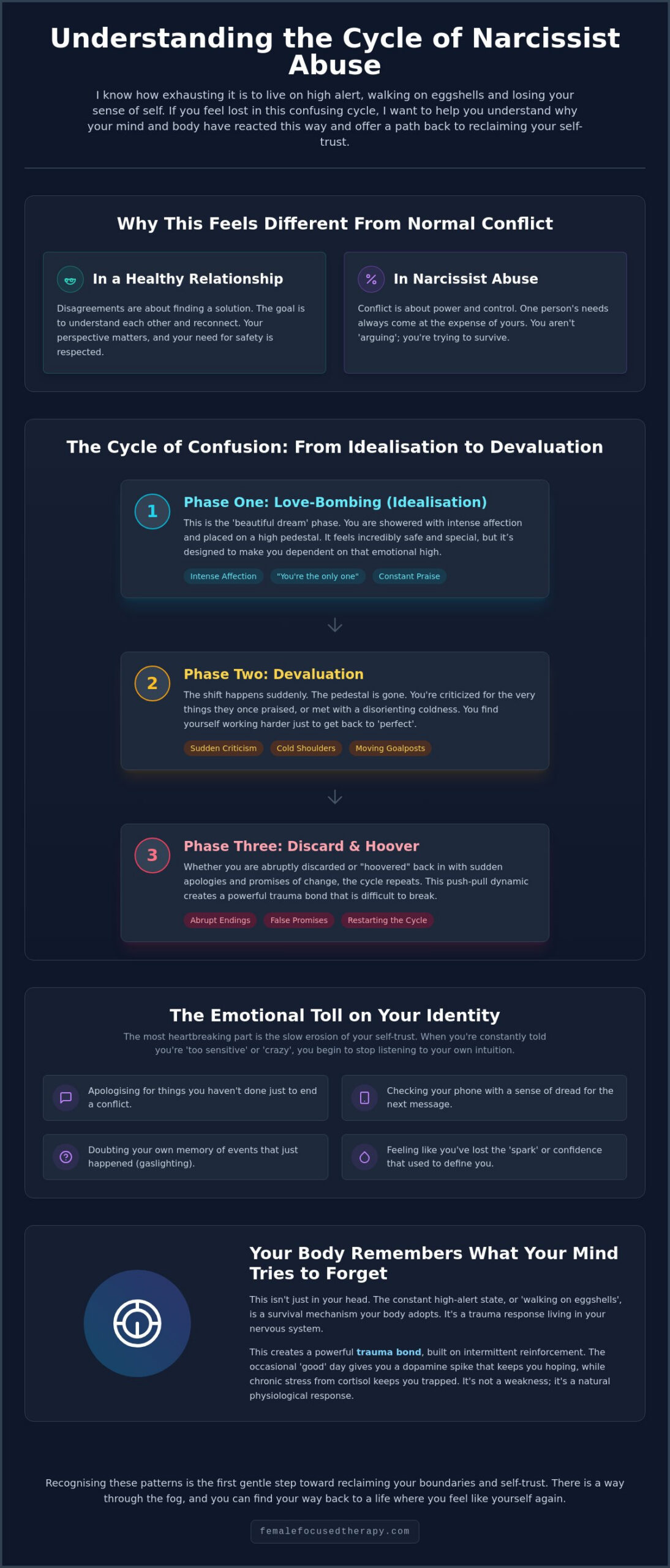
In a healthy relationship, disagreements are about finding a solution and understanding each other. Narcissist abuse is different because it’s rooted in a power imbalance where one person’s needs always come at the expense of yours. There’s no room for your perspective because their need for control overrides your need for safety.
You aren’t just ‘arguing’; you’re surviving. Walking on eggshells isn’t a personality trait; it’s a survival mechanism your body has adopted to avoid the next explosion or cold shoulder. In my relationship trauma and narcissistic abuse practice, I see how this constant state of alert changes the way women move through the world and inhabit their own bodies.
The Emotional Toll on Your Identity
The most heartbreaking part of this experience is the slow erosion of your self-trust. Over months or years, you stop listening to your intuition because you’ve been told so often that you’re ‘too sensitive’ or ‘crazy.’ When you’re told your feelings aren’t valid, you begin to outsource your reality to the person hurting you.
This is gaslighting in its purest form. It makes you start minimising your own needs just to keep the peace, eventually leaving you feeling hollow. You might notice yourself:
- Apologising for things you haven’t done just to end a conflict.
- Checking your phone with a sense of dread whenever a notification pops up.
- Doubting your memory of events that happened only moments ago.
- Feeling like you’ve lost the ‘spark’ or the confidence that used to define you.
This isn’t a sign of weakness. It’s a natural response to a confusing environment where the rules change every day and your emotional safety is never guaranteed.
The Cycle of Confusion: From Love-Bombing to the Discard
The beginning of these relationships often feels like a beautiful dream. You’re showered with intense affection, told you’re the ‘only one’ who truly understands them, and placed on a high pedestal. This is love-bombing, and it’s designed to make you feel incredibly safe and chosen. However, in the context of narcissist abuse, this isn’t about genuine love; it’s about making you dependent on that emotional high.
Then, the shift happens. Suddenly, the pedestal is gone. You’re criticised for the very things they once praised, or met with a coldness that feels impossible to explain. This devaluation phase is disorienting because you find yourself working twice as hard to get back to that initial ‘perfect’ version of the relationship. It’s a cruel game where the rules change without warning.
It’s essential to recognize the signs of narcissistic abuse as they manifest in this push-pull cycle. Whether they discard you or ‘hoover’ you back in with sudden promises of change, the focus shouldn’t be on diagnosing them. Instead, I want you to look at the impact these behaviours have on your peace and your sense of self.
Understanding the Trauma Bond
I’ve seen so many women struggle to leave because of a powerful trauma bond. It’s built on intermittent reinforcement, where the occasional ‘good’ day makes you stay through a hundred bad ones. Your brain gets hooked on dopamine spikes during the highs, while cortisol keeps you trapped in a loop of high-stress survival. It’s not a lack of strength that keeps you there; it’s a physiological response to a very confusing environment.
Recognising Gaslighting in Real-Time
You might hear phrases like “You’re too sensitive,” “I never said that,” or “You’re imagining things.” These words are designed to make you doubt your own memory and rely on the abuser’s version of reality. It’s an isolating experience that forces you to disconnect from your own intuition just to keep the peace. If you’re feeling ready to start unpicking this confusion, you can book a session with me to explore your experience in a safe, grounded space.
Trusting your gut is a muscle you can rebuild. That small, quiet voice telling you something is ‘off’ isn’t being ‘crazy.’ It’s your intuition trying to guide you back to your own truth.
Why Your Body Remembers What Your Mind Tries to Forget
You might find yourself logically understanding the relationship, yet still feeling a heavy knot in your stomach or a sudden racing heart. This is because trauma isn’t just a story your mind tells; it’s a physical state your nervous system lives in. Your body often keeps the score, even when you’re trying to move on.
When you’ve lived through narcissist abuse, your body stays stuck in a survival loop long after the conflict has ended. This is what I call somatic memory. Your cells remember the tension of waiting for a door to slam or the heavy silence that felt like a weapon. It’s a physiological imprint that doesn’t just disappear with time.
I see this manifest in many physical ways with the women I support. You might experience chronic chest tightness, unexplained digestive issues, or a constant state of hyper-vigilance where you’re startled by the smallest noises. These aren’t just ‘stress symptoms’; they’re your body’s way of trying to protect you.
Sometimes, ‘talking it out’ isn’t enough because the trauma is stored in the primitive parts of your brain that don’t use language. Somatic restoration is an essential part of my integrative approach, helping you release that stored tension and feel safe in your own skin again; for example, you might explore Wellness services, retreats, and educational programs to support your body’s physical healing.
The High-Functioning Freeze Response
Many of the women I work with are incredibly high-functioning and capable. If you have ADHD or a high-pressure career, you might have learned to ‘over-function’ as a way to mask the internal chaos. You keep going, ticking off tasks and looking after everyone else, while your body is actually in a state of functional freeze.
This disconnect leads to profound physical burnout and a feeling of being ‘numb’ or completely disconnected from your own physical needs. You might feel like you’re operating from the neck up, ignoring the signals of exhaustion or pain your body is sending you.
Using Breath and Movement as First Aid
Healing begins when we signal to the nervous system that the danger has passed. A simple way to start this process is the 4-7-8 breath. You breathe in for four counts, hold for seven, and exhale slowly for eight. This simple rhythm tells your brain it’s okay to come out of survival mode.
This isn’t about ‘fixing’ yourself; it’s about giving your body the rest it deserves. Somatic movement helps you ‘shake off’ the lingering stress response that talk therapy alone might miss. It’s a gentle way to reclaim your space and your energy.
If you want to explore this further, you can find more about my somatic movement and yoga resources. These tools are designed to help you reconnect with your body at a pace that feels manageable, kind, and entirely your own.
Gentle Steps Toward Reclaiming Your Boundaries and Self-Trust
Reclaiming your life after narcissist abuse often starts with creating physical and digital distance. Whether you choose ‘No Contact’ or ‘Low Contact,’ the goal is to stop the constant influx of manipulation. This space isn’t a wall to keep the world out; it’s a sanctuary where your own voice can finally grow louder than theirs.
I often help women realise that boundaries aren’t just for others. You also need ‘Internal Boundaries’ to protect yourself from the harsh self-criticism the abuser planted in your mind. Learning to say no to that inner voice that echoes their insults is a vital step in your restoration. It’s about being as kind to yourself as you would be to a dear friend.
Gaslighting leaves you feeling like you’re standing on shifting sand. One of the most powerful tools I recommend is writing down exactly what happened during a conflict. When you have a clear record of your truth, it becomes much harder for anyone to talk you out of your own reality. This simple act of self-validation is a quiet but firm rebellion.
Please remember that healing is a steady, unhurried journey. You aren’t in a race to ‘get over it’ or reach a specific milestone by a certain date. Some days will feel lighter than others, and that’s perfectly okay. You’re allowed to take all the time you need to feel like yourself again.
Rebuilding Your Circle of Support
As you heal, you’ll need to identify ‘safe’ people who validate your experience without question. It’s important to find a confidential therapy space where you can speak freely. This professional support provides a grounded environment where you don’t have to explain or defend your pain.
Be mindful of ‘flying monkeys,’ those people who try to stay neutral or encourage you to ‘just move on’ before you’re ready. Neutrality in the face of abuse is often just another form of invalidation. Surrounding yourself with people who truly see you is essential for rebuilding your sense of safety.
Learning to Trust Your Intuition Again
Your intuition is like a muscle that has been weakened by months or years of being ignored. You can start rebuilding it with small, daily exercises. Ask yourself simple questions: “What do I actually want for tea?” or “Do I really want to go to this event?” Notice how your body feels when you think of each option.
Mindfulness helps you notice your body’s ‘yes’ and ‘no’ signals. A ‘no’ might feel like a subtle tightness in your throat, while a ‘yes’ feels like a gentle expansion in your chest. Rebuilding this self-trust takes time, but every small choice you make for yourself is a victory. If you’re ready to start setting these boundaries and reclaiming your peace, you can book a session with me here.
How I Can Walk Beside You Toward Internal Restoration
Healing from narcissist abuse isn’t a straight line, and you don’t have to walk it alone. My role isn’t to ‘fix’ you, because you aren’t broken. Instead, I offer a warm, professional partnership where we can unpick the layers of confusion and restore your internal stability. You’ve spent so long defending your reality; here, you can simply be.
I use an integrative approach that blends traditional talk therapy with somatic awareness. This means we don’t just talk about the trauma; we listen to how your body is holding it. By combining these methods, we can address the cognitive fog of gaslighting while simultaneously calming the physical ‘high alert’ state your nervous system has lived in for so long.
My practice is specifically designed for women, providing a safe, non-judgmental space where your reality is never questioned. Together, we work on rebuilding that core of self-trust that was eroded. We’ll help you move from a place of constant survival back into a life of peace and self-assurance, where your own voice is the one you trust most.
A Tailored Approach for Your Unique Journey
I understand that your experience is unique, often intersecting with other life transitions or neurodivergence. Whether you’re navigating the complexities of ADHD or the shifting tides of midlife, our work is tailored to your specific needs. Many of the women I support find that online therapy offers a level of privacy and comfort that makes it easier to open up about difficult experiences from home.
You might feel like you’ve lost your edge or that you’re ‘too much’ now. I’m here to remind you that your sensitivity is a strength, and your body’s reactions are simply a sign of how hard you’ve been working to stay safe. You deserve a soft place to land where you can finally let go of the weight you’ve been carrying for everyone else.
Taking the First Step Toward Peace
Reading this guide is a significant step toward your restoration. It takes immense courage to look clearly at the patterns of narcissist abuse and decide that you deserve better. You’ve already started the process of reclaiming your truth, and that is something to be truly proud of.
If you feel ready to explore these themes further, I invite you to connect with me in a way that feels comfortable for you. You might start by looking through my free therapy resources or by reaching out for a quiet chat. There’s no pressure and no urgency; we move at the pace that feels right for your nervous system.
I want to leave you with a sense of hope. The fog will clear, the tension in your body will eventually soften, and you can feel like yourself again. You are capable of finding your way back to a life where you trust your own heart and inhabit your own peace.
Reclaiming Your Peace and Your Self
You’ve spent so long living by someone else’s rules and questioning your own reality. Healing from narcissist abuse is a journey of coming home to yourself; a process of quietening the external noise so you can finally hear your own intuition again. We’ve explored how the cycle of manipulation affects your mind and why your body continues to hold onto that tension long after the conflict has passed.
As a Registered Integrative Psychotherapist specialising in female-focused trauma recovery, I am here to support you with a mind-body somatic approach. My goal is to help you build the internal boundaries and self-trust you need to feel stable and secure. You don’t need to have all the answers right now; you just need a safe, confidential space to begin.
If you feel ready to move toward a life of peace and internal restoration, you can book a confidential consultation with me today. You have already shown immense strength by seeking understanding and reading this guide. I look forward to walking beside you as you find your way back to the woman you were always meant to be.
Common Questions About Healing and Restoration
What are the most common signs of narcissist abuse?
Common signs include an initial period of intense affection followed by sudden criticism and a lack of empathy for your needs. You might notice a pattern where your partner avoids accountability by shifting blame onto you or making you feel responsible for their moods. This often leaves you feeling isolated from your friends and family. Recognising these patterns is a vital step toward reclaiming your sense of reality.
Can a narcissist ever change their behaviour in therapy?
It is quite rare for someone with these traits to change, as it requires a genuine capacity for empathy and self-reflection. In many cases, therapy is used as another tool for manipulation or to learn better ways to gaslight a partner. My focus is always on your healing and safety. I prefer to work on your internal restoration rather than attempting to change the person causing the harm.
How do I know if I am being gaslit in my relationship?
You are likely being gaslit if you consistently doubt your own memory or feel like you’re ‘losing it’ during arguments. Gaslighting is a tactic used in narcissist abuse to make you rely on the abuser’s version of events. If you find yourself frequently apologising for things you know you didn’t do just to keep the peace, it’s a clear sign your reality is being manipulated.
Why do I feel so exhausted after spending time with my partner?
This exhaustion comes from the constant state of ‘hyper-vigilance’ your body stays in to avoid conflict. When you’re always scanning for mood shifts or walking on eggshells, your nervous system never gets a chance to rest. This chronic emotional labor drains your energy. It leads to the deep, unexplained fatigue that many women in these relationships describe as feeling completely bone-tired.
How long does it typically take to recover from narcissist abuse?
Recovery is a deeply personal process with no fixed timeline, as it depends on the length and intensity of your experience. Some women begin to feel a sense of relief within months, while for others, the journey of internal restoration takes longer. I encourage you to be patient with yourself. View your healing as a steady, unhurried path rather than a race to a specific finish line.
Is it possible to have a healthy relationship after experiencing abuse?
Yes, it is absolutely possible to build healthy, loving connections once you have restored your relationship with yourself. Healing involves learning to trust your intuition again and recognising the ‘green flags’ of mutual respect and consistency. By doing this internal work, you create a foundation where you no longer feel the need to minimise your needs or hide your true self for a partner.
What is the difference between narcissist abuse and ‘toxic’ behaviour?
While toxic behaviour can be reactive or occasional, narcissist abuse is a systematic and repetitive cycle of power and control. It involves a specific pattern of idealisation, devaluation, and discarding that is designed to keep you off-balance. Toxicity might stem from a lack of communication skills, but this type of abuse is an intentional erosion of your identity to maintain dominance in the relationship.
How can somatic therapy help me heal from relationship trauma?
Somatic therapy helps by addressing the trauma that remains trapped in your nervous system even after you’ve processed it mentally. I use movement, breath, and awareness to help you release the physical tension and ‘freeze’ responses that talk therapy alone might miss. It allows you to feel safe in your body again. This is essential for rebuilding your confidence and finding your way back to peace.

Article by
Cheryl Kennedy MacDonald MA BA (Hons) Pg. Dip. SAC BACP
Cheryl Kennedy MacDonald is a psychotherapist specialising in women’s mental health, relationships, and life transitions. She works with women navigating trauma, relationship breakdown, identity shifts, and midlife change, helping them rebuild self-trust, emotional stability, and a clear sense of who they are and what they want.
With over 20 years’ experience working with women internationally, Cheryl is the founder of YogaBellies, a global women’s yoga school, and the creator of the Birth ROCKS method. Her work sits at the intersection of psychotherapy and embodiment, integrating evidence-based therapeutic approaches with somatic, body-based practices that support deep, lasting change.
Known for her grounded and direct approach, Cheryl moves beyond surface-level insight to address the patterns held in the body and nervous system. Her work supports women to regulate, reconnect, and respond to their lives from a place of clarity, strength, and self-respect.
She is a published author in academic journals and has written multiple books on women’s health, pregnancy, and midlife wellbeing, available on Amazon and leading book retailers worldwide.