
What if that feeling of being “too much” isn’t a personality flaw, but a nervous system that’s simply been trying too hard to keep you safe? You likely spend your days appearing perfectly organised at work, only to collapse in total exhaustion the moment the door finally closes. I know this feeling because I live it too, and I promise to help you understand how working with a female-focused adhd therapist can move you from chronic overwhelm to internal restoration.
We’ll explore how somatic tools and a warm, boundaried relationship can help you stop masking and finally find calm in your own skin. You don’t need another generic planner; you deserve a space where you feel truly seen and understood in your specific experience.
Key Takeaways
- Discover why life transitions like menopause can make ADHD symptoms feel suddenly unmanageable and how to navigate these shifts with compassion.
- Learn why choosing an adhd therapist with lived experience can help you feel truly understood without the need for constant explanation.
- Understand how to move beyond basic time-management tips and begin regulating your nervous system using gentle somatic tools.
- Find out what to expect in a therapeutic space designed specifically for the high-functioning woman who is tired of the exhaustion of masking.
That feeling of being ‘too much’ yet never enough
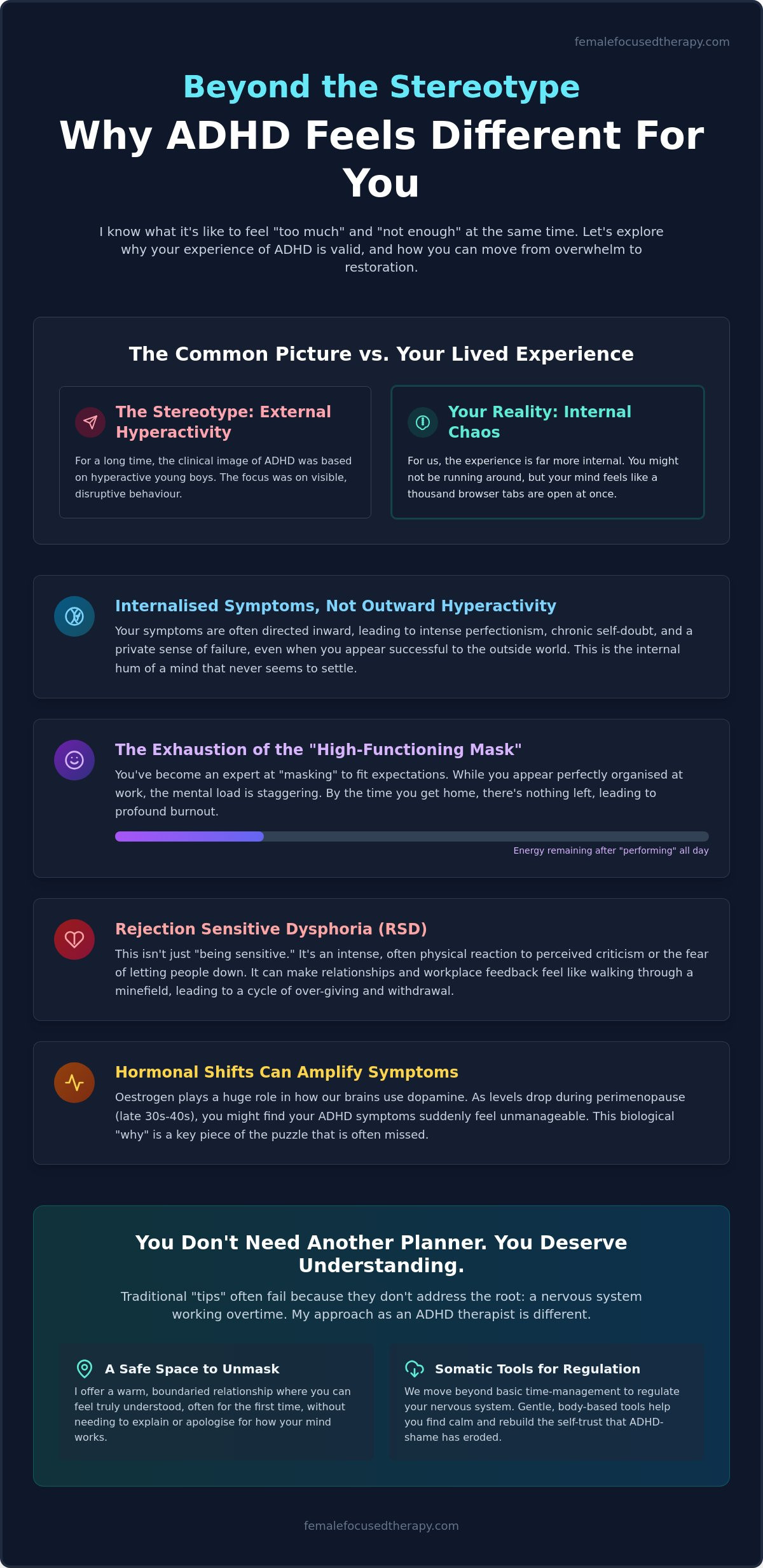
I know what it’s like to have a mind that feels like a thousand browser tabs are open at once. It’s a relentless hum of ideas, worries, and half-finished thoughts that never seems to settle. For many of the women I work with in Singapore, this internal chaos is paired with a crushing sense of being “too much” for others while simultaneously feeling like you’re never doing enough.
You might have spent years being told you’re just “sensitive” or “highly strung.” Perhaps you’ve even seen professionals who dismissed your struggles as simple anxiety or the byproduct of a busy career. While anxiety is often present, it’s usually a symptom of a nervous system that’s working overtime to process a world not designed for it. My approach as an adhd therapist starts with your internal world, not just your to-do list.
The exhaustion of the high-functioning mask
Many women become experts at “masking” their symptoms to fit into social and professional expectations. You might appear perfectly organised at work, but the mental load required to maintain that image is staggering. By the time you get home, there is nothing left for yourself or your family. This performance is what leads to the profound burnout I see so often in high-achieving women.
Traditional talk therapy often fails us because it focuses on changing “maladaptive” thoughts without acknowledging how our brains actually process information. As a woman living with ADHD myself, I chose to specialise in ADHD-focused therapy because I understand that you don’t need more “tips” on how to use a planner. You need a space where the mask can finally drop.
Moving beyond the ‘disorder’ label
I don’t view ADHD as a character deficit or a broken brain. It’s a different way of processing the world. Research into ADHD in girls and women shows that our symptoms are often internalised, leading to perfectionism and chronic self-doubt rather than outward hyperactivity.
In our sessions, we work together to rebuild the self-trust that years of ADHD-shame have eroded. You don’t have to explain your “quirks” or apologise for your scattered thoughts here. Instead, we focus on internal restoration, helping you understand your unique rhythm so you can move through life with more ease and less apology.
Why ADHD looks different in our lives as women
For a long time, the clinical image of ADHD was based on hyperactive young boys. However, for us as women, the experience is far more internal. You might not be running around the room, but your mind is never still. Working with a specialised adhd therapist helps you see that perfectionism and chronic restlessness are actually neurological traits, not personality flaws.
One of the most painful aspects we face is Rejection Sensitive Dysphoria (RSD). This isn’t just “being sensitive.” It’s an intense, physical reaction to perceived criticism or the fear of letting people down. It can make navigating relationships and workplace feedback feel like walking through a minefield. This emotional weight often leads to a cycle of over-giving and then withdrawing in exhaustion. Understanding this lens is essential for true self-acceptance.
According to the National Institute of Mental Health, ADHD affects millions of adults, yet women are frequently diagnosed late because our symptoms are so easily misunderstood. We often internalise our struggles, which leads to a private sense of failure even when we appear successful to the outside world.
Hormones and the neurodivergent brain
I often find that my clients first reach out for an adhd therapist when they hit their late 30s or 40s. Oestrogen plays a huge role in how our brains use dopamine. When levels drop during perimenopause, your symptoms can suddenly feel unmanageable. I specialise in supporting women through these specific life transitions, helping you understand the biological “why” behind your struggle.
The social pressure to ‘do it all’
Society expects women to be “household CEOs” and emotional anchors. For a neurodivergent brain, the mental load of managing schedules and social obligations can be paralysing, creating deep shame. In our work, we focus on unlearning this shame. I’ve found that learning to truly rest is often the most difficult but necessary skill to master. It allows your nervous system to finally feel safe in stillness.
If you’re ready to explore how your unique brain works in a safe, female-focused space, you can book a session with me here. We’ll work together to move from a state of constant “doing” to a place of internal restoration and calm.
Beyond the checklist: What to look for in an ADHD therapist
Finding the right adhd therapist is about more than just checking a box on a medical directory. It’s about finding a professional relationship where you don’t have to translate your experience into “neurotypical” language. I believe the most effective therapy happens when you feel truly seen, not just diagnosed. You need a space where your brain’s unique rhythm is respected rather than pathologised.
When you’re looking for support in Singapore, you’ll encounter many options. It’s vital to find someone who balances clinical expertise with genuine human warmth. You want a space that feels boundaried but safe, where your “too-muchness” is welcomed rather than managed. This is particularly important for high-functioning women who are used to being the “strong ones” for everyone else in their lives.
Therapy vs. Coaching: Which do you need?
I often get asked about the difference between an ADHD coach and a registered adhd therapist. Essentially, coaching focuses on the “how.” It’s about systems, planners, and productivity. While these are useful, they often fail if the underlying emotional “why” isn’t addressed. If you’ve spent decades feeling like you’re failing, a new planner won’t fix the shame you carry.
Therapy goes deeper. It addresses the “small-t” trauma of growing up feeling like you were lazy or broken. If you’ve also experienced relationship trauma, you need a professional who can hold both your neurodivergence and your recovery in one hand. This integrative approach ensures we’re healing the roots of your overwhelm, not just trimming the branches.
The value of a specialized female-focused space
Research from Duke University on how ADHD presents differently in women highlights that our struggles are often masked by social expectations. This is why a gender-centric environment is so powerful. You don’t have to filter your reality to fit a male-skewed diagnostic model or explain why a messy kitchen feels like a moral failure. You can simply be yourself.
You might consider asking a potential therapist if they have experience with the specific intersections of hormones, career burnout, and female socialisation. I offer online therapy precisely because I want this specialised support to be accessible to women wherever they are. Having a therapist with lived experience can significantly shorten the time it takes for you to feel understood and at ease.
The mind-body connection: Somatic tools for a neurodivergent nervous system
If you’ve ever felt like your body is vibrating with a restless energy you can’t quite switch off, you aren’t alone. ADHD isn’t just a collection of thoughts in your head; it’s a physiological experience rooted deeply in your nervous system. As an adhd therapist, I’ve found that traditional talk therapy is only half the story. We also need to address how your body holds onto the stress of navigating a world that feels too loud and too fast.
Many of my clients describe a physical “buzz” that keeps them awake at night or a tightness in the chest that appears when their to-do list grows. Somatic tools help “discharge” this pent-up energy. Instead of just talking about your overwhelm, we use movement and breath to signal to your brain that you are actually safe. This isn’t about fitness; it’s about finding a way to feel at home in your own skin again.
Why ‘just sitting still’ doesn’t work for us
Traditional meditation can feel like actual torture when you have an ADHD brain. Being told to “clear your mind” while sitting perfectly still often just makes the internal noise louder. This is why I prefer a “bottom-up” approach to regulation. We start with the body to calm the mind, rather than the other way around.
Through somatic movement, we explore how gentle, intentional shifts can release the physical tension that mirrors your mental clutter. It allows you to process emotions that feel “stuck” without needing to find the perfect words for them. It’s a way of listening to what your body needs before you reach the point of a total meltdown.
Building a toolkit that actually works
In our sessions, I’ll help you build a practical toolkit for those moments when life feels like it’s spinning out of control. I integrate mindfulness in a way that’s grounded and realistic for a busy woman’s life. We might use a simple one-minute breathwork technique to find a pocket of calm between meetings or use specific somatic anchors to ground you when you feel a wave of rejection sensitivity hitting.
- Learning to recognise the physical “tells” of an impending ADHD burnout.
- Using rhythmic movement to soothe a frayed nervous system.
- Practising the radical act of rest, even when your brain insists you should be “productive.”
Redefining your relationship with your body is a vital part of internal restoration. If you’re ready to move beyond just managing your symptoms and start truly regulating your system, you can schedule a time to speak with me here. We’ll work together to find the somatic tools that feel natural and supportive for your unique life.
Beginning your journey toward ADHD restoration
I know that taking this first step can feel daunting. You’ve likely spent a lifetime trying to figure it all out on your own, thinking that if you just tried harder, the overwhelm would disappear. I’m here to offer you a gentle reassurance: you don’t have to carry this by yourself anymore.
A typical session with me is unhurried and compassionate. We aren’t here to “fix” you, because you aren’t broken. Instead, we focus on understanding your unique nervous system and finding ways to bring you back to a place of internal restoration. It’s about creating a life that works with your brain, not against it.
The one realistic next step is simply reaching out for a conversation. We’ll see if we’re a good fit and if the way I work feels right for your specific needs. I promise that a life with less overwhelm is possible when you have the right support in place.
What to expect in our first session
I strive to create a warm but boundaried environment where you can finally feel safe to drop the mask. In our first session, we’ll begin to gently unpick the layers of shame that often come with being a high-functioning woman with ADHD. It’s a space for you to be heard without judgment.
It’s a collaborative process where we look at your life as a whole. While I bring my expertise as an adhd therapist and my own lived experience, you remain the expert on your own life. I am simply here to act as your guide and support as you navigate this new understanding of yourself.
Taking that first brave step
Choosing a therapist is a deeply personal decision. I encourage you to trust your intuition; you’ll know when a space feels right for you. If my words have resonated with you, I’d love to hear from you. We can explore how my integrative approach can support your journey toward calm.
You can book a consultation with me here, whether you’re looking for support in Singapore or online. This isn’t a high-pressure commitment, just a chance for us to connect. It’s the first step toward reclaiming your energy and finding your internal balance.
Please remember: you are not “too much.” You’ve simply been doing too much without the right tools or support. You are enough exactly as you are, and a calmer, more restored way of living is absolutely within your reach.
Reclaiming your rhythm and your self
You’ve spent so long trying to keep up with a world that wasn’t built for your brain. We’ve explored how ADHD in women often hides behind perfectionism and exhaustion, and why traditional, clinical approaches often miss the mark. By focusing on your nervous system through an integrative somatic approach, we can move away from just “managing” and toward genuine internal restoration.
Finding the right adhd therapist is about more than finding a professional; it’s about finding a partner who truly understands your lived experience. As a Registered Integrative Psychotherapist and a specialist in female neurodivergence, I’m here to hold that space for you. You aren’t too much, and you don’t have to carry the weight of masking alone any longer.
If you’re ready to start feeling at home in your own mind and body again, I’d love to help. Book a session with me to begin your journey toward ADHD restoration. You deserve a life that feels unhurried, compassionate, and entirely your own. Your journey toward a calmer, more grounded version of yourself starts whenever you’re ready.
Frequently Asked Questions
Can an ADHD therapist diagnose me in Singapore?
I can help you prepare for a formal assessment if that’s a path you choose to take. However, many of the women I work with find that understanding their traits and beginning the healing process is their primary goal, regardless of an official report.
How is ADHD therapy different from regular counselling?
ADHD therapy is specifically tailored to a neurodivergent nervous system rather than just discussing general life problems. Traditional counselling often assumes a neurotypical baseline, which can leave you feeling misunderstood or like you’re “failing” at therapy itself. We focus on the biological “why” behind your struggles.
In our sessions, we look at executive function, rejection sensitivity, and sensory processing. We don’t just talk about your feelings; we work on practical, somatic ways to regulate your system. It’s a more targeted, validating approach that respects how your brain actually works.
Do I need a formal diagnosis before I start therapy with you?
You don’t need a formal piece of paper to begin working with me. If you resonate with the experiences of high-functioning women with ADHD, that’s a perfectly valid place to start. Many women spend years in the “self-discovery” phase before seeking a clinical label.
My role is to support your internal restoration and help you manage the overwhelm. We can explore your traits and how they’ve shaped your life story without needing a doctor’s note. Your lived experience is the most important evidence we have.
How long does ADHD therapy usually take to see results?
There isn’t a fixed timeline for healing, but many women feel a significant shift in their self-compassion within the first few sessions. Deep work on unmasking and nervous system regulation is a steady journey rather than a quick fix. It’s about building sustainable changes at a pace that feels safe.
Some clients find they gain the clarity they need in a few months, while others prefer ongoing support as they navigate different life transitions. We’ll always move at a speed that respects your energy levels and prevents further burnout.
Can you help me if I also have relationship trauma or narcissistic abuse history?
Yes, I specialise in the intersection of neurodivergence and relationship trauma. ADHD women are often more vulnerable to toxic dynamics because of traits like rejection sensitivity and a tendency to over-explain. This can lead to a painful cycle of being misunderstood or even gaslit in relationships.
We work on rebuilding the self-trust that narcissistic abuse often erodes. By understanding your ADHD, you can begin to see why certain patterns occurred and how to set warmer, firmer boundaries for the future. It’s about reclaiming your sense of self.
Is online therapy as effective as in-person sessions for ADHD?
Online therapy is highly effective and often more accessible for women with ADHD. It removes the stress of travel and the sensory overwhelm of a new environment. You can be in your own safe, comfortable space, which often helps you open up more easily.
I’ve found that the screen doesn’t diminish the “warm but boundaried” connection we build. Many of my clients appreciate the flexibility it offers, making it easier to stay consistent with their sessions even when life feels particularly scattered or busy.
What is the difference between an ADHD coach and a psychotherapist?
An ADHD coach generally focuses on external systems, such as time management, organisation, and productivity. While these tools are helpful, they don’t always address the deep-seated shame or trauma that many women carry. As an adhd therapist, I work with your internal emotional world.
I am trained to help you heal the “small-t” trauma of growing up feeling “wrong” or “lazy.” We look at the roots of your emotional dysregulation and use somatic tools to calm your nervous system. It’s a deeper, more restorative process than coaching alone.
How do I know if my ‘anxiety’ is actually undiagnosed ADHD?
If your “anxiety” feels like a constant internal motor that you can’t switch off, it might actually be undiagnosed ADHD. For many women, anxiety is a secondary symptom of a brain that’s constantly working overtime to keep up. You might feel anxious because you’re worried about dropping one of the many balls you’re juggling.
Standard anxiety treatments often don’t work for neurodivergent women because they don’t address the underlying cognitive load. If you find that “calming thoughts” don’t stop the mental hum, we can explore if ADHD is the real root. Understanding this distinction is often the first step toward true relief.

Article by
Cheryl Kennedy MacDonald MA BA (Hons) Pg. Dip. SAC BACP
Cheryl Kennedy MacDonald is a psychotherapist specialising in women’s mental health, relationships, and life transitions. She works with women navigating trauma, relationship breakdown, identity shifts, and midlife change, helping them rebuild self-trust, emotional stability, and a clear sense of who they are and what they want.
With over 20 years’ experience working with women internationally, Cheryl is the founder of YogaBellies, a global women’s yoga school, and the creator of the Birth ROCKS method. Her work sits at the intersection of psychotherapy and embodiment, integrating evidence-based therapeutic approaches with somatic, body-based practices that support deep, lasting change.
Known for her grounded and direct approach, Cheryl moves beyond surface-level insight to address the patterns held in the body and nervous system. Her work supports women to regulate, reconnect, and respond to their lives from a place of clarity, strength, and self-respect.
She is a published author in academic journals and has written multiple books on women’s health, pregnancy, and midlife wellbeing, available on Amazon and leading book retailers worldwide.