
You find yourself staring at the wall, wondering when you lost the version of you that felt certain and strong. It’s that heavy, confusing fog that makes even the simplest decisions feel like a mountain to climb. If you’ve started the journey of healing from narcissistic abuse, you already know how painful it is to doubt your own reality.
I know how exhausting it is to live in a constant state of hyper-vigilance, always waiting for the next shift in the atmosphere. It’s incredibly draining to feel stuck in a ‘freeze’ state where your mind wants to move forward, but your body just can’t seem to follow. You’ve spent so long explaining yourself to someone who denies your experience that you’ve grown tired of your own voice.
I want you to know that your sense of self isn’t gone; it’s just buried under layers of survival. I will help you understand this emotional fog and show you how we can gently rebuild your self-trust and internal stability. It’s a process of coming home to yourself at a pace that feels safe and manageable.
In this article, we’ll explore why your body reacts the way it does and how to restore your internal confidence. We’ll look at practical ways to clear the mental clutter and move toward a life where you finally feel grounded in your own truth again.
Key Takeaways
- Understand that the heavy mental fog and exhaustion you feel are natural responses to gaslighting, not a personal failing.
- Discover why your nervous system holds onto trauma and how a mind-body approach can help you feel truly safe in your skin again.
- Learn to shift your focus away from decoding their behaviour and back toward nurturing your own deep-seated needs.
- Gain practical tools for healing from narcissistic abuse by making small, independent choices that slowly restore your internal compass.
- Find out how a confidential, female-focused space can provide the stability you need to move forward with renewed self-assurance.
The Quiet Exhaustion of Living in the Fog
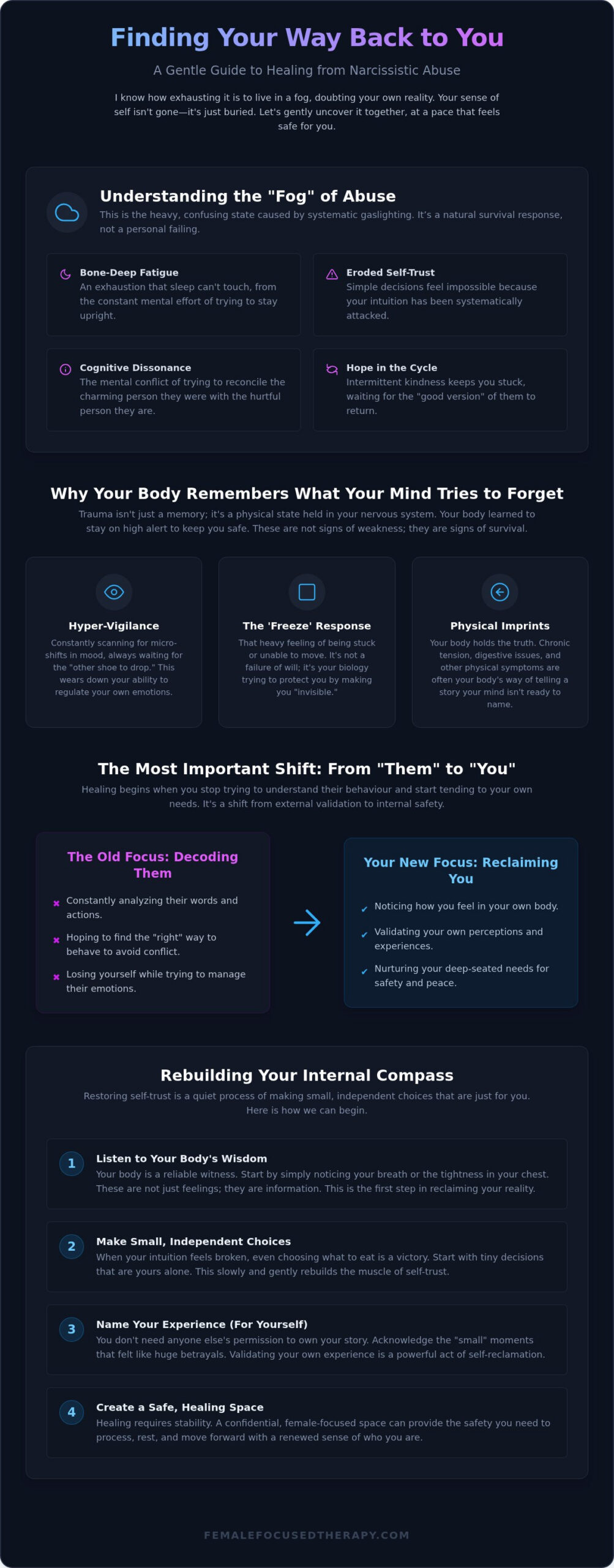
I want to start by acknowledging the profound, bone-deep fatigue you likely feel right now. It is an exhaustion that sleep doesn’t seem to touch. This is the weight of “the fog,” a state of being where your reality feels constantly under fire and your energy is spent simply trying to stay upright.
This fog is the direct result of cognitive dissonance and systematic gaslighting. It happens when you try to reconcile the person you thought they were with the person they actually are. At its core, What is narcissistic abuse? is a psychological erosion of your self-trust. It is the slow dismantling of your confidence until you no longer recognise your own reflection.
I often see high-functioning, intelligent women in my practice who wonder how they “let” this happen. Please know that it’s not your fault. Your empathy and capacity for love were used against you, but those qualities remain your strengths as you begin the journey of healing from narcissistic abuse.
Recognising the Signs of Relational Trauma
I see you struggling to make even the simplest decisions because your internal compass feels broken. When you’ve been told for so long that your perceptions are wrong, choosing what to wear or what to eat can feel paralysing. You aren’t being indecisive; you are recovering from a systematic attack on your intuition.
This trauma takes a physical toll, often manifesting as chronic tension in your neck or digestive issues that won’t go away. I want to validate those “small” moments that felt like huge betrayals; they were the warning lights your body was trying to show you. Your physical self often remembers the truth long before your mind is ready to name it.
Why It Is So Hard to Name Your Experience
The confusion usually starts with the “love-bombing” phase, where everything felt perfect and you were placed on a pedestal. The eventual devaluation is so jarring because it contradicts everything you first experienced. This creates a psychological split that makes it incredibly difficult to trust your own judgment or explain the situation to others.
I understand how the intermittent reinforcement, those rare moments of kindness, keeps you stuck in a loop of hope. You keep waiting for the “good” version of them to return, which is exactly how the cycle of healing from narcissistic abuse becomes so complicated. Breaking the silence begins with simply noticing how you feel in the present moment.
Start by paying attention to your breath and the tightness in your chest when you are around them. Your body is a reliable witness to your experience. Noticing these somatic cues is the first step toward reclaiming your reality and stepping out of the fog for good.
Why Your Body Remembers What Your Mind Tries to Forget
I believe that healing from narcissistic abuse requires us to look far beyond the stories we tell ourselves. Trauma isn’t just a memory stored in your mind; it is a physical state alive in your nervous system. When you’ve spent years managing someone else’s volatile emotions, your body learns to stay in a state of high alert to keep you safe.
You might frequently find yourself in a ‘freeze’ response, that heavy feeling of being stuck or unable to make a move even when you know you should. This isn’t a failure of your will. It is your biology trying to protect you by making you “invisible” to a perceived threat. True restoration happens when we stop fighting these responses and start listening to the messages your body is sending.
I use an integrative approach in my practice because talking alone often isn’t enough to make you feel truly safe again. We need to address the physiological imprint of the trauma. By acknowledging the physical weight of your experience, we can begin to release the tension that has been held in your muscles and breath for far too long.
The Nervous System Under Pressure
Living with a narcissist means living in a state of constant hyper-vigilance. You are always scanning for micro-shifts in their mood, waiting for the “other shoe to drop” before it even leaves the ground. This long-term stress wears down your ability to regulate your own emotions and makes it incredibly hard to focus on daily tasks or long-term goals.
I often find that women with ADHD experience this intensity even more acutely. If your brain already struggles with sensory processing or emotional regulation, the added chaos of a narcissistic dynamic can feel like a total system overload. Your nervous system is already finely tuned; the added layer of relational trauma can lead to a state of profound, persistent burnout.
Introducing Somatic Awareness into Healing
I don’t offer a “quick fix” because your system needs time to unlearn years of survival patterns. Instead, I provide a steady path toward calming your system. We use simple, accessible tools like conscious breath and gentle movement to signal to your brain that the immediate danger has passed and it’s okay to let go.
By incorporating somatic movement and yoga, we create a bridge between your mind and body. This isn’t about physical fitness; it is about reclaiming the space inside your own skin. It’s about teaching your brain that you are safe in the present moment, regardless of what happened in the past.
If you feel ready to move from a state of survival into one of internal stability, starting a conversation can be the first step toward feeling grounded in your own truth again.
Shifting the Lens: From Understanding Them to Reclaiming You
I know you have likely spent months, maybe even years, trying to figure out “why” they do what they do. You’ve probably read countless articles and watched videos on personality traits, searching for a logical explanation for the illogical. While this research can provide a brief sense of control, true healing from narcissistic abuse begins when you stop being a student of their behaviour and start being a student of your own needs.
In our sessions, I will never ask you to provide a formal diagnosis for them. My focus isn’t on the person who caused the harm, but on the restoration of the woman who survived it. I’m here to help you look inward with kindness, shifting the spotlight from their chaos back to your own potential for growth. You can learn more about who I work with and how I support women in this specific stage of recovery.
By moving the focus back to yourself, you begin to reclaim the energy you’ve been using to manage their moods. This shift isn’t about being selfish; it’s about survival and restoration. It is the moment you decide that your internal world is more important than their external drama.
Breaking the Trauma Bond
I often describe the trauma bond as a powerful addiction to the intense highs and lows of the relationship. It’s a chemical loop in the brain where the breadcrumbs of affection feel like a lifeline after periods of cruelty. This bond is what makes leaving feel so physically and emotionally painful, often mimicking the symptoms of drug withdrawal.
When we talk about ‘going no contact’ or ‘low contact’, it’s vital to remember this is about your peace, not their punishment. It isn’t a game or a tactic to get a reaction; it’s a boundary designed to give your nervous system the quiet it needs to recalibrate. I am here to hold space for you as you navigate the cravings to reach out and the deep grief that often follows.
Dealing with Toxic Shame and Guilt
Shame is a heavy, suffocating burden that simply doesn’t belong to you. I want to help you put it down. Many women carry the weight of what they “allowed” or didn’t see, but that shame is actually a projection of the abuser’s own internal state. It was never yours to carry, and it isn’t your responsibility to fix.
There is a profound difference between taking responsibility for your future and taking the blame for someone else’s choices. You are responsible for your healing from narcissistic abuse, but you aren’t to blame for the harm you endured. I believe in building a ‘warm but boundaried’ stance toward your past self, treating her with the same compassion you would offer a dear friend.
We work together to peel back these layers of guilt, allowing you to see that your survival strategies were just that: ways to survive. As you begin the process of restoration, you’ll find that the more you forgive your past self, the more space you create for the woman you are becoming today.
Practical Steps for Rebuilding Your Internal Compass
I want to offer you a few realistic ways to begin trusting yourself again today. Reclaiming your life after the chaos of a toxic relationship doesn’t happen in one giant leap. Instead, it happens through tiny, consistent acts of self-loyalty that slowly prove you are a reliable guide for your own life.
We start with “small wins.” Practice making minor decisions, like what to have for lunch or which route to take home, without seeking external validation or asking for anyone else’s opinion. Every time you make a choice and follow through, you are repairing the connection to your intuition that was systematically damaged during the relationship.
When your mind is spinning and the old “fog” starts to roll in, I encourage you to embrace radical rest. This is more than just sleep; it is a conscious decision to step away from the mental labour of trying to “fix” the past or predict the future. A safe space is one where your boundaries are respected without question.
Restoring Your Sense of Agency
Rebuilding your boundary muscles often starts with learning to say ‘no’ in very low-stakes situations. You might decline an extra task at work or say no to a social invitation you aren’t feeling up for. These small moments of assertion are training sessions for the bigger boundaries you’ll eventually set for your peace and protection.
I also encourage you to reconnect with hobbies or interests that were lost or perhaps even mocked during the relationship. Whether it’s a specific type of music, a craft, or a way of moving your body, these activities act as anchors to your true self. Self-compassion is a functional tool for recovery, not just a ‘nice to have’ concept, because it allows you to fail and try again without the crushing weight of self-criticism.
Mindfulness and Grounding for Daily Life
I use simple grounding techniques to help my clients manage moments of intense overwhelm and anxiety. One of my favourites is the “5-4-3-2-1” method, where you name five things you can see, four you can touch, three you can hear, two you can smell, and one you can taste. This pulls your awareness out of the trauma-loop in your mind and back into the safety of the present moment.
Creating a physical ‘soothing kit’ can also be incredibly helpful for those days when the fog feels particularly thick. This might include a specific essential oil, a soft piece of fabric, or a list of supportive affirmations you’ve written to yourself. For more practical tools you can use right now, I’ve gathered several free therapy resources to support your daily practice.
Healing from narcissistic abuse is a process of coming home to yourself one breath at a time. If you feel you need more personalised support to navigate these steps, I am here to help you find your footing. You can book a session with me to start building your own path toward restoration.
Creating a Safe Space for Your Restoration and Growth
I provide a confidential, trauma-informed space specifically designed for the unique needs of women. When you’ve spent years in an environment where your reality was denied, finding a place where you’re believed without question is the foundation of your recovery. I understand that safety isn’t just a physical requirement but an emotional necessity.
Whether we meet in person at my practice in Singapore or through online therapy sessions globally, my primary goal is your internal stability. I understand the logistical and emotional hurdles of seeking help, so I’ve created a flexible environment that fits into your life rather than adding more stress to it. You deserve a space that adapts to your needs.
To support your unique journey of healing from narcissistic abuse, I integrate evidence-based practices like CBT with mindfulness and somatic movement. This multidisciplinary approach ensures we aren’t just talking about the trauma, but actually helping your mind and body find a sense of peace again. It is about restoring your sense of self from the inside out.
How Individual Psychotherapy Can Help
I offer one-on-one sessions that prioritise your feeling of safety and being heard. In our work together, we create a boundary around our time where you can explore your experiences without fear of judgement or interruption. This focused attention is often the first step in reclaiming the voice you felt you had to quiet for so long.
My approach to relationship trauma and narcissistic abuse therapy is designed to peel back the layers of confusion at a pace that feels right for you. We don’t rush the process, as true restoration requires patience and a steady hand. I am here to help you make sense of the past while building a stronger foundation for your future.
For those who feel they need more concentrated support, I also offer focused intensive therapy options. These sessions allow for deeper work in a shorter timeframe, providing a significant boost to your sense of internal confidence and self-reliance. It is an opportunity to focus entirely on your restoration without the usual weekly gaps.
Your Next Step Toward Peace
I invite you to book a consultation when you feel ready to prioritise your healing from narcissistic abuse. Taking that first step can feel daunting, especially when your trust has been broken, but you don’t need to have all the answers or a perfectly clear plan before we start. I am here to help you find the words when they feel out of reach.
You might still feel the lingering effects of the “fog,” or perhaps you’re worried you won’t know what to say. That’s perfectly okay. My role is to hold that space for you and guide the conversation with empathy and professional insight. We move at your speed, ensuring you always feel grounded and supported.
When you are ready to begin this journey of restoration, you can book a session directly through my calendar. Healing is a steady process, and I am here to walk that path alongside you, helping you find your way back to the woman you were always meant to be.
Reclaiming Your Voice and Your Future
I know the path back to yourself feels long, but every small choice you make for your own peace is a victory. We’ve explored how the emotional fog lifts when you stop trying to understand their behaviour and start honouring your own needs. By listening to your body’s signals and rebuilding your internal compass, you’re not just surviving; you’re restoring the woman you were always meant to be.
As a Registered Integrative Psychotherapist and specialist in female-focused relationship trauma, I use an integrative mind-body approach to help you feel safe in your own skin again. The process of healing from narcissistic abuse is a steady journey of restoration, and you don’t have to navigate it alone. My goal is to provide the grounded, expert support you need to trust your own intuition once more.
When you feel ready to step out of the fog and into your own light, I am here to hold that space for you. You can book a consultation with me to start your journey of restoration whenever you’re ready. You are stronger than the fog, and your future is waiting for you.
Frequently Asked Questions
How do I know if I was actually experiencing narcissistic abuse?
You can identify this by looking for a pattern of psychological erosion rather than a single event. The Domestic Abuse Act 2021 legally defines this to include controlling or coercive behaviour, which often leaves you feeling like you are constantly walking on eggshells. If you find yourself doubting your own memory or feeling like your reality is being systematically denied, these are clear indicators of a harmful dynamic.
Is it possible to heal from narcissistic abuse without the other person admitting what they did?
You absolutely can heal without their validation or an apology. Waiting for an abuser to admit fault is often another way they keep you stuck in their orbit and dependent on their version of the truth. True restoration happens when you decide your reality is valid regardless of their denial. I focus on helping you find that internal certainty so their silence no longer has power over you.
How long does the healing process typically take?
There is no fixed timeline for healing from narcissistic abuse because every woman’s experience and nervous system are unique. Some days will feel like a leap forward, while others might feel like a quiet retreat into necessary rest. It is a steady process of unlearning survival habits and rebuilding self-trust. I encourage you to view it as a journey of coming home to yourself at your own pace.
Can online therapy be as effective as in-person sessions for trauma recovery?
Online therapy is incredibly effective for trauma recovery, as it allows you to engage from a space where you already feel safe. For many women I work with globally, removing the stress of travel helps them stay grounded during difficult conversations. It provides the same professional depth and confidentiality as my in-person sessions in Singapore while offering the flexibility and comfort your nervous system needs during restoration.
Why do I still feel a pull toward my former partner even though I know they were harmful?
This pull is usually a trauma bond, which functions much like a physical addiction in your brain. Your system has been conditioned to seek relief from the very person causing the pain during the “highs” of the relationship. It is a confusing cycle of intermittent reinforcement that makes leaving feel like physical withdrawal. I help you understand these chemical signals so you can treat yourself with more kindness.
What is the difference between narcissistic abuse and a ‘toxic’ relationship?
While toxic relationships involve general dysfunction, narcissistic abuse is a systematic dismantling of your identity and self-trust. It involves specific patterns like gaslighting and devaluation designed to make you dependent on the abuser’s reality. A toxic relationship might be mutually difficult or argumentative, but this type of abuse is a profound imbalance of power that leaves you feeling psychologically erased, confused, and physically exhausted.
How can I explain my experience to friends or family who don’t understand?
You don’t have to provide a clinical explanation or a diagnosis to make your experience valid to others. I suggest describing how you feel, such as the profound exhaustion or the “fog” that makes simple decisions feel impossible. If they haven’t lived it, they might not understand the mechanics of the abuse, but they can understand your need for support. Your peace is always more important than their full comprehension.
Will I ever be able to trust someone again after this experience?
Trusting others again is possible, but the foundation of that journey is learning to trust yourself first. When you rebuild your internal compass through healing from narcissistic abuse, you’ll feel more confident in your ability to spot red flags and set firm boundaries. We work on restoring that self-reliance so that your future relationships are built on a sense of safety and mutual respect rather than survival.

Article by
Cheryl Kennedy MacDonald MA BA (Hons) Pg. Dip. SAC BACP
Cheryl Kennedy MacDonald is a psychotherapist specialising in women’s mental health, relationships, and life transitions. She works with women navigating trauma, relationship breakdown, identity shifts, and midlife change, helping them rebuild self-trust, emotional stability, and a clear sense of who they are and what they want.
With over 20 years’ experience working with women internationally, Cheryl is the founder of YogaBellies, a global women’s yoga school, and the creator of the Birth ROCKS method. Her work sits at the intersection of psychotherapy and embodiment, integrating evidence-based therapeutic approaches with somatic, body-based practices that support deep, lasting change.
Known for her grounded and direct approach, Cheryl moves beyond surface-level insight to address the patterns held in the body and nervous system. Her work supports women to regulate, reconnect, and respond to their lives from a place of clarity, strength, and self-respect.
She is a published author in academic journals and has written multiple books on women’s health, pregnancy, and midlife wellbeing, available on Amazon and leading book retailers worldwide.