
You’re sitting in your living room, staring at a screen or a receipt, and suddenly the ground beneath you feels like it’s dissolved into nothing. That moment when you realise the person you trusted most has been leading a double life is more than just a heartbreak. It’s a physiological injury known as betrayal trauma, and it can leave you feeling gaslit and doubting your very own reality.
I know that feeling of being hyper-vigilant, your heart racing at every notification while you struggle with insomnia and a sense of deep unsafety. It’s incredibly painful when your primary source of comfort becomes your primary source of harm. I want you to know that your reaction is a completely normal response to an abnormal amount of stress.
I will help you understand the deep impact of this experience and offer a somatic, compassionate path toward rebuilding your self-trust. We’ll explore how to calm your nervous system and find a sense of hope that you can restore your internal stability. I’m here to guide you through a journey of mind-body restoration that honours your pace and your pain.
Key Takeaways
- Learn how to validate your experience as a physiological response to a broken bond rather than a personal failing.
- Discover how betrayal trauma impacts your nervous system and why your brain’s alarm system can stay stuck on high alert.
- Identify the patterns of gaslighting and blame-shifting that often accompany narcissistic abuse to help you regain your sense of reality.
- Explore practical somatic tools and gentle mind-body practices that I use to help you find stability and calm in your daily life.
- Understand the journey toward internal restoration and how an integrative approach supports your recovery through every life transition.
When Trust is Shattered: What Betrayal Trauma Really Feels Like
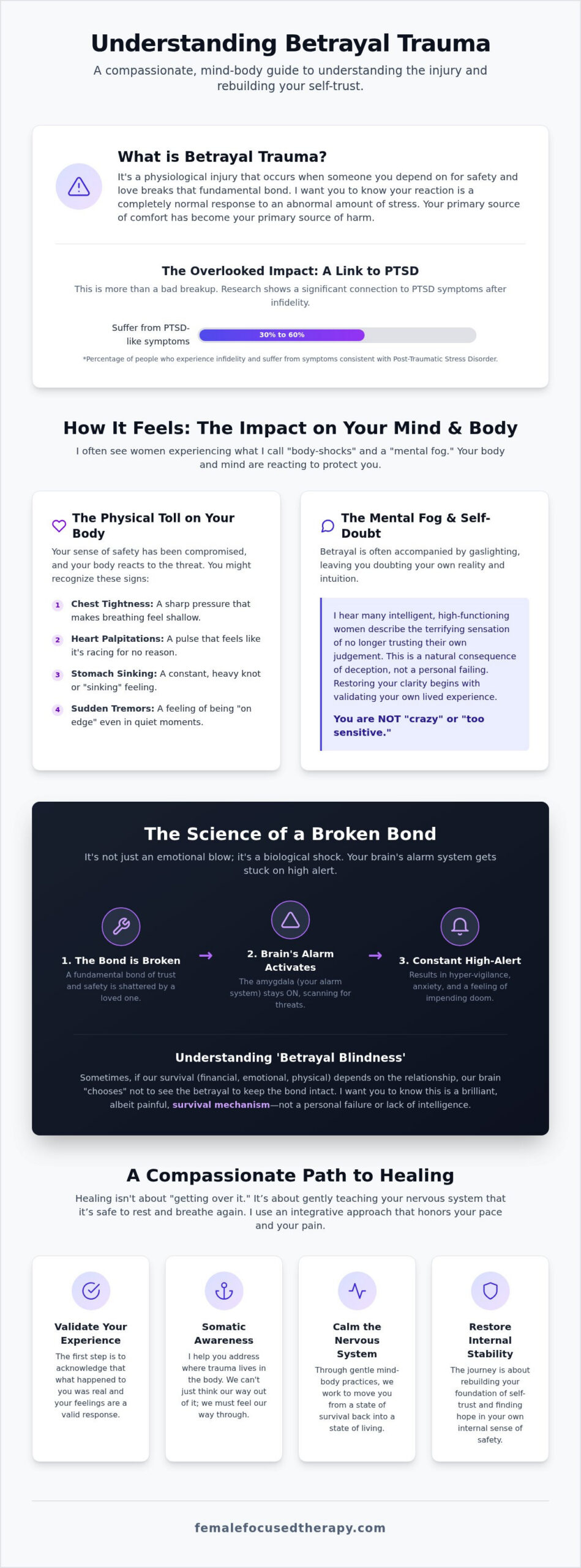
I want to start by acknowledging the heavy, suffocating weight you might be carrying right now. It’s a burden that feels almost impossible to describe to those who haven’t lived it. Betrayal trauma occurs when someone you depend on for safety and love breaks that fundamental bond. It’s a unique type of pain because the person you’d usually turn to for comfort is the very one who caused the hurt.
You aren’t “crazy” or “too sensitive” for feeling this way. Your entire world has been shaken, and your mind is simply trying to make sense of the unthinkable. Research from 2026 shows that between 30% and 60% of people who experience infidelity suffer from symptoms consistent with PTSD. This isn’t just a bad breakup; it’s a physiological injury to your sense of security.
The Physical Toll on Your Body
In my work with relationship trauma and narcissistic abuse, I often see women experiencing what I call “body-shocks.” These are physical manifestations of a safe haven that has been compromised. You might recognize these signs in your own body:
- A sharp tightness or pressure in your chest that makes breathing feel shallow.
- Heart palpitations or a pulse that feels like it’s racing for no reason.
- A constant, heavy knot or “sinking” feeling in your stomach.
- Sudden tremors or a feeling of being “on edge” even in quiet moments.
Your body has lost its sense of safety, and it’s reacting exactly as it should to protect you from further harm. When your primary source of safety becomes a source of threat, your brain’s alarm system stays switched on. Understanding that these physical reactions are protective is a vital first step toward finding stability again.
The Mental Fog and Self-Doubt
Betrayal often doesn’t travel alone; it usually comes with gaslighting. This can leave you in a thick “mental fog” where you doubt your own memories and intuition. I hear many intelligent, high-functioning women describe the terrifying sensation of no longer trusting their own judgement or reality because of the deception they’ve faced.
This self-doubt is a natural consequence of being told that what you see and feel isn’t real. Restoring your clarity is a gentle, unhurried process of returning to yourself. It begins with validating your own lived experience and acknowledging that what happened was real, even if your partner tried to convince you otherwise.
The Science of the Broken Bond and Your Nervous System
I find it helpful to understand that our brains are wired for attachment; we need trust to survive and thrive. From the moment we’re born, we seek out safe people to help us navigate the world. When a partner or loved one betrays that trust, it isn’t just an emotional blow. It’s a biological shock that disrupts your internal sense of safety.
When that trust is broken, your brain’s alarm system, the amygdala, stays on. It remains in a state of high alert even when the immediate threat seems to have passed. This is why you might feel betrayal trauma as a constant, buzzing anxiety or a sense of impending doom that you can’t quite shake.
I use an integrative approach to help you move from this exhausting state of survival back into a state of living. Healing isn’t about simply “getting over it” or forcing yourself to move on before you’re ready. It’s about gently teaching your nervous system that it’s safe to rest and breathe again.
Understanding Betrayal Blindness
Sometimes, we “choose” not to see the betrayal because our survival depends on the relationship. Betrayal trauma theory explains how this dependency can lead to a kind of psychological blindness. If you need someone for financial, emotional, or physical security, your brain might filter out red flags to keep the bond intact.
I want to simplify this: your brain is choosing the path of least resistance to keep you safe in the moment. It’s a brilliant, albeit painful, survival mechanism. There’s no shame in having missed the signs or ignored your gut feeling. It was a strategy for preservation, not a personal failure or a lack of intelligence.
The Role of Somatic Awareness
In my work, I blend traditional talk therapy with somatic movement to address where trauma lives in the body. I believe that we cannot simply think our way out of betrayal. We must feel our way through it. Our bodies often remember the shock long after our minds have tried to rationalise the events.
By noticing your breath, your heart rate, and where you hold tension, I help you start the process of internal restoration. We work together to release the physical grip of the past. If you feel ready to begin this gentle process, you can book a session with me to explore a path forward.
Recognizing the Patterns of Betrayal and Gaslighting
I often work with high-functioning, intelligent women who have navigated the confusing waters of narcissistic abuse. In these dynamics, betrayal isn’t usually a one-time mistake or a momentary lapse in judgement. Instead, it’s often a recurring pattern designed to keep you off-balance and doubting your own worth.
One of the most painful parts of this experience is how the other person shifts the blame onto you. You might find yourself constantly questioning if you were “too much” or perhaps “not enough.” I want to help you identify these patterns so you can stop carrying the heavy weight of someone else’s choices.
Understanding these dynamics is the first step in clearing the mental fog that betrayal leaves behind. When you see the tactics for what they are, you can begin reclaiming your reality. You can start to separate your partner’s actions from your own identity and value as a woman.
This process of “clearing the fog” isn’t about blaming. It’s about honesty and safety. When we work together in online therapy, we look at these patterns with compassion, giving you the space to see the truth without the pressure to “fix” everything immediately.
Identifying DARVO Tactics
DARVO is a term that stands for Deny, Attack, and Reverse Victim and Offender. It’s a common pattern in betrayal trauma. When you finally gather the courage to confront the betrayal, the other person denies the act, attacks your character, and then claims they are the one being harmed.
I see this loop so often in my practice. You start a conversation looking for honesty and somehow end up being the one apologizing for your “tone” or your “lack of trust.” Recognizing this pattern allows you to step out of the cycle and see the truth for what it is.
Once you see the DARVO pattern, it loses its power over you. You stop trying to defend yourself against false accusations and start focusing on your own internal restoration. You realize that their reaction is a reflection of their character, not a measure of your sanity.
Reclaiming Your Intuition
Betrayal has a way of silencing that quiet inner voice that tells you when something is wrong. That gut feeling you had was likely your body’s way of trying to protect you. But gaslighting makes you ignore those signals until you can’t hear them anymore.
I focus on helping you listen to your gut again, even if it feels quiet or uncertain right now. We use somatic awareness to reconnect with those physical signals in your body. Trusting yourself is the most important foundation we’ll rebuild together as you move toward healing.
Rebuilding Your Foundation: Somatic and Emotional Tools for Healing
I believe that healing happens in the small, quiet moments of self-care and somatic awareness. It isn’t about a sudden, massive overhaul or a magical erasure of the past. Instead, it’s about slowly and gently reclaiming your body and mind from the shock of betrayal trauma. We focus on progress, not perfection.
I want to offer you a few realistic steps you can take to start feeling more grounded today. These tools aren’t about “fixing” you, because you aren’t broken. They’re about creating a safe space within yourself where you can finally catch your breath. We’ll work at a pace that feels manageable for you, focusing on steady, lasting change.
Somatic Practices for Calm
In my work as a yoga master and psychotherapist, I see how trauma gets “stuck” in our muscles and our breath. I encourage you to try simple breathwork to help settle your system. A slow, intentional exhale can signal to your nervous system that the immediate danger is passing. It’s a way of telling your brain it can finally step down from high alert.
Gentle movement, such as a slow walk or somatic movement, helps release that deep-seated tension. I often suggest a simple grounding exercise to bring you back to the present moment. Try noticing:
- Five things you can see right now, like the light on the wall or a plant.
- Four things you can touch, such as the fabric of your sleeve.
- Three things you can hear in the distance.
- Two things you can smell.
- One thing you can taste.
Setting Boundaries for Safety
Healing requires what I call a “safe container.” This often means setting firm boundaries with the person who hurt you to prevent further impact from betrayal trauma. I will help you explore what boundaries look like for you. This might involve physical distance, limited contact, or specific emotional limits that protect your peace.
Setting a boundary is an act of kindness to yourself. It isn’t about being “mean” or “punishing” the other person; it’s about protecting your energy so you can focus on your own restoration. If you need support in defining these limits and finding your voice again, you can book an individual psychotherapy session with me.
We focus on your unique life transitions and challenges throughout this process. Whether you’re navigating midlife or managing the sensory overwhelm of ADHD, these somatic tools provide a foundation of internal stability. You deserve a space where you can feel heard, held, and eventually, whole again.
Moving Forward: How I Support Your Journey to Restoration
I offer a compassionate, warm space for you to process your experience without judgement. When you’ve been through the shock of betrayal trauma, you need more than just a listener. You need a guide who understands the intricate way your mind and body have reacted to this crisis.
My approach is truly integrative. I look at the whole you, including your mind, your body, and your unique life transitions. Whether you are navigating the complexities of midlife, menopause, or the unique sensory challenges of ADHD, I tailor our work to your specific needs.
Whether we meet in my Singapore practice or through online therapy, my goal is to help you feel seen and supported. I want you to leave our sessions feeling more stable, more clear, and more like yourself again. Restoration isn’t about going back to who you were, but moving forward into a stronger version of yourself.
Individual Psychotherapy for Women
I specialize in working with women navigating relationship trauma and the lasting impact of narcissistic abuse. I provide a boundaried but deeply personal environment where you can safely explore difficult emotions. It’s a place where you don’t have to “hold it all together” for anyone else.
In our individual psychotherapy sessions, we focus on rebuilding your internal confidence. You can learn more about who I work with to see if my approach feels like the right fit for your current journey. I am here to help you navigate the path from overwhelm to internal stability.
Your Next Step Toward Healing
I know that reaching out can feel daunting. When your trust has been shattered, the idea of opening up to someone new can feel like a mountain to climb. But you don’t have to navigate this thick fog alone. I’m here to hold space for you while you find your footing again.
I invite you to take one small, realistic step today. Perhaps it is just sitting quietly with your breath for a moment, or acknowledging that you deserve to feel safe. This tiny act of self-care is a powerful way to start reclaiming your own life and your own peace of mind.
If you feel ready to talk, I’m ready to listen. You can book a consultation with me to begin your journey. Together, we can work toward a future where you feel grounded, clear, and fully restored.
Finding Your Way Back to Yourself
Healing from betrayal trauma isn’t a quick fix; it’s a gentle journey of returning to your own internal stability. We’ve explored how your nervous system reacts to a broken bond and why somatic tools are so vital for reclaiming your sense of safety. I want you to remember that your reaction is normal and that you don’t have to carry the weight of gaslighting or self-doubt any longer.
As a registered integrative psychotherapist and a specialist in relationship trauma and narcissistic abuse, I provide a warm, non-judgmental environment where you can safely process your experience. My goal is to help you feel seen and supported as you rebuild your self-trust. You deserve a space where your mind and body can finally rest.
If you are ready to begin your journey toward restoration, I invite you to book a consultation with me here. You’ve already taken a brave first step by being here today. Trust that you have the strength to find your clarity again, and I’ll be here to walk beside you whenever you’re ready.
Frequently Asked Questions
What is the difference between betrayal trauma and a normal breakup?
Betrayal trauma is different from a standard breakup because it involves a profound violation of trust by someone you depend on for safety. In a normal breakup, you might feel sad or rejected, but your sense of reality remains intact. With betrayal, you often experience symptoms similar to PTSD, such as hyper-vigilance and flashbacks, because the person you turned to for comfort became the source of your harm. It is a physiological injury, not just emotional sadness.
Can I really heal from betrayal trauma if I’m still in the relationship?
Yes, you can begin the healing process while remaining in the relationship, but it requires a safe environment and clear boundaries. Healing focuses on your internal restoration and nervous system regulation rather than just the state of the partnership. I help women find their grounding and clarity regardless of their relationship status. However, if the betrayal continues or gaslighting remains present, it becomes much harder for your body to feel truly safe enough to rest and recover.
Why do I feel so exhausted all the time after experiencing betrayal?
You feel exhausted because your nervous system is stuck in a state of high alert, which drains your energy reserves. When you experience betrayal trauma, your amygdala stays on, constantly scanning for threats and keeping you in a fight-or-flight mode. This chronic stress leads to physical fatigue, brain fog, and sleep disturbances. Your body is working overtime to protect you from further harm, leaving you with very little energy for daily life or self-care.
How long does it typically take to recover from betrayal trauma?
There is no set timeline for recovery, as every woman’s journey is unique and depends on various factors. Some people begin to feel more grounded within months of starting somatic work, while for others, the process of rebuilding self-trust takes longer. I focus on steady, manageable progress rather than a quick fix. Healing from betrayal trauma often happens in waves, and my role is to support you through the ebbs and flows at a pace that feels safe.
Is it possible to trust my own intuition again after being gaslit?
It is absolutely possible to reclaim your intuition, though it takes patience and gentle practice. Gaslighting is designed to make you doubt your own reality, which silences your inner voice. In our sessions, we use somatic awareness to reconnect with the physical signals your body sends you. By learning to listen to your gut feelings again and validating your lived experience, you slowly rebuild the foundation of self-reliance that was shaken by the betrayal and deception.
What should I look for in a therapist who specializes in betrayal trauma?
You should look for a therapist who is trauma-informed and understands the specific dynamics of narcissistic abuse and attachment. It’s helpful to find someone who uses an integrative approach, combining traditional talk therapy with somatic or body-based techniques. You need a space that feels warm and non-judgmental, where you feel truly seen. I offer individual psychotherapy sessions that focus on these exact areas, ensuring you have a safe, confidential container to process your pain.
How do I know if I’m experiencing somatic symptoms of trauma?
Somatic symptoms often manifest as physical sensations that don’t have a clear medical cause but correlate with your emotional state. You might notice a tight knot in your stomach, shallow breathing, or a racing heart when you think about the betrayal. Other signs include chronic muscle tension, headaches, or a feeling of being numb in your body. These are your nervous system’s ways of storing the shock of the trauma when words aren’t enough to process it.
Can online therapy be as effective as in-person sessions for trauma recovery?
Online therapy is highly effective for trauma recovery and offers the added benefit of allowing you to stay in your own safe environment. I work with women globally, and I find that being in a familiar, comfortable space can actually help the nervous system settle more quickly during somatic work. We can still build a deep, personal connection and use the same integrative tools to help you move from survival mode back into a state of living.

Article by
Cheryl Kennedy MacDonald MA BA (Hons) Pg. Dip. SAC BACP
Cheryl Kennedy MacDonald is a psychotherapist specialising in women’s mental health, relationships, and life transitions. She works with women navigating trauma, relationship breakdown, identity shifts, and midlife change, helping them rebuild self-trust, emotional stability, and a clear sense of who they are and what they want.
With over 20 years’ experience working with women internationally, Cheryl is the founder of YogaBellies, a global women’s yoga school, and the creator of the Birth ROCKS method. Her work sits at the intersection of psychotherapy and embodiment, integrating evidence-based therapeutic approaches with somatic, body-based practices that support deep, lasting change.
Known for her grounded and direct approach, Cheryl moves beyond surface-level insight to address the patterns held in the body and nervous system. Her work supports women to regulate, reconnect, and respond to their lives from a place of clarity, strength, and self-respect.
She is a published author in academic journals and has written multiple books on women’s health, pregnancy, and midlife wellbeing, available on Amazon and leading book retailers worldwide.