
What if the sensitivity you’ve spent years trying to hide is actually the key to your internal restoration? I know how exhausting it is to feel everything so deeply, especially when you’re also navigating the invisible weight of ADHD masking or the lingering echoes of past narcissistic abuse. You aren’t “too much,” and you aren’t broken.
I’ve seen so many intelligent, self-aware women struggle with the physical tension that comes from constant emotional hyper-vigilance. My goal is to help you understand that finding balance isn’t about silencing your heart or becoming “less.” It’s about creating a sense of safety in your own skin and trusting your own pace.
In this article, I’ll share how gentle, somatic-informed practices can help you navigate overwhelming moments and rebuild your internal stability. You’ll learn how to soften the edges of intense reactions and start trusting your own intuition again, one breath at a time.
Key Takeaways
- I’ll help you understand why you feel “too much” and how to view your sensitivity as a natural signal rather than a burden.
- You’ll learn how to engage your vagus nerve for immediate relief when your body reacts to stress before your mind can catch up.
- Discover how to quiet your inner critic by reframing those harsh thoughts as protective parts of yourself that are simply trying to keep you safe.
- I’ll share gentle emotional regulation techniques for women that fit into your busiest days through simple, restorative micro-moments.
- We’ll explore how deeper healing happens within a safe therapeutic container, especially if your feelings are tied to past relationship trauma.
Understanding why your emotions feel so intense right now
I’ve sat with so many women who feel like they’re constantly on the edge of an emotional cliff. You might feel like you’re “too much” or that your sensitivity is a burden to those around you. I want to tell you right now that your depth is a strength, even if it feels overwhelming today.
When we talk about Emotional self-regulation, we aren’t talking about self-control in a rigid, policing sense. It’s really about building your capacity to sit with a feeling without it swallowing you whole. It’s the difference between being in the middle of a storm and watching that storm from a safe, dry window.
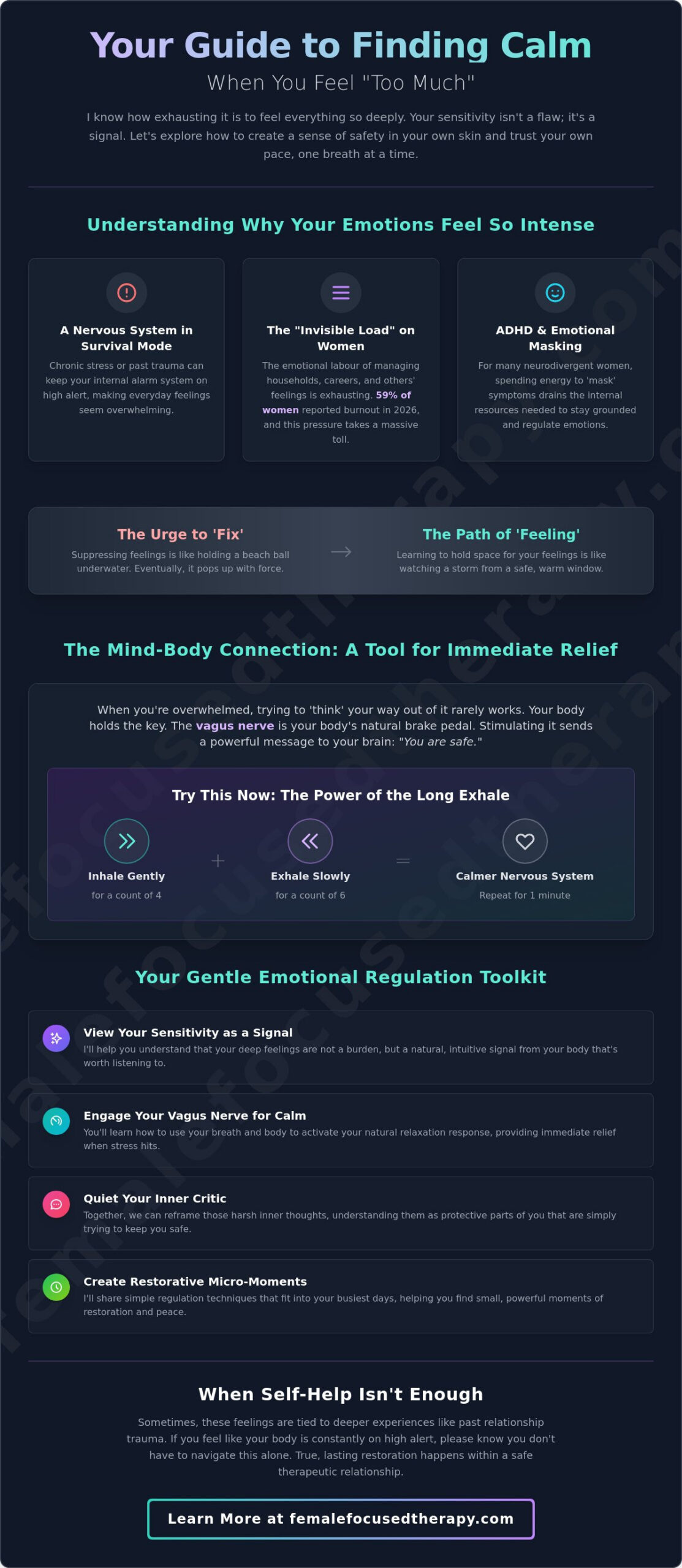
Many of us are living with nervous systems stuck in “survival mode.” This happens when chronic stress or past trauma keeps your body in a state of high alert. If you’re navigating the aftermath of relationship trauma, your internal alarm system is likely tuned to a very high frequency. This makes gentle emotional regulation techniques for women feel like a necessity rather than a luxury.
Why women experience emotional intensity differently
Women face a specific set of pressures that can make emotions feel more volatile. We carry the “invisible load” of running households and managing the feelings of everyone else around us. This emotional labour is exhausting. With 59% of women reporting burnout in 2026, the pressure to “do it all” is taking a massive toll on our collective well-being.
When you add the hormonal shifts of menopause or midlife transitions, the baseline for our stress levels naturally rises. I also see this intensity frequently in my ADHD-focused therapy. For neurodivergent women, emotional dysregulation is often the most taxing part of the day. We spend so much energy masking our symptoms that we eventually run out of the internal resources needed to stay grounded.
Moving from ‘fixing’ to ‘feeling’
Most of us were taught that big emotions are problems to be solved or hidden away. But I’ve learned that suppressing your feelings is like trying to hold a beach ball underwater. Eventually, it’s going to pop up with a lot of force. Learning effective emotional regulation techniques for women starts with giving yourself permission to just feel.
In my practice, I encourage moving away from the urge to “fix” yourself. Instead, we work on holding space for whatever arises, just as I do for my clients in online therapy. This shift is vital because the body often holds onto these emotions before the mind even has a name for them. By acknowledging the physical sensation first, we start the journey toward true internal restoration.
The mind-body connection: Somatic tools for immediate relief
Have you ever noticed your heart racing or your stomach tightening before you even realise you’re upset? That’s because your body is often the first to register a threat. As an integrative psychotherapist and yoga master, I’ve seen how powerful it is to stop trying to “think” our way out of a panic. Sometimes, the most effective emotional regulation techniques for women start below the neck.
Take a moment right now. Where are you holding tension? Perhaps your jaw is clenched, or your shoulders are creeping up toward your ears. Just noticing this is the first step toward restoration. If you feel like your body is constantly on high alert, you might want to reach out for a chat about how we can work together.
The power of the ‘long exhale’
One of the fastest strategies for getting a handle on emotions is simply changing the way you breathe. When you make your exhale longer than your inhale, you’re physically forcing your heart rate to slow down. It’s a biological hack that tells your brain the crisis is over.
Try inhaling for a count of four and exhaling for a count of six. Do this for just one minute. You don’t need a yoga mat or a quiet room; you can do this while making tea or sitting in a meeting. It’s a tiny act of self-care that builds internal safety by calming your nervous system instantly.
Grounding your senses in the present
If your mind is spiralling, grounding helps pull you back into the “now.” A quick way to do this is the 5-4-3-2-1 technique. Name five things you can see, four you can touch, three you can hear, two you can smell, and one you can taste. This simple sensory check-in interrupts the overwhelm by focusing on the physical world.
I also find that somatic movement is incredibly helpful for releasing trauma that we’ve tucked away in our bodies. Simply feeling your feet firm on the floor can be a profound grounding experience. It reminds your brain that you are here, you are safe, and you are supported by the earth beneath you.
Cognitive shifts to quiet your inner critic
I know that voice well. It’s the one that whispers you aren’t doing enough or that you’re failing at everything. We often call it the Inner Critic. While it feels like an enemy, it’s usually a part of you that’s trying to protect you from pain or rejection based on past experiences. It’s a protective mechanism that has simply outlived its original purpose.
In my work with integrative therapy, I help women bridge the gap between their logical minds and their feeling hearts. It’s about understanding that while your thoughts are loud, they aren’t always true. You are the observer of your thoughts, not the thoughts themselves. This distinction is vital for internal restoration.
Using specific emotional regulation strategies helps you create distance between a feeling and your reaction to it. This space is where your power lives. When you stop being the emotion and start observing it, the intensity begins to fade. It allows you to respond with intention rather than reacting from a place of fear or habit.
Rewriting the ‘I am’ narrative
Try a simple shift in your language. Instead of saying “I am angry,” try saying “I am noticing anger in me right now.” Adding “right now” reminds your brain that this state is temporary. It’s a small tweak, but it moves you from judgment to curiosity. When we stop judging our feelings, they lose their power to overwhelm us. It changes the experience from an identity to a passing weather pattern.
You can also use simple curiosity prompts to break the cycle of self-criticism. Ask yourself, “What is this feeling trying to tell me?” or “Where did I learn that I had to be perfect to be safe?” These questions invite your wise, adult self to take the lead. These emotional regulation techniques for women are about reclaiming your narrative from the voices of the past.
Developing radical self-compassion
Being strict with yourself doesn’t lead to healing; it just leads to more tension. I’ve found that a “gentle authority” is much more effective. This means being kind but firm about your needs and boundaries. It’s the voice of a supportive mentor rather than a harsh critic. You wouldn’t speak to a dear friend the way you speak to yourself in your darkest moments.
Acknowledge that healing is a slow, steady journey. You don’t have to get it right every time. Some days will feel easier than others, and that’s perfectly okay. By practising radical self-compassion, you create the internal safety needed for real change to take root. You are learning to trust your own intuition again, and that takes patience.
Creating your daily regulation toolkit for high-pressure days
Most of us wait until we’re already boiling over before we try to cool down. But the real magic happens in the micro-moments. Practising emotional regulation techniques for women works best when it’s woven into the fabric of a normal Tuesday afternoon. It’s about building a reservoir of calm before you actually need it.
If you’re living with ADHD overwhelm, your nervous system is working overtime just to keep up. Masking your symptoms all day takes a massive toll on your internal stability. You might find that you’re “holding it together” for everyone else, only to feel completely depleted later.
Consistency matters so much more than intensity. Five minutes of grounding every day is far more restorative for your brain than an hour-long yoga class once a month. Think of this as your personal toolkit; it isn’t another chore on your to-do list, but a way to protect your energy.
These small signals tell your brain that it’s safe to downregulate. When these tools become second nature, you’ll find you have more capacity to handle the unexpected triggers life throws your way. You start to move from a place of reaction to a place of grounded intention.
The 5-minute morning check-in
Before you reach for your phone or check emails, I invite you to check in with your body. Scan for any tightness in your jaw, chest, or belly. Just noticing these sensations starts the process of restoration. It allows you to acknowledge your state before the world demands your attention.
Setting a “tonal intention” can change the entire trajectory of your morning. I often tell myself, “I will be patient with my pace today.” It’s a gentle authority that allows me to move through the world with more grace. This simple shift helps quiet the inner critic before the day begins.
Follow this with one simple movement to wake up the spine. A gentle twist or a seated stretch helps shift any stagnant energy from sleep. It prepares your nervous system for the day ahead in a kind, unhurried way, connecting your mind and body before you start “doing.”
Managing the ‘evening crash’
Have you ever noticed that you feel most dysregulated the moment you stop working? When the adrenaline of the day finally drops, everything you’ve been pushing aside comes rushing in. This “evening crash” is a sign that your system needs a soft place to land after hours of high-functioning.
I’m a big believer in the “rest as resistance” philosophy; giving yourself permission to do absolutely nothing is a radical act of self-care. In a world that demands constant productivity, choosing rest is how we rebuild our self-reliance. It is an essential part of your healing journey, and if you’re looking for inspiration on this path, you can check out Woman Star World to explore a creative platform designed for women.
Create a gentle ritual to transition from “doing” to “being.” This might be changing into soft clothes or simply sitting in silence for five minutes without a screen. These are practical emotional regulation techniques for women that signal to your brain that the workday is officially over.
If you find that your evenings are consistently heavy with anxiety or old triggers, you can book a psychotherapy session. We can explore these patterns in a safe, boundaried space together, helping you find a steadier sense of internal safety.
When self-help isn’t enough: Moving toward deeper healing
Sometimes, even the most gentle tools feel like they aren’t quite reaching the root of the problem. If you’ve spent years in survival mode, your nervous system might need more than just a few exercises to feel safe again. It’s okay to acknowledge that you need more support than a blog post can provide.
I often find that deep-seated emotional patterns are rooted in relationship trauma. When you’ve experienced narcissistic abuse, your internal sense of stability is often shattered. You might feel like you can’t trust your own reactions or that you’re constantly waiting for the next crisis to hit.
Seeking support isn’t a sign that you’ve failed at fixing yourself. It is actually a profound act of self-awareness. In a therapeutic relationship, I provide a safe container for your biggest, most overwhelming feelings. It’s a space where you don’t have to mask, allowing us to work together on your restoration.
Rebuilding self-trust after trauma
Trauma has a way of disconnecting us from our own intuition. You might find yourself second-guessing every choice or feeling completely detached from your emotions. My role as a therapist is to help you befriend your nervous system again. We work on identifying physical triggers before they turn into full-blown emotional storms.
Taking the first step toward restoration
I want you to know that things can feel different. You don’t have to carry this invisible load alone forever. If you aren’t ready for a full session yet, I invite you to explore my free resources to start your journey at a pace that feels comfortable for you.
When you’re ready to explore these patterns more deeply, you can book a psychotherapy session. For now, let’s take one realistic next step. Put down your phone, soften your shoulders, and take one slow, deep breath. You are doing enough, and you are safe in this moment.
Embracing your journey toward internal restoration
Healing isn’t about becoming a different person; it’s about coming home to yourself. We’ve explored how understanding your nervous system and using somatic tools can help you navigate the storm of big feelings. By shifting your narrative and building a daily toolkit, you are already laying the foundation for lasting self-trust. These small, intentional acts of kindness toward yourself are where the real transformation begins.
I know that applying emotional regulation techniques for women can feel like a lot to manage on your own, especially when you’re balancing the complexities of ADHD or recovering from the impact of narcissistic abuse. As a Registered Integrative Psychotherapist and Yoga Master with a somatic focus, I’m here to help you bridge the gap between your mind and body. You don’t have to figure this out in isolation.
If you’re ready to move beyond self-help and want a safe, compassionate space to process your experiences, I invite you to take that next step. You deserve to feel grounded and secure in your own life. Book a private consultation with me to begin your healing journey. Rest well tonight, knowing that you have already begun the work of restoration.
Frequently Asked Questions
What is the fastest way to regulate my emotions when I’m panicking?
The fastest way to calm your system is to lengthen your exhale. When you make your breath out longer than your breath in, you send an immediate signal of safety to your brain via the vagus nerve. This isn’t just a “calming thought”; it’s a biological shift that can lower your heart rate in less than a minute. I often suggest inhaling for four counts and exhaling for six to find immediate relief.
Is emotional dysregulation the same thing as having ADHD?
Emotional dysregulation is a core experience for many women with ADHD, but they aren’t identical. While ADHD involves challenges with focus and executive function, the intense feelings often come from a nervous system that struggles to filter emotional input. In my ADHD-focused therapy, we look at how your brain processes these signals so you can stop feeling like you’re at the mercy of every passing mood.
Can I learn emotional regulation if I’ve had trauma in my past?
You can absolutely learn to find your calm, even if you carry the weight of past trauma. Your brain has a wonderful capacity for change throughout your entire life. While past experiences might have tuned your internal alarm system to be very sensitive, somatic-based emotional regulation techniques for women help you slowly rebuild a sense of safety. We work on befriending your nervous system rather than fighting against it.
Why do I feel so much more emotional during my period or menopause?
Hormonal transitions like menopause or your monthly cycle directly impact how your nervous system handles daily stress. Oestrogen and progesterone influence the chemicals in your brain that keep you feeling grounded and stable. When these levels fluctuate, your “window of tolerance” for stress can shrink. This makes you feel much more reactive to things that you would usually handle with ease during other times of the month.
How long does it take to see progress with these techniques?
You’ll often feel a shift in your physical tension immediately after using a somatic tool like grounding or mindful breathing. However, changing long-standing emotional patterns usually takes more time and consistent, gentle practice. Most women I work with start to notice a more stable sense of self-trust and internal safety after a few months of regular practice. Consistency is always more important than how much time you spend each day.
Is it possible to be ‘too old’ to change how I react to stress?
It is never too late to change your internal landscape and how you respond to the world. Our brains remain “plastic” and capable of forming new, healthier pathways well into our 60s and beyond. I’ve worked with many women in midlife who have successfully shifted away from lifelong habits of hyper-vigilance toward a much more grounded and peaceful way of living. Your capacity for restoration doesn’t have an expiry date.
What should I do if my partner says I’m being ‘too emotional’?
If a partner labels you as “too emotional,” it’s often a sign that your feelings are being dismissed rather than heard. Your emotions are valid data about your internal experience and your needs. While we can all work on how we communicate during a conflict, the goal isn’t to stop having feelings. It’s about learning to hold space for your emotions so you can express them from a place of grounded authority.
How do I know if I need therapy or if I can handle this on my own?
If you find that self-help tools aren’t sticking or that your emotional reactions feel out of your control, it might be time for professional support. Therapy is particularly helpful when your emotional state starts to interfere with your relationships, your work, or your ability to simply enjoy your life. It provides a safe, boundaried space to explore the root of those big feelings with someone who understands the journey.

Article by
Cheryl Kennedy MacDonald MA BA (Hons) Pg. Dip. SAC BACP
Cheryl Kennedy MacDonald is a psychotherapist specialising in women’s mental health, relationships, and life transitions. She works with women navigating trauma, relationship breakdown, identity shifts, and midlife change, helping them rebuild self-trust, emotional stability, and a clear sense of who they are and what they want.
With over 20 years’ experience working with women internationally, Cheryl is the founder of YogaBellies, a global women’s yoga school, and the creator of the Birth ROCKS method. Her work sits at the intersection of psychotherapy and embodiment, integrating evidence-based therapeutic approaches with somatic, body-based practices that support deep, lasting change.
Known for her grounded and direct approach, Cheryl moves beyond surface-level insight to address the patterns held in the body and nervous system. Her work supports women to regulate, reconnect, and respond to their lives from a place of clarity, strength, and self-respect.
She is a published author in academic journals and has written multiple books on women’s health, pregnancy, and midlife wellbeing, available on Amazon and leading book retailers worldwide.