
Have you ever felt like a “floating head,” completely disconnected from your neck down? It’s a lonely sensation, living in a body that feels like a stranger or worrying that a single physical feeling might trigger a flood you can’t stop. I want to help you understand why your system has pulled away and share gentle ways for how to reconnect with the body after trauma.
Rebuilding internal safety isn’t about “fixing” a problem, but about inviting yourself back into a space that has been protecting you by staying quiet. I’ve spent years helping women navigate this journey, and I know that restoring self-trust happens best when we move at a pace that feels truly manageable for your nervous system. Together, we’ll explore why your system pulls away and how you can find a quiet, grounded space within yourself once again.
Key Takeaways
- Reframe numbness and dissociation as protective survival tools rather than something you need to fix or feel ashamed of.
- Discover gentle, somatic ways for how to reconnect with the body after trauma that focus on safety rather than pushing through the pain.
- Learn the art of titration, which helps you experience tiny, manageable sips of physical sensation at a pace that feels right for you.
- Explore how simple micro-movements and the use of weight can help you find a sense of calm and grounding in your everyday life.
- Understand why an integrative approach is often the key to moving beyond traditional talk therapy to restore your internal sense of agency.
Why your body feels like a stranger after trauma
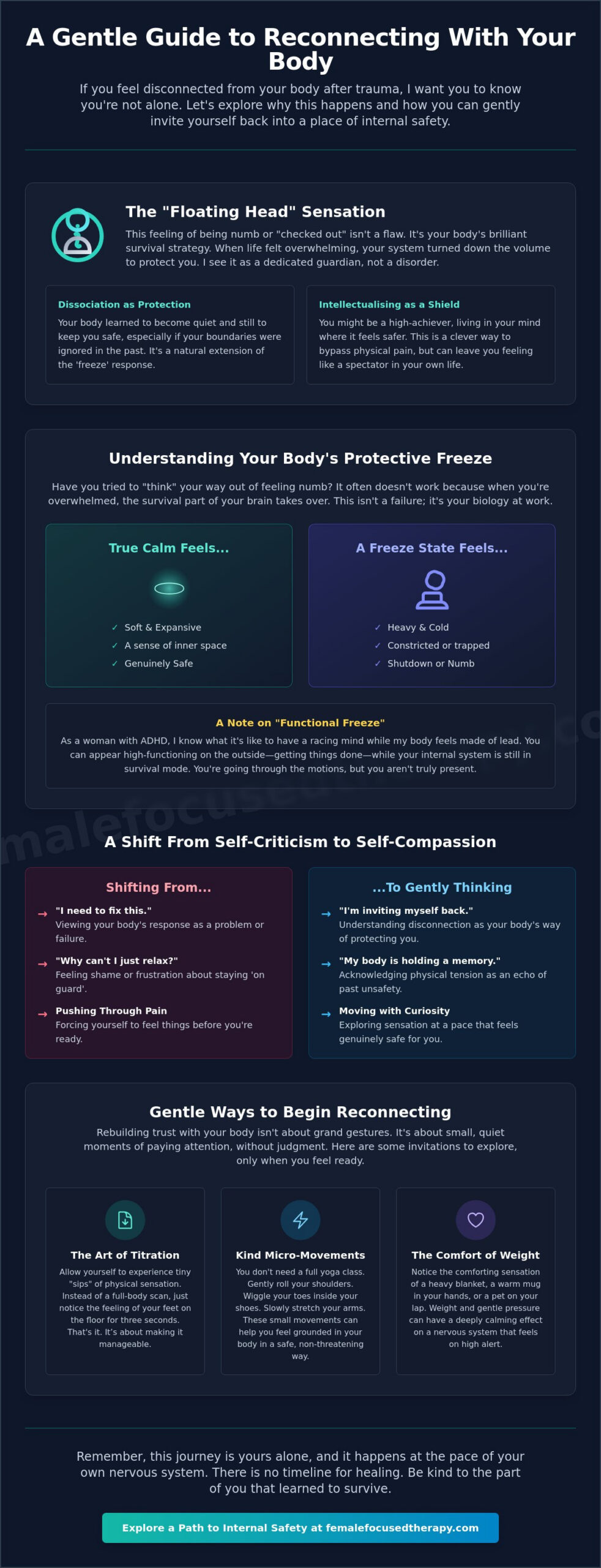
I want to start by telling you something you might not hear often: that feeling of being numb or “checked out” is actually a brilliant piece of biological engineering. When life becomes too overwhelming, your system knows how to turn down the volume to protect you. It’s not that you’re broken; it’s that your body is a dedicated guardian.
We often call this dissociation. In clinical spaces, it’s sometimes framed as a disorder, but I prefer to see it as your body’s way of keeping you safe when the world felt unsafe. It’s a natural extension of the freeze response, where your nervous system decides that the best way to survive is to stay very, very still and quiet.
This is particularly common if you’ve experienced relationship trauma or narcissistic abuse. In those environments, your physical needs and boundaries were likely ignored or punished. To survive, you might have learned to make your body “quiet” or invisible, retreating into your mind where it felt more secure. You live in your head because the physical echoes of the past feel too heavy to carry.
The “floating head” experience
Many of the intelligent, high-functioning women I work with describe themselves as a “floating head.” You might be incredibly successful, making sharp decisions and running a household, all while feeling completely disconnected from the neck down. It’s a clever trick the mind plays to bypass physical pain. This intellectualising is a survival skill, but it often makes you feel like you’re watching your life from a distance, like a movie you’re not quite starring in.
When the body becomes a trauma reminder
For some, the body doesn’t just feel quiet; it feels like a threat. When you start learning how to reconnect with the body after trauma, you might notice that a slightly faster heartbeat or a shallow breath feels like a warning of impending danger. I call this somatic hyper-vigilance, and it’s a natural response to past danger where your brain misinterprets normal physical sensations as echoes of old trauma.
Because these feelings are so intense, it’s normal to get stuck in a cycle of avoiding physical sensations to prevent an emotional flood. You might find yourself constantly busy or distracted, simply because being still feels like opening a door you aren’t ready to walk through yet. Understanding this is the first step toward finding a sense of internal calm again.
Understanding the freeze response and why you cannot “think” your way out
Have you ever tried to “positive think” your way out of a panic attack or a period of deep numbness? It usually doesn’t work, and there’s a very good reason for that. When your nervous system is overwhelmed, the thinking part of your brain essentially goes offline. Your Vagus nerve, a long and winding nerve that connects your brain to almost every major organ, takes the lead. If it senses you’re in a situation you can’t escape, it triggers a freeze state. It’s like your body’s internal circuit breaker tripping to prevent a fire.
As a woman living with ADHD, I’ve found that this state can be particularly confusing. My mind might be racing with a thousand thoughts, yet my body feels like it’s made of lead. This is often a “functional freeze.” You might look like you’re coping, or even thriving, because you’re busy and high-functioning, but you aren’t actually present. You’re simply going through the motions while your system stays in survival mode. Understanding common physical and emotional responses to trauma helps us see that this isn’t a character flaw; it’s biology.
There is also a vital distinction between being truly calm and being shut down. True calm feels like a soft, expansive safety. Shutting down, or the freeze response, feels heavy, cold, and restrictive. If you’re struggling to tell the difference, you aren’t alone. Learning how to reconnect with the body after trauma involves gently teaching your system that it’s okay to come out of that defensive crouch.
Why “just relaxing” feels impossible
If you’ve ever felt frustrated because you can’t “just relax” during a massage or a quiet evening, please be kind to yourself. Your muscles might stay “on guard” because your nervous system is still holding onto threats from the past. It’s a physical memory that stays long after the danger has gone. It is deeply exhausting to logically know you’re safe while your body continues to scream otherwise. If you’re ready to start unpicking these physical knots, we can work through them in individual psychotherapy sessions at your own pace.
Moving from shame to curiosity
The path toward healing begins when we stop judging our bodies for how they protected us. Instead of feeling shame about freezing, we can move toward curiosity. When you feel that heaviness or disconnection, try saying to yourself: “My body is doing its best to protect me right now.” This shift is a cornerstone of relationship trauma and narcissistic abuse recovery. By acknowledging the body’s intent, you start to rebuild the trust that was once broken, slowly finding your way back to a sense of internal agency.
Shifting from hyper-vigilance to a sense of internal safety
When we explore how to reconnect with the body after trauma, the most important rule is to move slowly. I often use a concept called “titration.” In a lab, titration involves adding a substance one tiny drop at a time to prevent a violent reaction. In your healing journey, it means taking tiny, manageable sips of physical sensation rather than trying to gulp down the whole experience at once.
I often see women try to “push through” their disconnection by committing to intense, forced exercise. While movement is wonderful, forcing your body into high-intensity environments when you feel fragile can actually reinforce a sense of unsafety. If your heart starts racing during a workout, your brain might misinterpret it as a trauma response. This is why I use an integrative approach that prioritises gentle, somatic awareness over “no pain, no gain” mentalities.
The goal is to show your nervous system that the environment has changed. Research into the neurobiological consequences of trauma shows us that the brain stays in a state of high alert to protect us from future harm. By creating a “safety map” of your body, we can begin to find the areas that feel neutral or quiet, helping your brain realise that not every inch of you is a zone of conflict.
Finding your “neutral” zone
Most of us are conditioned to focus only on the parts of our bodies that are in pain or feel “wrong.” I invite you to try something different. Right now, can you find one tiny area that feels “okay”? It might be your pinky toe, your earlobe, or even the tip of your nose. This is your neutral zone. When the rest of your body feels overwhelming, you can anchor your attention here. These are what I call “glimmers”—tiny, microscopic moments of physical comfort that remind your system that safety is possible.
The role of boundaries in somatic healing
Healing your relationship with your body also means reclaiming agency over your physical space. This often involves learning to say “no” to movements, touches, or environments that feel like “too much.” Reclaiming this power is a vital part of couples therapy and intimacy. If you don’t feel in charge of your own physical boundaries, it’s very difficult to feel safe connecting with another person. True restoration happens when you realise you have the right to decide who is allowed in your space and how you choose to move within it.
Gentle somatic practices to help you feel grounded today
I often hear from women who find traditional yoga classes or meditation apps incredibly stressful. If being still with your thoughts feels like a recipe for a panic attack, you aren’t doing it wrong. Your system is simply doing its job. In my work with somatic movement and yoga, we focus on tiny “micro-movements” that don’t require a mat or special clothes.
Sometimes, the most healing thing you can do is offer your body a clear sense of where it begins and ends. Using a weighted blanket or giving yourself a firm, steady self-hug provides the pressure your nervous system needs to feel contained. It’s a way of saying “I am here” without needing to use words. These small acts of self-care help rebuild the physical boundaries that trauma often erodes.
When we talk about how to reconnect with the body after trauma, I always suggest treating the breath as an invitation rather than a command. If someone tells you to “take a deep breath” and it makes your chest feel tight, you can stop. You don’t have to follow a specific rhythm to be “calm.”
Breathwork for the overwhelmed
For many survivors, deep inhalations can feel like they are preparing for a fight. If that’s you, try shifting your focus entirely to the exhale. Making your out-breath just a little bit longer than your in-breath sends a direct signal of safety to your brain. The breath acts as a bridge between mind and body, allowing them to communicate in a language that doesn’t require logic.
Grounding through the senses
Grounding is about pulling your awareness out of a traumatic loop and back into the present. You might know the 5-4-3-2-1 technique, but I suggest adapting it for what feels safe for you. If looking at things feels too much, focus on touch or sound. Using temperature is also a powerful tool. Holding a warm cup of tea or splashing cold water on your face can act as a gentle reset for a racing system.
Finally, I want to remind you that rest is a radical act of recovery. It isn’t something you earn; it’s something your body needs to process and integrate healing. If you’re finding it hard to navigate these steps alone, you can book a psychotherapy session with me to explore these practices in a safe, supported space.
How integrative therapy helps you rebuild trust with yourself
Many women come to me after years of traditional talk therapy feeling like they’ve hit a wall. While understanding your story is vital, talking is often only half the journey. If your body still feels like it’s in a state of high alert, we need to address the physical echoes of your past. My role isn’t to “fix” you because you aren’t a broken machine. Instead, I work with you to integrate your lived experience with your physical sensations.
In my practice, I blend evidence-based psychotherapy with somatic awareness. This multidisciplinary approach ensures we aren’t just treating thoughts, but the entire nervous system. Learning how to reconnect with the body after trauma is a process of small, brave choices that lead you back to a sense of wholeness. It’s about making your internal world a place where you can finally rest and feel at home again.
We move at your pace, always. There is no timeline for healing, and forcing progress only signals more danger to your nervous system. Restoration happens in the quiet moments when you realise you can trust your own signals again. You’ve spent a long time surviving; therapy is the space where you can finally begin to live with a sense of internal calm and stability.
The power of being seen and validated
A trauma-informed therapist does more than listen to your words; I hold space for your body’s silence too. We shift the perspective from “what is wrong with me” to “what happened to me.” When you feel seen in a safe, boundaried space, your body begins to understand that the crisis is over. This validation allows your system to finally let its guard down and move forward with renewed self-assurance.
If you feel you need a more dedicated space to begin this work, I offer focused intensive therapy options. These sessions allow us to dive deeper into the mind-body connection without the pressure of time constraints. It is a way to fast-track your understanding of how to reconnect with the body after trauma while feeling completely supported and held.
Your next gentle step
Please know that you don’t have to navigate this path alone. Rebuilding self-trust is a collaborative process, and it’s okay to ask for support when the weight feels too heavy. You’ve already shown incredible resilience by simply being here and seeking understanding. Every small step you take is a testament to your strength and your desire for a more peaceful life.
If you aren’t ready for one-to-one work yet, I invite you to explore my free therapy resources. They offer gentle starting points for your journey back to yourself, designed to be used in your own time. Your spirit is remarkably resilient, and even when you feel most disconnected, that core part of you is still there, waiting for the right moment to come home.
You deserve to feel safe, grounded, and at peace within your own skin. Healing is possible, and it starts with the very next breath you take.
Finding your way back home
It takes immense courage to even consider living fully in your body again when it has felt like an unsafe place for so long. We’ve seen that your system’s tendency to freeze or check out isn’t a sign of weakness; it’s a testament to how well you’ve protected yourself through relationship trauma or narcissistic abuse. By choosing tiny, manageable sips of awareness over forced “fixes,” you’re already starting to rebuild that vital sense of internal agency.
Learning how to reconnect with the body after trauma doesn’t have to be a loud or overwhelming process. It can be a series of quiet, gentle invitations to feel safe in your own skin once more. As a Registered Integrative Psychotherapist and Yoga Master, I specialise in helping women navigate this path with a multidisciplinary mind-body approach that respects your unique rhythm.
If you’re ready to move from survival into a space of calm restoration, I’m here to hold that space for you. You can book a consultation with me to begin your journey home to yourself whenever you feel ready. You’ve survived the hardest parts already. Now, let’s work on making your body a place where you can finally rest.
Common questions about healing the mind-body connection
Is it normal to feel “numb” or disconnected after a traumatic event?
Yes, feeling numb is a natural and brilliant survival response called dissociation. It is your body’s way of protecting you when a situation feels like too much to bear. I see this often in my work with women recovering from relationship trauma. It isn’t a sign that you’re broken; it is a sign that your system did its job to keep you safe during a crisis.
Can I reconnect with my body if the trauma happened a long time ago?
You can absolutely learn how to reconnect with the body after trauma, regardless of how much time has passed. The nervous system is remarkably adaptable and resilient. Even if the events happened decades ago, your body is still capable of finding its way back to a state of safety. We focus on gentle, consistent restoration to help you find that internal calm again.
What if I feel overwhelmed or start crying when I try somatic exercises?
Feeling overwhelmed or crying during somatic work is a very common part of the emotional release process. If this happens, I encourage you to pause and return to a “neutral zone,” such as focusing on the sensation of your feet on the floor. It is your body’s way of processing stored tension, but you should never feel forced to push through a flood that feels too intense.
How long does it take to feel “normal” in my body again after trauma?
There is no set timeline for feeling “normal” again, as every woman’s journey is deeply individual. Some of my clients start to notice small, positive shifts in a few weeks, while for others, it is a longer path of rebuilding trust. The goal is steady, manageable progress at your own pace rather than a quick fix, allowing your sense of agency to grow naturally.
Why does my ADHD make it harder to stay grounded in my body?
My own ADHD often means my mind is moving much faster than my body, which can make grounding feel quite clunky. If you are neurodivergent, your system might be more sensitive to sensory input, making the stillness of the body feel loud or even threatening. We work with this by using micro-movements that match your energy levels rather than forcing a state of quiet stillness.
Do I need to do yoga to reconnect with my body?
You don’t need to do traditional yoga to find your way back to yourself. While I am a yoga master, I often find that simple micro-movements, weighted pressure, or sensory grounding are much more effective for trauma survivors. The best practice is always the one that makes you feel safe, supported, and in complete control of your own physical space and boundaries.
How can therapy help if I can’t remember all the details of the trauma?
Integrative therapy is incredibly helpful because it doesn’t rely on verbal memories alone to facilitate healing. We focus on the “felt sense” in your body, which often holds the story even when your mind has tucked the specific details away. I will help you understand how to reconnect with the body after trauma by listening to these physical signals and sensations instead.
What is the first thing I should do when I feel myself “freezing” up?
The first thing you should do is try to orient yourself gently to your current surroundings. Look around the room and name three things you can see, or focus on making your exhale slightly longer than your inhale. This sends a direct message to your nervous system that you are in the present moment and that the immediate danger has passed, helping you feel grounded.

Article by
Cheryl Kennedy MacDonald MA BA (Hons) Pg. Dip. SAC BACP
Cheryl Kennedy MacDonald is a psychotherapist specialising in women’s mental health, relationships, and life transitions. She works with women navigating trauma, relationship breakdown, identity shifts, and midlife change, helping them rebuild self-trust, emotional stability, and a clear sense of who they are and what they want.
With over 20 years’ experience working with women internationally, Cheryl is the founder of YogaBellies, a global women’s yoga school, and the creator of the Birth ROCKS method. Her work sits at the intersection of psychotherapy and embodiment, integrating evidence-based therapeutic approaches with somatic, body-based practices that support deep, lasting change.
Known for her grounded and direct approach, Cheryl moves beyond surface-level insight to address the patterns held in the body and nervous system. Her work supports women to regulate, reconnect, and respond to their lives from a place of clarity, strength, and self-respect.
She is a published author in academic journals and has written multiple books on women’s health, pregnancy, and midlife wellbeing, available on Amazon and leading book retailers worldwide.