
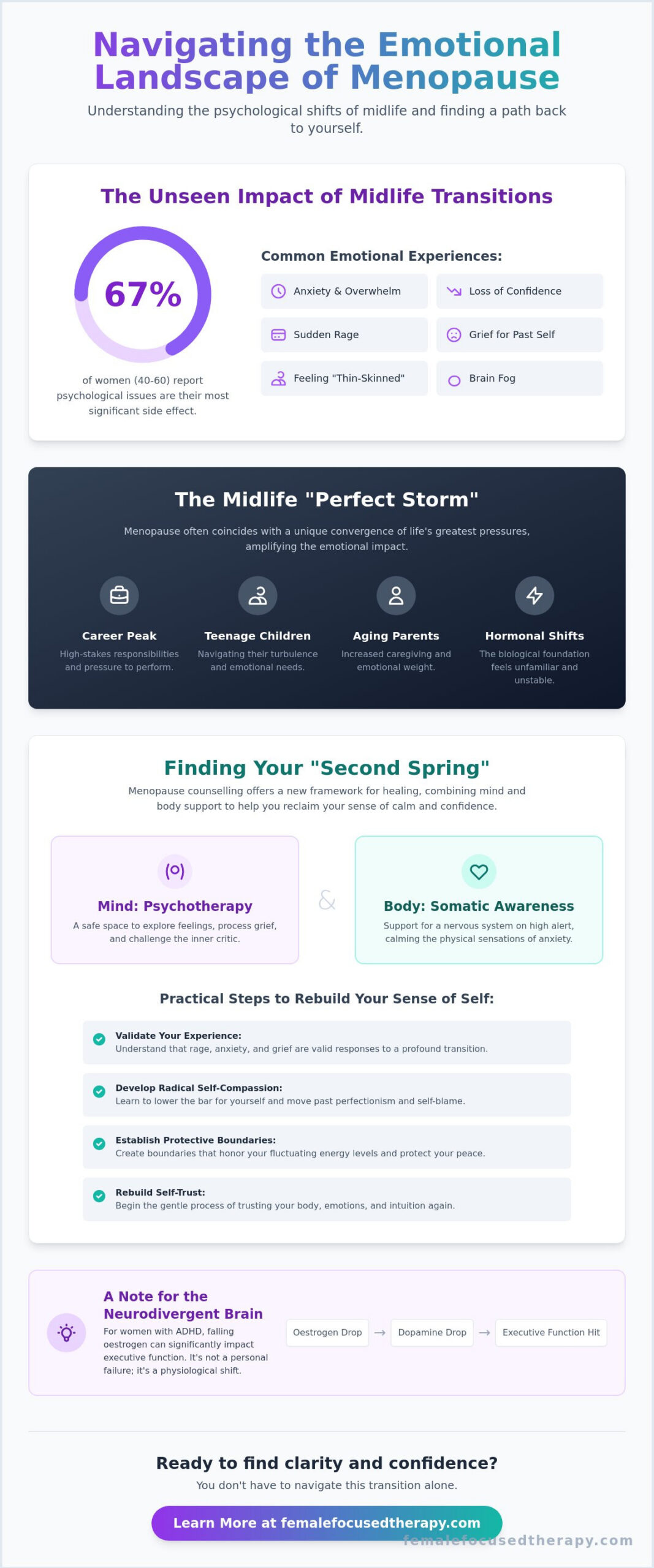
Did you know that 67% of women aged 40 to 60 report that psychological issues like anxiety and a loss of confidence are their most significant side effects? If you’re looking into menopause counselling, it’s likely because you feel suddenly thin-skinned or you’re grieving the version of yourself you used to know. It’s a confusing time when the invisible load of midlife meets a body that feels increasingly unfamiliar.
I provide online menopause counselling to women globally, supporting those in the UK, Europe, and across Asia. This flexibility is especially helpful for expat women who want to work with a therapist who understands the specific challenges of relocation. You can access professional, warm support from the comfort and privacy of your own home, while those seeking local support in Western Australia can find professional psychotherapy and counselling services through Intune Mindset Pty Ltd.
I understand how unsettling it is to lose that sense of internal steady ground. I’m here to help you see that these shifts aren’t something you need to “fix” in isolation, but a transition that deserves gentle, professional support. I’ll help you move through this emotional intensity so you can rebuild self-trust and find clarity in this life stage.
In this article, I’ll share how we can manage these big feelings without shame. We’ll explore how a mind-body approach can help you find your “second spring” of confidence and reclaim a sense of calm that feels sustainable and real.
Key Takeaways
- Understand that the rage, anxiety, and “thin-skinned” feelings you’re experiencing are valid responses to this profound life transition.
- Learn how menopause counselling provides a safe, confidential space to navigate the “perfect storm” of midlife pressures and career peaks.
- Discover why I use an integrative approach, combining psychotherapy with somatic awareness, to support a nervous system that feels on high alert.
- Identify practical ways to lower the bar for yourself through radical self-compassion and boundaries that protect your energy.
- Begin the gentle process of rebuilding self-trust so you can move forward with a stronger sense of clarity and confidence.
What is Menopause Counselling and Why Does it Matter Now?
I often hear women describe this stage of life as though they’ve woken up in someone else’s life. You might find yourself snapping at a partner for something small, or feeling a wave of anxiety before a meeting you used to handle with ease. It’s an unsettling shift that can make you feel like you’re losing your “edge” or your very sense of self.
Menopause counselling isn’t about clinical checklists or “fixing” a problem. It’s a safe, confidential space where we can explore the profound psychological impact of this midlife transition. While you might be looking for a comprehensive overview of menopause and its physical stages, the internal, emotional journey is often where we need the most support.
Traditional talk therapy sometimes misses the mark because it treats these feelings as standard depression or anxiety. However, a female-focused lens acknowledges that your nervous system is navigating a unique hormonal and social recalibration. You aren’t broken; you’re in a state of deep transition that requires a specific kind of holding for both your mind and your body.
The Emotional Landscape of Perimenopause
Many women tell me they feel “thin-skinned.” A 2026 survey found that 67% of women aged 40 to 60 struggle with mood disturbances and a loss of confidence. These aren’t just “symptoms” to be ignored. They’re often tied to a quiet grief as your reproductive years come to a close and your role in the world shifts.
You might feel a sudden rage that feels out of character, or an anxiety that keeps you awake at 3 am. These experiences are valid and real. The emotional load of this decade often involves the weight of being the primary emotional anchor for everyone else while your own foundation feels like it’s shifting.
Moving Beyond the Medical Label
It’s tempting to view everything through a medical lens, but your identity is evolving just as much as your hormones. Managing symptoms is one thing, but integrating this change into your life is how you achieve long-term wellbeing. This is why I offer specialized menopause therapy for women to help you find your feet again.
We create a safe, grounded space to look at who you are becoming. It’s about moving from a place of reactive survival to one of conscious growth. When we work together in menopause counselling, we focus on rebuilding that lost self-trust, ensuring you feel heard and validated every step of the way.
Why Midlife Transitions Feel Like Losing Your North Star
I often think of midlife as the “sandwich decade.” You’re likely caring for aging parents while navigating the turbulence of teenage children, all while reaching the peak of your career responsibilities. It’s a heavy load to carry. When you add the physiological shifts of menopause to this mix, it’s no wonder you feel like you’ve lost your internal compass.
This is where menopause counselling becomes so vital. It’s a place to acknowledge that your “invisible load” isn’t just a personal struggle, but a systemic one. Many of the women I work with are high-achievers who have spent years “emotional over-functioning.” This is essentially taking on the emotional labour for everyone around them. By the time perimenopause hits, that capacity for over-functioning often evaporates, leading to a profound sense of burnout.
Your inner critic might tell you that you’re failing, but the reality is that your nervous system is simply overextended. When you’re busy managing menopause symptoms, you have less energy to quiet those self-critical thoughts. It’s a time when old patterns of people-pleasing or chronic self-blame can feel louder than ever before.
Menopause and the Neurodivergent Brain
If you’re an adult woman with ADHD, the drop in oestrogen during this transition can feel particularly cruel. Oestrogen plays a huge role in dopamine production. As levels fall, your executive function might take a significant hit. Tasks that used to be manageable suddenly feel impossible. The “brain fog” isn’t a personal failure of will; it’s a physiological shift that requires a new set of tools.
I’ve found that ADHD therapy for women needs to be integrated with an understanding of these hormonal cycles. You don’t have to navigate this cognitive maze alone. We can work together to find strategies that respect your changing brain chemistry while keeping your life on track.
Navigating Relationship Trauma and Midlife
Midlife often brings a sharp, sometimes painful clarity. It’s a time when you might start looking at your history through a different lens. For many, this includes the realisation that they’ve been surviving narcissistic abuse or long-term relationship trauma. The vulnerability of menopause can bring these old wounds to the surface, making the process of rebuilding self-trust feel urgent.
Specialised menopause counselling can help you untangle these complex feelings and rediscover your voice. Healing from these experiences while your body is changing requires a gentle, trauma-informed approach. If you’re feeling ready to explore these shifts in a supportive environment, you can reach out to me here to see how we might work together.
An Integrative Approach: Healing Through Mind and Body
I’ve found that menopause isn’t something we can simply think our way through. It’s a full-body experience that vibrates through your nervous system. When you’re dealing with night sweats or that sudden “electric” feeling of anxiety, your body is effectively on high alert. This is why menopause counselling works best when we bridge the gap between your thoughts and your physical sensations.
While we often look for an authoritative definition of menopause to understand the biological shifts, the lived experience is much more nuanced. Just talking about your feelings can be helpful, but if your body still feels like it’s in a state of emergency, you won’t feel truly settled. We need to help your nervous system feel safe again.
My integrative approach combines traditional psychotherapy with somatic awareness to create a holistic path forward. We move at a pace that feels sustainable for you, ensuring you never feel overwhelmed by the process itself. Healing happens in the quiet moments when your body finally feels it has permission to let its guard down.
The Role of Somatic Movement
I often introduce gentle movement to help you reconnect with a body that might feel foreign or even like it’s betraying you. Through somatic movement and yoga, we learn to listen to what your physical self is actually saying. This isn’t about fitness; it’s a “warm but boundaried” way to inhabit your skin again with kindness.
Using breath and micro-movements helps regulate your system when the “invisible load” feels too heavy. It’s about finding small pockets of calm that you can carry into your daily life. This somatic work allows you to process emotions that words alone sometimes can’t reach, especially when you’re feeling emotionally exhausted.
CBT and Mindfulness for Menopausal Anxiety
We also use evidence-based tools from Cognitive Behavioural Therapy (CBT) to quiet the “hormonal” inner critic. When you’re in the middle of a hot flush or a sleepless night, it’s easy to spiral into catastrophic thinking. Mindfulness helps you stay grounded in the present moment, rather than being swept away by the intensity of your symptoms.
Practical mindfulness exercises can be incredibly effective for managing sleep disturbances and sudden mood shifts. By practising grounded awareness, you can reclaim your clarity and respond to your body’s needs with compassion instead of shame. This combination of mind and body work is how we rebuild the self-trust that this transition so often erodes.
Practical Steps to Rebuild Your Sense of Self
I want to encourage you to start with something that might feel radical: lowering the bar for yourself. Many of the women I see in my practice are high-achievers who have spent decades meeting everyone else’s needs before their own. In this stage of life, that old way of living is no longer sustainable or healthy for your well-being.
Self-compassion isn’t just a nice idea; it’s a necessary part of your healing. A March 2026 poll by the Royal College of Psychiatrists found that nearly 75% of UK women don’t realise menopause can trigger new mental health challenges. If you’re seeking menopause counselling, you’re already taking the first step toward reclaiming your time and understanding these shifts.
Prioritising rest must become a non-negotiable tool in your life. I’m not just talking about sleep, though that’s important. I mean active rest, where you give your nervous system permission to be still without the pressure of “doing” something productive. It’s helpful to find a therapist who specialises in life transitions to guide you through this process.
Setting Boundaries in Midlife
You might find that the emotional labour you’ve always carried for others now feels like a lead weight. This invisible load is often what leads to the burnout many women feel in midlife. Learning to say “no” is a skill we can develop together, allowing you to communicate your needs to your family and colleagues without the heavy shadow of guilt.
Remember that boundaries are a profound act of self-care, not a sign of selfishness. When you protect your energy, you’re actually ensuring you have the capacity to show up for the things that truly matter to you. Through dedicated menopause counselling, we work on establishing these boundaries in a way that feels safe and grounded.
Rediscovering Your Joy
In some cultures, this transition is referred to as a “Second Spring.” It’s a time for personal growth where the focus shifts from nurturing others to nurturing your own desires. It’s a move from merely “fixing” symptoms to truly thriving in your evolving identity and finding a new sense of purpose.
Small, daily practices help you reconnect with what you actually want. This might be five minutes of quiet breath, a walk in nature without your phone, or simply sitting with a cup of tea in silence. These tiny acts of reclamation are what help you move through this stage with a sense of wonder rather than just endurance.
If you’re ready to start this journey of reclamation, you can book a session with me to begin.
Finding Your Safe Space: How I Can Support You
I’ve spent my career supporting women through their most challenging transitions. As an integrative psychotherapist born in Scotland and now based in Singapore, I understand the unique blend of cultural and personal pressures you’re facing. My approach to menopause counselling is rooted in the belief that you deserve a space where you’re truly heard without judgment.
In my practice, I bring what many clients describe as a “gorgeous Scottish warmth.” This isn’t just about being friendly; it’s about creating a safe, professional container where you can let down your guard. Whether we meet in person in Singapore or through online therapy from elsewhere in the world, the goal remains the same: helping you move forward with clarity and confidence.
I use an integrative model that respects the connection between your mind and your body. We’ll talk about your experiences, but we’ll also pay attention to how your body is holding tension or anxiety. This holistic perspective ensures that your healing isn’t just a mental exercise, but a physical reclamation of your well-being.
Therapy Tailored for the Modern Woman
Living as an expat in Singapore often adds another layer to the midlife transition. Relocation and the distance from traditional support networks can make the emotional shifts of menopause feel even more isolating. I’ve worked with many women navigating these specific pressures while managing high-functioning careers and family lives.
I know that your schedule is likely demanding. This is why I offer focused intensive therapy for those who need a more concentrated approach to their healing. You don’t have to carry the weight of this transition alone, and you certainly don’t have to wait for a crisis to seek support.
My sessions are designed to be flexible, fitting into your life rather than becoming another burden. Whether you prefer the grounding presence of an in-person meeting or the convenience of online therapy, we’ll find a rhythm that works for you. The most important thing is that you feel supported in a way that feels sustainable.
Ready to Reconnect?
Taking the first step toward menopause counselling can feel daunting, but it doesn’t have to be a high-pressure decision. I invite you to consider a consultation booking as a gentle way to see if we’re a good fit. It’s a low-pressure conversation where we can discuss what you’re experiencing and how I can help you rebuild that vital sense of self-trust.
Midlife isn’t an ending; it’s a powerful transformation. I’ve seen incredible resilience in the women I work with, and I know that you have that same strength within you. You are navigating a major life shift, and having a guide can make all the difference in how you emerge on the other side. I am here when you are ready to talk.
Embracing Your Second Spring with Confidence
Navigating the shifts of midlife doesn’t have to be a lonely or overwhelming experience. We’ve explored how an integrative approach helps you manage emotional intensity and why setting boundaries is a vital act of self-preservation. By moving away from the idea of “fixing” yourself and toward a path of integration, you can begin to trust your own inner voice again.
I bring over 20 years of experience as a Registered Integrative Psychotherapist to our work together. My trauma-informed and ADHD-aware approach ensures that your unique cognitive and emotional needs are always at the centre of our sessions. Through menopause counselling, we create a steady foundation where you can rediscover your joy and reclaim your sense of purpose.
You’ve carried the load for others for a long time; now it’s time to turn that same care toward yourself. I’m here to support you in finding that “second spring” of confidence at a pace that feels sustainable and safe. When you’re ready to start this journey of reconnection, please book a gentle consultation with me today. You deserve to feel like yourself again.
Frequently Asked Questions
Is menopause counselling only for women with severe depression?
No, menopause counselling is for any woman navigating the emotional and psychological shifts of midlife. You don’t need to be in a state of clinical crisis to deserve a safe space to talk. Many high-functioning women I work with seek support because they simply feel “off” or more reactive than they used to be.
We focus on the transition itself, helping you manage the “thin-skinned” feelings before they lead to burnout. It’s about reclaiming your sense of self during a time of profound change, rather than just treating a medical diagnosis.
How is menopause therapy different from regular counselling?
This approach uses a female-focused lens that accounts for the specific intersection of hormonal shifts, identity changes, and midlife pressures. Unlike general therapy, I integrate somatic awareness to help regulate a nervous system that’s often on high alert. We acknowledge the “invisible load” you carry and how it impacts your mental well-being.
Can therapy help with the physical symptoms like hot flushes and insomnia?
While I don’t provide medical treatment, therapy helps change how your brain and nervous system respond to physical distress. The 2026 update to the NICE guidelines highlights CBT as a primary tool for managing the impact of flushes and sleep issues. By lowering your overall anxiety, we can make these physical experiences feel much less overwhelming.
I feel like my personality has changed; is this normal during menopause?
Yes, feeling like a “different person” is one of the most common experiences women share with me. When your oestrogen levels shift, it can feel like your internal filter has vanished, leading to sudden rage or unexpected tears. It’s a physiological recalibration of your system, not a permanent change to who you are as a person.
Do you offer online menopause counselling for women outside of Singapore?
I provide online menopause counselling to women globally, supporting those in the UK, Europe, and across Asia. This flexibility is especially helpful for expat women who want to work with a therapist who understands the specific challenges of relocation. You can access professional, warm support from the comfort and privacy of your own home.
How many sessions will I need to start feeling like myself again?
Most of my clients begin to feel a renewed sense of clarity and self-trust within 6 to 10 weekly sessions. Healing isn’t a race, and we always work at a pace that feels safe and sustainable for you. We focus on building long-term tools that help you navigate the entire transition with more confidence.
Can you help me talk to my partner about what I am going through?
I can help you find the words to explain your internal experience to your partner without feeling guilty or defensive. We work on communication strategies that move away from “emotional over-functioning” and toward clear, boundaried requests for support. This helps your partner understand that your changes are physiological, not a reflection of the relationship.
What if I am not sure if I am in perimenopause yet?
You don’t need a formal medical diagnosis or a blood test to begin this work. If you’re in your late 30s or 40s and notice you’re feeling more anxious, forgetful, or emotionally exhausted, your experience is valid. We focus on supporting your mental health and well-being exactly where you are today.

Article by
Cheryl Kennedy MacDonald MA BA (Hons) Pg. Dip. SAC BACP
Cheryl Kennedy MacDonald is a psychotherapist specialising in women’s mental health, relationships, and life transitions. She works with women navigating trauma, relationship breakdown, identity shifts, and midlife change, helping them rebuild self-trust, emotional stability, and a clear sense of who they are and what they want.
With over 20 years’ experience working with women internationally, Cheryl is the founder of YogaBellies, a global women’s yoga school, and the creator of the Birth ROCKS method. Her work sits at the intersection of psychotherapy and embodiment, integrating evidence-based therapeutic approaches with somatic, body-based practices that support deep, lasting change.
Known for her grounded and direct approach, Cheryl moves beyond surface-level insight to address the patterns held in the body and nervous system. Her work supports women to regulate, reconnect, and respond to their lives from a place of clarity, strength, and self-respect.
She is a published author in academic journals and has written multiple books on women’s health, pregnancy, and midlife wellbeing, available on Amazon and leading book retailers worldwide.