
You’re staring at a simple task, but your brain feels like it’s full of static; your battery hasn’t just hit zero, it feels like the charger itself has broken. I know the heavy cost of masking until you’re left in a state of adhd burnout. I will help you recognise the signs of this shutdown and share somatic ways to rebuild your self-trust through gentle, low-energy steps toward recovery.
Key Takeaways
- Understand why your exhaustion feels different and how it stems from the constant cost of coping in a world not designed for our brains.
- Identify how “masking” and emotional over-functioning drain your energy and contribute to the cycle of adhd burnout.
- Learn to spot the early sensory warning signs I often see, like noises feeling louder, before you’ve reached total depletion.
- Discover how to prioritise “rest as a verb” and use my gentle somatic movements to discharge stored stress from your body.
- Explore how my integrative approach to therapy can help you rebuild self-trust and find a balance that’s safe for you.
What is ADHD burnout and why does it feel so heavy?
I often describe adhd burnout as more than just being “tired.” It is a complete state of mental, emotional, and physical depletion that leaves you feeling hollow and unable to meet the basic demands of your day. While neurotypical burnout usually stems from the volume of work you’re doing, this specific type of exhaustion comes from the invisible cost of coping with a world that doesn’t fit your brain.
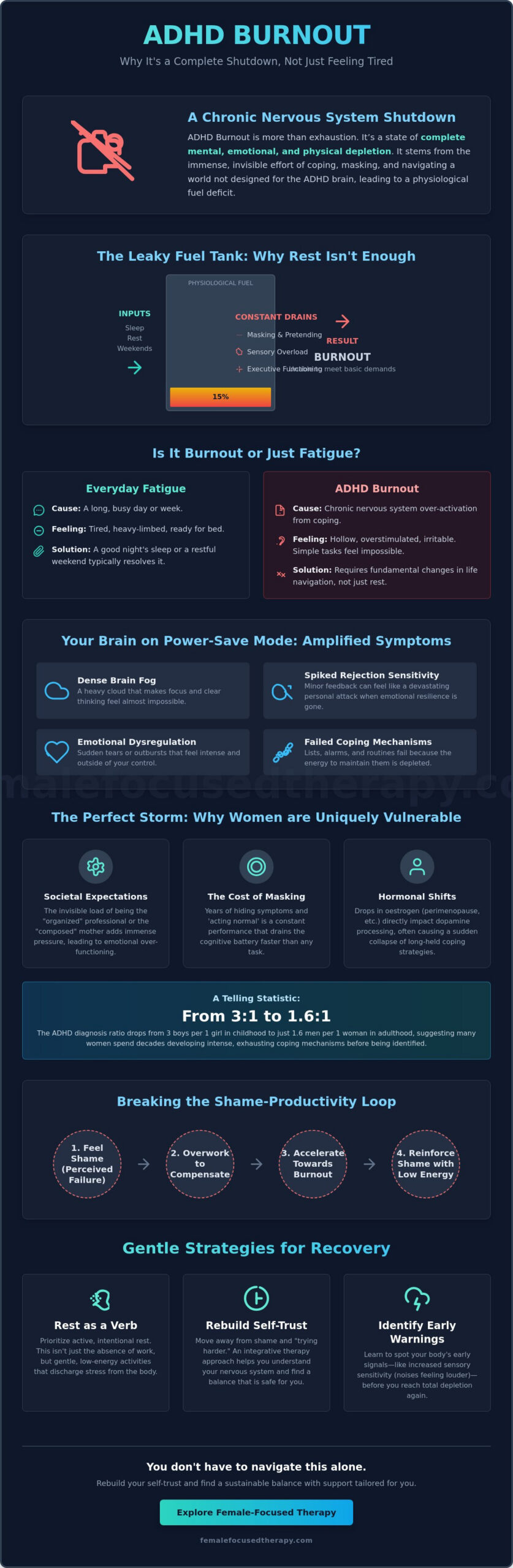
Essentially, adhd burnout is a chronic nervous system shutdown. It happens when the effort required to manage your symptoms, filter sensory input, and navigate social expectations exceeds your available energy for too long. It is the cumulative result of trying to function in a way that is fundamentally at odds with your neurobiology.
Imagine your internal fuel tank. For most people, a restful weekend or a good night’s sleep refills it. But for us, the tank often has a leak caused by the constant friction of Understanding ADHD and its impact on our daily lives. When that tank is empty, even simple tasks like opening an email or putting a dish in the dishwasher feel like climbing a mountain. It isn’t a lack of willpower; it is a lack of physiological fuel.
The difference between fatigue and neurodivergent burnout
Fatigue is what you feel after a long, busy day, and it is usually solved by sleep. Burnout is different because it requires a fundamental change in how you navigate your life. You might feel like you’ve “hit a wall” where your executive functions, like planning or starting tasks, simply stop working. This isn’t something you can just push through.
In my ADHD-focused therapy sessions, I often hear women describe a sudden, intense irritability. You might find that sensory inputs, like the hum of a fridge or the texture of your clothes, suddenly feel unbearable. Your brain is so overtaxed that it can no longer filter out the “noise” of the world, leaving your nervous system in a state of constant, prickly high alert.
How your ADHD symptoms change during burnout
When you’re in this state, your usual symptoms don’t just stay the same; they intensify and shift. Brain fog becomes a dense, heavy cloud that makes focus almost impossible. You might find that you’re losing your keys more often or forgetting appointments that you would normally remember. Your brain is essentially on “power-save mode,” prioritising basic survival over complex cognitive tasks.
There is also a sharp increase in rejection sensitivity. A small piece of feedback at work can feel like a devastating personal attack when your emotional resilience is gone. Your emotional dysregulation might peak, leading to tears or outbursts that feel outside of your control. Perhaps most frustratingly, the coping mechanisms you’ve used for years, like lists or alarms, suddenly fail you because you no longer have the energy to maintain them.
Why women are uniquely vulnerable to the ADHD burnout cycle
Women often carry an invisible load that makes them particularly susceptible to total depletion. While anyone can experience exhaustion, the intersection of neurodivergence and societal expectations for women creates a perfect storm. I see this frequently in who I work with. These are often intelligent, capable women who are performing at a high level while their internal systems are screaming for a break. You might find yourself “emotional over-functioning,” where you take on the mental and emotional labour for everyone in your life, from your partner to your colleagues, leaving nothing for yourself. This constant output is a direct route into the ADHD burnout cycle.
While the male-to-female ratio for an ADHD diagnosis is 3:1 in children, it drops to 1.6:1 in adults. This suggests that many of us spend our younger years undiagnosed, developing intense coping mechanisms just to get by. By the time we reach adulthood, the sheer effort required to maintain these facades becomes unsustainable. If you feel like you’re drowning while everyone else seems to be swimming, it’s likely because you’re working twice as hard to stay afloat.
The cost of masking and “trying harder”
Masking is the energy you spend pretending to be “fine” when you’re actually struggling to keep up. It’s the forced eye contact, the rehearsed social responses, and the desperate effort to hide your disorganisation. This constant performance drains your cognitive battery much faster than the tasks themselves. It’s a survival mechanism, but it’s one with a very high price tag. When you’re masking, you’re never truly resting, even when you’re alone.
There is also a deep, internalised shame when we feel we aren’t meeting the traditional roles of being the “organised” mother or the “composed” professional. This often leads to a shame-productivity loop. You feel you’ve failed, so you overwork to compensate, which only accelerates your journey toward adhd burnout. Breaking this loop requires us to acknowledge that your worth isn’t tied to your productivity.
Hormonal shifts and neurodivergence
For many women, the real crisis hits during hormonal shifts. Oestrogen plays a massive role in how our brains process dopamine. When oestrogen levels drop, particularly during perimenopause or menopause, ADHD symptoms can suddenly feel unmanageable. This is why midlife often feels like a sudden “collapse” of coping strategies that worked for decades. coping mechanisms that were “good enough” in your 30s may no longer support you in your 40s or 50s.
If you feel like your brain has changed overnight, you aren’t alone. I offer specific support for life transitions and menopause therapy to help you navigate these shifts without losing yourself. You can always book a session with me to explore how we can help you unmask safely and find a rhythm that actually works for your body.
Recognising the signs of an impending ADHD burnout
I’ve noticed that for many women, the road to adhd burnout begins with a period of intense, almost addictive productivity. You might find yourself in a hyperfocus phase where you feel like you have a superpower. You’re saying “yes” to every project and managing your household with military precision. But this isn’t sustainable energy. It’s actually the “over-commitment” phase. You’re borrowing from tomorrow’s reserves to pay for today’s performance.
When those reserves run dry, the early warning signs are often sensory rather than mental. You might find that the hum of the air conditioner suddenly feels like a roar. Your favourite jumper might start to feel itchy or restrictive. I call this the “static” phase. It’s as if your brain’s volume has been turned up too high, and you can no longer filter out the world around you.
The sensory and emotional red flags
If you have children, you might feel “too touched” or overwhelmed by their natural need for proximity. This isn’t because you’re a bad parent. It’s because your nervous system is at its limit. You might also notice a sudden loss of interest in the hobbies that usually give you a dopamine hit. That book you were loving or the garden you were tending suddenly feels like a chore. This is often accompanied by an increase in “ADHD paralysis,” where the simple act of starting a task feels physically impossible.
The shame-spiral: “Why can’t I just do it?”
As your productivity drops, the self-critical voice in your head usually gets much louder. You might ask yourself why you can’t just do the laundry or why you’re failing at things that felt easy last week. This internal narrative is dangerous because it creates more stress, which only accelerates the burnout. Recent research, such as this ADHD and job burnout study, highlights the direct link between executive function struggles and professional depletion. Adding shame to that burden makes recovery even harder.
I want to offer you a gentle redirection. Your brain is not broken; it is simply exhausted. The withdrawal you feel, where you stop responding to texts or dread social calls, is your mind trying to save what little energy you have left. In the final shutdown phase, even choosing what to eat can feel like a crisis. Recognising these signs early is the first step in rebuilding your self-trust and finding a way back to yourself.
Somatic and gentle strategies for your recovery
Recovery from adhd burnout isn’t about adding more to your to-do list. I often see advice suggesting “better routines,” but when you’re spent, a routine feels like a cage. Instead, I want you to prioritise rest as a verb. This means moving away from the idea that rest is something you earn after you’ve been productive enough. Rest is the fuel, not the reward.
One of the most effective ways I’ve found to navigate this state is through somatic movement. This isn’t about traditional exercise or “working out.” It is about gentle, intuitive movement that helps your nervous system discharge the stress stored in your body from months of masking. I explore these mind-body connections deeply in my work with somatic movement and yoga for women.
I also recommend implementing “low-demand” days. On these days, you intentionally minimise the requirements on your executive function. This might mean choosing the simplest meal possible, letting the laundry wait, or using paper plates to avoid the dishes. By reducing the number of decisions you have to make, you give your brain the space it needs to slowly come back online.
Reconnecting with your body through breath and rest
When your nervous system is frazzled, simple breathwork can signal immediate safety to your brain. You don’t need a complicated practice; just a few minutes of focusing on a long, slow exhale can shift you out of a “fight or flight” state. This is a foundational part of the healing process I use with my clients. I also suggest creating a “sensory diet” for yourself. If 74% of employees have experienced burnout by 2026, many are likely struggling with the same sensory overwhelm you feel. You can recover by intentionally reducing input:
- Dimming the lights in your home for an hour each evening.
- Using noise-cancelling headphones to reduce auditory clutter.
- Choosing soft, loose-fitting clothing that doesn’t irritate your skin.
Setting boundaries with yourself and others
Healing requires you to say “no” more often than you might be comfortable with. This is an act of radical self-compassion. It isn’t being selfish; it’s being realistic about your current capacity. I encourage you to write down three things you will NOT do today. This simple act helps protect your remaining energy from the “shoulds” that drive the adhd burnout cycle.
If you feel ready to explore these somatic tools in a supportive environment, you can book a session with me to start your journey back to yourself. We can work together to find a pace that feels safe and sustainable for your unique neurodivergent brain.
How I support you in rebuilding self-trust and finding balance
Rebuilding your life after adhd burnout isn’t something you have to do alone. My approach to ADHD therapy is integrative, meaning we look at both the mind and the body. We don’t just talk about cognitive strategies; we work to soothe your nervous system and address the emotional exhaustion that comes from years of over-functioning.
Many women spend their lives trying to “fix” their brains to fit into a neurotypical world. In our sessions, the goal isn’t to change who you are or make you more “productive” in a traditional sense. It’s about creating a safe, non-judgemental space where you can finally unmask. For many of my clients, this is the first time they’ve felt truly heard and supported without the need to perform.
We focus heavily on the rebuilding of self-trust. When you’ve been in a cycle of constant effort followed by total collapse, you stop trusting your own internal signals. We work together to help you listen to your body again and honour your needs without the heavy weight of shame. This reconnection is the foundation of a life that feels more sustainable and grounded.
If you feel you’re in a crisis of exhaustion and need more immediate support, I also offer focused intensive therapy sessions. These are designed for deep, concentrated work when a weekly hour doesn’t feel like enough to help you find your footing. It’s a dedicated time to step away from the noise and focus entirely on your recovery and growth.
A trauma-informed space for neurodivergent women
I understand the unique weight you carry because I share that lived experience as an adult woman with ADHD. This work isn’t just clinical for me; it’s deeply human. My practice is trauma-informed, which means I prioritise your safety and emotional wellbeing above all else. We move at a pace that feels safe for you, ensuring you never feel overwhelmed by the therapeutic process itself.
We won’t rush your healing. Recovering from adhd burnout takes time, and trying to “speed run” the process only adds more pressure to an already overtaxed system. We’ll work to find a sustainable rhythm that respects your energy levels and your life’s current demands. Together, we can find clarity and a stronger sense of self without the need for constant struggle.
Taking your first step toward healing
You don’t need to have a perfect plan or even a full understanding of why you’re so tired to start this work. It’s okay to show up exactly as you are, even if that feels messy or uncertain right now. Many women I work with start by simply acknowledging that they can’t keep going the way they have been.
Your first step can be very simple and low-pressure. You can book a consultation with me today to see how we might work together. It’s a calm, realistic way to begin moving from depletion back toward a sense of balance. I’m here to hold space for you whenever you’re ready to begin.
Moving forward with kindness and clarity
Healing from adhd burnout isn’t about finding a better system to be more productive. It’s about learning to trust your body again and recognising that your worth isn’t tied to your output. We’ve explored how masking and sensory overwhelm contribute to this deep exhaustion, and how gentle, somatic tools can help you start to discharge that stored stress. Recovery is a journey of unmasking and finding a rhythm that actually fits your neurobiology.
As a Registered Integrative Psychotherapist with my own lived experience of adult ADHD, I provide trauma-informed and neuro-affirming care that meets you exactly where you are. You don’t have to navigate this recovery alone or feel ashamed of your need for rest. My goal is to help you move forward with a stronger sense of self and the clarity you need to protect your energy in the future.
When you feel ready to take that first gentle step, book your therapy consultation with me today. You deserve a space where you can finally feel heard and supported as you rebuild your life at a pace that feels safe for you. There is hope, and you can find your way back to balance.
Common questions about ADHD burnout and recovery
What is the main difference between ADHD burnout and clinical depression?
The primary difference is that burnout is usually situational and driven by chronic over-extension, whereas depression is a persistent mood disorder. If your mood and energy improve when your responsibilities are removed, you’re likely experiencing burnout. Depression often stays with you even when your schedule is completely clear.
In my practice, I find that women in burnout feel a desperate desire to “do,” but their bodies simply won’t let them. Depression often feels more like a loss of interest in “doing” altogether. Understanding this distinction is a key part of how I support your journey toward rebuilding self-trust.
How long does it typically take to recover from an ADHD burnout episode?
Recovery isn’t a linear process and can take anywhere from three months to over a year. A 2026 report on workplace exhaustion suggests that 74% of people who experience burnout need significant lifestyle changes to fully recover. It depends on how long you’ve been masking and your current level of depletion.
I work with you to ensure your recovery happens at a pace that feels safe. We focus on small, sustainable shifts rather than quick fixes. This unhurried approach helps prevent you from falling back into the same cycle of over-functioning as soon as you start to feel a bit better.
Can you have ADHD burnout even if you are not working a traditional job?
You can absolutely experience this even if you don’t have a 9-to-5 career. Managing a household, parenting, or navigating complex family dynamics requires intense executive function. The mental load of “emotional over-functioning” is a common trigger for the women I see in therapy.
The effort required to manage a home while neurodivergent is real work. When you’re constantly filtering sensory input and managing everyone else’s schedules, your battery drains just as fast as it would in an office. Your struggle is valid regardless of your employment status.
Is ADHD burnout a recognised medical diagnosis in 2026?
Burnout is classified by the World Health Organization in the ICD-11 as an occupational phenomenon rather than a medical disease. While adhd burnout isn’t a standalone clinical diagnosis in 2026, it is a widely recognised state of depletion among neuro-affirming therapists. It describes the specific physiological impact of living with a neurodivergent brain.
I treat this state as a very real nervous system crisis. Even without a formal “code” in a medical manual, the physical and mental symptoms you’re feeling are a direct result of your brain’s unique way of processing the world. My approach focuses on your lived experience rather than just a label.
How can I explain my ADHD burnout to my partner or employer?
I suggest using the “sensory cup” metaphor to explain that your ability to process information is currently overflowing. You might tell your employer that you need “low-demand” tasks for a period to remain productive. This focuses on your needs rather than your perceived failures.
With a partner, explaining the energy cost of masking can help them understand why you need periods of silence or solitude to recharge. It’s about helping them see that your withdrawal isn’t a reflection of your relationship. It’s a necessary biological requirement for your nervous system to reset.
Does medication help with ADHD burnout or just the daily symptoms?
Medication usually helps manage daily executive function, but it cannot “fix” a burnt-out nervous system. In 2026, new options like centanafadine are being reviewed by the FDA with a decision date of July 24, 2026. While these can support your focus, true recovery requires somatic rest.
Think of medication as a tool that can help you navigate your day, but not as a replacement for rest. If you’re already in a state of adhd burnout, relying solely on stimulants can sometimes lead to further depletion. We must address the underlying exhaustion through lifestyle changes and somatic support.
What are some “low-dopamine” activities that help with recovery?
Low-dopamine activities are those that soothe your nervous system without over-stimulating it. I often recommend gentle somatic movement, sitting in nature, or repetitive tasks like knitting. These activities allow your brain to rest while still providing a grounding sensory experience that doesn’t demand high cognitive effort.
The goal is to move away from high-stimulation activities, like scrolling on your phone, which can actually leave you feeling more drained. By choosing activities that feel calm and predictable, you give your dopamine receptors a chance to recover. This is a vital part of my integrative mind-body approach to healing.
Is it possible to prevent ADHD burnout from happening again?
Prevention is possible once you learn to recognise your unique early warning signs. I help women identify their “sensory red flags” before they reach a total shutdown. By setting clear boundaries and reducing the pressure to mask, you can build a life that respects your natural energy limits.
It’s about moving from a “crisis” mindset to one of sustainable self-care. We work together to create a life where you don’t feel the need to over-function to be worthy. When you trust yourself to say “no” when your cup is full, you break the cycle of depletion for good.

Article by
Cheryl Kennedy MacDonald MA BA (Hons) Pg. Dip. SAC BACP
Cheryl Kennedy MacDonald is a psychotherapist specialising in women’s mental health, relationships, and life transitions. She works with women navigating trauma, relationship breakdown, identity shifts, and midlife change, helping them rebuild self-trust, emotional stability, and a clear sense of who they are and what they want.
With over 20 years’ experience working with women internationally, Cheryl is the founder of YogaBellies, a global women’s yoga school, and the creator of the Birth ROCKS method. Her work sits at the intersection of psychotherapy and embodiment, integrating evidence-based therapeutic approaches with somatic, body-based practices that support deep, lasting change.
Known for her grounded and direct approach, Cheryl moves beyond surface-level insight to address the patterns held in the body and nervous system. Her work supports women to regulate, reconnect, and respond to their lives from a place of clarity, strength, and self-respect.
She is a published author in academic journals and has written multiple books on women’s health, pregnancy, and midlife wellbeing, available on Amazon and leading book retailers worldwide.