
You have just finished a long day of balancing career demands and family needs, and the thought of driving across town to sit in a clinical waiting room feels like one more chore you cannot carry. You know you need support, but you worry that a screen will only add to the emotional distance you already feel from yourself and the world around you.
It is completely natural to feel this way. You might have felt unseen by generic healthcare providers in the past, or perhaps you fear that online psychotherapy for women lacks the deep, somatic connection required for true healing. You need a space that respects your time without sacrificing the human warmth that makes therapy work.
I will help you understand how online sessions can provide a private, body-integrated sanctuary for your journey. This digital space allows us to work through complex experiences like narcissistic abuse or neurodivergent burnout while staying grounded in the comfort of your own environment.
We will explore how to find a specialist who understands your unique nervous system and how to set a sustainable pace for rebuilding your self-trust. I will also explain how modern, HIPAA-compliant platforms ensure your privacy remains a priority while we focus on your growth and wellbeing.
Key Takeaways
- Discover why online psychotherapy for women creates a unique sanctuary by lowering your stress levels through the comfort and safety of your own home.
- Learn how to navigate the complex weight of being a caregiver or professional while healing from relationship trauma and narcissistic abuse.
- Understand how we integrate somatic practices like breath and rest into digital sessions to ensure your body heals alongside your mind.
- Identify the specific qualities to look for in a therapist to ensure they are warm but boundaried and truly capable of holding space for you.
- Explore the gentle, sustainable process of rebuilding self-trust and learning to listen to your own inner voice once again.
Why I believe online therapy offers a unique sanctuary for women
I define online psychotherapy for women as a private, trauma-informed space for self-reflection where you can explore your inner world without the pressure of a clinical setting. It is more than just a video call; it is a dedicated sanctuary that meets you exactly where you are. In this digital room, we focus entirely on your story, your body, and your path toward rebuilding self-trust.
When you are in your own familiar environment, your body inherently understands that it is safe. This physical reassurance signals your nervous system to lower cortisol levels, which is a physiological shift that helps you open up more deeply. In a sterile office, your brain might stay in a “high alert” mode. At home, we can bypass that defensive layer to reach the core of your experience more quickly.
There is a common misconception that digital sessions lack the warmth of in-person meetings. I have found the opposite to be true. The evolution of online counseling has proven that distance does not mean a lack of depth. I use our digital connection to bridge the gap, paying close attention to your tone, your expressions, and your breath to ensure you feel held and heard throughout our time together.
The comfort of your own space
Sitting in your favourite chair with a warm cup of tea isn’t just about comfort; it’s therapeutic in itself. By eliminating the stress of a commute, we remove a significant trigger for high-functioning anxiety. A 2024 survey showed that 89% of people using telehealth preferred it for this exact convenience. You arrive at our session feeling grounded rather than frazzled by traffic.
- Absolute Privacy: You never have to worry about bumping into a colleague or neighbour in a physical waiting room.
- Emotional Safety: Being surrounded by your own things helps you feel more in control of the healing process.
- Energy Conservation: You can use the time you would have spent travelling to rest or integrate the work we have done.
Creating a consistent rhythm for healing
Healing is not a race. It is a journey that requires a sustainable pace. Online sessions allow us to maintain this rhythm even when life feels overwhelming or complicated. Whether you are navigating a career change, moving house, or managing the shifts of midlife, we can keep our connection steady. This consistency is vital for long-term growth.
I understand how difficult it can be to prioritise yourself when you are constantly caring for others. You can learn more about my background as a therapist and yoga master on my about me page. This flexibility ensures that your healing doesn’t have to pause just because your schedule is full. We create a space that fits into your life, not one that adds more pressure to it.
Navigating the specific challenges we face as women today
I understand that our struggles are often tied to our roles as caregivers, professionals, and partners. You might find yourself carrying the mental load for everyone else, a state I call emotional over-functioning. This isn’t just about being busy; it’s the invisible weight of anticipating everyone’s needs while your own fall to the bottom of the list. It leads to a profound sense of exhaustion that generic healthcare often misses because you look like you’re handling it all.
When we work together in online psychotherapy for women, we look at the whole picture. This includes the physical and emotional shifts of menopause and midlife transitions. These aren’t just hormonal issues; they’re significant life evolutions that deserve space and validation. I see the way these transitions intersect with your career and family life, creating a unique set of pressures that require a gentle, tailored approach.
You might wonder if a screen can handle such complex topics. Research compiled by the National Center for Health Research, asking Does Online Therapy Work?, suggests that digital interventions are highly effective for trauma and anxiety. This data supports what I see every day: women finding deep, lasting relief through virtual sessions that respect their time and their boundaries.
Healing from relationship trauma and narcissistic abuse
Relationship trauma often leaves you feeling like you’ve lost your compass. If you’ve experienced narcissistic abuse, you likely know the sting of chronic self-blame and the confusion of gaslighting. It’s not just about a bad breakup; it’s about the systematic erosion of your identity. You might find yourself constantly second-guessing your memories or feeling responsible for things that weren’t your fault.
In my practice, recovering from relationship trauma is about more than just talking through the past. It’s about rebuilding the self-trust that was taken away. A female-focused lens is vital here because it recognises the specific ways women are often socialised to stay small or keep the peace at their own expense. We work to untangle those knots at a pace that feels safe for you.
Supporting the neurodivergent female mind
The flexibility of online psychotherapy for women is particularly helpful for those of us with neurodivergent brains. For many of the women I see, life feels like a constant battle against sensory overload and masking. ADHD in women often presents as internalised overwhelm and emotional intensity rather than outward hyperactivity. You aren’t broken or lazy; your brain simply processes the world differently.
I work with neurodivergent women to create strategies that actually fit your life. We use a trauma-informed approach to navigate a world that wasn’t built for your unique mind, focusing on managing stress without trying to fix who you are. If you feel ready to explore these challenges in a safe space, you can schedule a time to talk with me.
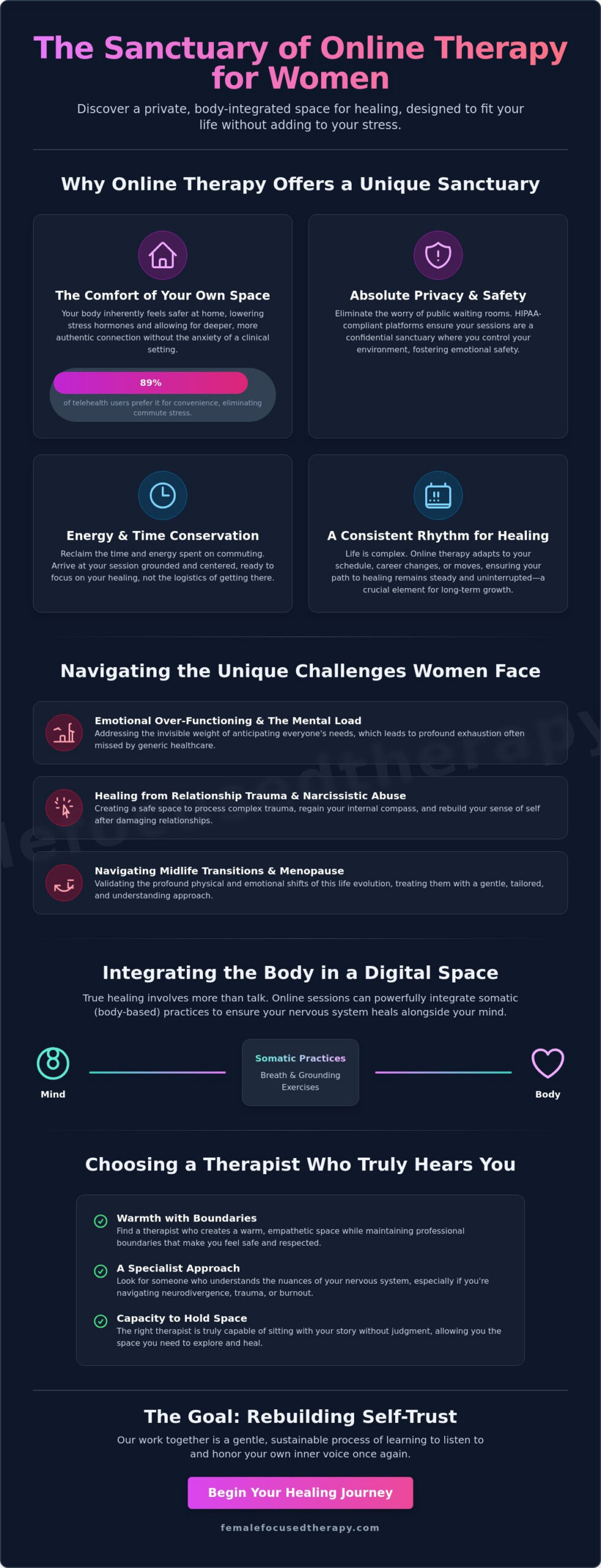
Integrating the body: Somatic work in a digital space
I believe that healing happens in both the body and the mind; one cannot be truly well without the other. For many high-functioning women, “just talking” isn’t always enough. You might be incredibly articulate at describing your problems while remaining completely disconnected from your physical self. If your body is still holding onto the tension of a traumatic event or the chronic stress of masking ADHD, simply intellectualising the experience won’t bring the relief you deserve.
In our sessions, I weave somatic themes like breath and rest into the conversation. You might wonder how we track “felt senses” or bodily tension through a video call. It’s actually quite natural. I pay close attention to the way your shoulders rise when we discuss a specific memory or how your breath shallows when you feel overwhelmed. By bringing your awareness to these physical shifts, we can begin to process emotions that your mind might be trying to bypass.
Research published by the American Psychological Association in January 2021 highlights the effectiveness of online therapy, noting that virtual interventions produce outcomes similar to in-person care. Interestingly, some studies suggest that women may even have better outcomes with virtual therapy because the safety of their own environment allows for deeper emotional and physical expression. This supports my belief that online psychotherapy for women is a powerful tool for holistic recovery.
Breath and movement as therapeutic tools
A simple breathing exercise can ground us during a difficult session. When we touch on painful topics, your nervous system might try to “exit” the room. By pausing to focus on a slow, rhythmic breath, we signal to your brain that you are safe in this moment. This isn’t about doing a workout; it’s about the subtle integration of somatic movement and yoga to release stored tension.
- Grounding: Using your feet on the floor to reconnect when thoughts feel scattered.
- Release: Gentle neck or shoulder movements to unlock the “armour” we carry.
- Daily Tools: I empower you to use these techniques in your daily life, long after our session ends.
Learning to listen to your body’s signals
During our conversations, I help you recognise the “freeze” or “fawn” response as it happens. You might notice yourself becoming very still or suddenly trying to please me with your answers. These are survival strategies your body learned long ago. By identifying them in real-time, we create a boundaried space where your body feels safe enough to share its story without fear of judgment.
We also use mindfulness to stay present when your mind wants to wander to your to-do list or the needs of your family. This isn’t a performance; it’s a practice of coming back to yourself. Online psychotherapy for women provides the perfect container for this work, allowing you to practice these somatic connections in the very place where you live your life every day.
How to choose an online therapist who truly hears you
Choosing a therapist isn’t about scrolling through an app and picking a name at random. It’s a deeply personal decision where the “click” you feel is just as important as the credentials on the wall. While I always recommend verifying that a practitioner is registered with the BACP or equivalent UK standards, that’s just the baseline. You’re looking for a human connection that feels safe, grounded, and unmistakably real.
I often describe the ideal therapeutic relationship as being “warm but boundaried”. You need someone who can hold space for your darkest moments without becoming overwhelmed by them. This professional distance isn’t about being cold or clinical. Instead, it’s what allows me to remain a steady guide while you navigate your healing journey. It ensures that the focus stays entirely on your growth and wellbeing.
When looking into online psychotherapy for women, don’t be afraid to ask about their specific experience. If you’re dealing with ADHD or the complexities of midlife, you deserve a therapist who understands these nuances. You shouldn’t have to explain why your brain feels like it has too many tabs open or why menopause is affecting your sense of self. A specialist already knows the terrain you’re walking.
Evaluating the therapeutic fit
Trust your intuition during an initial consultation. This “chemistry call” is your chance to see if my voice and approach feel like a safe harbour for your story. Pay attention to your physical response as we talk. Does your heart rate slow down? Do you feel a sense of relief? For a deeper look at this process, you can explore my guide on finding a therapist in Singapore.
Questions to ask before you begin
It’s important to be proactive about your care. Since pandemic-era waivers for non-secure platforms have expired as of May 2026, you should ask about the security of the online platform being used. Your privacy is paramount. A professional should always be using HIPAA-compliant tools that protect your data and ensure our digital room remains completely confidential and secure.
You might also ask how they work with high-functioning women who are used to “doing it all”. Many of the women I work with are experts at masking their struggle behind a polished exterior. You need to know that your therapist can see past that mask. Inquire about their approach to trauma and how they might integrate the somatic themes we’ve discussed to help you reconnect with your body.
These questions ensure that the space we build together is both secure and effective. Finding the right fit is the first step toward rebuilding your self-trust and finding your voice again. If you’d like to explore how we might work together to support your healing, you can book a consultation with me here.
Rebuilding your self-trust through our work together
My ultimate goal is never to “fix” you. You aren’t a broken machine or a set of symptoms to be managed; you’re a woman who has likely been through a great deal. Instead, online psychotherapy for women is about helping you find your way back to the person you were before life’s weight became too heavy. We work together to peel back the layers of “shoulds” and “musts” that have buried your true self.
Rebuilding self-trust is a quiet, steady process. It’s about learning to hear your own voice again, even if it’s just a whisper right now. After years of navigating relationship trauma, emotional over-functioning, or masking neurodivergent traits, that inner voice can feel foreign. I provide the calm insight and gentle authority you need to start trusting your own instincts once more, helping you feel grounded in your own skin.
When you step into our digital room, you can expect a space filled with my natural Scottish warmth and genuine empathy. I don’t sit behind a clinical mask or use detached academic language. I’m here as a human being who understands the complexities of your world. You don’t have to navigate this life transition or this healing journey alone; I am here to hold that space with you.
Taking the first step toward clarity
We always start at a pace that feels sustainable for you. I know how easy it is to feel overwhelmed by the idea of “doing therapy” on top of your career and family demands. This isn’t another task for your to-do list. It’s the opposite. It is one hour a week that is entirely, unapologetically about you and your healing.
This hour is a sanctuary where you can finally set down the mental load you carry for everyone else. It’s a time for rest, reflection, and reconnection. If you aren’t quite ready for a full session yet, I encourage you to explore my free therapy resources. They are a gentle way to begin your journey at your own speed without any pressure.
Let’s begin your journey
There is rarely a “perfect” time to start therapy. Life will always be busy, and there will always be reasons to put your own needs last. However, the moment you decide you deserve support is the moment the real shift begins. You’ve already shown immense strength by seeking out this information and acknowledging that you need a safe space to breathe.
I invite you to book a session when you feel ready to move forward. Whether you are navigating the shifts of midlife, recovering from narcissistic abuse, or managing the overwhelm of ADHD, I am here to walk alongside you. We will move at a pace that feels safe, with kindness and patience, as you rebuild a life that feels authentically yours.
Your path toward a stronger sense of self
I hope you now feel that online psychotherapy for women is more than just a digital meeting; it is a genuine mind-body sanctuary. We have explored how the safety of your own environment can lower cortisol and how somatic work helps you process what words alone cannot reach. As a Registered Integrative Psychotherapist, I am committed to providing trauma-informed and ADHD-focused care that respects your unique rhythm and life transitions.
A 2024 survey found that 89% of people were satisfied with telehealth for its convenience, but for us, it is about the depth of connection we build from a place where you feel most secure. My integrative mind-body approach ensures we bridge the digital gap with warmth and patience. You don’t have to navigate this journey alone, and you don’t have to wait for the “perfect” moment to prioritise your wellbeing.
If you feel ready to start rebuilding your self-trust, I invite you to book a session with me here. You have carried the weight for long enough. I am here to walk beside you as you find your way back to clarity, confidence, and a more grounded version of yourself.
Frequently Asked Questions
Is online psychotherapy as effective as in-person sessions for women?
Online psychotherapy for women is just as effective as in-person sessions, with research showing that virtual outcomes match traditional settings. A 2021 meta-analysis by the American Psychological Association confirmed that women often find it easier to open up in their own environment. You receive the same depth of care and somatic integration without the stress of a commute, helping you stay grounded and present during our work together.
How do I ensure my privacy during an online therapy session at home?
You can ensure your privacy by using headphones and choosing a quiet time when you are alone. Some women find that playing white noise outside their door or sitting in a parked car provides the necessary sanctuary. Since pandemic-era waivers expired in May 2026, I only use fully encrypted, HIPAA-compliant platforms to ensure our digital room remains a confidential and secure space for your sensitive healing journey.
What kind of technology do I need for online psychotherapy?
You only need a reliable internet connection and a device with a working camera and microphone, such as a laptop, tablet, or smartphone. I will send you a secure, private link before our session, so there’s no need to download complicated software. It is helpful to have your charger nearby and to close other apps to ensure our connection remains steady and uninterrupted throughout our hour together.
Can online therapy help with specific issues like menopause or ADHD?
Yes, I specialise in supporting women through the unique challenges of ADHD and midlife transitions. The tailored nature of online psychotherapy for women allows us to use strategies that respect your neurodivergent brain or the hormonal shifts you’re experiencing. Whether you’re managing the brain fog of menopause or the emotional intensity of ADHD, our sessions provide practical support and deep validation for your specific journey.
What should I do if I feel awkward talking to a screen?
It is completely normal to feel a bit awkward during your first few minutes of talking to a screen. Most women find that this feeling disappears within the first session as we settle into a natural rhythm. I focus on your breath and felt senses, which helps move the attention away from the technology and back to your internal experience, making the screen feel like a transparent window between us.
How long does a typical online psychotherapy session last?
A typical online psychotherapy session lasts for 50 to 60 minutes. This timeframe provides enough space to check in with your body, explore deeper emotions, and integrate new insights without becoming overwhelming. We always work at a sustainable pace, ensuring you have a few minutes at the end to ground yourself before returning to your daily responsibilities and the needs of your family.
Can we do somatic or body-based work through a video call?
We can absolutely do somatic and body-based work through a video call by tracking your physical responses in real-time. I pay close attention to your posture, breath, and micro-expressions to help you identify where you’re holding tension. Even through a screen, we can use gentle movement and grounding exercises to release stored trauma and help you feel more connected to your physical self and inner voice.
What happens if I have a technical issue during our session?
If we experience a technical glitch or a dropped connection, we will simply try to reconnect through our original secure link. If the internet remains unstable, I have a backup plan where we can switch to a private phone call to finish our session. You don’t need to worry about losing your time; we will always find a way to ensure you feel supported and heard regardless of technology.

Article by
Cheryl Kennedy MacDonald MA BA (Hons) Pg. Dip. SAC BACP
Cheryl Kennedy MacDonald is a psychotherapist specialising in women’s mental health, relationships, and life transitions. She works with women navigating trauma, relationship breakdown, identity shifts, and midlife change, helping them rebuild self-trust, emotional stability, and a clear sense of who they are and what they want.
With over 20 years’ experience working with women internationally, Cheryl is the founder of YogaBellies, a global women’s yoga school, and the creator of the Birth ROCKS method. Her work sits at the intersection of psychotherapy and embodiment, integrating evidence-based therapeutic approaches with somatic, body-based practices that support deep, lasting change.
Known for her grounded and direct approach, Cheryl moves beyond surface-level insight to address the patterns held in the body and nervous system. Her work supports women to regulate, reconnect, and respond to their lives from a place of clarity, strength, and self-respect.
She is a published author in academic journals and has written multiple books on women’s health, pregnancy, and midlife wellbeing, available on Amazon and leading book retailers worldwide.