
You sit on the therapy sofa, heart racing, hoping this session will finally be the one where he truly hears you. Instead, you find yourself defending your “tone” while the actual issues vanish into thin air. If you’ve left sessions feeling more confused and depleted than when you arrived, you’re likely asking: Does couples therapy work with a narcissist? It’s a question I hear often from women in Singapore who are exhausted by the heavy brain fog of constant gaslighting and being blamed for every conflict.
I know how painful it is to feel completely unheard in your own relationship. You’ve likely spent months trying to bridge the gap, only to feel more isolated. I want to offer you the validation you’ve been searching for. I’ll help you understand why traditional couples counselling often fails when a partner is unwilling to be vulnerable, and how you can protect your emotional wellbeing when the process feels like a trap.
We’ll explore how these sessions can be weaponised and, more importantly, how to find a path toward your own internal restoration. You deserve to feel steady, grounded, and safe again. Let’s look at how you can start to trust your own intuition and reclaim your sense of self in a space that is entirely your own.
Key Takeaways
- Understand why the question “Does couples therapy work with a narcissist?” usually reveals that traditional counselling requires a level of mutual empathy that is often missing in these dynamics.
- Learn how to recognise when therapy-speak is being weaponised to shift blame and why the “charming patient” dynamic can leave you feeling even more unheard.
- Explore why I prioritise individual therapy as a safe, boundaried space to help you rebuild the self-trust and clarity that constant gaslighting has dismantled.
- Discover how to listen to your body’s somatic signals, such as changes in your breath or heart rate, to identify when a situation is truly safe for your emotional wellbeing.
- Gain clarity on your next steps toward internal restoration, allowing you to move away from the exhaustion of trying to save a relationship alone and toward your own healing.
The Hope for a ‘Fix’ and the Reality of Narcissism
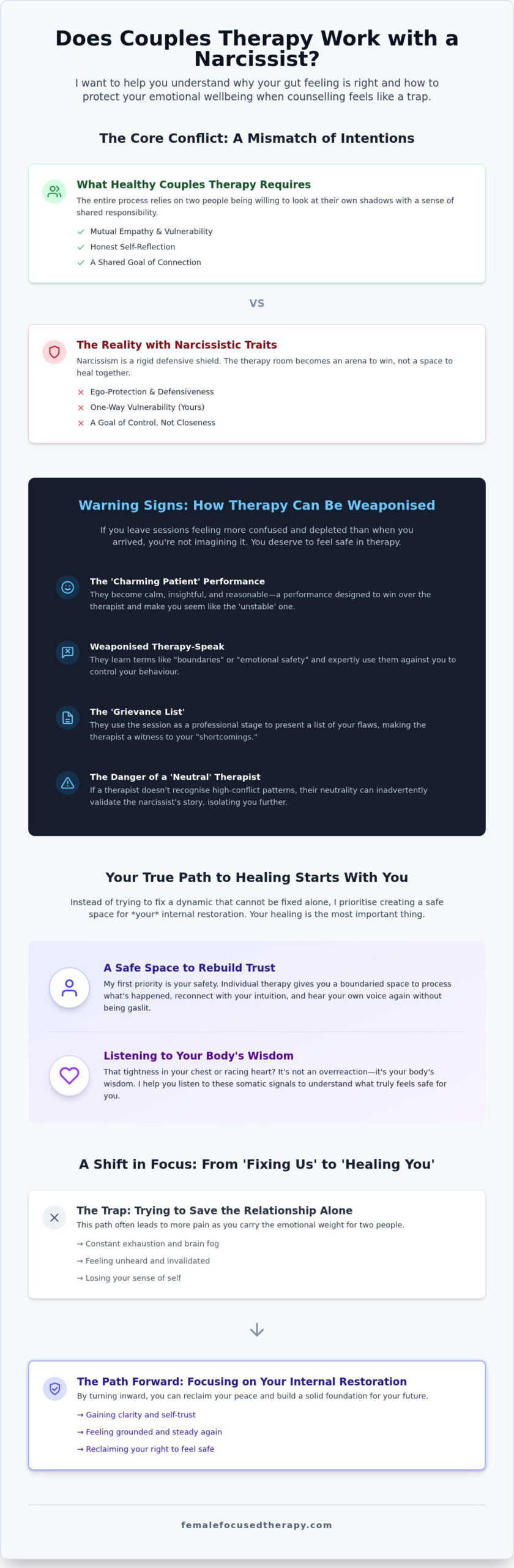
I know that deep, aching desire to find a professional who can finally make things right. You’ve likely spent years adjusting your own behaviour, hoping that if you just found the right words or the right therapist, your partner would finally “get it.” It’s a natural, loving response to want to save your home and your history. But when we ask the question, does couples therapy work with a narcissist?, we have to look at what the process actually requires. Couples work relies entirely on two people being willing to look at their own shadows with a sense of mutual empathy and self-reflection.
Narcissism is often a rigid defensive shield built to protect against any form of perceived criticism or vulnerability. In a therapeutic setting, this creates a fundamental conflict. If one person uses the sessions to genuinely grow while the other uses them to defend their ego, the room is no longer a safe space. From my perspective as a therapist, I often see this as a significant safety issue for the woman involved. You’re being asked to open up and be vulnerable in front of someone who may later use those very admissions as ammunition during an argument at home.
When Vulnerability is a One-Way Street
The collaborative nature of therapy only works if both people are playing by the same rules. In a healthy dynamic, you both own your part, even when it’s uncomfortable. With a narcissist, the therapist is often viewed as a pawn to be won over or an enemy to be discredited. This is fundamentally different from “normal” relationship conflict where both partners might be messy but ultimately want connection. In these high-conflict dynamics, the goal is often control rather than closeness. When one person refuses to be wrong, the “work” of the relationship falls entirely on you, which is why does couples therapy work with a narcissist? is such a complex question to answer with a simple yes or no.
Recognising the ‘Felt Sense’ of the Relationship
I want you to take a moment to notice how your body feels when you even think about suggesting couples therapy. Does your chest tighten? Do you find yourself rehearsing exactly what you’ll say so you don’t “set him off” in front of the professional? This is your somatic intelligence telling you that the emotional work is currently one-sided. The physical exhaustion and brain fog you’re feeling are real responses to a lack of safety. It’s the weight of carrying the emotional health of two people on your own shoulders. Your instinct that something feels “off” isn’t a mistake; it’s a vital piece of information about your relationship trauma that deserves to be heard.
Why Couples Counselling Can Become a Tool for Manipulation
I’ve sat with many women who describe a baffling shift the moment they enter the therapy room. Their partner, who may have been cold or volatile just an hour before, suddenly becomes the “Charming Patient.” They speak with calm, measured tones and display a level of insight that feels completely foreign to you. It’s a performance designed to win over the therapist, often leaving you looking like the “difficult” or “unstable” one because you’re reacting to the hidden reality of your home life.
This is where the process often breaks down. Instead of a space for healing, the session can become a televised trial of your flaws. I’ve seen narcissists bring a literal or mental “Grievance List,” using the therapist as a professional witness to your supposed shortcomings. When you ask, does couples therapy work with a narcissist?, you have to consider how they might weaponise the very language of growth. They often learn terms like “boundaries” or “emotional safety” and use them to control your behaviour rather than to improve the relationship.
You might leave these sessions feeling more confused and depleted than when you arrived. It’s a specific kind of exhaustion that comes from being gaslit in front of a professional. If the therapist doesn’t recognise these high-conflict patterns, they may inadvertently validate your partner’s narrative, making you feel even more isolated in your experience.
The Danger of the ‘Neutral’ Therapist
Most traditional training encourages therapists to remain neutral, but in the context of relationship trauma, neutrality can be harmful. If a practitioner treats a power imbalance as a simple “communication issue,” they’re essentially asking you to compromise with your own mistreatment. It’s vital to identify if your therapist truly understands narcissistic traits, otherwise, you risk being further traumatised by a process that is supposed to help you.
Post-Session Fallout: The Price You Pay at Home
The hour in the chair is often just the beginning of the ordeal. I’ve worked with many women in Singapore who describe the “punishment” that follows a session where they were finally honest about their partner’s behaviour. Your vulnerability becomes future ammunition, used against you during the car ride home or in the days that follow. This fallout makes it nearly impossible to be genuinely open in future sessions.
Protecting your emotional energy is your first priority. If you find that every session feels like a trap, it may be time to step away from the shared sofa. Choosing individual psychotherapy sessions can provide a truly safe, boundaried space where your reality isn’t up for debate and your restoration is the only goal.
Individual vs. Couples Therapy: Choosing Your Path to Healing
I often see women in Singapore who feel a heavy sense of obligation to “try everything” before they consider changing their life or leaving a difficult dynamic. You might feel that if you don’t agree to joint sessions, you’re the one being “difficult” or not trying hard enough. However, I consistently prioritise individual work for women experiencing Relationship Trauma & Narcissistic Abuse. Safety is the non-negotiable foundation of any therapeutic process. If you cannot speak your truth without fear of the “price” you’ll pay at home, the room simply isn’t safe.
When you ask, does couples therapy work with a narcissist?, it’s important to realise that couples work is actually contraindicated in many abusive dynamics. Most professional guidelines suggest that joint sessions can inadvertently put the survivor at greater risk. My goal in individual sessions is to help you rebuild the self-trust he has systematically dismantled. We focus on your internal restoration rather than the impossible task of managing his external behaviour.
Reclaiming Your Narrative in a Private Space
In a private session, you finally have the freedom to speak without being interrupted, corrected, or “fact-checked” by your partner. This is where we begin to clear the thick brain fog that comes from years of gaslighting. I provide a boundaried space where your experience is the only one that matters. We work on several key areas of your healing:
- Identifying your own needs and desires, which have likely been buried under his demands.
- Processing the trauma of the relationship without having to defend your perspective in real-time.
- Regaining your voice and learning to trust your own intuition again.
Comparing the Outcomes: What to Expect
The outcomes of individual therapy are very different from the goals of standard couples work. While joint therapy often focuses on “saving the marriage,” I believe that isn’t always the healthiest or safest goal for you. Individual restoration focuses on your long-term emotional wellbeing. It’s about finding the strength to set boundaries that are for your protection, not for his control. You learn that your value isn’t tied to how well you can placate another person.
By choosing yourself, you aren’t giving up. You’re starting a journey toward a life where you no longer feel like you’re walking on eggshells every day. You deserve a space where you can breathe, reflect, and grow without the constant weight of someone else’s ego holding you down.
Listening to Your Body: Somatic Clues in the Therapy Room
My work as a psychotherapist is deeply informed by my background as a yoga master. I don’t just listen to the words being spoken in the room; I watch the way a woman’s body responds to the environment. When you ask, does couples therapy work with a narcissist?, the answer is often written in your physiology before your mind can even process the question. I see clients whose breath becomes shallow or whose shoulders hike up toward their ears the moment their partner starts to speak.
Your gut feeling isn’t a vague hunch. It is a sophisticated biological warning system that has evolved over thousands of years to keep you safe. In a high-conflict relationship, your nervous system is often stuck in a state of high alert. This chronic stress can manifest as physical exhaustion, digestive issues, or a constant sense of being “on edge.” Your body knows when the narrative is being twisted, even if you’ve been conditioned to doubt your own reality.
When we explore the question, does couples therapy work with a narcissist?, we must look at the physical cost of staying in a dynamic where your reality is constantly denied. This somatic load is why many women describe feeling “heavy” or “foggy” after a joint session. Your body is trying to tell you that the environment isn’t conducive to genuine healing or safety.
The Physicality of Gaslighting
Your mind might try to excuse his behaviour or rationalise why the therapy session went “well,” but your body remembers the truth. Common somatic symptoms of narcissistic abuse include a tight chest, a knot in the stomach, or a “freezing” sensation where you feel unable to speak up for yourself. These are physical indicators that your boundaries are being crossed in real-time.
I integrate Somatic Movement & Yoga for Women into my practice because healing must happen in the body as much as the mind. We use mindfulness to help you stay grounded when you feel the world spinning. By learning to notice these tiny physical shifts, you can start to trust yourself again. You begin to realise that your body is a reliable ally that has been trying to protect you all along.
Restoring Your Nervous System
The journey toward restoration involves moving out of a constant “fight or flight” response and back into a state of rest. This isn’t a quick fix; it’s a gentle process of teaching your nervous system that it is finally safe to let go. I use simple, grounding techniques to help you feel safe in your own skin again, such as intentional breathing and soft, mindful movement.
When you step away from the pressure of “fixing” a relationship that feels like a battlefield, your body finally has the space to heal. Reclaiming your physical sense of safety is a vital step in rebuilding your internal confidence. If you feel ready to prioritise your own emotional and physical wellbeing, you can book individual psychotherapy sessions to begin your own path to restoration.
Your Next Steps: Moving Toward Internal Restoration
I see so many women in Singapore caught in a cycle of “trying harder” for two people. You’ve likely read every book, adjusted your tone, and perhaps even suggested joint sessions in a desperate bid for peace. If you are still wondering, does couples therapy work with a narcissist?, the most compassionate answer I can give is that it cannot work if you are the only one present for the truth. You cannot create a bridge when the other person is busy dismantling the foundation.
Choosing to focus on your own healing is not the same as “giving up.” It is a profound act of self-preservation. When you stop pouring your energy into a bottomless vessel, you finally have the resources to rebuild your own life. I want to reassure you that you are not alone in this experience. Many high-functioning, intelligent women find themselves in this exact position, and there is a clear path back to your sense of self.
Prioritising Your Emotional Safety
Your mental health requires a safety plan just as much as your physical wellbeing does. This starts with creating a confidential, female-focused support system where your reality isn’t up for debate. Finding a therapist who truly understands the nuances of narcissistic abuse is vital. Without this specific lens, a practitioner might inadvertently encourage you to stay in a dynamic that is actively harming you. I provide a safe, boundaried space where we can work through the fog together, unhurried and without judgment.
Taking the first step toward a life that feels like yours again can feel daunting. You’ve been conditioned to put your needs last for so long that prioritising yourself might feel like a betrayal. It isn’t. It’s the beginning of your internal restoration. We will work on steadying your nervous system and helping you trust your own intuition again, step by manageable step.
Take a Realistic Next Step Today
I invite you to explore my free therapy resources to help you begin making sense of your experience in your own time. When you’re ready, a private consultation can offer the clarity that joint sessions often obscure. I encourage you to take a quiet moment today to centre yourself and perhaps even speak this commitment aloud: I choose my own peace over the chaos of a relationship that demands my disappearance.
You don’t have to carry this weight alone anymore. Your journey toward healing and self-reliance starts with a single, courageous decision to put yourself first. Book a session with me to begin your own healing journey and let’s start the work of bringing you back to yourself.
Reclaiming Your Peace and Trusting Your Truth
You’ve likely spent a long time looking for answers and wondering, does couples therapy work with a narcissist? While the hope for a shared resolution is a testament to your kindness, it’s vital to recognise when a process is no longer serving your safety. We’ve explored how joint sessions can be weaponised and why your body’s somatic signals are such a powerful guide to your actual reality.
Healing doesn’t require his participation. It starts when you decide that your emotional wellbeing and internal restoration are worth the investment. As a Registered Integrative Psychotherapist and a specialist in trauma-informed care for women, I’m here to provide a safe, boundaried space for you to find your footing again. Whether you’re in Singapore or elsewhere, confidential online sessions are available to support you; for those seeking additional specialized support in trauma and relationship therapy from resources like The Project of You, you can click here to learn more.
You don’t have to navigate this fog alone. I invite you to book your private consultation with Cheryl today to begin prioritising your own needs. You deserve a life that feels steady, grounded, and entirely your own. I look forward to holding space for you as you move toward the clarity you deserve.
Frequently Asked Questions
Is it ever safe to go to couples therapy with a narcissist?
I believe safety must be the foundation of all therapeutic work. In high-conflict dynamics, joint sessions often create a space where your vulnerability is used as ammunition during arguments at home. If you’re asking, does couples therapy work with a narcissist?, you must first consider if you can speak freely without fear of the “price” you’ll pay later. For many women, the answer is sadly no.
What if the therapist doesn’t see the narcissism?
This is a painful and common experience I hear about from many clients. Narcissists are frequently “charming patients” who perform exceptionally well in professional settings. If a therapist doesn’t have specific training in high-conflict personalities, they might inadvertently validate your partner’s narrative. This leaves you feeling gaslit in front of a witness. Trust your intuition if you feel the therapist is being manipulated.
Can a narcissist ever change through therapy?
Change is only possible when someone is willing to look at their own shadows with genuine empathy and self-reflection. For someone with narcissistic traits, this level of vulnerability is often seen as a direct threat to their ego. While people can change their outward behaviours for a time, the deep internal shift required for a healthy relationship is rare. It’s usually more productive to focus on your own restoration.
Why do I feel worse after couples counselling sessions?
You likely feel worse because you’re doing the emotional work for two people while your own reality is being denied. In these sessions, you’re often forced to defend your character while your partner shifts blame or uses “therapy-speak” to control the narrative. This leads to a specific kind of exhaustion and brain fog. Your body is reacting to the lack of safety in the room, telling you that your boundaries are being crossed.
What should I look for in a therapist if I suspect narcissistic abuse?
Look for a practitioner who is trauma-informed and specifically mentions experience with high-conflict personalities or relationship trauma. It’s helpful to find someone who understands gender-specific challenges and won’t push for “neutrality” when there’s a clear power imbalance. You need a space that prioritises your emotional safety and internal confidence over “saving the marriage” at any cost.
How do I tell my partner I want individual therapy instead?
I suggest keeping the conversation focused entirely on your own needs rather than their behaviour. You might say, “I’ve realised I need a private space to work through my own stress and focus on my health.” Avoid using labels or attempting to diagnose them, as this often triggers a defensive reaction. Frame it as a necessary step for your own mental clarity and peace.
Can couples therapy work if the narcissist is ‘high-functioning’?
High-functioning individuals are often even more skilled at the “charming patient” performance in the therapy room. They may use their intelligence to master the language of personal growth, making it even harder for a neutral therapist to spot the underlying patterns. The core issue remains a lack of empathy and a refusal to be genuinely vulnerable, regardless of how successful they are in their professional life.
What happens if we stop therapy altogether?
Stopping a process that feels harmful is often the first step toward your own healing journey. You might feel a sudden sense of relief as the pressure to “fix” the unfixable finally lifts. This gives you the emotional energy to focus on your own internal restoration. Without the constant cycle of therapeutic conflict, you can finally start to hear your own voice again and trust your own intuition.

Article by
Cheryl Kennedy MacDonald MA BA (Hons) Pg. Dip. SAC BACP
Cheryl Kennedy MacDonald is a psychotherapist specialising in women’s mental health, relationships, and life transitions. She works with women navigating trauma, relationship breakdown, identity shifts, and midlife change, helping them rebuild self-trust, emotional stability, and a clear sense of who they are and what they want.
With over 20 years’ experience working with women internationally, Cheryl is the founder of YogaBellies, a global women’s yoga school, and the creator of the Birth ROCKS method. Her work sits at the intersection of psychotherapy and embodiment, integrating evidence-based therapeutic approaches with somatic, body-based practices that support deep, lasting change.
Known for her grounded and direct approach, Cheryl moves beyond surface-level insight to address the patterns held in the body and nervous system. Her work supports women to regulate, reconnect, and respond to their lives from a place of clarity, strength, and self-respect.
She is a published author in academic journals and has written multiple books on women’s health, pregnancy, and midlife wellbeing, available on Amazon and leading book retailers worldwide.