
That bone-deep exhaustion you feel after a day of juggling everything-is it just stress, or something more? If you find yourself feeling increasingly cynical, disconnected, and burdened by the guilt of not being able to ‘handle it all,’ please know you are not alone. This profound state of emotional, physical, and mental depletion is often burnout, a condition that presents uniquely in women due to societal pressures and expectations. Recognising this is the first courageous step towards healing, and exploring specialised burnout therapy Singapore offers can be a truly transformative journey back to yourself.
This compassionate guide is here to support you through that process. Together, we will gently explore the subtle signs of burnout in women, understand its root causes, and illuminate how a dedicated therapeutic space can help you heal and thrive. You will learn practical, sustainable strategies to manage overwhelming demands, prevent future burnout, and finally feel energetic and engaged with your life again. This isn’t just another item on your to-do list; it’s a supportive space to rebuild, reconnect, and rediscover your wellbeing.
Understanding Burnout: More Than Just Stress, Especially for Women
You may feel like you’re running on empty, that the constant pressure has become unbearable. This profound sense of exhaustion is often dismissed as ‘just stress,’ but it’s crucial to recognise it for what it truly is: burnout. Defined as a state of chronic workplace stress that has not been successfully managed, burnout is an occupational phenomenon with deep and lasting effects on your wellbeing. It’s a gradual erosion of your spirit, leaving you feeling depleted and disconnected. For a deeper dive into its clinical background, you can explore this resource on Understanding Occupational Burnout.
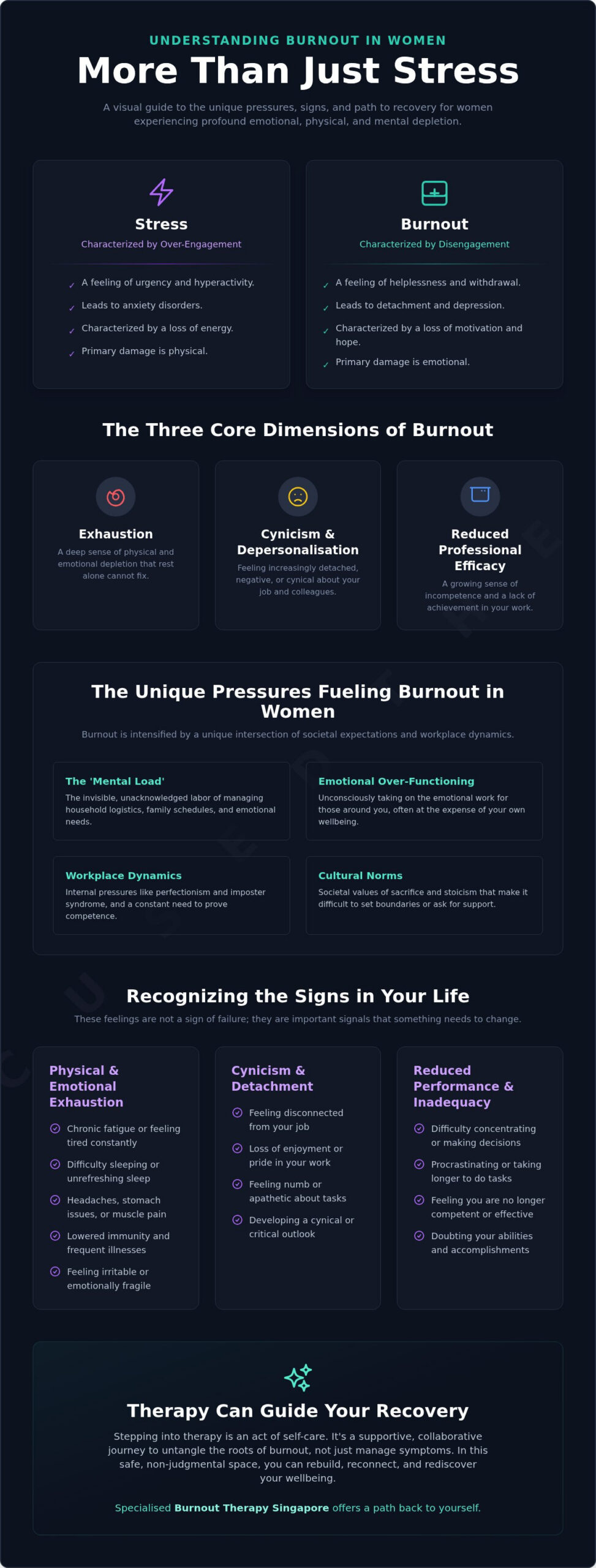
Burnout manifests across three core dimensions:
- Exhaustion: A deep sense of physical and emotional depletion that rest alone cannot fix.
- Cynicism or Depersonalisation: Feeling increasingly detached, negative, or cynical about your job and colleagues.
- Reduced Professional Efficacy: A growing sense of incompetence and a lack of achievement in your work.
While stress is often characterised by over-engagement-a feeling of urgency and hyperactivity-burnout is the opposite. It is a state of disengagement, where you withdraw, feel helpless, and lose motivation. For many professionals, exploring burnout therapy singapore becomes a vital step toward navigating this complex state and rebuilding a connection with themselves and their work.
For women in Singapore, this experience is often intensified by a unique intersection of professional demands and societal expectations.
The ‘Mental Load’ and Emotional Over-Functioning
Beyond professional responsibilities, many women carry the invisible weight of the ‘mental load’-the endless, often unacknowledged, labour of managing household logistics, family schedules, and emotional needs. This is compounded by societal pressures that position women as primary caregivers, leading to emotional over-functioning, where you unconsciously take on the emotional work for those around you, often at the expense of your own wellbeing.
Workplace Dynamics and the ‘Glass Cliff’
In the demanding professional landscape of Singapore, internal pressures like perfectionism and imposter syndrome can flourish. Women may feel a constant need to prove their competence, pushing themselves harder to overcome perceived biases. This can be amplified by cultural norms that value sacrifice and stoicism, making it difficult to set boundaries or ask for support. This unique combination of internal and external pressures makes women particularly vulnerable to burnout.
Recognising the Signs of Burnout in Your Life
Burnout rarely announces its arrival. Instead, it often creeps in slowly, a gradual erosion of your energy, enthusiasm, and sense of self. What starts as a stressful week can quietly morph into months of exhaustion. It’s crucial to remember that these feelings are not a sign of failure or weakness; they are important signals from your mind and body that something needs to change. Learning to listen to these signals is the first step toward healing. Leading medical resources provide clear frameworks for Recognizing the signs of burnout, which often manifest across your physical, emotional, and professional life.
Physical and Emotional Exhaustion
This is often the most noticeable and debilitating aspect of burnout. It’s a deep, bone-weary fatigue that sleep doesn’t seem to fix. You may be here because you feel completely drained, both physically and emotionally. Does any of this feel familiar?
- Chronic fatigue or feeling tired most of the time
- Difficulty sleeping, such as insomnia or unrefreshing sleep
- Increased physical symptoms like headaches, stomach issues, or muscle pain
- Lowered immunity, leading to more frequent illnesses
- A persistent feeling of dread or anxiety about the workday ahead
- Feeling tearful, irritable, or emotionally fragile
It’s important to note that chronic stress can also manifest in other physical ways, such as changes to your hair and scalp. If this is a concern, seeking advice from a doctor-led clinic like Terra Medical can be a helpful step alongside addressing the root causes of burnout.
Cynicism, Detachment, and a Loss of Purpose
When you’re burned out, it’s common to build an emotional wall as a way to cope. This can lead to feeling disconnected from your work, your colleagues, and even the purpose that once drove you. You might notice a growing sense of cynicism or negativity that wasn’t there before.
- Feeling disconnected or disengaged from your job
- A loss of enjoyment or pride in your work and achievements
- Feeling numb or apathetic about tasks and responsibilities you used to care about
- Developing a cynical or critical outlook towards your work environment
Reduced Performance and a Sense of Inadequacy
Burnout directly impacts your cognitive functions, making it harder to perform at the level you’re used to. This can create a frustrating cycle where you feel less effective, which in turn fuels feelings of self-doubt and inadequacy. This might look like:
- Difficulty concentrating, remembering things, or making decisions
- Procrastinating or taking much longer to complete tasks
- A nagging feeling that you are no longer competent or effective in your role
- Doubting your abilities and accomplishments, despite past successes
If these checklists resonate with you, please know you are not alone. Acknowledging these patterns is a courageous step. Navigating this experience with professional support can make all the difference, and specialised burnout therapy Singapore provides a safe, confidential space to rebuild your wellbeing and find clarity again.
How Burnout Therapy Can Guide Your Recovery
Stepping into therapy for burnout is an act of profound self-care. It’s not about finding a quick fix, but about beginning a supportive, collaborative journey toward lasting recovery. The goal isn’t simply to manage the exhaustion; it’s to gently untangle the roots of why it happened in the first place. Burnout is more than just stress-as the World Health Organization’s definition of burnout clarifies, it is a complex occupational phenomenon. Effective burnout therapy Singapore offers is a process that creates a safe, non-judgmental space where you can be vulnerable, explore the underlying causes, and rebuild a more sustainable way of living and working.
Step 1: Identifying the Root Causes and Triggers
Together, we move beyond the surface-level symptoms of exhaustion and cynicism. In our sessions, we will compassionately explore the specific sources of your burnout. This often involves looking at ingrained patterns you may not even be aware of, such as:
- Workplace dynamics and unrealistic expectations.
- Personal beliefs around productivity, perfectionism, and self-worth.
- A tendency towards people-pleasing or difficulty setting boundaries.
By understanding these deeper triggers, we can begin the foundational work of true healing.
Step 2: Developing Your Personalised Coping Toolkit
This stage is about equipping you with practical, evidence-based tools to navigate stress and restore your wellbeing. Your personalised toolkit will be tailored to your unique needs, incorporating strategies to help you manage difficult emotions and regulate your nervous system. We will explore techniques from Cognitive Behavioural Therapy (CBT) to challenge unhelpful thought patterns, mindfulness practices to ground you in the present, and exercises in self-compassion to counter your harsh inner critic. This is especially crucial for women navigating burnout alongside co-occurring challenges like ADHD, where a tailored approach is essential.
Step 3: Rebuilding Boundaries and Reconnecting with Your Values
Recovery culminates in rebuilding a life that feels authentic and aligned with your core values. Therapy provides the support and guidance to put your new insights into practice. You will learn how to confidently say ‘no’ to protect your energy and reclaim your time. We will work together to redefine what success and a meaningful life look like for you, separate from external pressures. This is a powerful process of reconnecting with hobbies, relationships, and parts of yourself that were lost in the cycle of burnout, allowing you to move forward with renewed clarity and self-trust.
Finding the Right Burnout Therapist in Singapore
The single most important factor in successful therapy is the quality of the relationship you build with your therapist. Feeling safe, seen, and understood is not a luxury-it is the foundation of healing. Taking the time to find the right person is an investment in your own wellbeing. Here are a few practical steps to help you navigate this important decision.
Look for a Specialist, Not a Generalist
While many therapists are skilled, someone who specialises in burnout and the unique pressures faced by professional women offers a deeper level of understanding. Look for a professional with experience in workplace stress, perfectionism, or navigating significant life transitions. A therapist with a trauma-informed approach is essential, as this ensures they are equipped to create a safe, non-judgmental space where you can be vulnerable and begin to heal.
Consider the Therapeutic Approach
Therapy is not one-size-fits-all. Different modalities work for different people. Some common approaches include:
- Cognitive Behavioural Therapy (CBT): Focuses on identifying and changing unhelpful thinking patterns and behaviours.
- Psychodynamic Therapy: Explores how past experiences and unconscious patterns influence your present.
- Somatic Therapy: Helps you connect with your body to process stress and trauma held physically.
An integrative approach often provides the most tailored support, blending different techniques to meet your specific needs. The goal is to find a process that resonates with you and empowers you on your path to recovery.
The Importance of a Consultation
Most therapists offer an initial consultation, which is your opportunity to gauge rapport. This is more than a formality; it’s a chance to see if you feel a genuine connection. When choosing a provider for burnout therapy singapore, ask yourself: Do I feel heard and respected? Does this person’s energy feel supportive? Trust your intuition. The right therapist will make you feel at ease, creating a sense of hope and collaboration from the very first conversation.
If you are ready to explore how therapy can help, you can learn more about how we work with women to rebuild confidence and find balance.
Your First Steps Towards Healing: What to Expect
Taking the step to seek support is a profound act of self-care. It’s an acknowledgement that you deserve to feel better, and a courageous move towards reclaiming your wellbeing. We understand that starting burnout therapy Singapore can feel daunting, especially when you’re already feeling depleted. This is why we aim to make the process as gentle and transparent as possible. You are not alone in this, and the path to recovery begins with this single, supportive step.
Preparing for Your First Session
You don’t need to have everything figured out before your first conversation. There is no pressure to arrive with a perfect summary of your struggles or to know exactly what to say. All that is required is a willingness to explore. It can be helpful to gently reflect on a few things:
- What are the biggest challenges you’re facing right now?
- What do you hope might feel different in your life?
- What does feeling “well” look like to you?
Simply bringing an open and curious mind is more than enough to begin.
What Happens in a Consultation?
Your initial consultation is simply a confidential, safe conversation. It’s an opportunity for you to share what’s been happening in a non-judgemental space and for me to listen with warmth and understanding. Together, we can begin to clarify your concerns and explore what you hope to achieve through therapy. Importantly, it is also your chance to see if you feel comfortable and if my approach feels like the right fit for you. Trust and connection are the foundations of effective therapy.
Taking Action Today
We know that reaching out is often the most difficult part of the journey. Burnout recovery is not a quick fix, but a gentle process of rebuilding and reconnecting with yourself. Finding the right professional for burnout therapy in Singapore is a critical part of that process. You deserve to navigate your life with a sense of clarity, energy, and purpose, and you don’t have to find your way back on your own.
If you are ready to take the next gentle step, we invite you to learn more about our approach and book a confidential consultation. Your journey towards a more authentic and fulfilling life can start today.
Your Path Forward From Burnout Starts Today
Navigating the overwhelming weight of burnout is a profound challenge, but as we’ve explored, recognising its unique impact on women is the first powerful step toward healing. Remember, burnout is far more than just stress-it’s a state of deep exhaustion that requires a nuanced, compassionate response. Recovery is not only possible; it is a journey of reconnection you deserve to take.
Finding the right professional for burnout therapy singapore is a crucial investment in your wellbeing. At Female Focused Therapy, you are offered a confidential and safe space designed specifically for women. Through a trauma-informed, integrative therapeutic approach, we provide specialised support to help you navigate this difficult period and rebuild self-trust. Confidential sessions are available in-person in Singapore and online globally, ensuring support is always within reach.
You do not have to walk this path alone. Begin your journey to recovery. Book a confidential consultation today. Taking this step is an act of profound self-compassion, and your path towards clarity, confidence, and renewed energy can begin now.
Frequently Asked Questions About Burnout Therapy
Is burnout a recognised medical condition in Singapore?
While burnout is not classified as a distinct medical condition in Singapore, it is recognised by the World Health Organization (WHO) as a serious “occupational phenomenon.” Mental health professionals across Singapore widely acknowledge it as a significant state of emotional, physical, and mental exhaustion resulting from prolonged workplace stress. Seeking support is a valid and important step to protect your long-term health and rebuild your sense of wellbeing.
How long does burnout therapy typically take?
The duration of therapy is a deeply personal journey that is unique to each individual. Many professionals begin to feel significant relief and learn effective coping strategies within 3 to 6 months of consistent sessions. Others may benefit from longer-term support to address underlying patterns. Our approach is to work at a pace that feels safe and sustainable for you, ensuring that the healing and growth you achieve are lasting.
Can I recover from burnout without quitting my job?
Yes, it is often possible to recover from burnout without leaving your job. Therapy provides a confidential space to develop practical strategies for managing your current work environment. We can focus on rebuilding your resilience by setting firm boundaries, improving communication, and changing your relationship with stress and work-related pressures. The goal is to empower you to find a more sustainable and fulfilling way to navigate your professional life.
What is the difference between burnout and depression?
While they share symptoms like exhaustion, the key difference lies in their scope. Burnout is specifically work-related, defined by cynicism towards your job, emotional exhaustion, and a feeling of reduced professional accomplishment. Depression is a broader clinical mood disorder that pervades all areas of your life, not just work. However, chronic and unaddressed burnout can be a significant risk factor for developing depression, making early intervention vital.
How much does burnout therapy cost in Singapore?
The cost for private burnout therapy in Singapore typically ranges from S$180 to S$250+ per 50-minute session. The rate often depends on the therapist’s experience, qualifications, and the location of their practice. Some therapists may offer packages for multiple sessions. It is always a good idea to inquire directly about fees during your initial consultation to find a professional who aligns with your needs and budget.
Is online therapy as effective as in-person for treating burnout?
Absolutely. For many busy professionals, online therapy is just as effective as face-to-face sessions for treating burnout. Numerous studies confirm its efficacy, and it offers greater convenience, flexibility, and accessibility. The most critical element for successful therapy is the quality of the therapeutic relationship you build with your counsellor. A strong, supportive connection can be fostered just as effectively through a secure online platform, right from the comfort of your own space.

Article by
Cheryl Kennedy MacDonald MA BA (Hons) Pg. Dip. SAC BACP
Cheryl Kennedy MacDonald is a psychotherapist specialising in women’s mental health, relationships, and life transitions. She works with women navigating trauma, relationship breakdown, identity shifts, and midlife change, helping them rebuild self-trust, emotional stability, and a clear sense of who they are and what they want.
With over 20 years’ experience working with women internationally, Cheryl is the founder of YogaBellies, a global women’s yoga school, and the creator of the Birth ROCKS method. Her work sits at the intersection of psychotherapy and embodiment, integrating evidence-based therapeutic approaches with somatic, body-based practices that support deep, lasting change.
Known for her grounded and direct approach, Cheryl moves beyond surface-level insight to address the patterns held in the body and nervous system. Her work supports women to regulate, reconnect, and respond to their lives from a place of clarity, strength, and self-respect.
She is a published author in academic journals and has written multiple books on women’s health, pregnancy, and midlife wellbeing, available on Amazon and leading book retailers worldwide.