
You’re staring at a basket of clean laundry that’s been sitting there for three days, feeling a heavy wave of shame because such a “simple” task feels like climbing a mountain. Perhaps you’ve spent years being told you’re just anxious or depressed, yet you’re still bone-tired from the constant effort of masking your struggles to appear “normal” to the outside world. I’ve been exactly where you are, and I want you to know that understanding adult adhd in women starts with the realisation that you aren’t lazy or broken. Your brain is simply wired in a way that requires a different kind of care.
I agree that it’s incredibly draining to live in a world that wasn’t designed for your unique rhythm, especially when life transitions or hormonal shifts make everything feel suddenly unmanageable. My promise is to help you make sense of your neurological landscape through a compassionate, somatic lens that honours both your mind and body. We’ll explore why your symptoms might be intensifying right now and I’ll share the gentle, non-clinical strategies I use to help my clients reclaim their self-trust and find a sense of internal stability.
Key Takeaways
- Discover why your symptoms were likely overlooked in childhood and how to release the shame of not meeting societal expectations of being “perfectly organised.”
- Gain a clearer understanding adult adhd in women by identifying the internalised restlessness and executive dysfunction that often hide behind a high-functioning exterior.
- Learn how your hormones and life transitions, like perimenopause, directly impact your dopamine levels and the severity of your daily symptoms.
- Explore somatic strategies that move you away from stressful time management and toward a more compassionate way of managing your energy and nervous system.
- Shift your perspective from trying to “fix” your brain to building a foundation of self-trust and finding support that truly honours your neurodivergent experience.
The Unseen Struggle: Why ADHD Often Goes Unnoticed in Women
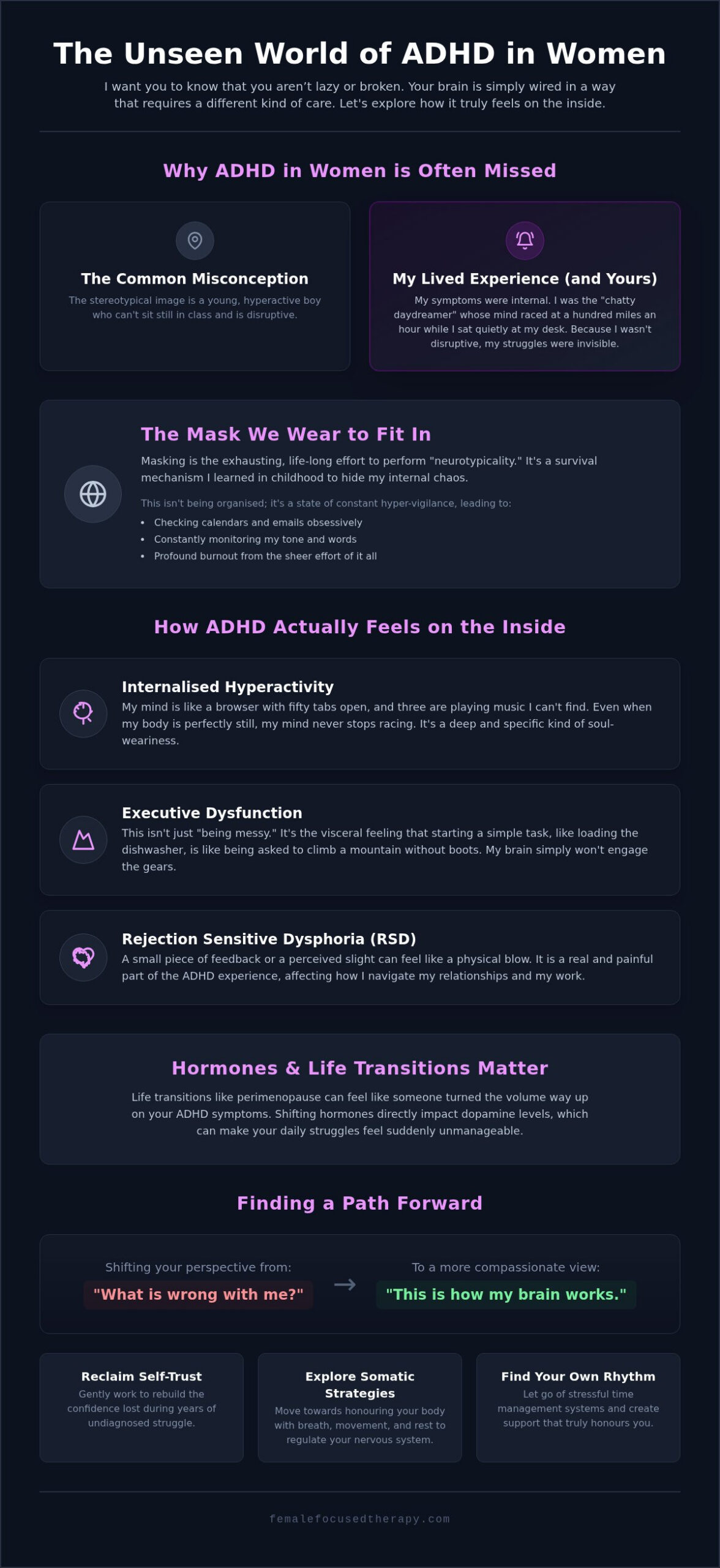
Growing up, I was often told I was “too chatty” or that I needed to “stop daydreaming” and focus. Like many girls, my symptoms didn’t look like the stereotypical hyperactive child who couldn’t sit still. Instead of running around the classroom, my mind was racing at a hundred miles an hour while I sat quietly at my desk. Because I wasn’t disruptive, my struggles were invisible to the adults around me.
There’s a heavy societal weight on women to be the natural organisers, the nurturers, and the keepers of the family schedule. When we struggle to keep the kitchen tidy or forget an important email, we don’t usually think about neurology. We think about failure. For years, I misidentified my own internal restlessness as chronic anxiety, never realising that my brain was simply trying to navigate a world that wasn’t built for its rhythm.
Truly understanding adult adhd in women requires us to look past the label of “inattention.” At its core, Adult attention deficit hyperactivity disorder is a struggle with regulation. It affects how we manage our emotions, our energy, and our executive functions. It isn’t that we can’t pay attention; it’s that we often can’t choose where that attention goes or how to pull ourselves out of a state of overwhelm.
The Mask We Wear to Fit In
Masking is the exhausting effort to perform neurotypicality, and for most women, it’s a survival mechanism we’ve used since childhood. We learn to mimic the social cues of others and over-compensate for our internal chaos by becoming hyper-vigilant. We check our calendars ten times a day and obsess over our tone of voice just to ensure we don’t “slip up” or appear disorganized.
There’s a massive difference between being naturally organised and being in a state of constant hyper-vigilance. One feels like a steady flow, while the other feels like you’re holding your breath, waiting for the moment someone notices you’re actually struggling to keep it all together. This constant performance is why so many of us hit a wall of profound burnout in our thirties or forties. The mask simply becomes too heavy to carry.
Why a Late Diagnosis Can Feel Like Grief
When you finally start understanding adult adhd in women, it’s common to feel a wave of grief for the younger version of yourself who struggled so hard without knowing why. You might find yourself stuck in “what if” thoughts. You might wonder how different your career or your relationships could have been if you’d had the right support decades ago.
In my ADHD therapy sessions, I help women navigate this complex transition. We move away from the painful question of “what is wrong with me” and toward a compassionate acceptance of “this is how my brain works.” It’s a journey of internal restoration. We work together to rebuild the self-trust that was lost during those years of undiagnosed struggle.
Recognising the Signs: How ADHD Actually Feels on the Inside
When you look at a clinical checklist for ADHD, you might not see yourself. Most diagnostic tools were built around the external behaviours of young boys. For us, hyperactivity is rarely about running around; it’s an internalised storm. It’s the feeling of a mind that never stops racing, even when your body is perfectly still on the sofa. You might look calm to the outside world, but inside, your mind is like a browser with fifty tabs open, and three of them are playing music you can’t find.
This internalised restlessness is a core part of understanding adult adhd in women. It leads to a specific kind of exhaustion. You spend your day constantly monitoring your own behaviour, checking your tone, and trying to keep your thoughts organised. By the time evening rolls around, you aren’t just tired; you’re soul-weary from the effort of performing a version of yourself that feels coherent to others.
Then there’s executive dysfunction. This isn’t just “being a bit messy.” It’s the visceral feeling that “just starting” a simple task, like replying to a text or loading the dishwasher, is like being asked to climb a mountain without boots. Your brain simply won’t engage the gears. This is often accompanied by Rejection Sensitive Dysphoria (RSD), where a small piece of feedback or a perceived slight feels like a physical blow. A clinical review of ADHD in women and girls highlights how these emotional and internalised symptoms are frequently the most debilitating parts of the condition.
The Fog of Inattentive ADHD
Have you ever found yourself nodding along in a meeting, only to realise you’ve “checked out” for the last five minutes? This isn’t a lack of intelligence. It’s the “thousand-yard stare” that happens when your brain retreats into the rich, vivid internal world women with ADHD often inhabit. The shame that follows losing the thread of a conversation can be crushing, making you feel disconnected from the people right in front of you.
In a typical day, this might look like leaving your tea to go cold in five different rooms or losing your keys while they’re literally in your hand. These aren’t just “ditzy” moments; they are signs of a brain that is constantly prioritising new stimuli over the mundane details of daily life. If these experiences feel familiar, you might find it helpful to explore these patterns in a safe space where your neurodivergence is understood, not judged.
Emotional Intensity and Dysregulation
For many of us, emotions aren’t just feelings; they are tidal waves. We feel joy, grief, and frustration with an intensity that can feel frightening to others. You might struggle to “just let it go” because your nervous system is stuck in a high-alert state. It feels like an emotional sunburn, where even the smallest change in plans or a slightly sharp word feels like a painful touch on raw skin.
This deep sensitivity is part of the unique way ADHD presents in our lives. It’s why we often feel emotionally overwhelmed by things that others seem to breeze through. Understanding adult adhd in women means recognising that your deep empathy and intense feelings are a direct result of your brain’s wiring. You aren’t being “dramatic”; your system is simply processing the world at a much higher volume than those around you.
The Intersections: Life Transitions, Hormones, and ADHD
One of the most overlooked aspects of understanding adult adhd in women is the powerful role of our physiology. Oestrogen acts as a key modulator for dopamine, the neurotransmitter that helps us focus and regulate our mood. When our oestrogen levels are high, our brains often feel more capable and steady. However, when those levels drop, such as during the week before a period or during the transition into perimenopause, our dopamine levels plummet too. This can make your usual ADHD symptoms feel suddenly, and quite frighteningly, unmanageable.
For many women, perimenopause is the moment the “scaffolding” they’ve built to hold their lives together finally collapses. You might feel like your brain has suddenly “broken,” but in reality, your decreasing hormones are simply making your neurodivergence more visible. This is why a significant number of women receive their diagnosis in their forties or fifties. It’s a complex time of navigating life transitions where your internal and external worlds are shifting simultaneously.
It’s also vital to recognise how trauma and ADHD can exist side-by-side. Both can lead to a state of hyper-vigilance and emotional dysregulation, making it difficult to know where one ends and the other begins. When looking at ADHD symptoms in women, we must consider how a history of trauma might be amplifying your sensory sensitivities or your struggle to feel safe in your own body.
When the Coping Mechanisms Stop Working
Many women hit a wall when they reach motherhood or move into high-pressure leadership roles. The sheer volume of cognitive load, the constant “mental load” of managing a household, and the need to be “always on” can be too much for a neurodivergent brain to process. You aren’t failing; you are simply trying to run an intensive operating system on a battery that is being drained by too many open apps.
For women in these high-pressure positions, strategic support can be a lifeline. While I help with the internal psychological shifts, Francine Mbvoumbo works with leaders to navigate complex partnerships and shape the future of capital and community, providing the high-level strategic guidance needed to thrive in global roles.
My integrative approach focuses on helping you find a new way to balance. We look at how to support your nervous system through somatic grounding and tailored psychological strategies. We move away from the “push through” mentality and toward a way of living that honours your brain’s natural rhythm and capacity.
ADHD and Relationship Trauma
There is a painful link between ADHD and a vulnerability to narcissistic abuse. Because we often grow up feeling “wrong” or “too much,” we can become highly attuned to the needs of others as a way to find safety. This people-pleasing tendency, combined with the intense sting of rejection sensitivity, can make it incredibly difficult to set and maintain healthy boundaries.
Healing involves more than just understanding your brain; it’s about restoring your sense of self-worth. In our work together, we focus on releasing the deep-seated shame of being “difficult” or “overly sensitive.” You deserve relationships where your intensity is seen as a gift, not a burden, and where your neurodivergent needs are met with kindness rather than criticism.
Working With Your Brain: Practical and Somatic Strategies
For most of my life, I tried to force myself into neurotypical productivity boxes. I bought the planners, I set the alarms, and I felt like a failure when I couldn’t stick to them. True understanding adult adhd in women means accepting that we cannot manage time in the same way others do. We have to stop trying to manage minutes and start managing our energy and our nervous system instead.
One of the most effective tools I use is a “dopamine menu.” This is a pre-prepared list of activities that give your brain a healthy hit of engagement when you’re feeling under-stimulated or stuck in a “task paralysis” pit. It might include a five-minute dance break, a quick walk in the sun, or a specific creative hobby. The key is to have these options ready so you don’t default to the “cheap” dopamine of doom-scrolling, which usually leaves us feeling more depleted than before.
Somatic Tools for the Overwhelmed Mind
When your mind is racing at a hundred miles an hour, you can’t always “think” your way into calmness. You have to use your body to signal safety to your brain. This is where somatic movement and yoga become essential. By engaging with your physical self, you can lower your cortisol levels and pull yourself out of an ADHD spiral. If you’re feeling overwhelmed right now, try this 30-second grounding exercise:
- Press your feet firmly into the floor and feel the solid ground beneath you.
- Slowly scan the room and name three things you can see that are a specific colour, like green or blue.
- Take a deep breath in through your nose, and exhale through your mouth for twice as long as the inhale.
This simple sequence helps to quiet the “internalised hyperactivity” we discussed earlier. It reminds your nervous system that you are safe in the present moment, allowing your racing thoughts to settle. It’s not about “fixing” the ADHD; it’s about giving your body the support it needs to navigate the world with more ease.
Practical Hacks for Daily Life
I also encourage my clients to embrace what I call “the ADHD way” of doing things. If you struggle to put laundry away, give yourself permission to keep clean clothes in open baskets. If you forget to eat, keep high-protein snacks in every room. We also use “body doubling,” which is simply the act of having someone else present, even virtually, while you work. This provides a gentle “anchor” that helps your brain stay on task without the usual friction.
Externalising your memory is another game-changer. Stop trying to keep everything in your head. Use whiteboards on the fridge, voice notes to yourself, or visual cues around your home. These aren’t just “another planner”; they are vital supports that work with your brain’s natural wiring. If you’re ready to build a life that honours your unique rhythm, you can book a session with me to begin your journey of restoration.
Reclaiming Your Self-Trust and Finding a Path Forward
The journey toward understanding adult adhd in women often begins with a search for answers. But once you have those answers, the real work is about healing the relationship you have with yourself. For years, you’ve likely been fighting against your own nature, trying to force a neurodivergent brain to act in neurotypical ways. This constant conflict erodes your self-trust, leaving you feeling like an unreliable narrator in your own life.
My goal isn’t to “fix” you, because you aren’t broken. Instead, I work with women to facilitate a process of internal restoration. We look at the parts of you that have been shamed or hidden and we begin to invite them back into the light. Reclaiming your self-reliance means learning to work with your brain’s unique wiring rather than constantly apologising for it.
Finding a therapist who truly understands the female ADHD experience is a vital part of this path. You need someone who knows that your “messy” desk isn’t a character flaw and that your emotional intensity is a physiological reality. Specialized wellness centers, such as ZenVana Medical and Wellness Group LLC, can provide the comprehensive mental health support needed to navigate these challenges. When you feel truly seen, the heavy burden of “masking” begins to lift, allowing you to breathe more deeply and move forward with a renewed sense of stability.
Finding Your Safe Space
When we work together in individual psychotherapy, we create a sanctuary where your neurodivergence is respected. There is a profound relief in finally being able to speak about your struggles without the fear of judgement. You don’t have to perform here; you can simply be yourself, exactly as you are.
I offer online therapy because I know how difficult the logistics of daily life can be for a neurodivergent mind. Removing the stress of a commute or the sensory overwhelm of a clinical waiting room makes support much more accessible. It allows you to engage in our sessions from the safety and comfort of your own familiar environment.
A Final Reassurance From Me to You
I want to remind you of something very important. You are not “lazy,” you are not “stupid,” and you are certainly not “too much.” You are simply neurodivergent. The exhaustion you feel is the result of running a marathon every day just to keep up with a world that isn’t paced for you. Understanding adult adhd in women is the first step toward a life that feels lighter and more authentic.
Healing is possible when we stop fighting our nature and start nurturing it. It happens in the quiet moments when you choose compassion over criticism. If you feel ready to explore this path, I invite you to take one small, realistic step today. Perhaps it’s simply closing your eyes for thirty seconds and noticing the rhythm of your breath. When you’re ready for more, I’m here to walk alongside you when you feel ready to reach out.
Step Into a Life That Honours Your Rhythm
We’ve explored how understanding adult adhd in women is about so much more than just focus. It’s about recognising the racing mind, the impact of hormonal shifts, and the somatic weight of years spent masking. You now have the initial tools to begin shifting from exhausting time management to gentle, nervous system regulation. My deepest hope is that you feel less alone and more validated in your unique experience.
As a registered integrative psychotherapist with my own lived ADHD experience, I know that healing isn’t about fitting into a neurotypical box. My trauma-informed, gender-centric approach is designed to help you rebuild your self-trust and find internal restoration. Through flexible online therapy options, I support women globally in navigating these complex life transitions at a pace that feels safe and steady.
If you’re ready to explore your own neurodivergent journey in a safe, empathetic space, I invite you to book a consultation with me today. You’ve always been enough; now it’s time to build a life that truly honours your nature.
Frequently Asked Questions
What does ADHD look like in adult women?
ADHD in adult women often presents as internalised restlessness and executive dysfunction rather than the physical hyperactivity we see in children. It looks like a mind that won’t turn off, chronic forgetfulness, and feeling constantly overwhelmed by “simple” daily tasks like laundry or emails. You might appear perfectly calm to others while feeling like you’re running a marathon inside your own head.
Can you have ADHD and still be successful in your career?
Yes, many women with ADHD are high-achieving professionals who use hyper-focus and creativity to excel in their fields. However, this success often comes at a high cost of chronic exhaustion. You might be “brilliant but burnt out,” using massive amounts of mental energy to mask your struggles and meeting deadlines through sheer adrenaline at the very last second.
Why is ADHD in women so often misdiagnosed as anxiety?
ADHD is frequently misdiagnosed as anxiety because the internalised symptoms, like racing thoughts and restlessness, look identical to an anxiety disorder on the surface. When you’re constantly worried about forgetting things or missing social cues, you naturally feel anxious. Without understanding adult adhd in women, practitioners often treat the secondary anxiety rather than the neurological root of the struggle.
How does menopause affect ADHD symptoms in women?
Menopause significantly worsens ADHD symptoms because the drop in oestrogen leads to a corresponding drop in dopamine levels in the brain. Since dopamine is already a challenge for neurodivergent brains, this hormonal shift can make brain fog and emotional dysregulation feel suddenly unmanageable. It’s a physiological change that often makes existing coping mechanisms stop working entirely.
What is ADHD masking and why is it so exhausting?
ADHD masking is the subconscious effort to hide your symptoms and “act normal” to fit into neurotypical social expectations. It’s exhausting because you’re constantly monitoring your speech, facial expressions, and organisational habits. This 24/7 performance drains your mental battery and is a primary cause of the profound burnout many women experience in their thirties and forties.
Is Rejection Sensitive Dysphoria (RSD) a real part of ADHD?
Rejection Sensitive Dysphoria is a very real experience for many women with ADHD, involving intense emotional pain triggered by perceived rejection or criticism. It feels like an “emotional sunburn” where a small comment can feel devastating. While not yet in the official diagnostic manuals, it is a hallmark symptom that can deeply impact your relationships and self-trust.
How can somatic movement help with ADHD symptoms?
Somatic movement helps by grounding your racing mind in the physical sensations of your body, which lowers cortisol and regulates your nervous system. By using breath and intentional movement, you can shift out of “task paralysis” or an emotional spiral. It provides a way to quiet the internal noise and find stability without needing to “think” your way out of the overwhelm.
Do I need a formal diagnosis to start ADHD-focused therapy?
You do not need a formal medical diagnosis to begin working with me in ADHD-focused therapy. If the patterns and experiences we’ve discussed resonate with your life, we can begin the journey of internal restoration immediately. Therapy is about supporting your lived experience and understanding adult adhd in women through your own unique lens, regardless of whether you have a piece of paper from a psychiatrist.

Article by
Cheryl Kennedy MacDonald MA BA (Hons) Pg. Dip. SAC BACP
Cheryl Kennedy MacDonald is a psychotherapist specialising in women’s mental health, relationships, and life transitions. She works with women navigating trauma, relationship breakdown, identity shifts, and midlife change, helping them rebuild self-trust, emotional stability, and a clear sense of who they are and what they want.
With over 20 years’ experience working with women internationally, Cheryl is the founder of YogaBellies, a global women’s yoga school, and the creator of the Birth ROCKS method. Her work sits at the intersection of psychotherapy and embodiment, integrating evidence-based therapeutic approaches with somatic, body-based practices that support deep, lasting change.
Known for her grounded and direct approach, Cheryl moves beyond surface-level insight to address the patterns held in the body and nervous system. Her work supports women to regulate, reconnect, and respond to their lives from a place of clarity, strength, and self-respect.
She is a published author in academic journals and has written multiple books on women’s health, pregnancy, and midlife wellbeing, available on Amazon and leading book retailers worldwide.