
What if your “niceness” isn’t actually a personality trait, but a survival strategy your body learned a long time ago? I often see women in my practice seeking therapy for people-pleasing tendencies because they’re exhausted by the weight of everyone else’s expectations. I know that heavy feeling of saying “yes” when your body is screaming “no,” leaving you stuck with a quiet knot of resentment.
I will help you understand why you struggle to say no and how an integrative approach can help you rebuild your self-trust. We’ll work together to move past the fear of being seen as difficult and start listening to what your intuition is trying to tell you. It’s about moving from a place of constant scanning to a place of internal safety and restoration.
In this post, I’ll explain how we can use a mix of psychotherapy and somatic awareness to restore your confidence. You’ll learn how to communicate authentically in your relationships and finally feel steady enough to set boundaries that feel supportive rather than scary. We’ll look at how your mind and body can work together to help you reclaim your voice.
Key Takeaways
- Understand why I see people-pleasing as a “fawn” survival response and how to recognise your body’s physical signals.
- Learn how therapy for people-pleasing tendencies uses my integrative approach to help you unpick deep-seated patterns in a safe space.
- Discover why boundaries often fail without somatic awareness and how I help you reconnect with your body’s natural “no.”
- Explore the connection between ADHD and the exhaustion of trying to be “liked” by everyone around you.
- Gain clarity on the first steps toward reclaiming your voice and learning to trust your own intuition again.
The ‘Why’ Behind the ‘Yes’: Understanding People-Pleasing as a Survival Strategy
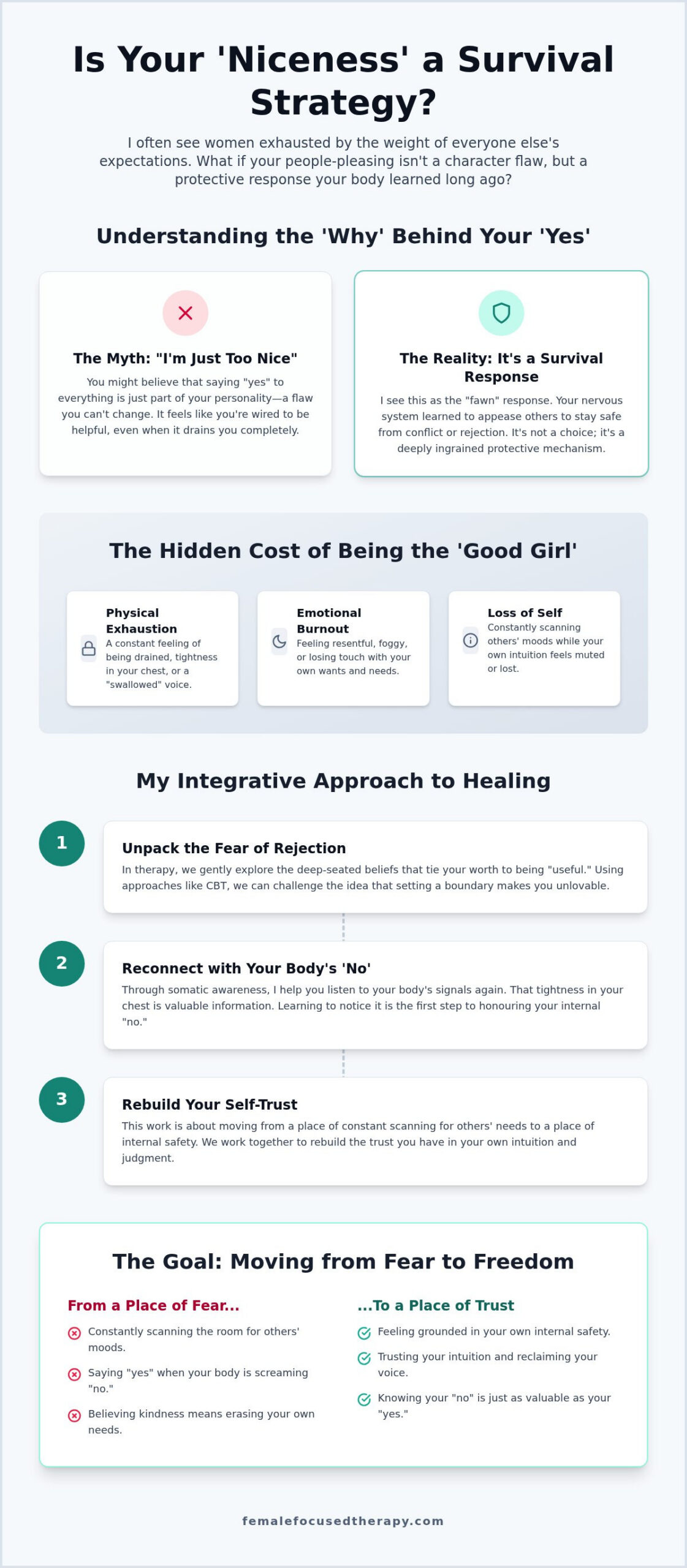
What if I told you that your tendency to say yes when you want to say no isn’t a character flaw? In my work providing therapy for people-pleasing tendencies, I’ve found that most women aren’t just “too nice.” They are responding to a deeply ingrained survival mechanism that once kept them safe.
When you feel that familiar tightness in your chest or your voice feels “swallowed” as you agree to another favour, your nervous system is taking over. This isn’t a conscious choice; it’s a physiological reaction. Your body is trying to protect you from the perceived danger of conflict or rejection.
I see the fawn response as a survival mechanism used to appease a perceived threat. By staying small and helpful, you once ensured your safety or belonging in a difficult environment. While that strategy worked back then, it’s now leaving you physically and emotionally exhausted in your adult life.
The Socialisation of the ‘Good Girl’
From a young age, many of us are taught that being “good” means being quiet, helpful, and easy-going. We learn that our value is tied to how useful we are to the people around us. This socialisation runs deep, often making us feel that our own needs are a burden to others.
The cost of being “low-maintenance” in adulthood is incredibly high. You might find yourself constantly scanning the room for other people’s moods, losing touch with your own desires in the process. It’s vital to recognise the difference between genuine kindness and fear-based compliance, as one fills you up while the other drains you dry.
When People-Pleasing Becomes a Burden
There is a specific point where “helping” turns into emotional burnout. When you constantly erase your own boundaries to keep the peace, you risk losing your sense of self entirely. This self-erasure can feel like a heavy fog, making it impossible to know what you actually want or feel.
This pattern often links back to relationship trauma or a history of needing to manage the emotions of those around you. Understanding People-Pleasing as a Survival Strategy helps us see that this isn’t about being weak. It’s about how you learned to navigate a world that didn’t always feel safe.
Finding the root of these patterns is the essential first step toward internal restoration. Using therapy for people-pleasing tendencies allows us to move from reactive survival into a state of calm, grounded self-trust. We begin to listen to the body’s signals, acknowledging that your “no” is just as valuable as your “yes.”
How Therapy for People-Pleasing Tendencies Helps You Reclaim Yourself
When you step into my room, or join me online, the focus shifts entirely to you. For many women, this is the first time they’ve been in a space where they don’t have to manage anyone else’s feelings. It can feel strange, or even a bit daunting, to have your needs come first for once.
I use individual psychotherapy to help you rebuild the self-trust that’s been worn away over the years. We work together to unpick these patterns using an integrative approach. This means we look at your thoughts, your history, and how your body holds onto the need to please.
How Therapy for People-Pleasing Tendencies Helps is by moving you away from the constant question of “What do they want?” and back to “What do I need?” This internal restoration is the core of our work together. It’s about finding the steady ground beneath your feet so you can stand firm in your own truth.
Unpacking the Fear of Rejection
The thought of saying “no” often triggers intense anxiety that feels almost physical. We use Cognitive Behavioural Therapy (CBT) to look at the beliefs you hold about your worth. If you believe your value only exists when you’re making others happy, setting a boundary will naturally feel like a threat to your safety.
I’m here to validate that “unsafe” feeling; it’s a real response from your nervous system. We’ll work on challenging the belief that you are only lovable when you are being useful. By doing this at a pace that feels manageable, you can start to feel more comfortable with the idea of being “difficult” if it means being honest.
Healing from Narcissistic Abuse and People-Pleasing
For many of the women I support, people-pleasing wasn’t just a habit. It was a vital tool for survival. In the context of narcissistic abuse recovery, being “nice” was often the only way to avoid escalating a toxic situation or protecting yourself from emotional harm.
If your intuition was silenced for a long time, it takes patience and kindness to hear it again. We focus on listening to that quiet inner voice that was drowned out by the loud needs of others. You might find it helpful to explore how we can start this journey together in a confidential and supportive environment where your voice is the one that matters most.
Beyond Boundaries: Reconnecting with Your Body’s ‘No’
I’ve found that scripts for saying “no” are often useless if your body feels like it’s in a state of emergency. Many of the women I support know exactly what they should say, yet when the moment comes, their throat tightens and they agree anyway. This happens because boundaries often fail if we don’t address the somatic “alarm” that goes off in your nervous system.
When I provide therapy for people-pleasing tendencies, we look beneath the surface of your thoughts. We explore how your muscles, breath, and gut react when you think about setting a limit. Integrating somatic movement and mindfulness into the healing process allows you to process these feelings where they actually live.
Learning to recognise the physical “yes” versus the physical “no” is a skill we build together over time. A true “yes” usually feels expansive, light, or steady. In contrast, a “no” often manifests as a sharp contraction, a heavy weight in the stomach, or a sudden urge to flee. Recognising these signals early helps you stay grounded in your own reality.
Somatic Awareness in Therapy
I’ll help you track the physical sensations of guilt and obligation as they arise. You might notice a sinking feeling in your chest or a sudden heat in your face when someone asks for a “quick favour.” We use simple breathwork techniques to calm your nervous system before you enter a difficult conversation. The body often remembers the need to please even when the mind wants to stop.
This body-based approach ensures that your boundaries aren’t just words you’ve memorised. They become a felt sense of safety within your own skin. By acknowledging the physical roots of your people-pleasing, we can begin the process of internal restoration and self-reliance.
The Power of the Pause
Reclaiming your voice requires creating space between a request and your response. I call this “the power of the pause.” It’s about using mindfulness to sit with the temporary discomfort of “disappointing” someone else while staying loyal to yourself. It’s okay to feel the sting of guilt and still say no.
I also encourage you to see rest and “not doing” as an act of rebellion against people-pleasing. For a high-functioning woman, constantly doing for others is a way to prove her worth. Choosing to rest helps you rebuild the energy needed for self-advocacy and reminds you that your value isn’t tied to your productivity for others.
The ADHD Connection: When People-Pleasing Meets Rejection Sensitivity
As a woman with ADHD myself, I know that the urge to please isn’t always about being “nice.” Sometimes, it’s a frantic attempt to manage the intense emotional pain of perceived rejection. This is why therapy for people-pleasing tendencies needs to look different for neurodivergent women. We aren’t just dealing with habits; we’re working with how our brains are wired to process social signals.
Women with ADHD often work twice as hard to be liked because we’ve spent years feeling “too much” or “not enough.” We over-compensate for our perceived failings by becoming the ultimate helpers. Rejection Sensitive Dysphoria (RSD) is an intense emotional pain related to the perception of being rejected.
This creates a cycle of overwhelm. You might say “yes” impulsively because the thought of saying no feels like an immediate threat to a relationship. This leads to a calendar full of commitments you don’t have the executive function to manage. The result is a deep, bone-weary burnout that feels impossible to escape.
Masking and People-Pleasing
Masking is the exhausting process of hiding your ADHD symptoms to fit into a neurotypical world. For many of us, people-pleasing is the ultimate mask. If we’re busy being useful, perhaps no one will notice our struggles with organisation or focus. It’s a heavy weight to carry every single day.
I often talk about the “ADHD tax” of over-committing. You might agree to things you don’t want to do simply to avoid the shame of being seen as “difficult” or “unreliable.” In our sessions, we develop coping strategies that respect your unique brain wiring. We look for ways to support your needs without sacrificing your mental health.
Healing the ‘Not Enough’ Narrative
The internalised shame that comes with a late ADHD diagnosis can drive a desperate need to please others. You might feel you have to “earn” your place in your friendships or workplace. We work together to address this shame, moving toward a place of internal restoration and self-acceptance.
My approach is neurodivergent-friendly, meaning I won’t just give you a “to-do” list of boundaries. We’ll explore how your sensory needs and energy levels impact your ability to stand your ground. Finding your authentic voice means learning that you are allowed to have needs, even on the days your brain feels messy.
If you’re ready to stop the cycle of burnout and understand your brain better, you can book an ADHD-focused therapy session with me today. Together, we can find a way to live that feels sustainable and true to who you really are.
Reclaiming Your Voice: Your Next Steps in Therapy
Deciding to start therapy for people-pleasing tendencies is a profound act of self-care. It marks the moment you decide that your needs, your time, and your peace are worth protecting. When you seek support, you aren’t just changing a habit; you’re embarking on a journey of internal restoration where you finally learn to trust your own intuition again.
In our first session together, my priority is to make you feel safe and heard. We won’t rush into “fixing” things. Instead, we’ll spend time understanding your unique story and how these patterns served you in the past. It’s a confidential space where you can finally put down the heavy mask of the “good girl” and simply be yourself.
Preparing for Change
As you begin to set boundaries, your relationships will naturally start to change. Some people might find your new-found voice difficult to handle, and that is okay. It’s a sign that you’re no longer playing a role that was designed to make others comfortable at your expense. True connections will survive your growth.
Our therapeutic relationship serves as a “warm but boundaried” blueprint for your life outside our sessions. You’ll experience what it feels like to be supported without being controlled. Whether we meet through my online therapy sessions or in person, we’ll find a rhythm that fits naturally into your life and supports your healing.
Taking the First Step
If you’re ready to start this journey, you can book a consultation with me to see how we can work together. We’ll explore which approach, from CBT to somatic movement, feels right for your specific needs. You don’t need to have all the answers before you reach out; you just need the desire for change.
For today, I invite you to try one small, realistic step. When someone asks something of you, instead of an immediate “yes,” try saying, “I’ll think about it.” This simple phrase creates the space you need to check in with your body. It allows you to decide if you’re agreeing out of genuine desire or old fear.
I want to close with a message of hope. You are allowed to take up space. You are allowed to have needs that don’t revolve around others. Healing is possible, and you deserve to live a life that feels like your own. I am here to support you in finding that path.
Step Into Your Own Steady Truth
You’ve spent so much of your life looking outward to see if you’re safe or liked. Moving toward a life where you trust your own “no” is the greatest act of kindness you can show yourself. It’s about more than just setting boundaries; it’s about finally coming home to your own body and your own needs.
We’ve explored how therapy for people-pleasing tendencies helps you unpick the fawn response and navigate the specific challenges of ADHD and rejection sensitivity. By combining traditional psychotherapy with somatic awareness, you can move past the exhaustion of masking. You can start to live a life that feels authentic rather than performative.
As a Registered Integrative Psychotherapist and specialist in trauma-informed care for women, I offer confidential online and in-person sessions designed specifically for you. I’m here to help you navigate this transition with patience and professional support. We’ll work at a steady pace that respects your nervous system and your unique brain wiring.
You don’t have to carry the weight of everyone else’s expectations alone. You can book a consultation with me to start your journey toward self-trust and begin reclaiming your voice. You are allowed to take up space, and I’m here to support you every step of the way.
Common Questions About People-Pleasing and Healing
What exactly is people-pleasing in a therapeutic context?
In a therapeutic context, people-pleasing is a survival strategy known as the “fawn” response. It involves prioritising the needs and emotions of others over your own to ensure safety or avoid conflict. I see it as a somatic pattern where you’ve learned to scan your environment for moods and adjust your behaviour to keep the peace, often at the cost of your own identity.
Is people-pleasing actually a sign of trauma?
Yes, it is frequently a response to past experiences where it didn’t feel safe to express your own needs or say no. When you’ve lived through relationship trauma or narcissistic abuse, people-pleasing becomes a protective shield. Your nervous system adopts this “niceness” as a way to navigate perceived threats, making it a deeply ingrained somatic survival mechanism rather than just a personality trait.
How can therapy help me stop being a people-pleaser?
Therapy for people-pleasing tendencies helps by identifying the root causes of your need to appease and rebuilding your internal confidence. I use an integrative approach that combines CBT with somatic awareness to help you recognise the physical “alarm” that triggers your compliance. We work together to help you listen to your intuition and communicate your boundaries with a sense of internal safety and self-trust.
What is the difference between being a kind person and a people-pleaser?
The main difference lies in your internal motivation and how the interaction leaves you feeling afterward. Genuine kindness comes from a place of abundance and choice, leaving you feeling connected and steady. People-pleasing is driven by fear, guilt, or a sense of obligation. It often leaves you feeling resentful, physically drained, and as though you’ve erased a part of yourself to keep someone else happy.
Will people-pleasing therapy make me selfish?
No, it actually makes your relationships more honest and sustainable because you aren’t operating from a place of hidden resentment. Learning to honour your own needs means that when you do say “yes,” you truly mean it. This transition allows you to show up more authentically for the people you love, as you’re no longer constantly pouring from an empty, exhausted cup.
How long does it take to see progress in therapy for these tendencies?
Progress is a personal journey, but many women start to feel a shift in their internal dialogue after just a few sessions of therapy for people-pleasing tendencies. Unlearning deep-seated patterns takes time and patience. We focus on making steady, manageable changes that help you rebuild your self-reliance at a pace that feels supportive to your nervous system rather than overwhelming it.
Can ADHD make people-pleasing worse?
Yes, ADHD often brings Rejection Sensitive Dysphoria (RSD), which makes the thought of disappointing others feel physically painful. You might find yourself over-committing to compensate for perceived failings or “masking” your symptoms to fit in. In our work, I help you understand how your unique brain wiring impacts your social interactions, allowing you to develop strategies that respect your neurodivergence and your energy.
Do you offer online therapy for women outside of Singapore?
I certainly do, as I provide confidential online therapy for women across the globe. Whether you’re navigating an international transition or simply prefer the comfort of your own home, I can support you in a safe, virtual space. This flexibility ensures that you can access professional, gender-focused care regardless of your geographical location, helping you find stability wherever you are in the world.

Article by
Cheryl Kennedy MacDonald MA BA (Hons) Pg. Dip. SAC BACP
Cheryl Kennedy MacDonald is a psychotherapist specialising in women’s mental health, relationships, and life transitions. She works with women navigating trauma, relationship breakdown, identity shifts, and midlife change, helping them rebuild self-trust, emotional stability, and a clear sense of who they are and what they want.
With over 20 years’ experience working with women internationally, Cheryl is the founder of YogaBellies, a global women’s yoga school, and the creator of the Birth ROCKS method. Her work sits at the intersection of psychotherapy and embodiment, integrating evidence-based therapeutic approaches with somatic, body-based practices that support deep, lasting change.
Known for her grounded and direct approach, Cheryl moves beyond surface-level insight to address the patterns held in the body and nervous system. Her work supports women to regulate, reconnect, and respond to their lives from a place of clarity, strength, and self-respect.
She is a published author in academic journals and has written multiple books on women’s health, pregnancy, and midlife wellbeing, available on Amazon and leading book retailers worldwide.