
You just finished a productive day at work, feeling capable and sharp, yet the moment you pull into your driveway, a heavy cloud of brain fog descends. You find yourself sitting in the car for an extra few minutes, taking deep breaths and mentally rehearsing how to say “hello” without triggering an argument. If you’ve started searching for the signs of a toxic marriage, it’s usually because your intuition is trying to tell you something that your heart isn’t quite ready to hear yet.
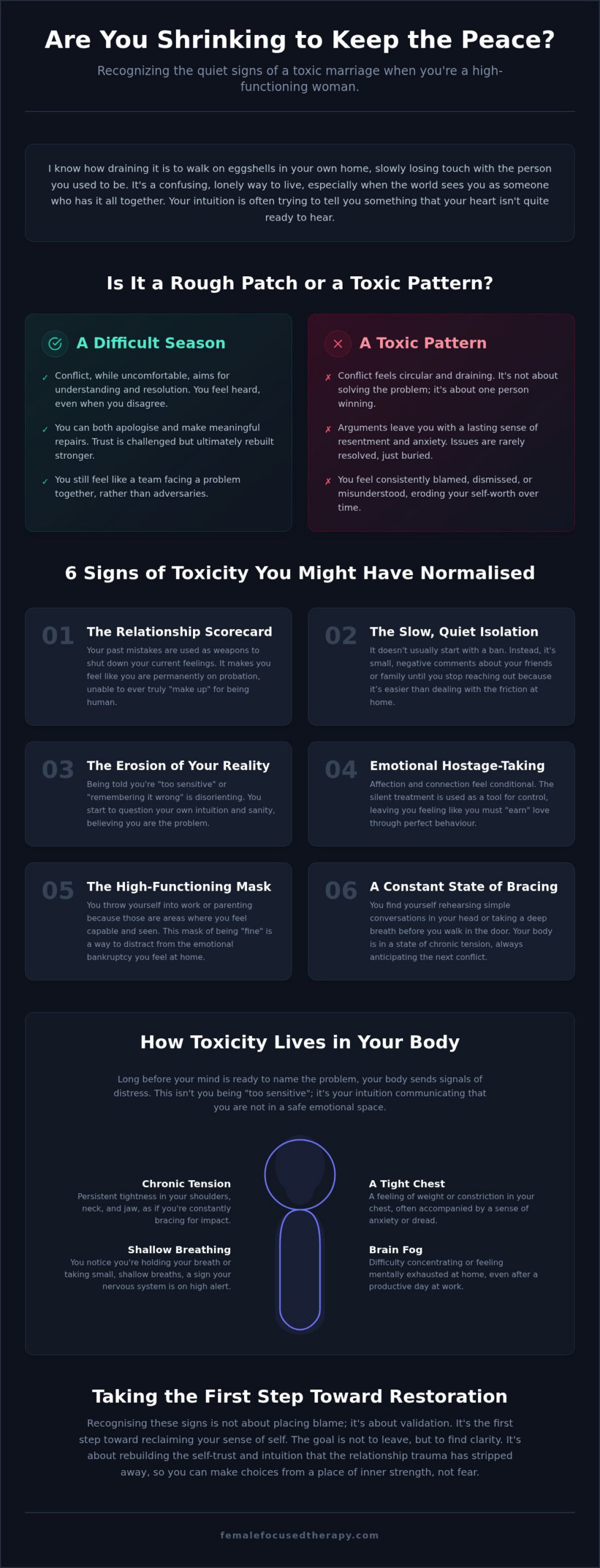
I know how draining it is to walk on eggshells in your own home, slowly losing touch with the person you used to be. It’s a confusing, lonely way to live, especially when the rest of the world sees you as a woman who has it all together. It’s not always about shouting; often, it’s the quiet erosion of your self-trust that hurts the most.
I will help you identify the subtle red flags in your marriage and understand how they impact your sense of self. We’ll explore the difference between a relationship that needs work and one that is truly harmful, giving you the validation you deserve and a sense of hope for your own internal restoration.
Key Takeaways
- I will help you distinguish between a difficult season and the persistent, quiet erosion of your identity.
- Learn to identify the subtle signs of a toxic marriage that you might have unintentionally normalised just to keep the peace.
- Understand why healthy conflict should lead to mutual growth rather than leaving you with a lasting sense of resentment.
- Discover how your body signals distress through chronic tension and bracing before your mind is ready to name the problem.
- Gain clarity on how to begin rebuilding the self-trust and intuition that relationship trauma often strips away.
Understanding the Quiet Weight of a Toxic Marriage
In my practice, I often sit with women who have built what looks like an enviable life. You might have the successful career, the beautiful home, and the family photos that suggest everything is perfect. Yet, behind closed doors, you feel hollow. I’ve learned that a toxic marriage isn’t always defined by what is said. Often, it is defined by what is silenced. It’s that persistent, heavy feeling that you are shrinking yourself just to keep the peace.
You may have been told you’re “too sensitive” or that you’re overreacting to small things. I want to help you see that your sensitivity might actually be your intuition speaking to you. When you start looking for the signs of a toxic marriage, it’s usually because your body has already sensed the imbalance. You feel it in the tightness of your chest or the way you hold your breath when your partner enters the room.
The High-Functioning Trap
Many of the women I work with are incredibly high-functioning. You might find yourself excelling at work or throwing yourself into parenting because those are areas where you feel capable and seen. It’s a common distraction from the emotional bankruptcy you feel at home. You’ve become an expert at wearing a mask, showing the world a version of yourself that is “fine” while you’re actually drowning in marital loneliness.
This “masking” is exhausting. It takes a massive amount of energy to maintain a perfect exterior when your internal world is crumbling. I see this often in my work with relationship trauma and narcissistic abuse, where the discrepancy between your public life and your private pain feels impossible to bridge. You aren’t failing; you’re simply exhausted from carrying a burden that was never meant to be yours alone.
When Love Becomes a Burden
We’re often taught that marriage is about compromise, but there’s a vital difference between healthy flexibility and total self-sacrifice. If you realise you’re the only one doing the emotional labour, you’re not in a partnership; you’re in a survival situation. You might be managing your partner’s moods, anticipating their triggers, and editing your own words before you speak them just to avoid a conflict.
This environment can involve subtle forms of psychological abuse, where your sense of reality is slowly eroded. I define this “quiet weight” as the invisible tax on your mental health. It’s the cost of staying in a space where your needs are consistently ignored or dismissed. When love becomes a burden rather than a source of support, it’s time to gently look at the patterns that are holding you back from your own restoration.
6 Signs of Toxicity You Might Have Normalised
I have found that the most damaging signs of a toxic marriage are often the ones we spend the most time justifying. You tell yourself it’s just a stressful season or that every couple has their “thing.” But when these behaviours become the wallpaper of your life, you stop noticing how much they’re peeling away your sense of self. It’s the subtle, daily interactions that eventually make you feel like a stranger in your own home.
One common sign is what I call the “Relationship Scorecard.” This is where your partner stores up your past mistakes and brings them out as current leverage. Every time you try to express a valid need, they remind you of something you did years ago to shut the conversation down. It makes you feel like you’re permanently on probation, unable to ever truly “make up” for being human.
Then there’s the slow, quiet isolation. It doesn’t usually start with a ban on seeing your friends. Instead, it’s a series of small, negative comments about how your best friend “doesn’t really get you” or how your family is “too dramatic.” Eventually, you stop reaching out to the people who truly see you because it’s just easier than dealing with the friction it causes at home. Research from The Gottman Institute shows that when respect and support vanish, the relationship foundation begins to crumble.
The Erosion of Reality (Gaslighting)
Being told you’re “too sensitive” or that you’re “remembering it wrong” is incredibly disorienting. For my clients with ADHD, this is particularly painful. If you already struggle with memory or focus, it’s so easy to believe you’re the problem. You end up in a constant state of confusion, questioning your own reality while your feelings are dismissed as irrational or incorrect.
Emotional Hostage-Taking
This happens when love feels like a transaction. You might experience the silent treatment as a tool for control rather than a genuine need for space. It leaves you feeling like you must “earn” affection through perfect behaviour. Arguments often end with the threat of the relationship ending, which is a form of emotional hostage-taking that keeps your nervous system in a permanent state of fight-or-flight.
If these patterns feel familiar, please know you don’t have to navigate this fog alone. You can book a safe, confidential session with me to start untangling these threads and finding your voice again.
Is It a Rough Patch or a Toxic Pattern?
I often hear women ask if they are just going through a difficult phase or if something is fundamentally wrong. Every marriage has seasons of winter, but you shouldn’t be freezing to death. A rough patch is a temporary dip caused by life’s pressures. A toxic pattern is a climate you are forced to live in, where the cold never seems to lift.
In my experience, the key difference lies in the safety to be vulnerable. In a healthy relationship, you can say, “I’m hurting,” and your partner responds with care. In a toxic dynamic, that same vulnerability is often used against you later. If you are searching for the signs of an unhealthy relationship, pay close attention to how your partner reacts when you bring up your pain.
I believe the most telling factor is a partner’s willingness to look at their own patterns. Real change requires both people to be willing to look in the mirror. When only one person is doing the emotional heavy lifting, the relationship becomes a source of depletion rather than a source of support.
Signs of a Solvable ‘Rough Patch’
Sometimes, the friction between you is caused by external stressors rather than character-based issues. If you are dealing with grief, job loss, or a major life transition, it’s natural for your bond to feel strained. In these cases, there is usually still a foundation of mutual respect and shared goals.
A solvable patch often involves both partners being willing to attend couples therapy. There is a sense that “we are in this together” against the problem. You still feel like a team, even if the teamwork currently feels clunky or difficult.
Signs of a Systemic Toxic Pattern
A toxic pattern feels like a loop that never ends. You might find that the same hurtful cycles repeat despite your best efforts to change your own behaviour. If you’ve tried everything and the signs of a toxic marriage only seem to intensify, the issue is likely systemic rather than situational.
You might notice that your partner flatly refuses to acknowledge their role in the dynamic. They might blame your “sensitivity” or your ADHD for every disagreement. Perhaps the most heartbreaking sign is when you realise you feel more like your true self when they are away than when they are home. Your body finally unbraces, your breath deepens, and the fog starts to clear only in their absence.
How Toxicity Lives in Your Body
I often tell my clients that your body is the most honest part of you. While your mind might still be trying to rationalise the signs of a toxic marriage, your body has likely been sounding the alarm for months. You might notice a persistent tightness in your chest or a jaw that feels permanently clenched. This is what I call “bracing,” where your physical self is literally preparing for an impact that hasn’t happened yet.
This chronic stress does more than just cause physical pain. It creates a mental fog that makes it nearly impossible to trust your own judgment. For women living with ADHD symptoms, relationship trauma can be particularly cruel. The constant state of alarm can mimic or worsen executive dysfunction, making you feel even more scattered and “at fault” than you did before.
The Nervous System on High Alert
Living in a toxic dynamic means your nervous system is trapped in a state of hyper-vigilance. You are constantly scanning for your partner’s mood, the sound of their footsteps, or the tone of a text message. This isn’t just “being careful”; it’s a survival mechanism that keeps your cortisol levels spiked. Your body keeps the score of emotional neglect by remaining in a state of high alert, even when you are supposed to be resting.
Eventually, this chronic stress impacts your sleep and hormonal health. You might find you’re exhausted but “wired,” unable to drift off because your system doesn’t believe it’s safe to let go. Over time, this leads to the deep emotional exhaustion I see in so many high-functioning women. You cannot heal a nervous system with logic alone; it requires a deeper, more grounded approach.
Restoring Your Internal Compass
Thinking your way out of toxicity isn’t enough when your body feels unsafe. I believe that true restoration happens when we involve the body in the healing process. Using breath and gentle movement helps you drop out of your busy, fearful mind and back into your physical self. This is where your intuition lives, and it’s the part of you that toxicity has tried to silence.
Finding a somatic approach to healing allows you to process trauma without having to find the “perfect” words right away. It’s about creating a sense of internal safety so your intuition can finally speak clearly again. If you feel ready to reconnect with yourself in a grounded, safe space, I invite you to book an individual psychotherapy session with me today.
Taking the First Step Toward Restoration
I want to be very clear with you. I am not here to tell you whether you should stay or leave your relationship. That is a deeply personal decision that only you can make when you feel ready. My role is to help you find “you” again. When you’ve spent years identifying the signs of a toxic marriage, the person you used to be can feel like a distant memory.
Rebuilding self-trust is the most vital part of this journey. Toxicity works by stripping away your confidence in your own perceptions. Restoration isn’t about “fixing” the relationship; it’s about repairing the relationship you have with yourself. Through individual psychotherapy, we create a safe, female-focused space where your voice is the one that matters most.
I believe that healing is a journey of internal restoration rather than a quick fix. You’ve likely spent a long time looking for the signs of a toxic marriage to validate your pain. Now, I want to help you turn that focus inward, learning to trust your intuition and your body’s signals once again. Your next step doesn’t have to be a big one; it just has to be for you.
Choosing Your Support System
It is important to find a therapist who understands the specific, often hidden nuance of narcissistic abuse. You don’t need someone to give you a clinical checklist. You need someone who can hold space for the complexity of your experience. I offer a compassionate, multidisciplinary approach that respects both your mind and your body.
A Realistic Next Step
Your next step doesn’t have to be a monumental life change. I want you to give yourself permission to simply notice how you feel throughout the day without any judgment. If you feel a “bracing” sensation in your body when your phone pings, just acknowledge it. This awareness is the beginning of reclaiming your internal compass.
If you feel ready to explore your options in a quiet, confidential setting, you can book a consultation with me. We can talk about what you’re facing and how we might work together to clear the fog. Remember that you deserve a life where you can breathe deeply again, and that journey starts with a single, gentle step toward yourself.
Reclaiming Your Voice and Your Peace
Identifying the signs of a toxic marriage is often the hardest part of the journey because it requires you to trust your intuition when it’s at its most fragile. We’ve explored how these patterns impact your body and how to tell a difficult season apart from a harmful, systemic dynamic. I want you to remember that your feelings are valid, and you don’t have to carry the weight of this clarity alone.
I’ve spent over 20 years as a Registered Integrative Psychotherapist helping women find their way back to themselves after relationship trauma and narcissistic abuse. Whether you’re in Singapore or connecting with me online, I provide a safe, non-judgmental space to help you rebuild your self-trust and somatic awareness. You deserve to live a life where your home is a sanctuary rather than a source of constant stress.
If you feel ready to take a gentle step toward your own internal restoration, I’m here to support you. You can book a confidential therapy session with Cheryl in Singapore or online to begin your healing process at a pace that feels right for you. There is hope for a future where you can breathe deeply and trust your own heart once more.
Common Questions About Toxic Marriages
Can a toxic marriage be fixed if only one person is trying?
A marriage cannot be healed by one person alone because a partnership requires two active participants. If you’re the only one doing the emotional work, you’re merely managing the toxicity rather than fixing the relationship. I often see women burn themselves out trying to “love” their partner into changing. Real restoration only happens when both people are willing to look at their own patterns with honesty.
How do I know if I’m being gaslighted or if I’m just forgetful?
Gaslighting is a deliberate pattern of making you doubt your own perceptions, whereas forgetfulness is simply a human slip in memory. If your partner uses your memory as a weapon to win arguments or dismiss your feelings, that’s a red flag. For my clients with ADHD, this is a common way the signs of a toxic marriage manifest, as your natural traits are used against you.
What is the difference between a narcissist and someone who is just selfish?
Selfishness is usually a temporary lack of consideration, while toxic patterns involve a persistent lack of empathy and a drive for control. I don’t believe in diagnosing partners from afar, but I do look at how their behaviour makes you feel. If you feel like you’re constantly shrinking to accommodate their ego, the label matters less than the impact on your long-term well-being.
How does relationship trauma affect women with ADHD differently?
Relationship trauma hits women with ADHD harder because it often targets your existing insecurities about memory and focus. The emotional “noise” of a toxic environment makes it almost impossible to manage your ADHD symptoms effectively. You might find your executive dysfunction worsens as your nervous system stays in a state of high alert, making the daily brain fog feel insurmountable.
Is it possible to be in a toxic marriage without any physical abuse?
Yes, it’s absolutely possible to be in a toxic relationship without any physical violence occurring. Emotional, psychological, and financial control are all valid signs of a toxic marriage that can leave deep internal scars. I believe that the invisible wounds of being silenced or dismissed are just as significant as physical ones and deserve the same level of professional support.
What should I do if I feel unsafe but I’m not ready to leave yet?
If you feel unsafe but aren’t ready to make a big move, your priority should be creating small pockets of internal safety. This might mean setting gentle boundaries around your time or starting a quiet somatic practice to ground your nervous system. I encourage you to build a confidential support network of trusted friends or professionals who can hold space for you while you find your footing.
How can I explain my situation to my children without blaming my partner?
Explaining things to children is best done by focusing on feelings and household “weather” rather than assigning blame. You can say things like, “Mummy and Daddy are having a hard time communicating right now, but we both love you.” It’s about validating their experience of the tension without making them responsible for the adult conflict or forcing them to choose a side.
Can therapy help me if my partner refuses to go to couples counselling?
Individual therapy is incredibly effective even if your partner refuses to join you for counselling. In fact, it’s often the best place to start because it allows you to focus entirely on your own restoration and self-trust. I help you untangle the confusion and decide what you need for your own peace, regardless of whether the relationship dynamic itself changes.

Article by
Cheryl Kennedy MacDonald MA BA (Hons) Pg. Dip. SAC BACP
Cheryl Kennedy MacDonald is a psychotherapist specialising in women’s mental health, relationships, and life transitions. She works with women navigating trauma, relationship breakdown, identity shifts, and midlife change, helping them rebuild self-trust, emotional stability, and a clear sense of who they are and what they want.
With over 20 years’ experience working with women internationally, Cheryl is the founder of YogaBellies, a global women’s yoga school, and the creator of the Birth ROCKS method. Her work sits at the intersection of psychotherapy and embodiment, integrating evidence-based therapeutic approaches with somatic, body-based practices that support deep, lasting change.
Known for her grounded and direct approach, Cheryl moves beyond surface-level insight to address the patterns held in the body and nervous system. Her work supports women to regulate, reconnect, and respond to their lives from a place of clarity, strength, and self-respect.
She is a published author in academic journals and has written multiple books on women’s health, pregnancy, and midlife wellbeing, available on Amazon and leading book retailers worldwide.