
What if the “selfishness” you’ve been told you possess is actually just a brain that processes the world with a different set of rules? I’ve sat with so many women who carry a heavy, silent fear that they’re fundamentally “bad” because they struggle with social cues or need intense solitude. You might’ve spent hours wondering if you’re autistic or narcissistic, feeling a knot of guilt every time you can’t meet a partner’s emotional expectations.
I know how exhausting it is to constantly monitor your own reactions. It’s draining to wonder if your directness is actually cruelty, or if your sensory overwhelm is being mistaken for a lack of empathy. You’ve likely spent years “masking” your true self just to fit in, only to be told you’re being difficult or cold.
I’ll help you navigate the confusing overlap between neurodivergence and narcissistic traits so you can rebuild your self-trust. We’ll explore how your nervous system works versus how an ego-driven defense operates. By the end, I hope you feel a sense of validation for your lived experience and a path toward internal peace and self-acceptance.
Key Takeaways
- Learn why social withdrawal and intense focus are often healthy sensory needs rather than a lack of interest in others.
- Discover how to distinguish if your behaviors are autistic or narcissistic by looking at the underlying intent behind your actions.
- Understand the “Double Empathy Problem” and why communication breakdowns aren’t a sign that you lack deep compassion.
- Identify how the exhaustion of “masking” can lead to burnout that is frequently mislabeled as a personality flaw.
- Find out how a mind-body approach can help you move past shame and rebuild trust in your own intuition.
When You Worry You’re the Problem: The Confusion Between Autism and Narcissism
I often hear women in my practice ask if they are autistic or narcissistic with a heavy heart and a lot of shame. It’s a question that usually comes after a painful argument or a lifetime of feeling “different.” As a therapist who lives with ADHD, I know how it feels to have your internal world completely misunderstood by those around you. It can be incredibly isolating when your intentions don’t match the way others perceive your actions.
This isn’t about clinical labels or ticking boxes for the sake of it. My goal is to help you find a sense of safety in your own skin. We are looking for the truth of your experience so you can stop living in a state of constant self-defence. When we understand how our brains are wired, we can move away from guilt and toward a place of internal restoration.
I see so many women who have spent years trying to “fix” themselves, believing they are fundamentally broken. When you’re constantly told that your way of being is wrong, it’s natural to internalise that criticism. My perspective allows me to see the beauty in your unique wiring, rather than just the “deficits” others might point out.
The Weight of a Label
I want to start by acknowledging the courage it takes to even ask this question. For many neurodivergent women, being called a narcissist feels like a “soul-wound.” It strikes at the very heart of your identity, making you question every kind thought or empathetic feeling you’ve ever had. It’s a heavy burden to carry, especially when you’re already struggling to manage a sensitive nervous system.
There is a massive difference between a clinical diagnosis and a weaponised label used to “win” an argument. In my work with relationship trauma and narcissistic abuse, I see how these labels are often thrown around to silence women who are simply trying to set boundaries. A diagnosis is a tool for understanding yourself, but a weaponised label is a tool for someone else to maintain control over you.
Why They Can Look Similar from the Outside
On the surface, some traits can overlap, which is why the question of being autistic or narcissistic is so common. A special interest might look like “self-focus” to someone who doesn’t understand how your brain works. While Narcissistic Personality Disorder involves a need for constant external validation to bolster a fragile ego, autism is often about managing internal sensory input and deep passions.
Social exhaustion, or autistic burnout, can also be mistaken for narcissistic “coldness.” When your nervous system is fried, you might withdraw or stop responding to emotional cues to protect yourself. This isn’t a lack of care; it’s a lack of capacity. You are simply trying to find a moment of rest in a world that feels too loud and too fast.
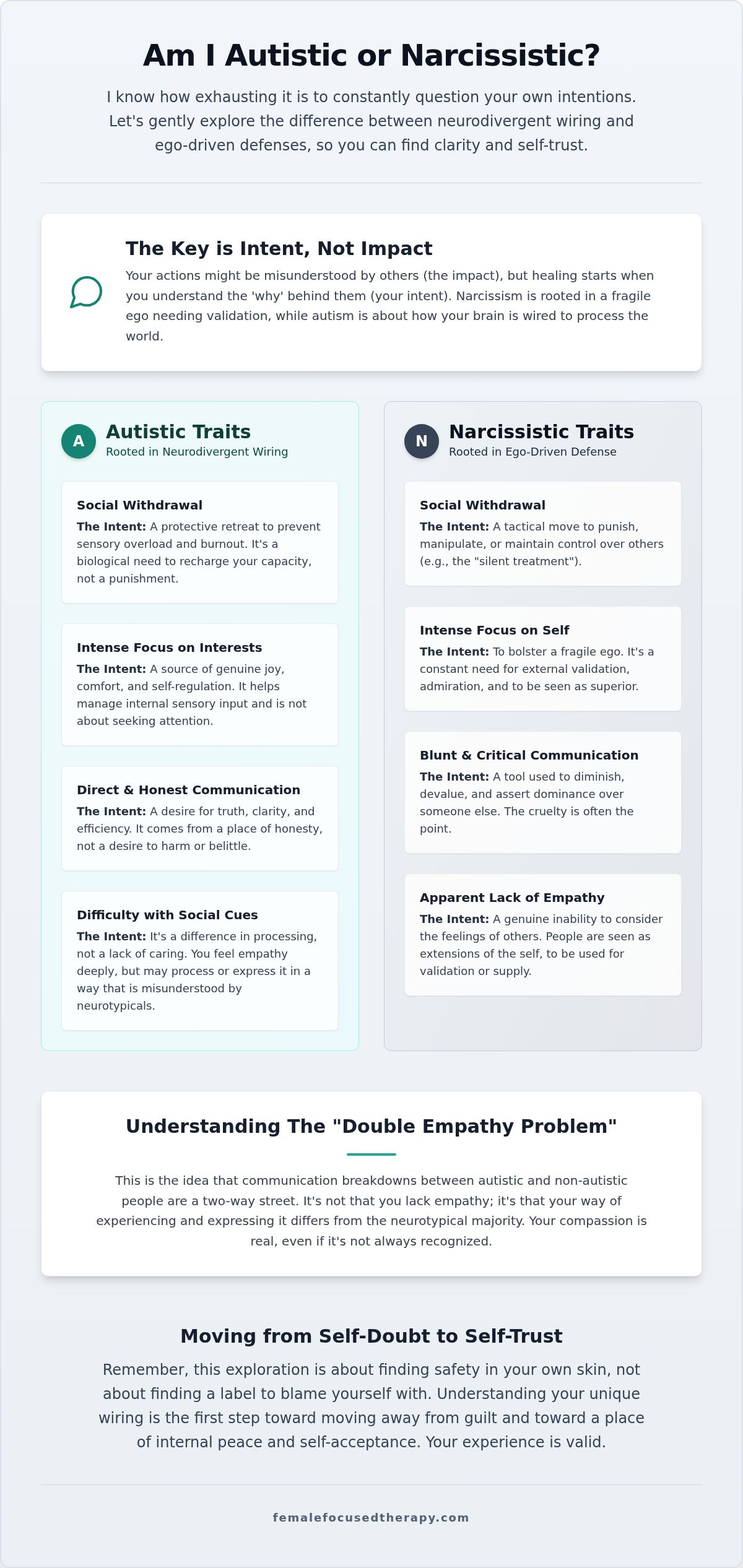
Neurodivergent withdrawal is a protective retreat to prevent sensory collapse, whereas narcissistic withdrawal is often a tactical move to maintain control or punish others.
Intent versus Impact: How Autistic Needs Can Look Like Narcissistic Traits
I believe that understanding the “why” behind your actions is the first step toward healing your self-image. When you’re constantly questioning if you’re autistic or narcissistic, you’re usually looking at the impact you have on others without looking at the intent in your own heart. Narcissism is often rooted in a fragile sense of self that requires constant external validation to feel safe. In contrast, autism is a different way of processing sensory information and social data. It’s about how your brain is wired, not a desire for power.
Take “bluntness” as an example. For many neurodivergent women, being direct is a desire for truth and clarity. You aren’t trying to hurt anyone; you’re trying to be honest and efficient. A narcissistic intent, however, might use bluntness as a tool to diminish someone else. Understanding this distinction is vital, especially when we consider how female narcissism is misdiagnosed or misunderstood in clinical settings that weren’t designed with women in mind.
A Comparison of Intent
To help you see these differences more clearly, I’ve put together a simple comparison of how the same behaviour can stem from two very different internal worlds.
| Apparent Behaviour | The Autistic Why | The Narcissistic Why |
|---|---|---|
| Talking about oneself | Sharing a similar experience to show empathy and connection. | Redirecting attention to self to gain admiration or dominance. |
| Following strict rules | A need for predictability and fairness to feel safe. | Using rules to control others while exempting themselves. |
| Reacting to criticism | Confusion, literal interpretation, or sensory shutdown. | Rage or redirection to protect a vulnerable ego. |
You might notice that an autistic person often “monologues” or “info-dumps” about a passion. This usually comes from a deep desire to connect through shared information. It’s a way of saying, “I value you, so I’m sharing this thing I love.” It isn’t an attempt to dominate the conversation or prove superiority.
The Need for Control
Narcissistic control is about managing other people to protect the ego from perceived threats. Autistic control is almost always about managing the environment to prevent sensory or cognitive overwhelm. If you need the lights dimmed, the volume lowered, or a specific routine followed, it’s about survival and nervous system regulation, not superiority.
In my practice, I help women distinguish these two patterns in their own lives or in their partners’ behaviour. When you can name the need for what it actually is, the shame begins to lift. If you’re feeling lost in these comparisons, we can explore your specific experiences in a safe, non-judgmental space when you book a session.
The Empathy Question: Understanding the Different Ways We Process Connection
I want to clear up the myth that autistic people don’t have empathy. In my experience, it’s often the exact opposite. Many women I work with feel the weight of the world so intensely that they have to shut down just to survive the day. When you’re trying to figure out if you’re autistic or narcissistic, the way you experience other people’s pain is one of the clearest indicators of your true nature.
We often see communication break down because of the “Double Empathy Problem.” This is the idea that communication isn’t just failing on the neurodivergent side. Instead, it’s a mutual mismatch between different neurotypes who process social data differently. It isn’t a lack of heart; it’s a difference in language. You aren’t failing to care; you’re simply speaking a different emotional dialect.
Many autistic women live with “Hyper-Empathy,” where they feel everyone’s emotions so intensely it becomes physically painful. This is vastly different from the narcissistic pattern, where empathy is often performative. In those cases, “care” is used as a tool for manipulation or to maintain a certain image, rather than being a genuine, felt connection. Research into narcissistic vulnerability in adults with autism helps us understand how these internal sensitivities can be misread by outside observers.
Cognitive vs. Affective Empathy
Affective empathy is the experience of “feeling with” someone, while cognitive empathy is the intellectual act of “knowing” what they feel. You might struggle to “read the room” or miss a subtle facial cue, which is a hurdle in cognitive empathy. However, once you realise someone is hurting, you might feel a deep, physical ache in your own chest. That is profound affective empathy in action.
This differs sharply from the narcissistic profile. A person with narcissistic traits often has very high cognitive empathy. They are experts at reading your feelings, but they use that information to gain an advantage or protect their own ego. They know exactly how you feel, but they don’t “feel it” with you. They understand the “rules” of connection but lack the shared emotional resonance that you carry.
The Somatic Experience of Empathy
Empathy isn’t just a thought; it’s a somatic experience that lives in your tissues. For neurodivergent women, this often manifests as a “mirroring” effect where you physically absorb the stress or anxiety of the people around you. Your body doesn’t always know where you end and someone else begins. This can lead to a state of constant high alert, making the world feel incredibly overwhelming.
I find that traditional talk therapy isn’t always enough to process this level of intensity. This is why I integrate a somatic movement and yoga approach into my work. Learning to use breath and intentional rest helps you create a boundary for your nervous system. It allows you to be a deeply feeling person without being constantly drowned by the emotional noise of a loud, crowded world.
Why Neurodivergent Women Are So Frequently Mislabeled as Narcissistic
I see so many women who have been “gaslit” into believing their sensory needs are actually “demands.” It’s a common story in my practice. You might’ve been told you’re being “difficult” or “controlling” because you need the house quiet or the lights low. When you’re constantly fighting for a baseline of comfort, it’s easy to start wondering if you’re autistic or narcissistic, especially if someone you love is using those words against you.
The “Masking” trap is often where this confusion begins. You spend decades trying to fit in, mimicking neurotypical social rules until you’re completely depleted. When the eventual burnout hits, you might withdraw or stop performing the “nurturer” role. To an outsider, this looks like a “narcissistic collapse” or a sudden lack of care. In reality, you’ve simply run out of the fuel required to pretend, and your nervous system is begging for rest.
I often hear from women who have been told they’re “selfish” because they need intense solitude to recover from the day. But for a neurodivergent brain, quiet isn’t a luxury; it’s air. Needing to regulate your sensory input is a biological necessity, not a character flaw. It’s about survival, not an ego-driven desire to be the centre of attention.
The Weaponisation of Neurodivergence
A narcissistic partner might weaponise your ADHD or neurodivergence to avoid taking accountability for their own behaviour. They might point to your struggles with executive function or your need for routine as proof that you are the “unstable” one in the relationship. This is a form of trauma that cuts deep, making you doubt your own perception of reality.
Your need for a predictable environment isn’t “narcissistic entitlement.” It’s a way to prevent cognitive overwhelm. I spend a lot of time helping women in rebuilding their self-trust after they’ve been told their traits are actually moral failings. We work on separating your natural wiring from the labels that were forced upon you during times of conflict.
Late Diagnosis and the “Grief” Phase
A 2026 study published by the American Medical Association noted a significant “catch-up identification” of women being diagnosed with autism. This explains the relief, and the deep grief, of discovering your neurodivergence in mid-life. Suddenly, the decades of being called “dramatic” or “self-absorbed” start to make sense through a completely different lens. It wasn’t that you were “bad”; it was that your needs were unmet.
One realistic step you can take today is to look back at your childhood through this new lens. Instead of seeing “bad behaviour” in your memories, try to see a child who was overwhelmed by a world that was too loud or too bright. If you’re ready to unpack these labels and find your own truth, I invite you to book an individual psychotherapy session with me today.
Moving From Self-Doubt to Self-Trust: How I Support Your Healing Journey
I believe that healing isn’t just about a diagnosis. While understanding whether you are autistic or narcissistic provides a vital framework, the real work is about learning to trust your own intuition again. For too long, you’ve likely relied on others to define your character, leading to a deep sense of internal disconnection and shame.
Our work together focuses on calming your nervous system so you can see your truth clearly. When you’re in a state of high alert, it’s impossible to distinguish between a trauma response and your natural personality. By creating a safe, confidential space where you don’t have to “mask,” we allow your true self to safely emerge.
My integrative approach combines traditional talk therapy with somatic awareness. We don’t just talk about the pain of being misjudged; we work to release that trauma from where it lives in your tissues. This mind-body perspective is essential for neurodivergent women who have spent years feeling physically and emotionally unsafe in their own environments.
Restoring Your Internal Compass
Healing involves a fundamental shift in the questions you ask yourself. We move away from the shame-filled “Am I a bad person?” and toward the compassionate “What does my nervous system need right now?” When you stop wondering if you are autistic or narcissistic and start listening to your body, the path forward becomes much clearer.
I use mindfulness and gentle movement to help you reconnect with your physical sensations. This isn’t about “fixing” who you are or trying to become neurotypical. Instead, the goal is restoration and building a foundation of self-compassion that allows you to navigate the world without the weight of constant self-doubt.
Your Next Step Toward Clarity
I invite you to take a slow breath right now and notice how your body feels. Are your shoulders tight? Is your breath shallow? Simply noticing these sensations without judgment is the first step toward reclaiming your sense of self. It’s a small act of kindness toward a nervous system that has likely been under fire for a long time.
If you feel ready for a calm, insightful conversation about your experience, I am here to hold that space for you. You don’t have to carry the weight of these questions alone anymore. You might find it helpful to start by exploring my free therapy resources as a gentle way to begin your journey toward clarity and peace.
Finding Your Truth Beyond the Labels
I hope you can take a moment to acknowledge the weight that’s lifted just by seeking these answers. We’ve explored how your intent defines your heart, and how your sensory needs are biological requirements rather than narcissistic demands. Understanding whether you are autistic or narcissistic isn’t about finding a new box to fit into; it’s about clearing away the shame that has obscured your true self for far too long.
As a Registered Integrative Psychotherapist and specialist in women’s relationship trauma, I’ve seen how powerful it is when a woman finally stops fighting her own nature. My trauma-informed, somatic approach is designed to help you release the physical tension of “masking” and rebuild a sense of internal safety. You deserve to live in a world where your directness is seen as honesty and your need for quiet is respected as self-care.
If you’re tired of second-guessing your every move, I would be honoured to support you in your restoration. Together, we can work through the layers of misdiagnosis and gaslighting to find the steady ground beneath. You are not a problem to be solved; you’re a person who is finally learning to speak her own language.
Book a gentle consultation with me to find your path back to self-trust
Frequently Asked Questions
Can a person be both autistic and narcissistic?
Yes, it is possible for these to co-occur, though research shows it is quite rare. Studies indicate that between 0% and 6.4% of individuals with Autism Spectrum Disorder also meet the criteria for Narcissistic Personality Disorder. While the overlap is small, I often help women navigate the confusion of whether they are autistic or narcissistic by looking at the deep-seated motivations behind their actions.
Why do I feel like a narcissist when I talk about my special interests?
You likely feel this way because of “monologuing,” which is a common autistic way of connecting through shared information. Unlike narcissism, where talking is about gaining admiration or proving superiority, your “info-dumping” is an act of sharing something you love with someone you value. It is an attempt at connection, not a desire to dominate the conversation.
Is “autistic burnout” the same as a narcissistic collapse?
No, these are fundamentally different internal states with very different causes. Autistic burnout is a total physical and mental exhaustion caused by years of “masking” and sensory overload. Narcissistic collapse happens when a person’s external source of validation is removed, which threatens their ego. One is a loss of biological capacity; the other is a loss of external control.
How can I tell if my partner is narcissistic or just neurodivergent?
I suggest looking closely at the intent behind their withdrawal or their directness. A neurodivergent partner might withdraw because they are overstimulated and need a safe, quiet environment to regulate. A narcissistic partner often uses withdrawal as a tactical move to punish you or maintain power. One is about seeking safety; the other is about seeking leverage.
Why do I struggle with empathy if I’m not a narcissist?
You likely struggle with cognitive empathy, which is the intellectual ability to “read the room” or pick up on subtle social cues. However, many neurodivergent women have very high affective empathy, meaning they feel the physical ache of another person’s pain. This is the opposite of the narcissistic profile, where a person can read you perfectly but feels no emotional resonance with your suffering.
What should I do if my partner calls me a narcissist when I’m overwhelmed?
Recognise that this may be a weaponisation of your neurodivergence to avoid taking accountability for their own behaviour. When you are in sensory overwhelm, you simply do not have the capacity for emotional labour. Being called “selfish” or “narcissistic” for needing quiet time is a form of gaslighting that ignores your biological needs for nervous system regulation.
Can neurodivergence be mistaken for “covert” narcissism?
Yes, because both can involve social withdrawal and intense emotional dysregulation. Autistic individuals sometimes score higher on measures of “vulnerable” or covert narcissism because they may appear self-focused when trying to manage their environment. However, the driver is a sensitive nervous system seeking predictability, not an ego-driven need for entitlement or exploitation.
How does ADHD play into the confusion between autism and narcissism?
ADHD can cause impulsivity, distractibility, and forgetfulness that others might misinterpret as a lack of care or “selfishness.” If you have ADHD, you might interrupt others or miss social cues because of executive function challenges. This is a brain-based processing issue, not a narcissistic desire to be the centre of attention or to diminish others.

Article by
Cheryl Kennedy MacDonald MA BA (Hons) Pg. Dip. SAC BACP
Cheryl Kennedy MacDonald is a psychotherapist specialising in women’s mental health, relationships, and life transitions. She works with women navigating trauma, relationship breakdown, identity shifts, and midlife change, helping them rebuild self-trust, emotional stability, and a clear sense of who they are and what they want.
With over 20 years’ experience working with women internationally, Cheryl is the founder of YogaBellies, a global women’s yoga school, and the creator of the Birth ROCKS method. Her work sits at the intersection of psychotherapy and embodiment, integrating evidence-based therapeutic approaches with somatic, body-based practices that support deep, lasting change.
Known for her grounded and direct approach, Cheryl moves beyond surface-level insight to address the patterns held in the body and nervous system. Her work supports women to regulate, reconnect, and respond to their lives from a place of clarity, strength, and self-respect.
She is a published author in academic journals and has written multiple books on women’s health, pregnancy, and midlife wellbeing, available on Amazon and leading book retailers worldwide.