
You sit across from him at the dinner table, and although he’s physically there, it feels like he’s miles away. The silence in your home has become heavy and loud, leaving you feeling more like a roommate than a partner. You might find yourself searching for signs of emotionally disconnected husband behaviour just to prove to yourself that you aren’t imagining this distance.
I know how draining it is to constantly question your own reality and worth when the person you love stops truly seeing you. It’s a lonely place to be, but I want you to know that your feelings are real and valid. I’m here to help you understand why this wall has been built and, more importantly, how you can find your way back to your own inner stability.
In this post, I’ll share ten subtle indicators of emotional distance and offer practical somatic and therapeutic steps to help you feel grounded again. We’ll look at how to move forward with a renewed sense of self-assurance. I’ll guide you through a gentle journey of restoration that focuses on your own well-being, regardless of the silence in the house.
Key Takeaways
- I’ll help you recognise the subtle signs of emotionally disconnected husband behaviour so you can stop questioning your reality and start trusting your intuition.
- You’ll discover why emotional distance is often a protective wall built from past trauma or neurodivergence rather than a simple lack of love.
- Learn how to shift your energy away from “fixing” your partner and back toward your own somatic grounding and internal restoration.
- I’ll share how finding a safe, boundaried space in therapy can help you feel steady and self-assured as you decide on your next steps.
Understanding the Pain of Living with an Emotionally Disconnected Husband
I want to start by acknowledging that the loneliness you feel is real. It’s a heavy, quiet ache that often feels much worse than being alone. When you’re single, you expect solitude. When you’re married, the silence in the house feels like a betrayal. I see so many high-functioning, intelligent women who begin to wonder if they’re “too much” simply because they crave a basic level of emotional attunement. You aren’t asking for the impossible; you’re asking for the connection that makes a marriage feel like a partnership rather than a project.
Emotional disconnection is more than just a quiet house or a lack of things to talk about. It’s a lack of resonance. It feels like you’re shouting into a void, even when he’s sitting right next to you on the sofa. You share a win at work or a worry about the kids, and it just lands nowhere. This isn’t just about communication skills. It’s about whether your partner is emotionally present enough to meet you in those moments of vulnerability and joy.
What Does Emotional Disconnection Actually Look Like?
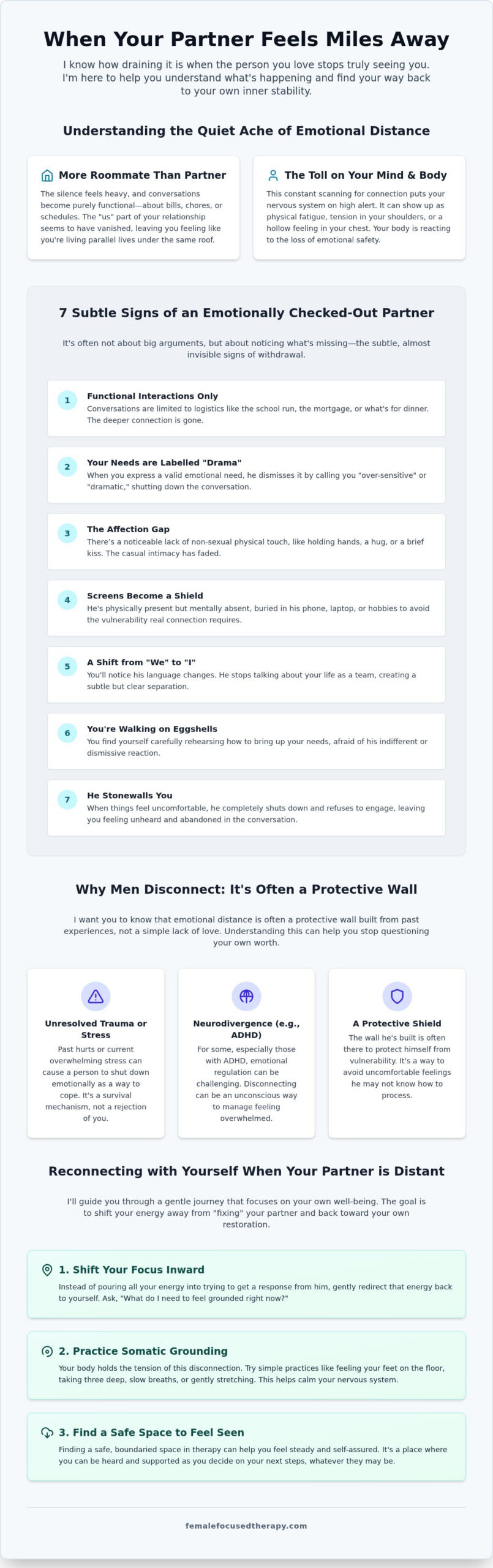
It’s often helpful to begin Understanding Emotional Detachment as a persistent pattern rather than a one-off mood. We aren’t talking about a rough patch where he’s stressed about a deadline for a week. We’re talking about a consistent lack of emotional reciprocity. You might find yourself in “roommate syndrome,” where your conversations are strictly functional. You talk about the mortgage, the school run, or what’s for dinner, but the “us” part of the conversation has vanished. These are common signs of emotionally disconnected husband patterns that can leave you feeling invisible. You’re living parallel lives under the same roof, sharing a bed but not a world.
The Impact on Your Mind and Body
Living this way takes a profound toll on your well-being. When your primary attachment figure is distant, your nervous system often goes into a state of “high alert.” You’re constantly scanning for connection, like a radio trying to find a signal through static. This isn’t just “in your head.” It shows up as physical fatigue, a persistent tension in your shoulders, or a heavy, hollow feeling in your chest. In my work with relationship trauma, I often hear women describe the somatic sensation of being unheard as a literal tightening in the throat. It’s your body’s way of reacting to the loss of emotional safety. You deserve to feel grounded and seen, not constantly on edge in your own sanctuary.
7 Clear Signs Your Husband May Be Emotionally Checked Out
Identifying the signs of emotionally disconnected husband behaviour isn’t always about spotting big, dramatic arguments. More often, it’s about noticing what is missing. I’ve found that the most painful part for the women I work with is the subtle, almost invisible withdrawal. It’s in the micro-expressions; the absence of a genuine smile when you walk into the room, or the way his eyes never quite meet yours when you’re trying to share something important.
When a partner checks out, they often use screens, work, or hobbies as a protective shield. You might notice he’s physically present on the sofa, but his mind is miles away, buried in a phone or a laptop. This isn’t just about being busy. It’s a way to avoid the vulnerability that real intimacy requires. You might also find yourself walking on eggshells, carefully rehearsing how to bring up your needs because you’re afraid of his reaction or, perhaps worse, his total indifference.
- Functional interactions: Your conversations are limited to the school run, the mortgage, or what’s for dinner.
- The “Drama” label: He dismisses your valid emotional needs as you being “over-sensitive” or “dramatic.”
- Affection gap: There is a noticeable lack of physical touch—like holding hands or a brief kiss—that doesn’t have the expectation of sex attached to it.
The Subtle Shift in Communication
In my sessions, I often talk about the “bid for connection.” These are the small ways we reach out for attention or affirmation. When a husband is disconnected, he stops making these bids and, crucially, stops responding to yours. You’ll notice a shift from “we” language to “I” or “you” language, as if you’re no longer operating as a team. He might also use stonewalling, which is a way of shutting down and refusing to engage when things feel uncomfortable. This is often part of a “demand-withdraw” cycle. Understanding Why Men Disconnect can help you see that this silence is usually a defensive reflex, though it feels like a personal rejection.
The Absence of Shared Joy and Vulnerability
Vulnerability is the glue that keeps a relationship resilient. When that glue thins, the bond begins to feel fragile. He may stop sharing his fears, his dreams, or even the small frustrations of his day. This leaves you feeling like you don’t really know him anymore. You might even find yourself sharing your own big news—a promotion or a personal worry—with your friends or colleagues before you tell him. You do this because you’ve come to expect a lukewarm or distracted response from him, and that sting is simply too much to carry alone.
If these patterns feel familiar, please know that you don’t have to navigate this isolation by yourself. I offer a safe, boundaried space where we can explore these feelings and help you find your footing again. You can book a session with me to start prioritising your own emotional well-being.
Why Men Disconnect: Stress, Trauma, and the ADHD Factor
I often find that disconnection is a protective wall, not a lack of love. It is easy to assume he’s stopped caring, but usually, he has just stopped feeling safe enough to be open. I have worked with many men who have simply reached their emotional capacity. They aren’t trying to hurt you; they are trying to survive their own internal noise.
In high-pressure environments like Singapore, work-related burnout is a massive factor. When a husband is under extreme professional stress, he might experience a total “emotional shutdown” just to get through the day. He comes home with an empty cup and nothing left to give. This looks exactly like the signs of emotionally disconnected husband behaviour we discussed earlier, even if his intentions are good.
Childhood trauma can also make emotional intimacy feel like a direct threat to his safety. If he grew up in a home where being vulnerable led to pain or ridicule, he will instinctively pull away when things get deep. We must look at the whole person before we jump to conclusions about the state of the marriage. Understanding his history can sometimes explain the wall, even if it doesn’t make the loneliness any easier for you to bear.
The ADHD Connection in Relationships
I understand the ADHD factor intimately. ADHD can cause intense “hyperfocus” on work or hobbies, which leaves a partner feeling completely ignored. It isn’t that he doesn’t value you; his brain is simply locked onto a different dopamine source. It can feel like you are competing with a screen or a project for his basic attention.
Emotional dysregulation is another hurdle. A husband with ADHD might “shut down” during a disagreement to avoid an emotional explosion he feels he cannot control. This withdrawal is a coping mechanism, but it leaves you stranded. This often affects both partners deeply, which is why I offer ADHD therapy for women to help you navigate these complex neurodivergent dynamics together.
Relationship Trauma and Narcissistic Patterns
It is vital to distinguish between a husband who is “struggling” and one who is “manipulating.” While some men disconnect because of stress or ADHD, others do it as part of a more damaging narcissistic pattern. This often involves a confusing cycle of idealisation followed by cold devaluation. You might feel like you are being punished with silence for reasons you don’t understand.
If you feel like your reality is being constantly twisted, you might be dealing with more than just a distracted partner. You can explore these nuances further in my guide on relationship trauma and narcissistic abuse. Recognising whether he is unwilling or unable to connect is the first step toward finding your own internal restoration.
Reconnecting with Yourself When Your Partner is Distant
My first piece of advice is always this: stop trying to “fix” him for a moment. I know you’ve spent months, perhaps years, analysing the signs of emotionally disconnected husband behaviour and trying to bridge the gap. But you cannot force an emotional door open from the outside; it must be opened from within.
When you spend all your energy trying to reach someone who is withdrawn, you lose touch with your own needs. I want you to shift that focus back to your own nervous system and self-trust. Finding small ways to “rest” your mind and body every day is essential for your internal restoration and sense of self.
I encourage you to reclaim the space in your own life that has been occupied by worry. You are more than just a partner trying to solve a relationship puzzle. By turning inward, you begin to rebuild the foundation of your own well-being, regardless of his current emotional state.
Somatic Tools for Emotional Stability
Healing happens in both the mind and the body. I often suggest simple breathwork to calm the “fight or flight” response that chronic loneliness triggers. A simple four-count inhale and exhale can signal to your brain that you are safe in this moment, helping to lower your baseline anxiety.
Grounding exercises are another way to feel present again when your thoughts start to spiral. Try noticing five things you can see in your room right now, or feel the weight of your feet on the floor. I also find that somatic movement and yoga can be incredibly helpful for processing the tension and trauma that builds up when you feel unheard.
Setting Boundaries for Your Own Peace
A boundary is not a wall; it is a gate that keeps you safe. It’s about deciding what you will and will not accept in your personal space. You might learn to say, “I am not available for this conversation when you are dismissive,” and then gently remove yourself from the room to protect your peace.
It’s also vital to find your “village” outside of the marriage to meet your emotional needs. Whether it’s friends, family, or a professional guide, you deserve to have your experiences validated. You don’t have to wait for him to change to start feeling grounded and supported again.
If you’re ready to stop the cycle of exhaustion and start focusing on your own healing, you can book an individual session with me. We can work together to rebuild your confidence and help you find a path forward that feels steady and true to you.
Taking the Next Step: How Therapy Can Help You Find Clarity
Whether you eventually decide to stay or go, you deserve to feel grounded in your decision. Living with the signs of emotionally disconnected husband behaviour for a long time can erode your sense of what’s real. My goal is to help you clear that fog and find your own internal restoration, regardless of the outcome of your marriage.
In my sessions, I provide a safe, boundaried space for you to explore these feelings without any judgment. We work together on rebuilding your self-trust so you can finally hear your own intuition again. Often, the loudest voice in the house has been the heavy silence from your partner; it’s time to start listening to your own heart instead.
I understand that reaching out for support can feel daunting, especially when you’re already emotionally exhausted. But you don’t have to carry the weight of a quiet house alone. My approach blends professional expertise with a deeply human, compassionate connection to help you move forward with a renewed sense of self-assurance and internal stability.
Individual vs. Couples Therapy
Sometimes, individual therapy is the most compassionate choice for you right now. It is particularly helpful for processing your own history of trauma or navigating the unique challenges of ADHD. This path gives you the space to heal and grow without the immediate pressure of “fixing” the relationship or waiting for your partner to be ready.
However, if both of you are willing to do the work, couples therapy in Singapore can help bridge the gap. It provides a structured environment to address the lack of attunement and find new ways to connect. For those who need rapid clarity, I also offer focused intensive sessions to help you dive deep and find answers more quickly.
How to Get Started
I invite you to book a consultation with me to see if we’re a good fit for your journey. I offer in-person sessions in Singapore and online therapy for those who are travelling or living globally. Distance, whether emotional or physical, shouldn’t be a barrier to your healing and peace of mind.
Please remember that taking this step is an act of immense courage, not a sign of failure. You’re choosing to prioritise your well-being and seeking the support you deserve. I’m here to hold space for you as you navigate this transition at a manageable and steady speed, helping you trust your own intuition once more.
Finding Your Way Back to Yourself
Recognising the signs of emotionally disconnected husband behaviour is often the first step toward reclaiming your own peace. I know the silence in your home can feel overwhelming, but please remember that your needs for attunement and connection are valid. You don’t have to carry the burden of “fixing” the distance alone while neglecting your own heart.
By shifting your focus back to your own nervous system and somatic grounding, you begin a journey of internal restoration. Whether through breathwork or setting gentle boundaries, you’re choosing to trust your intuition again. As a registered integrative psychotherapist with over 20 years of experience, I’ve seen how this shift allows women to move forward with a renewed sense of self-assurance.
I specialise in helping women navigate relationship trauma through a compassionate, mind-body approach. If you’re ready to stop questioning your worth and start finding clarity, I’m here to guide you. You can book a session with me to start your journey toward emotional clarity whenever you feel ready.
You deserve to feel seen, heard, and deeply grounded in your own life again.
Common Questions About Emotional Disconnection
Can a marriage survive emotional disconnection?
Yes, a marriage can absolutely survive if both partners are willing to address the underlying causes. I’ve helped many couples move past the “roommate” stage by rebuilding attunement and safety. It requires a commitment to moving beyond functional logistics and making space for vulnerability again. While it takes effort, the journey of restoration can often make the relationship stronger and more resilient than it was before.
How do I tell my husband I feel emotionally disconnected without starting a fight?
I suggest using “I” statements that focus on your own feelings rather than his perceived failings. You might say, “I’ve been feeling a bit lonely lately and I really miss our deep chats,” instead of accusing him of being distant. This approach invites him into a conversation rather than putting him on the defensive. It’s about sharing your experience to build a bridge rather than throwing a punch.
What is the difference between a husband who is depressed and one who is emotionally disconnected?
Depression usually involves a global loss of interest in life, including hobbies, work, and socialising. A depressed husband might also struggle with sleep, appetite, and low energy across all areas. Emotional disconnection is often more specific to the relationship itself. While the signs of emotionally disconnected husband behaviour can overlap with depression, disconnection is specifically about the lack of resonance and engagement between the two of you.
Is emotional disconnection a form of emotional abuse?
It can be, but it isn’t always. If silence is used intentionally to punish, control, or demean you, it may be a form of narcissistic abuse or coercive control. However, in many cases, I find that disconnection is a protective wall built from past trauma, ADHD, or extreme burnout. I work with women to help them distinguish between a partner who is struggling and one who is being manipulative.
How long does it take to fix emotional distance in a relationship?
There’s no single timeline, but many couples begin to feel a shift within 12 to 20 sessions of consistent therapy. Healing happens at a manageable and steady speed rather than through a quick fix. The duration depends on how long the walls have been up and how willing both partners are to engage in somatic and emotional work. Consistency and patience are your best tools during this process.
What if my husband refuses to go to therapy?
If he isn’t ready, I always recommend starting with individual therapy for yourself. You cannot force an emotional door open from the outside, but you can focus on your own grounding and internal restoration. Often, when you change your own responses and build self-trust, the entire dynamic of the marriage begins to shift. You deserve support regardless of whether he is ready to join you in the room.
Can ADHD cause a husband to seem emotionally distant?
Yes, ADHD is a very common factor in relationship distance. A husband’s hyperfocus on work or hobbies can leave you feeling completely invisible, even when he’s sitting right next to you. This isn’t a lack of love; it’s a brain-based challenge with regulating attention. Recognising these signs of emotionally disconnected husband patterns through a neurodivergent lens can help you both find more effective ways to stay connected.
Is it normal for a husband to be emotionally distant after having a baby?
It is incredibly common for partners to feel disconnected during major life transitions like early parenthood. The combination of sleep deprivation, new responsibilities, and “survival mode” can lead to a temporary emotional shutdown. I see many couples who feel like roommates during this stage. Acknowledging the distance early on allows you to work together to find small, somatic ways to reconnect amidst the chaos of new family life.

Article by
Cheryl Kennedy MacDonald MA BA (Hons) Pg. Dip. SAC BACP
Cheryl Kennedy MacDonald is a psychotherapist specialising in women’s mental health, relationships, and life transitions. She works with women navigating trauma, relationship breakdown, identity shifts, and midlife change, helping them rebuild self-trust, emotional stability, and a clear sense of who they are and what they want.
With over 20 years’ experience working with women internationally, Cheryl is the founder of YogaBellies, a global women’s yoga school, and the creator of the Birth ROCKS method. Her work sits at the intersection of psychotherapy and embodiment, integrating evidence-based therapeutic approaches with somatic, body-based practices that support deep, lasting change.
Known for her grounded and direct approach, Cheryl moves beyond surface-level insight to address the patterns held in the body and nervous system. Her work supports women to regulate, reconnect, and respond to their lives from a place of clarity, strength, and self-respect.
She is a published author in academic journals and has written multiple books on women’s health, pregnancy, and midlife wellbeing, available on Amazon and leading book retailers worldwide.