
I know how frustrating it feels to show up week after week, wondering if a sudden breakthrough is ever going to arrive. You might feel like you’re “doing therapy wrong” because you still feel raw, or perhaps you’re worried that your progress is moving too slowly for someone as capable as you. It’s completely normal to feel a bit lost in the middle of the process, especially when the emotional pain seems to increase before it settles.
Research indicates that around 75% of people in psychotherapy see a significant reduction in symptoms, but the path isn’t a straight line. I want to help you recognise the subtle, powerful shifts that signal your emotional healing is finally taking root. We’ll explore the real-world signs therapy is working, from the way you handle stress to the quiet restoration of your internal confidence.
Whether you are seeking individual support or specialized family counseling, you can learn more about Benessere Marriage and Family Therapy, Inc to understand how professional psychotherapy can facilitate this healing process.
We’ll look at why feeling temporarily worse is often a sign of growth and identify the concrete shifts in your body that prove you’re moving forward. My goal is to offer you validation and a sense of hope as you navigate this unique journey toward rebuilding your self-reliance.
Key Takeaways
- Understand why progress often feels invisible and internal, moving away from the high-functioning need for immediate, measurable results.
- Identify the subtle signs therapy is working, such as shifting your internal monologue from harsh self-criticism to gentle curiosity.
- Recognise how healing transforms your relationships, allowing you to spot red flags early and set boundaries without the burden of guilt.
- Discover why the “messy middle”—where old coping strategies fail but new ones feel fresh—is actually a profound indicator of growth.
- Learn to inhabit your body again by distinguishing between physical sensations of safety and the quiet signals of emotional distress.
Why progress in therapy often feels invisible at first
I see so many women in my practice who are incredibly capable. You manage careers, families, and complex lives with a level of efficiency that is, quite frankly, exhausting. When you start therapy, it’s natural to bring that same ‘get it done’ energy to your healing. You want a timeline, a checklist, and measurable results by week four. This is what I call the high-functioning trap. Because you’re used to fixing problems quickly, the slow, non-linear nature of emotional work can feel like failure.
It’s incredibly frustrating to feel like you’re ‘still the same’ after several sessions. You might still feel the prickle of anxiety in your chest or the weight of exhaustion when you wake up. I want to validate that feeling. Doing the work doesn’t always mean feeling better immediately. Sometimes, it means feeling more, which can be confusing. But please know that even when you can’t see it, the groundwork is being laid for a profound internal restoration.
The myth of the ‘quick fix’ in emotional healing
Your brain needs time to rewire its response to trauma and long-standing patterns. While the effectiveness of psychotherapy is well-documented, that progress doesn’t show up as a sudden burst of joy. We are moving away from ‘fixing’ yourself, as if you were a broken machine, and toward ‘understanding’ yourself as a whole person. This distinction is vital. Temporary relief might come from a quick fix, but long-term restoration requires the patience to look deeper at your history and your heart.
Recognising the quiet moments of shift
I often tell my clients that therapy is like watching a garden grow; nothing happens for weeks, then everything changes. You can’t force a flower to bloom by shouting at it, and you can’t force your healing to hurry up. Instead, I want you to look for the micro-wins in your weekly routine. These are the small, sturdy bricks that build your new foundation. They aren’t loud breakthroughs, but they are essential signs therapy is working.
I want you to look for the gaps where you didn’t react the old way. Perhaps you received a critical comment and didn’t spend the next three hours in a shame spiral. Maybe you felt a wave of overwhelm and, instead of pushing through, you stopped to notice your breath. When I integrate somatic movement and yoga into our work, these shifts often happen in the body first. You might notice your jaw is less clenched or your sleep is becoming more restorative. These small moments are the true signs therapy is working, signalling that your emotional healing is finally taking root.
Small signs that your emotional resilience is growing
Resilience isn’t about never falling; it’s about how you move through the fall. One of the most beautiful signs therapy is working is when you notice a tiny, quiet pause between a stressful event and your reaction. In the past, a critical email or a tense moment with a partner might have sent you straight into a shame spiral or a reactive argument. Now, you might find yourself stopping, even for just a second, to notice the feeling before you act on it.
This space is where your power lives. It’s the moment you decide to breathe rather than lash out or shut down. I see this shift often in my work with women who are used to being their own harshest critics. You start to replace the old monologue of “Why am I like this?” with a softer, curious “What do I need right now?” This transition from criticism to curiosity is one of the most reliable indicators of making progress in therapy.
You also begin to recognise your needs before you reach a state of total collapse. Instead of waiting until you are sobbing in the car or feeling completely burnt out, you might notice the physical signals of distress earlier. You learn to sit with discomfort rather than immediately trying to numb it with endless scrolling, work, or staying busy. These micro-shifts are the true signs therapy is working, even if they feel small at first.
Managing the ‘ADHD overwhelm’ differently
For many of the women I support, especially those navigating ADHD and neurodivergence, resilience looks like dropping the heavy weight of shame. You start to see overstimulation as a biological signal rather than a character flaw. Instead of forcing yourself to “power through” a sensory meltdown, you give yourself permission to rest. This change in how you handle intensity is a profound step toward internal restoration.
Being more honest with yourself (and me)
A massive breakthrough occurs the moment you stop ‘performing’ wellness in our sessions. Many high-functioning women try to be the ‘perfect’ client, tidying up their feelings before they speak so they don’t seem “too much.” When you allow yourself to be messy, difficult, or even angry during our time together, we can finally do the deep work. Being authentically yourself, even when it’s uncomfortable, is a massive win for your healing journey.
If you are ready to explore what this resilience could look like in your own life, you might want to book a session so we can begin that journey together.
How healing shows up in your relationships and boundaries
For many of the women I work with, the ‘good girl’ persona is a heavy coat they’ve worn for decades. You might be used to keeping the peace, over-functioning for others, or staying silent to avoid conflict. One of the most telling signs therapy is working is when you start to lay that coat down. You begin to set boundaries, not because you’ve stopped feeling guilty, but because you’ve realised that your peace is worth the discomfort of someone else’s disappointment.
This shift is particularly profound when you are recovering from relationship trauma and narcissistic abuse. In those dynamics, your boundaries were likely treated as obstacles. Healing means moving away from people-pleasing and toward genuine connection. It’s about choosing people who can hear a ‘no’ without punishing you for it. You stop asking how you can be ‘better’ for them and start asking if they are actually good for you.
Recognising patterns in relationship trauma
When you’ve experienced toxic dynamics, your internal compass can feel broken. You might have spent years asking, ‘What did I do wrong?’ or ‘How can I fix this?’ As we work together, you’ll notice a shift in your internal dialogue. You start asking, ‘Is this person safe for me?’ instead. Experts suggest that learning to use new coping skills and gaining self-awareness are key signs that therapy is effective.
This new self-trust is what allows you to walk away from toxicity. It isn’t always a loud, dramatic exit; it’s often a quiet, firm realisation that you deserve more. You start to see red flags that you used to dismiss as ‘eccentricities’ or ‘passion’ for what they truly are. Recognising these signals of a lack of safety is a major milestone in your internal restoration.
Deepening the healthy connections you already have
Healing doesn’t just mean leaving bad relationships; it means showing up differently in the good ones. You might find yourself communicating your needs clearly instead of hoping your partner will guess them. This requires a high level of vulnerability. It means saying, ‘I feel overwhelmed and I need help,’ rather than seething in silence. I see this often in my work with couples therapy in Singapore.
When you feel safe enough to show your true, messy self to your loved ones, your intimacy deepens. You stop performing and start connecting. These are the signs therapy is working in the real world, far beyond the walls of our session room. You are rebuilding your self-reliance through the strength of your healthy, honest connections.
Why feeling ‘worse’ can actually be a sign of growth
It is incredibly common to feel more vulnerable, tired, or even tearful as you move deeper into our work. I want you to know that feeling ‘raw’ is often a sign that you are finally safe enough to feel. For years, you might have been running on adrenaline or keeping your emotions in a tightly sealed box just to survive. When that box begins to open, the contents can feel overwhelming, but this is one of the most honest signs therapy is working.
I often see high-functioning women struggle with this stage because it feels like losing control. You are used to being the one who ‘has it all together,’ so when you find yourself crying in the supermarket or needing more sleep than usual, it feels like failure. It isn’t. Research suggests that between 5% and 14% of clients may feel worse before they begin to see lasting improvement. This is a natural part of the ‘thawing’ process.
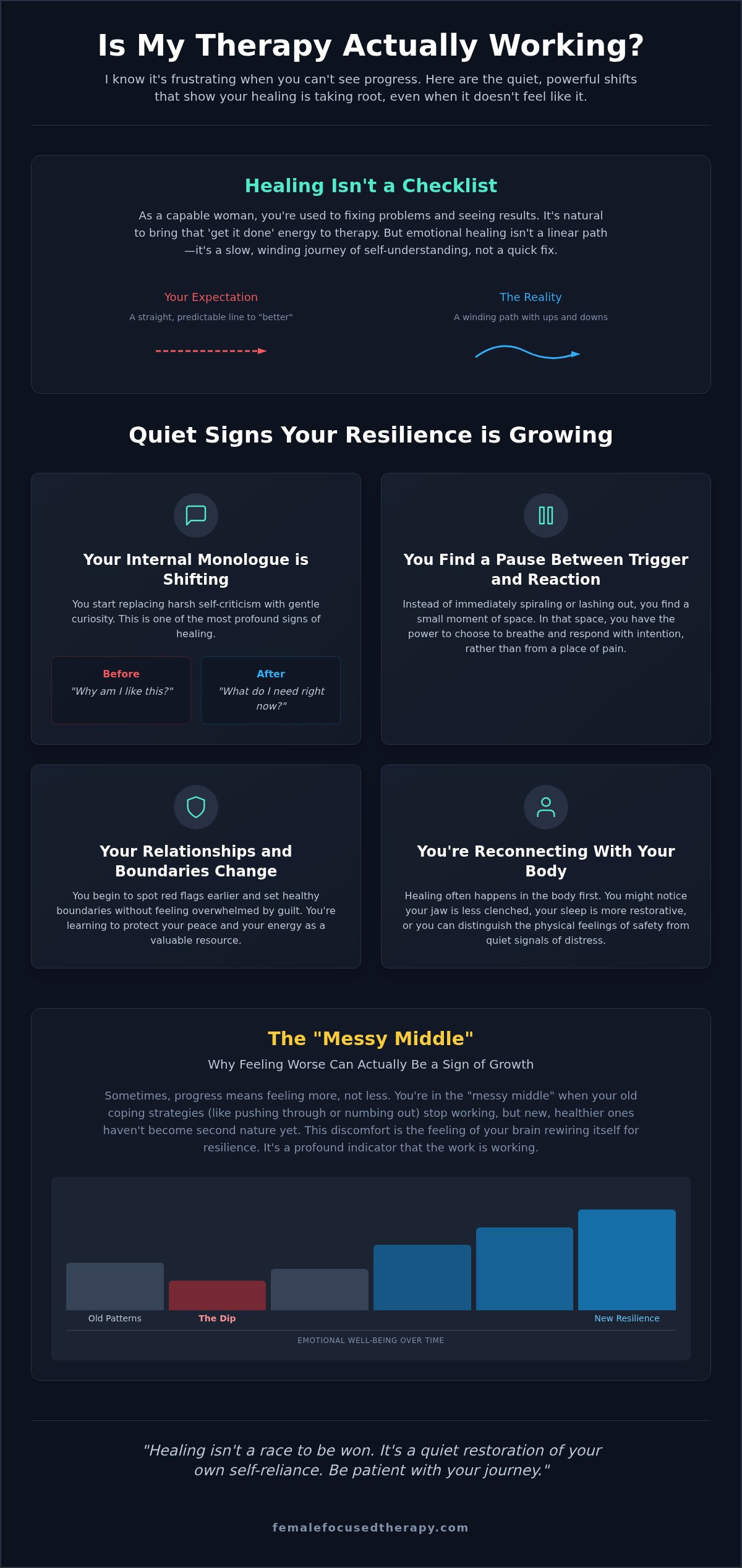
We are navigating what I call the messy middle. This is the period when your old, familiar coping mechanisms have stopped working, but your new, healthier tools aren’t fully formed yet. It is an exposed, uncomfortable place to be, but it is also where the most profound internal restoration happens. It means you are no longer bypassing your pain; you are finally moving through it.
The ‘messy middle’ of processing trauma
When we process trauma, we are often waking up parts of ourselves that have been numb for a very long time. This ‘thawing’ can bring buried emotions to the surface, making you feel more sensitive to the world around you. You might notice your body reacting more strongly to noise, stress, or even the needs of others. The messy middle is the necessary, often uncomfortable bridge between your old survival strategies and your new, authentic restoration.
During this stage, your mind and body are doing a lot of heavy lifting. It’s why I often encourage somatic rest, such as gentle breathwork or simply lying on the floor to ground yourself. You aren’t being ‘difficult’ or ‘weak’ by needing this space. You are simply allowing your system the time it needs to integrate the changes we are making in our sessions.
Setbacks as data, not as failure
A bad week doesn’t erase months of progress. One of the most important signs therapy is working is when you can have a difficult day without it turning into a week of self-loathing. I want you to treat yourself with the same kindness you would show a dear friend who is struggling. Setbacks are just data; they are signals that show us exactly where your triggers still live and what needs more of our attention.
If you are currently in the thick of this ‘messy middle’ and need a safe, grounded space to land, please feel free to book a session so we can navigate this stage together.
Rebuilding trust in your own intuition and body
Many of the women I support have spent years living entirely in their heads. When you’ve experienced trauma or chronic overwhelm, your body can feel like an unreliable or even dangerous place to be. One of the most profound signs therapy is working is when you finally begin to inhabit your physical self again. You start to notice that your body isn’t just a vehicle for your brain; it’s a source of deep, intuitive wisdom.
I use somatic movement and yoga to help you bridge this gap. This isn’t about exercise or ‘getting fit’. It’s about learning to feel the ground beneath your feet and the air in your lungs without immediately needing to flee or fix something. When you can sit in your body and feel a sense of quiet presence, you are witnessing the ultimate sign of healing.
As this connection grows, your ‘gut feeling’ becomes a reliable compass once more. You stop over-analysing every tiny decision because you can feel the ‘yes’ or ‘no’ in your nervous system. This return to self-trust is the heart of internal restoration. It means you are no longer looking outside of yourself for permission to feel okay; you are finding that stability from within.
Listening to the somatic signals of safety
I want you to start noticing the small ways your body signals that it feels safe. This might be the moment your shoulders drop away from your ears or when you realise your jaw has finally unclenched. Perhaps you notice your breath deepening naturally without you having to force it. These moments of physical ease are direct reflections of your emotional progress.
You can check in with your body throughout the day by simply pausing to notice where you are holding tension. Don’t judge the tightness; just acknowledge it. As you become more aware of these signals, you’ll find it easier to respond to your needs before they become emergencies. This awareness is a sturdy foundation for the rest of your life.
Your next step toward internal restoration
If you’ve read this far and feel like your progress is slow, please take a deep breath. You are exactly where you need to be. Healing is a quiet, steady process, and the fact that you are even asking these questions shows how much you’ve already grown. I want to encourage you to take one small, realistic step today to honour your journey.
Try journaling about just one ‘micro-win’ from this past week. It doesn’t have to be a huge breakthrough; maybe you just took five minutes to sit in the sun or you said ‘no’ to an extra task at work. If you’d like more support on this journey, I invite you to explore my free therapy resources which are designed to help you continue this work at your own pace.
Trusting the rhythm of your own restoration
I hope you now feel a little more grounded knowing that your experience, even the messy parts, is a normal part of the healing process. We have explored how signs therapy is working often appear in the quietest moments. It might be the way you choose curiosity over self-criticism or how you notice your breath deepening without effort.
Healing is not about reaching a state of perfection. It is about building a sturdy, compassionate relationship with yourself where you finally feel safe enough to be authentic. As a Registered Integrative Psychotherapist and a specialist in women’s trauma and ADHD, I use a warm, non-clinical approach to help you rebuild that internal stability and self-trust.
If you are ready to move from feeling overwhelmed to feeling restored, I would be honoured to walk alongside you. You can book a consultation with me to begin your journey of restoration whenever you feel ready. You have already taken the bravest step by showing up for yourself today. Trust your intuition and be gentle with your pace.
Frequently Asked Questions
How long does it typically take to see signs that therapy is working?
Most people notice subtle shifts in their perspective or emotional regulation within six to twelve sessions. The timeline is deeply personal and depends on the complexity of your history and the goals we set together. It is not a race; instead, it is about creating sustainable restoration that lasts long after our sessions end.
Is it normal to feel worse after a therapy session?
Yes, it is very common to feel emotionally raw or physically exhausted after we touch on difficult subjects. I often call this an “emotional hangover,” and it usually means you are finally safe enough to process heavy feelings you’ve carried for years. This temporary sensitivity is frequently one of the honest signs therapy is working.
What if I feel like I’ve hit a plateau in my progress?
Plateaus are a natural part of the healing rhythm and often mean your nervous system is integrating the changes we’ve already made. It is a time for consolidation rather than a sign of failure. We can use these moments to adjust our approach or focus more on somatic grounding and rest.
How do I know if I have the ‘right’ therapist for me?
You should feel safe, seen, and respected, even when the work is challenging. Research shows that the therapeutic alliance, which is the quality of our relationship, is the strongest predictor of a positive outcome. If you feel you can be your messy, authentic self without judgment, we likely have a good fit.
Can others see that I’m getting better before I notice it myself?
Often, yes, because internal shifts manifest in your external reactions first. Friends or partners might notice you are less reactive, more present, or setting firmer boundaries before you feel that internal sense of ease. These external observations can be encouraging signs therapy is working in your daily life.
What should I do if I don’t feel any different after several months?
The best step is to bring this directly into our sessions so we can explore any blockages together. We might need to shift from traditional talk therapy to more somatic work, revisit your core goals, or even consult a clinical psychologist Sunshine Coast at Professional Psychology Service for a different clinical perspective. Honest communication about your experience is essential for your long-term internal restoration and self-reliance.
How do I measure progress if my goals are emotional rather than practical?
We look for a shift in your “baseline” state, such as feeling more resilient or having a quieter internal critic. You can track how quickly you “bounce back” from a trigger compared to when we first started. These internal markers of peace and self-trust are just as valid as any practical achievement.
Is it a sign of progress if I want to talk about my therapist to my friends?
It usually indicates that the insights from our sessions are becoming integrated into your real-world identity. When you share a “lightbulb moment” or a new coping tool with a friend, you are reinforcing your own healing. It shows that the work we do together is providing a helpful framework for your daily life.

Article by
Cheryl Kennedy MacDonald MA BA (Hons) Pg. Dip. SAC BACP
Cheryl Kennedy MacDonald is a psychotherapist specialising in women’s mental health, relationships, and life transitions. She works with women navigating trauma, relationship breakdown, identity shifts, and midlife change, helping them rebuild self-trust, emotional stability, and a clear sense of who they are and what they want.
With over 20 years’ experience working with women internationally, Cheryl is the founder of YogaBellies, a global women’s yoga school, and the creator of the Birth ROCKS method. Her work sits at the intersection of psychotherapy and embodiment, integrating evidence-based therapeutic approaches with somatic, body-based practices that support deep, lasting change.
Known for her grounded and direct approach, Cheryl moves beyond surface-level insight to address the patterns held in the body and nervous system. Her work supports women to regulate, reconnect, and respond to their lives from a place of clarity, strength, and self-respect.
She is a published author in academic journals and has written multiple books on women’s health, pregnancy, and midlife wellbeing, available on Amazon and leading book retailers worldwide.