
You wake up with that familiar, heavy knot in your stomach, wondering if you really did imagine the whole thing. The constant questioning of your own memory is exhausting, and your body feels like it’s been running a marathon you never signed up for. It’s that heavy fog of confusion that makes you feel so unlike your old, vibrant self.
I know how isolating it feels to lose your sense of self in the fog of gaslighting. You’ve likely spent so long managing someone else’s emotions that you’ve forgotten how to listen to your own intuition. Finding a therapist specializing in narcissistic abuse is often the first step in realising that you aren’t “crazy” or “too sensitive.”
I’m here to help you understand the impact this has had on your well-being and guide you through a compassionate, mind-body approach to healing. We’ll look at how to regulate your nervous system and reclaim your self-trust. In this post, I’ll show you how to find your way back to the woman you are outside of that relationship.
Key Takeaways
- Understand how narcissistic abuse impacts both your mind and your body, often leaving you with chronic physical tension and a nervous system on high alert.
- Learn to shift your focus from analyzing the past to rebuilding your internal restoration and confidence in the present.
- Discover why working with a therapist specializing in narcissistic abuse is vital for receiving the specific validation and safety you need to move forward.
- Explore how a mind-body approach, including gentle somatic movement and breathwork, can help you release stored trauma and find your voice again.
Understanding the invisible weight of narcissistic abuse
I know that heavy, sinking feeling in your chest when you realize your own home doesn’t feel safe. It’s like living in a hall of mirrors where every time you try to speak your truth, the glass shifts. I understand how it feels to live in a world where your reality is constantly questioned.
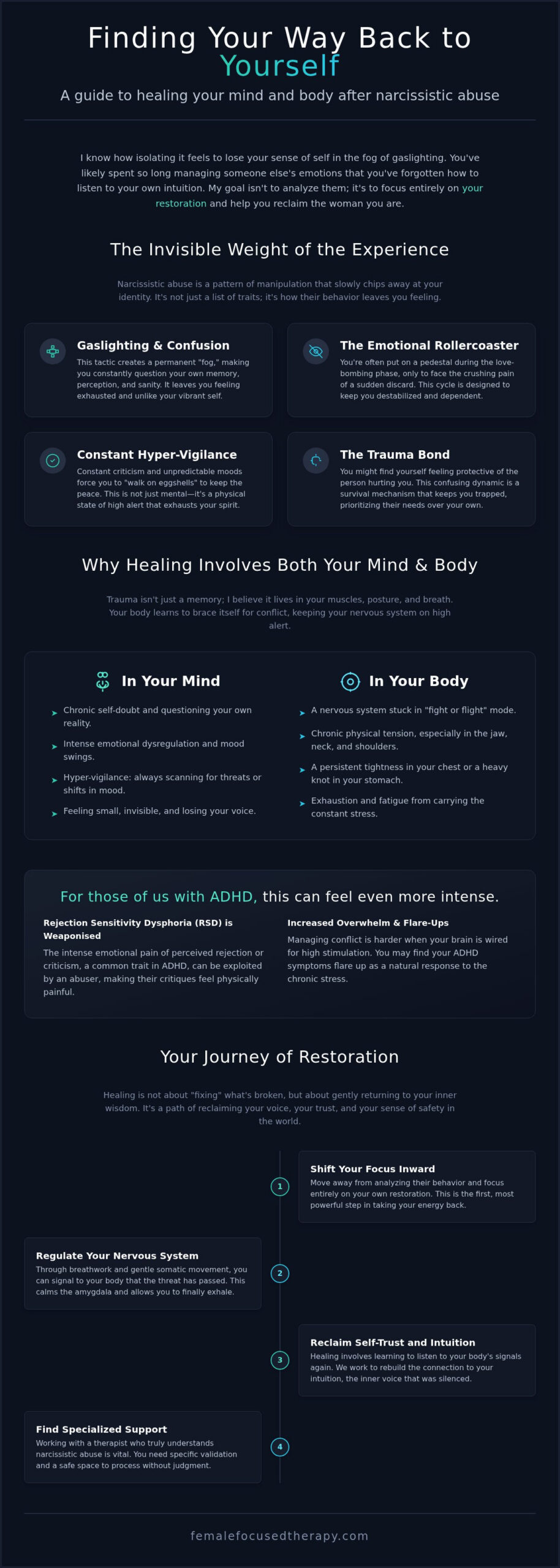
Narcissistic abuse isn’t just a list of traits found in a textbook. While Understanding Narcissism can help you make sense of their behaviour, I find it’s more helpful to focus on how it leaves you feeling. As a therapist specializing in narcissistic abuse, I look at the pattern of manipulation that slowly chips away at your identity.
You might feel like you’re living in a permanent fog. This is the result of gaslighting, a tactic used to make you doubt your own sanity. It leaves you exhausted and unlike your old, vibrant self. You’ve likely ridden the rollercoaster of love-bombing, where you were put on a pedestal, only to face the crushing pain of a sudden discard.
Finding a therapist specializing in narcissistic abuse is a vital part of clearing that fog and starting your journey back to yourself. It’s about moving away from their diagnosis and focusing entirely on your restoration. We’ll work together to untangle the confusion and help you stand in your own truth again.
The emotional toll of being ‘unseen’
Constant criticism erodes your internal sense of safety until you’re “walking on eggshells” just to keep the peace. This hyper-vigilance isn’t just in your mind; it’s a physical response that exhausts your spirit. I’ve seen how this relationship trauma can make you feel small and invisible.
You might even find yourself feeling protective of the person who is hurting you. This is a confusing but common part of the trauma bond. It’s a survival mechanism, but it keeps you trapped in a cycle that denies your own needs and feelings while you prioritize their unpredictable moods.
Why your ADHD might make this feel even more intense
For those of us with an ADHD brain, these dynamics can feel even more overwhelming. Rejection Sensitivity Dysphoria (RSD) is often weaponised by abusers, making their critiques feel physically painful. I see how your neurodivergent brain processes this trauma differently, often leading to intense emotional dysregulation.
Managing the overwhelm of conflict is harder when your brain is already wired for high stimulation. If you find your ADHD symptoms are flaring up, please know it’s a natural response to the stress. I’m here to help you navigate these specific challenges with kindness, ensuring you feel supported in a safe, grounded space.
Why healing involves both your mind and your body
Trauma isn’t just a memory that sits in the back of your mind. I believe it lives in your muscles, your posture, and the very rhythm of your breath. When you’ve spent years managing a difficult relationship, your body learns to brace itself for the next conflict.
Narcissistic abuse keeps your nervous system in a state of high alert. You might find you’re always scanning the room or jumping at small noises. This isn’t a flaw in your character; it’s your body’s way of trying to keep you safe from perceived danger.
As a therapist specializing in narcissistic abuse, I’ve seen how this chronic stress manifests as physical tension. It’s why I use an integrative approach. Combining talk therapy with somatic awareness allows us to address the “holding” that your body hasn’t yet let go of.
Somatic signs of relationship trauma
Do you notice a persistent tightness in your chest or a heavy knot in your stomach? These are often the first somatic signs of trauma. Your body might be trying to tell you what your mind isn’t quite ready to process or voice yet.
Learning to listen to these signals is a key part of recovery. Rest and restorative movement play a vital role in calming the amygdala. By slowing down, we signal to your nervous system that the immediate threat has passed and it’s finally safe to exhale.
You can learn more about my somatic movement approach and how it supports this deep internal restoration. It’s about giving your body the same level of care and attention we give your thoughts.
Moving beyond ‘just talking’
Understanding the abuse intellectually is a powerful first step, but logic alone rarely heals a wounded heart. You can know exactly what happened and why, yet still feel a deep sense of unease or panic. This is because trauma bypasses the logical brain.
I use mindfulness to help you find a grounded space within yourself. This isn’t about “fixing” you, but about creating a safe internal anchor. When you feel steady in your body, it’s much easier to process the complex emotions that come with leaving a toxic dynamic.
If you’re ready to explore how this mind-body approach can help you feel like yourself again, please feel free to reach out for a session. We can work together at a pace that feels manageable for you.
The journey of reclaiming your voice and self-trust
Reclaiming your voice is a quiet, steady process. For a long time, your energy was likely spent trying to decode someone else’s moods or survive their latest outburst. Healing is about moving your focus from ‘what happened?’ to ‘who am I now?’
I view this as a process of internal restoration. It isn’t about fixing a broken version of yourself, but about rebuilding the confidence that was systematically stripped away. We work on reconnecting you to your own needs, often for the first time in years.
Learning to listen to your intuition again is a major milestone. After years of being told your gut feelings are wrong or ‘crazy,’ it takes time to trust that inner whisper. Working with a therapist specializing in narcissistic abuse provides the safe mirror you need to see your own truth clearly again.
Setting boundaries is the final part of this restoration. We’ll explore how to create limits that feel safe and sustainable for your new life. These aren’t just walls to keep people out; they’re the foundations that allow you to feel secure within yourself.
Validating your own reality
To stop second-guessing your memories, I often suggest keeping a simple ‘reality journal.’ Writing down facts as they happen helps anchor you when the old fog of confusion tries to roll back in. It’s a practical way to prove to yourself that your feelings are valid.
Finding a witness who truly understands narcissistic patterns is essential for your recovery. You don’t have to explain the nuances of gaslighting here; I already see them. You can find out more about how I work with relationship trauma survivors to help them reclaim their story.
Grieving the relationship you thought you had
It’s important to allow yourself the space to mourn the ‘ideal’ version of your partner. You fell in love with a person you believed existed, and losing that dream is a real bereavement. It’s okay to feel sad even when you know the relationship was harmful.
Grief isn’t linear, and it often comes in waves. I support you through the complex layers of betrayal trauma, acknowledging the pain of the ‘discard’ while helping you stay grounded. We use breath and gentle movement to process these heavy emotions so they don’t stay trapped in your body.
What to look for in a therapist specialising in narcissistic abuse
Finding the right support is a deeply personal task, especially when your trust has been shattered. You’ve likely felt misunderstood before, perhaps by well-meaning friends or even other professionals who didn’t quite “get it.” It’s important to know that not every therapist is equipped to handle the nuances of narcissistic dynamics.
This type of recovery requires a specific understanding of how manipulation and power imbalances work. When you search for a therapist specializing in narcissistic abuse, you’re looking for someone who won’t ask “what was your part in this?” during a discussion about your mistreatment. In cases of psychological harm, “neutral” therapy can actually be quite damaging.
A neutral stance can feel like being gaslit all over again if the professional doesn’t recognize the reality of the abuse. A trauma-informed approach is non-negotiable for your recovery because it prioritises your safety and emotional stability. They should understand how your nervous system has been affected by the constant state of high alert.
I always encourage you to trust your gut during your first interaction. During a first call, you might want to ask:
- How do you view the power dynamics in abusive relationships?
- What is your experience with helping women recover from betrayal trauma?
- How do you integrate the body and nervous system into the healing process?
Red flags vs. green flags in trauma therapy
A major red flag is a therapist suggesting you “just try harder” or “communicate more clearly” with an abuser. These strategies are for healthy relationships where both people are acting in good faith. A specialist therapist validates the power imbalance and focuses on your internal restoration rather than “fixing” the toxic dynamic.
Green flags include a therapist who respects your pace and understands that healing isn’t linear. They should provide a space where your reality is never up for debate. You can read more about finding the right therapist in Singapore to help you navigate these initial choices and feel more confident in your search.
The value of a female-focused perspective
I believe there’s a unique value in a female-focused perspective when dealing with relationship trauma. Women often face specific societal pressures to be the “nurturers” or to “keep the family together” at any cost, even their own well-being. This can make the guilt of leaving or setting boundaries feel even more intense.
My background as a woman and a mother informs my therapeutic stance, allowing me to create a boundaried, safe container that is specifically for you. It’s about giving you the permission you might not have given yourself yet to put your own needs first. This is your time to be heard, seen, and truly understood.
Reclaiming your life requires a space where your voice is the only one that matters. If you’re ready to start that journey in a safe and supportive environment, I’m here to help. Book a session with me to see if we’re a good fit for your journey back to yourself.
How I support your restoration at Female Focused Therapy
I offer a space where you don’t have to explain the jargon. When you mention terms like gaslighting, hoovering, or flying monkeys, I already understand the weight behind those words. You don’t have to spend our time together educating me on the dynamics of your experience; I’m here to listen to your story.
My integrative method is a tailored form of psychotherapy that respects both your mind and your body. We don’t just talk about the past. We also look at how your nervous system is responding in the present, using gentle techniques to help you feel safe again. It’s a holistic way of working that treats you as a whole person, not just a set of symptoms.
Whether you’re visiting me in person in Singapore or connecting with me through online therapy, your safety is my absolute priority. I know how hard it can be to trust another person after your reality has been twisted. I’m here to hold space for your story until you feel strong enough to carry it yourself.
What to expect in our sessions together
Our sessions move at a calm, unhurried pace. I respect your current emotional capacity and will never push you to explore trauma before you’re ready. As a therapist specializing in narcissistic abuse, I know that true healing can’t be rushed; it needs a steady, supportive environment to take root.
We’ll focus on practical tools for managing the daily anxiety that often follows these relationships. This includes rebuilding your self-worth and learning how to set boundaries that actually stick. You can read more about me and my philosophy to see if my approach feels like the right fit for you.
Taking that first, gentle step
You don’t need to have all the answers or a perfectly clear timeline before we start. Many women come to me feeling completely overwhelmed, and that’s perfectly okay. We’ll start exactly where you are, with no pressure to perform or “fix” everything at once.
The process of booking a consultation is simple and designed to be as stress-free as possible. It’s just a way for us to see if we feel like a good match for your healing journey. I want you to feel empowered in this choice, knowing you’re in control of the pace and the direction we take.
Please remember that healing is possible, even when it feels a long way off. You’ve been through a lot, but you don’t have to navigate the path back to yourself alone. I’m here to walk alongside you as you reclaim your voice and your life.
Reclaiming your life and your light
Healing from this kind of betrayal isn’t about forgetting what happened. It’s about restoring your internal confidence and learning to trust that inner voice that was silenced for so long. You’ve already taken a significant step by acknowledging the impact this has had on your mind and your body. Rebuilding that connection to yourself is a quiet, powerful act of rebellion against the fog of the past.
Remember that real recovery involves more than just understanding the dynamics intellectually. It requires a gentle, somatic approach that allows your nervous system to finally feel safe. Finding a therapist specializing in narcissistic abuse can give you the validated, boundaried space you need to process these complex layers of trauma without judgement. This specialized support ensures you aren’t just surviving, but truly returning to the woman you were meant to be.
I’m here to support you as a Registered Integrative Psychotherapist, using a mind-body approach that respects your unique journey. You don’t have to carry the weight of this experience alone anymore. If you’re ready to take that first, gentle step toward yourself, please book a session with me to start your healing journey. You deserve to feel grounded, seen, and entirely at peace in your own skin.
Frequently Asked Questions
What exactly is narcissistic abuse in a romantic relationship?
Narcissistic abuse is a pattern of emotional control that leaves you feeling diminished and small. It’s often a subtle erosion of your boundaries, where your needs are treated as inconveniences. Over time, this dynamic can make you feel like you are constantly failing, leading to a deep sense of isolation and a loss of your own identity.
Can a therapist help me if I’m not sure if my partner is a narcissist?
You don’t need to wait for a formal diagnosis to start prioritising your own recovery. My work is centred on your experience and the emotional toll the relationship has taken on your spirit. If you feel constantly anxious or unheard, that is reason enough to seek support. We focus on helping you find your way back to yourself.
Why do I feel so much physical pain and fatigue after leaving?
How do I know if a therapist is truly ‘trauma-informed’?
A truly trauma-informed practitioner understands that traditional mediation or “hearing both sides” can be harmful in abusive dynamics. They should provide a boundaried space where your feelings are the priority and your reality isn’t up for debate. They will also recognise the physical impact of trauma, helping you find safety within your own body again.
Is it possible to heal from narcissistic abuse without going ‘no contact’?
Healing is possible even when you have to maintain some contact, such as for co-parenting or shared business interests. We focus on building your internal resilience so that their attempts to provoke or confuse you no longer have the same impact. It’s about creating emotional distance and reclaiming your power, even when physical distance isn’t fully possible.
What is the difference between couples therapy and individual trauma therapy?
Traditional couples therapy can sometimes be counterproductive if one partner is using manipulation to control the narrative. It can leave you feeling even more unseen or blamed for the relationship’s difficulties. Individual therapy, however, is a safe space dedicated entirely to your restoration, allowing you to process your feelings without the fear of being overheard or judged.
How long does the recovery process usually take?
The length of the recovery process varies for everyone because healing from betrayal trauma isn’t a straight line. It’s more like a series of shifts where you gradually feel more grounded and certain of your own truth. We move at a pace that respects your emotional capacity, focusing on building sustainable self-trust rather than looking for a quick fix.
Do you offer online therapy sessions for women outside of Singapore?
I offer online therapy sessions for women around the world, as well as in-person therapy in Singapore. This means you can access support from a space where you feel most comfortable and secure. My goal is to ensure that distance isn’t a barrier to you receiving the empathetic, professional guidance you need to move forward.
Cheryl Kennedy MacDonald
Registered Integrative Psychotherapist & Yoga Master
Female Focused Therapy | YogaBellies
Book a Session

Article by
Cheryl Kennedy MacDonald MA BA (Hons) Pg. Dip. SAC BACP
Cheryl Kennedy MacDonald is a psychotherapist specialising in women’s mental health, relationships, and life transitions. She works with women navigating trauma, relationship breakdown, identity shifts, and midlife change, helping them rebuild self-trust, emotional stability, and a clear sense of who they are and what they want.
With over 20 years’ experience working with women internationally, Cheryl is the founder of YogaBellies, a global women’s yoga school, and the creator of the Birth ROCKS method. Her work sits at the intersection of psychotherapy and embodiment, integrating evidence-based therapeutic approaches with somatic, body-based practices that support deep, lasting change.
Known for her grounded and direct approach, Cheryl moves beyond surface-level insight to address the patterns held in the body and nervous system. Her work supports women to regulate, reconnect, and respond to their lives from a place of clarity, strength, and self-respect.
She is a published author in academic journals and has written multiple books on women’s health, pregnancy, and midlife wellbeing, available on Amazon and leading book retailers worldwide.