
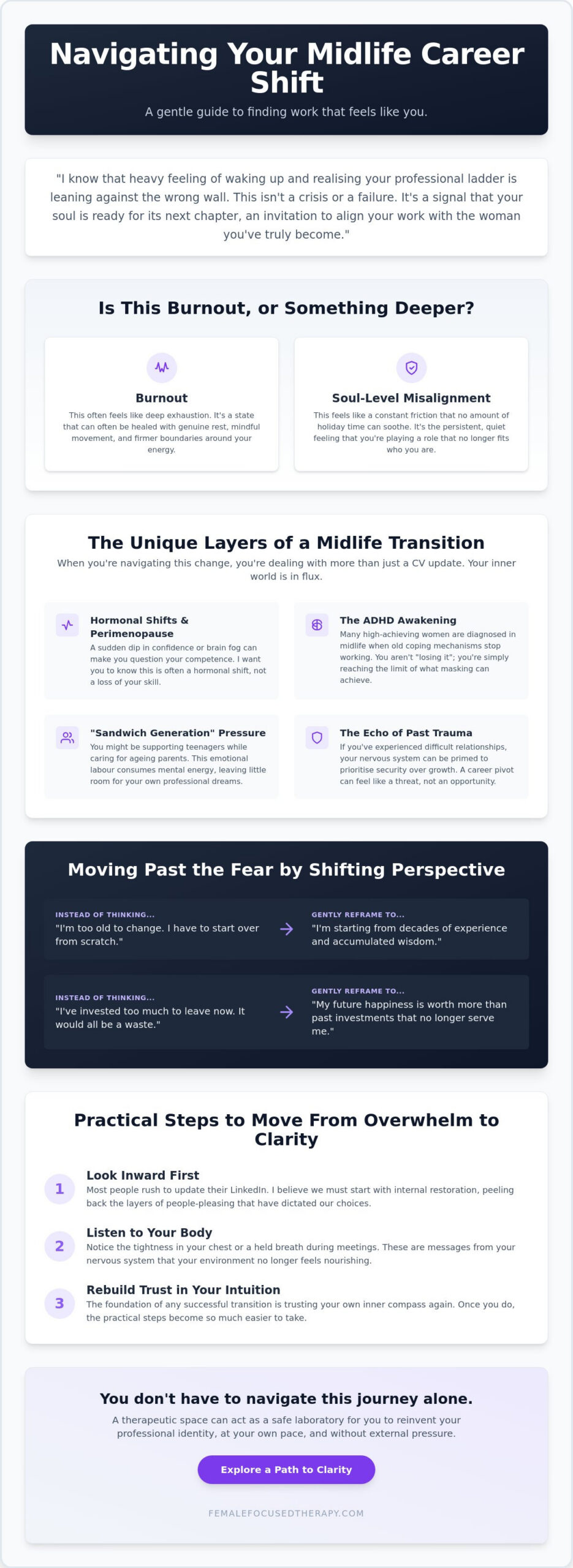
I know that heavy feeling of waking up and realising your professional ladder is leaning against the wrong wall. Whether you’re masking ADHD or managing the fatigue of menopause, navigating career change in midlife is a signal that you’re ready for work that aligns with your authentic self.
I’ll help you understand the emotional layers of this transition and provide a gentle framework for rediscovering your purpose. Together, we’ll look at managing the anxiety of change and rebuilding trust in your intuition.
Key Takeaways
- Understand why your professional restlessness is a natural developmental stage rather than a sign of failure or incompetence.
- Explore how navigating career change in midlife is often intertwined with the physical and emotional shifts of menopause or a new ADHD diagnosis.
- Learn how to untangle yourself from the “sunk cost” fallacy and the paralysing fear of financial instability.
- Discover practical, mind-body tools to help you move from a state of career exhaustion toward authentic clarity.
- Find out how a therapeutic space can act as a safe laboratory for you to reinvent your professional identity at your own pace.
Navigating career change in midlife: understanding the inner call
Have you ever sat at your desk, looked at your long list of achievements, and felt a hollow ache? It’s that quiet, persistent question: “is this all there is?” I want you to know that this isn’t a sign of failure or a lack of gratitude. It’s a signal that your soul is ready for its next chapter.
Instead of a crisis, this restlessness often signals a natural developmental stage. We often talk about the psychological layers of a midlife transition as something to be feared or avoided. I see it differently. It’s an invitation to align your outer world with the woman you’ve actually become.
In our 20s and 30s, we’re often driven by achievement, status, and building a foundation. By the time we reach our 40s or 50s, our internal compass often shifts toward contribution and meaning. Individual Psychotherapy Sessions can provide the space to honour that shift in your values, helping you navigate career change in midlife with greater spiritual and psychological depth.
It’s vital to distinguish between temporary burnout and a deep-seated need for change. Burnout can often be healed with rest, somatic movement, and better boundaries. A soul-level misalignment, however, feels like a constant friction that no amount of holiday time can soothe. It’s the feeling that you’re playing a role that no longer fits.
Recognising the ‘quiet whisper’ of transition
Your body often knows you’ve outgrown a role before your mind does. You might notice a persistent tightness in your chest or a habit of holding your breath during Zoom calls. These physical cues are messages from your nervous system telling you that your current environment no longer feels safe or nourishing.
Many women I meet are “high-functioning but hollow.” You’re doing the work, hitting the targets, and keeping everyone happy, but you feel like a ghost in your own life. I often see this manifest in my therapy room in Singapore, where the pressure to perform often masks a desperate need for authentic connection to one’s work.
Why midlife is the perfect time for reinvention
You aren’t starting from scratch; you’re starting from decades of accumulated wisdom. The “soft skills” you’ve mastered, such as empathy, complex problem solving, and emotional intelligence, are your greatest assets in any new field. You’ve already proven you can learn and succeed.
Midlife is the bridge between your past and your potential. When you reframe “starting over” as “starting from experience,” the path forward feels less like a cliff edge and more like a natural evolution. You’re finally old enough to know what you don’t want, which is the first step toward finding what you do.
The role of internal restoration in professional shifts
Most people rush to update their LinkedIn profile the moment they feel unhappy. I believe we must look inward first. Professional shifts require a period of internal restoration, where we peel back the layers of people-pleasing that have dictated our career choices for years.
Rebuilding self-trust is the foundation of any successful transition. I help the women who I work with to find this internal clarity through a blend of talk therapy and mind-body awareness. Once you trust your own intuition again, the practical steps of navigating career change in midlife become much easier to take.
The unique psychological layers of a midlife transition for women
When you’re navigating career change in midlife, you aren’t just dealing with a CV update. For women, this transition is layered with complex physiological and emotional shifts that men don’t experience in the same way. It’s a season where your internal world is in flux.
I often see professional confidence dip during perimenopause. The sudden onset of social anxiety or a loss of your familiar “edge” can make you question your hard-earned competence. This is a hormonal shift, not a loss of skill, yet it makes starting something new feel daunting.
Then there is the “ADHD awakening.” Many women I work with were never diagnosed because they were high-achievers. In midlife, hormonal changes mean your old coping mechanisms stop working. You aren’t “losing it”; you’re simply reaching the limit of what masking can achieve.
We also can’t ignore the “Sandwich Generation” pressure. You might be supporting teenagers while simultaneously managing the care of ageing parents. This emotional labour takes up all your mental energy, leaving little room for your own professional dreams.
If you’ve experienced past relationship trauma, taking a professional risk can feel physically unsafe. Your nervous system is primed to prioritise security over growth. This makes a career pivot feel like a threat rather than an opportunity for joy.
Hormones, ADHD, and the ‘brain fog’ of transition
It’s vital to validate that your struggle to focus is often physiological. Brain fog is a real, documented symptom that can make you feel like you’re losing your grip. In my ADHD therapy sessions, we work on understanding these patterns rather than fighting them.
Managing emotional intensity is key to making clear decisions about your future. When hormones fluctuate, workplace stress feels amplified. Learning to regulate your nervous system through breath helps you distinguish between a bad day and a career that no longer fits who you are.
The impact of gender-specific life transitions
Professional identity often shifts alongside family dynamics. Perhaps you’re facing an “empty nest” or a change in your marital status. These events force a re-evaluation of who you are outside of your roles as a mother or partner. I offer menopause therapy to help you navigate this.
Carrying the heavy weight of the mental load while navigating career change in midlife is an enormous burden. It’s okay to admit that you’re tired. If you feel ready to untangle these layers in a safe space, you might find it helpful to book a session so we can explore your path forward.
Moving past the fear of starting over in your 40s or 50s
Imposter Syndrome often flares up when we step outside our comfort zone. You might feel like a fraud because you don’t have a specific degree in a new field, even though you have decades of leadership and life experience. This internal critic is often just a protective mechanism trying to keep you safe from the unknown. It’s a sign that you are growing, not that you are incompetent.
It’s vital to begin separating your worth from your job title or your monthly pay packet. We’ve been conditioned to believe that our identity is tied to our professional status. When that status changes, it can trigger a deep sense of grief. It is okay to mourn the “old you” and the career you are leaving behind. This grief is a necessary part of making space for your authentic self to emerge.
Deconstructing the ‘too old’ myth
You aren’t “too old” to pivot. I prefer the concept of the “Modern Elder,” especially from a female perspective. This reframes your age as a strategic advantage. Your years of navigating complex human dynamics and solving problems are invaluable. Your brain is also incredibly resilient. Neuroplasticity allows for deep, meaningful learning at any age, meaning you are just as capable of mastering new skills now as you were in your 20s.
Healing from ‘workplace trauma’ and narcissistic environments
If you’ve spent years working for toxic bosses, your ability to trust your own intuition has likely been damaged. Toxic environments can mirror the dynamics of relationship trauma and narcissistic abuse, leaving you feeling hyper-vigilant and small. You might find yourself second-guessing every decision or waiting for a “trap” that isn’t there.
Healing your nervous system is the essential first step to a new career. When you are in a state of survival, you cannot access the creative part of your brain needed for reinvention. By prioritising internal restoration, you create a steady foundation. Navigating career change in midlife becomes a much more manageable process when you aren’t constantly fighting a “fight or flight” response from your past experiences.
Practical steps to move from career overwhelm to clarity
When the weight of your current role feels unbearable, the temptation is to make a sudden, dramatic exit. I’ve seen many women feel so burnt out that they want to burn the whole bridge down. But navigating career change in midlife requires a steadier, more compassionate approach to yourself.
Clarity doesn’t usually arrive in a lightning bolt of inspiration. It grows in the quiet spaces you create when you stop trying to “hustle” your way out of unhappiness. I’ve found that doing less is often the fastest way to discover what’s next. By slowing down, you allow your authentic desires to surface through the noise of expectation.
I recommend starting with micro-experiments rather than impulsive resignations. This might look like attending a one-day workshop, shadowing a friend for an afternoon, or starting a small creative project. These low-stakes trials allow you to test the waters without the paralysing pressure of needing to be “right” the first time.
Somatic practices for professional clarity
If your body is in a constant state of “fight or flight” due to workplace stress, you can’t access your creative brain. A simple practice is to focus on your exhale, making it longer than your inhale. This sends a direct signal to your nervous system that you are safe enough to think about your future.
I often use somatic movement to help women unlock “stuck” thoughts. When we move the body, we often move the mind. For those currently navigating deep burnout, I want you to see rest as a strategic professional tool. You cannot build a new life on a foundation of exhaustion.
Inventorying your ‘internal gifts’
Take a piece of paper and list what you actually love doing. Don’t list what you’re “good at” or what people pay you for; high-functioning women are often brilliant at things that drain them. We’re looking for the tasks that make you lose track of time and feel energised.
Identify your non-negotiables for this next chapter. Perhaps it’s a four-day week, a shorter commute, or an environment where you don’t have to mask your ADHD. Be honest about the difference between your ego goals, like a specific title, and your soul goals, like peace and genuine contribution.
Finding your support network in Singapore
You shouldn’t have to navigate this transition in isolation. Finding a safe space to explore your options is vital for rebuilding your confidence. Whether it’s a mentor or a professional peer group, having people who “get it” makes the path feel less lonely.
If you’re feeling particularly stuck, you might find my guide on finding a therapist in Singapore helpful. Professional support can act as a laboratory for your reinvention. If you’re ready to start that journey, I invite you to book a session to begin finding your clarity.
How I support you through your midlife career journey
I believe that navigating career change in midlife is one of the most courageous acts of self-care you can undertake. My role is to provide a steady, confidential space where you can untangle your professional identity from your personal worth. I use an integrative, trauma-informed approach that respects both your mind and your body.
Our sessions act as a “lab” for your reinvention. It’s a place where you can voice your wildest ambitions and your deepest fears without judgment. We look at the patterns that have held you back, from people-pleasing to the exhaustion of masking ADHD, and we build a new, sustainable way of working.
Safety and confidentiality are the cornerstones of our work together. In a world that often demands you have all the answers, my therapy room is a sanctuary where it’s safe to say “I don’t know yet.” We move at your pace, ensuring that every step forward feels grounded and authentic to who you are now.
A collaborative path to professional restoration
I often blend evidence-based CBT with mindfulness practices to help you quiet the harsh inner critic that flares up during transitions. We work together to rebuild your internal stability, ensuring you feel strong enough to handle the uncertainty of change. This internal restoration is what makes a successful career pivot possible.
If you feel like you need more concentrated support, I offer focused intensive therapy options. These sessions allow us to dive deeper into the roots of your career anxiety. We clear the path for your next chapter more quickly than traditional weekly sessions might allow.
Your next step toward clarity
You don’t have to have a plan before you reach out. I invite you to start with a low-pressure initial consultation where we can simply talk about where you are and where you’d like to be. It’s an opportunity for you to see if my approach feels like the right fit for your journey.
You might also find it helpful to explore the free therapy resources available on my website. These tools are designed to offer immediate support as you begin navigating career change in midlife. They provide a gentle way to start looking inward.
Your “second act” has the potential to be the most fulfilling part of your life. It is never too late to align your work with your soul. When you’re ready to start this transition with professional support, you can book a session with me. Let’s find the path that leads back to your most authentic self.
Stepping into your authentic professional chapter
You’ve explored how the restlessness you feel is a natural developmental stage rather than a crisis of competence. We’ve looked at the unique layers of menopause and ADHD that can impact your professional confidence and how to move past the fear of starting over. Navigating career change in midlife is a journey of internal restoration that allows your work to finally align with your soul.
As a Registered Integrative Psychotherapist and a specialist in life transitions, I’m here to support your evolution. My trauma-informed, female-centric approach ensures you have a safe laboratory to test new ideas and rebuild your self-trust. You have decades of wisdom to draw upon, and your age is a strategic advantage in this new chapter. You don’t have to carry the weight of this transition in isolation.
If you’re ready to move from a state of overwhelm toward grounded clarity, I invite you to take a gentle first step. You can book a session with me to explore your transition so we can begin this work together. Your second act has the potential to be your most authentic and fulfilling one yet.
Common questions about professional reinvention
Is it normal to feel like I’m having a midlife crisis because of my job?
Yes, it’s very normal to feel unsettled, but I prefer to call it a “midlife chrysalis” rather than a crisis. This stage of life often triggers a natural shift in your internal values, moving you away from external achievement and toward a desire for genuine contribution. It’s not a sign of failure; it’s a signal that your soul is ready to grow into a role that actually fits who you’ve become.
How do I know if I’m ready for a career change or just need a long holiday?
The key difference lies in how you feel after you’ve rested. Burnout can often be healed with a proper break, somatic movement, and better boundaries. However, if the “Sunday dread” returns the moment you land back from a holiday, you’re likely dealing with a soul-level misalignment. When your work no longer reflects your values, no amount of time off will soothe that persistent feeling of friction.
Can therapy actually help me find a new career path?
Therapy acts as a safe, confidential laboratory where you can explore your options without the weight of other people’s expectations. By stripping away years of people-pleasing and “shoulds,” we can uncover your true interests. I help you clear the emotional clutter and rebuild your self-trust, which naturally allows your next professional steps to emerge with much more clarity and less anxiety.
I have ADHD; will a career change just lead to more overwhelm?
Not if the change is designed to work with your brain rather than against it. Navigating career change in midlife with ADHD is often about ending the exhausting cycle of masking in a role that doesn’t suit your neurodivergence. Many women find that moving toward work they are genuinely passionate about actually reduces their overwhelm, as interest-based nervous systems thrive on authentic engagement and meaning.
What if I can’t afford to take a pay cut right now?
A career pivot doesn’t always mean a permanent financial loss. Research shows that approximately 77% of career changers earn the same or more than their previous salary within two years of making a switch. I encourage “micro-experiments” that allow you to test new paths while maintaining your current stability. This way, you can build a bridge to your next role without triggering a state of financial panic.
How does menopause affect my ability to make big life decisions?
Hormonal shifts during menopause can cause brain fog and social anxiety, which often leads to a temporary dip in professional confidence. It’s vital to remember that these are physiological changes, not a loss of your hard-earned skills. When navigating career change in midlife, I help you use somatic practices to regulate your nervous system. This ensures you make big decisions from a place of grounded clarity rather than from a state of hormonal depletion.

Article by
Cheryl Kennedy MacDonald MA BA (Hons) Pg. Dip. SAC BACP
Cheryl Kennedy MacDonald is a psychotherapist specialising in women’s mental health, relationships, and life transitions. She works with women navigating trauma, relationship breakdown, identity shifts, and midlife change, helping them rebuild self-trust, emotional stability, and a clear sense of who they are and what they want.
With over 20 years’ experience working with women internationally, Cheryl is the founder of YogaBellies, a global women’s yoga school, and the creator of the Birth ROCKS method. Her work sits at the intersection of psychotherapy and embodiment, integrating evidence-based therapeutic approaches with somatic, body-based practices that support deep, lasting change.
Known for her grounded and direct approach, Cheryl moves beyond surface-level insight to address the patterns held in the body and nervous system. Her work supports women to regulate, reconnect, and respond to their lives from a place of clarity, strength, and self-respect.
She is a published author in academic journals and has written multiple books on women’s health, pregnancy, and midlife wellbeing, available on Amazon and leading book retailers worldwide.