
What if the feeling of being invisible isn’t a sign that your life is fading, but a quiet invitation to finally look inward? For many of us, reaching our fifties feels like standing at a busy crossroads while everyone else seems to be looking right through us. You might be managing the heavy demands of the sandwich generation while exploring therapy for women over 50 to help manage the profound hormonal shifts and emotional transitions of this life stage.
I know how exhausting it is to hold space for everyone else while you’re secretly struggling with the echoes of past relationship trauma or the weight of narcissistic abuse. It’s easy to feel like you’ve lost the map to your own identity. I promise that finding your way back to yourself is not only possible, but it’s the most important work you’ll ever do to restore your internal stability.
In this guide, I’ll share how we can work together to process long-term emotional pain and find the clarity you deserve for this new chapter. We’ll look at gentle ways to navigate these transitions, helping you move from a place of overwhelm toward a future where you feel grounded, seen, and deeply connected to your own intuition once again.
Key Takeaways
- I’ll show you how therapy for women over 50 can be a collaborative journey to reclaim the parts of yourself you’ve set aside for others.
- Learn how to manage the unique pressures of the sandwich generation while navigating the emotional shift of an empty nest.
- Discover why I believe true healing happens when we listen to how trauma and stress are held within your body and nervous system.
- Explore the connection between menopause and late-diagnosed ADHD to finally understand the years of masking you’ve experienced.
- Understand what to expect from our first session together as you begin investing in the woman you are becoming.
What does therapy for women over 50 look like?
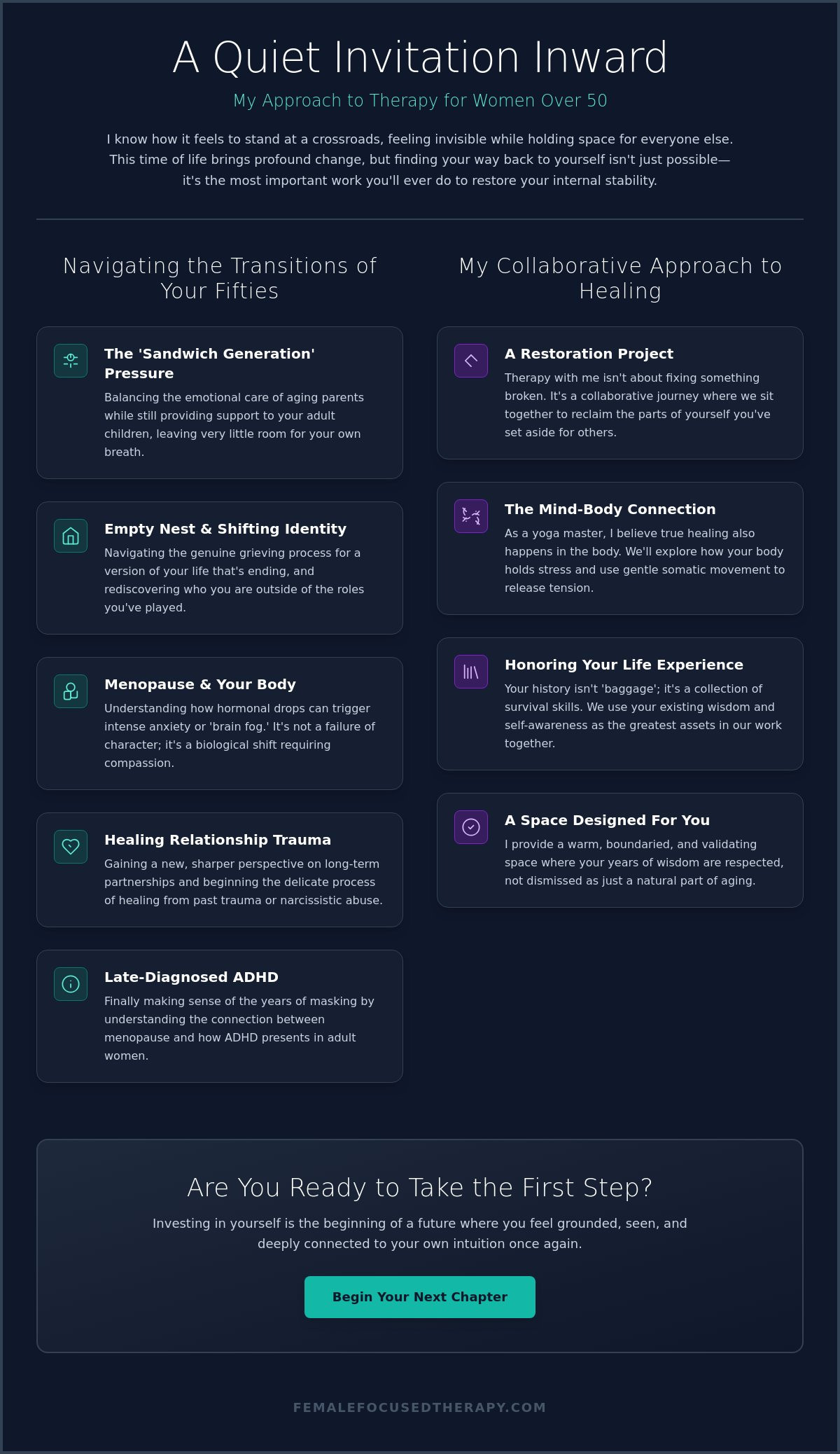
Therapy at this stage isn’t about fixing something broken. It’s a restoration project. I see it as a collaborative journey where we sit together to map out the landscape of your life. When you begin therapy for women over 50, we move away from cold, clinical labels and instead focus on your lived experience as the true guide for our work.
The focus I bring is tailored to the unique emotional landscape of women in their second act. This is a time of profound shift, where the roles you’ve played for decades might be changing. I provide a warm but boundaried space for you to reflect on who you are when you aren’t busy being a mother, a daughter, or a professional. It’s a chance to breathe and look at your life through a lens of compassion rather than judgment.
A space designed specifically for you
I’ve created an environment where your years of wisdom are respected rather than dismissed. Too often, women feel invisible in traditional healthcare, as if their concerns are just a natural part of ageing that they should endure. I don’t believe that’s true, and I’m here to validate the complexity of your feelings while offering professional support that acknowledges your history.
My integrative approach supports your mind and body together. Because I’m also a yoga master, I pay attention to how your body holds stress and old stories. We might explore somatic movement and yoga to help release the tension that words alone can’t reach. This mind-body connection is essential for true healing and internal restoration.
Why your life experience is your greatest asset in therapy
We often talk about ‘baggage’, but I prefer to see it as a collection of survival skills that deserve to be honoured. Every challenge you’ve faced, from career hurdles to family dynamics, has taught you something vital. When we engage in therapy for women over 50, we use your existing self-awareness to deepen the process and create lasting change.
You already have the tools; I’m just helping you find them in the dark and put them to use for your own wellbeing. Many women come to me while understanding midlife transitions and the complex feelings of anxiety or remorse that can surface. I help you connect those past experiences to your current resilience, seeing that you haven’t just survived; you’ve grown, and now we’re clearing the path for what comes next.
Navigating the transitions that define our fifties
Many of us find ourselves in what is often called the ‘sandwich generation’. You’re likely balancing the complex, emotional care of aging parents while still providing significant support to your adult children. It’s a relentless pressure that leaves very little room for your own breath, often making you feel like you’re the only one holding the family’s world together.
Along with this comes the sudden, sometimes jarring silence of a changing home. Empty nest syndrome isn’t just a cliché; it’s a genuine grieving process for a version of your life that’s ending. You might also be feeling a shift in your professional world, perhaps craving a different pace or a new direction entirely that feels more aligned with your current energy.
I see these moments as powerful invitations rather than just doors closing. This is your time to finally rediscover your own needs and desires. Through therapy for women over 50, we can look at these transitions as opportunities to reclaim your identity. You’ve spent years being the person everyone else needs you to be, and now we focus on who you want to be for yourself.
Menopause and the emotional impact of hormonal change
Your body’s chemistry has a direct line to your emotional wellbeing. During the menopause transition, the drop in estrogen can trigger intense anxiety or a confusing ‘brain fog’ that makes daily tasks feel insurmountable. It’s not a failure of character or a sign of weakness; it’s a biological shift that requires a compassionate, informed approach.
I focus on life transitions and menopause therapy to help you find your footing again. We look at how these hormonal changes impact your mental health and develop strategies to help you feel more grounded. You don’t have to navigate this internal weather alone, and there’s immense relief in understanding the physical roots of your emotional state.
Healing from relationship trauma and narcissistic abuse
Reaching fifty often brings a new, sharper perspective on our personal history. You might start to see patterns in a long-term partnership that you previously overlooked or minimised. Healing from relationship trauma is a delicate process, especially when you’ve been in a specific dynamic for twenty or thirty years and your sense of self has become intertwined with it.
The road to recovering from narcissistic abuse is about more than just understanding what happened; it’s about coming home to yourself. I work with you to rebuild the self-trust that may have been slowly eroded over the decades. We focus on restoring your internal stability so you can move forward into this next chapter with a clear sense of your own worth.
If the weight of these transitions feels too heavy to carry on your own, I’m here to hold that space with you. You can reach out to start our conversation whenever you feel ready to take that first step toward restoration.
Why I believe healing happens in the body too
My background as a yoga master deeply informs how I listen to your story. I don’t just hear your words; I notice the way your shoulders might tighten or how your breath catches when we speak about difficult memories. Trauma and stress aren’t just abstract thoughts. They live in your nervous system, often manifesting as physical tension or chronic fatigue that you can’t simply think your way out of.
When we work together in therapy for women over 50, I integrate this somatic awareness into our sessions. It’s about recognising that your body has been keeping score of every challenge you’ve faced for decades. By bringing the body into the conversation, we can address the root of your overwhelm rather than just managing the symptoms on the surface.
I also want you to understand that rest is a radical act of self-care. For women who have spent years caring for everyone else, choosing to pause can feel uncomfortable or even selfish. In our work, we reframe rest as a necessary part of your restoration. It’s the quiet space where your nervous system can finally begin to repair and settle into a new sense of peace.
Somatic movement for emotional release
Sometimes, words aren’t enough to reach the depth of what you’re feeling. I use gentle somatic movement to help you process grief and tension that has been stored in your muscles for years. This isn’t about exercise or flexibility. It’s about learning to recognise your body’s signals and giving yourself permission to release what no longer serves you without any judgement.
I guide you to listen to these signals with curiosity rather than fear. You might find that a certain movement brings up a memory or a feeling you hadn’t realised was still there. By moving through it physically, we create space for emotional release that talk therapy alone sometimes misses. It’s a deeply supportive way to reclaim your physical self as you navigate this life stage.
The power of the breath in managing overwhelm
Simple breathwork techniques are incredibly effective at regulating a frayed nervous system. When things feel like they’re spinning out of control, your breath is the most accessible tool you have to find immediate calm. I weave these mindfulness practices into our sessions to help you manage the specific anxieties that come with being a woman over fifty.
We work on creating a genuine sense of safety within your own skin. This isn’t a quick fix, but a steady practice of coming back to yourself. By focusing on the rhythm of your breath, you can learn to anchor yourself even when the external world feels chaotic. It’s about building an internal sanctuary that you can return to whenever you need to find your grounded centre again.
Addressing late-diagnosed ADHD in women over fifty
As a woman who lives with ADHD, I know exactly what it’s like to spend decades masking. You’ve likely become an expert at appearing together while your internal world feels like a storm of half-finished thoughts and intense overwhelm. For years, you might have blamed yourself for being disorganized or sensitive, never realizing that your brain was simply wired differently.
It’s no coincidence that many of us only realize our neurodivergence during the menopause transition. When estrogen levels drop, the coping mechanisms we’ve used for years often crumble. Statistics show that over half of all adults with a current ADHD diagnosis, about 55.9 percent, only received that diagnosis in adulthood. This shift can feel like a crisis, but it’s actually a moment of profound clarity.
Finding out you have ADHD later in life brings a mix of grief and immense relief. In our sessions of therapy for women over 50, we work on moving from deep-seated shame toward genuine self-compassion. We look at your history through this new lens, forgiving the woman who was just trying her best with a brain that worked differently than society expected.
Managing the overwhelm of a neurodivergent brain
I don’t focus on fixing your productivity to meet someone else’s standards. Instead, I help you find emotional regulation strategies that actually work for your specific brain type. We look at the intersection of your symptoms and hormonal shifts to give you back a sense of control over your daily life.
This process is about learning to thrive as you are, not trying to fit into a neurotypical mold. We explore how your internal restoration depends on understanding these biological patterns. By acknowledging how your brain type impacts your mental health, we can build a foundation of stability that feels manageable and sustainable for the long term.
Letting go of the ‘shoulds’ and finding your rhythm
Part of our work is releasing the heavy weight of societal expectations. You don’t have to function the way everyone else does, and you certainly don’t have to apologize for it. We’ll work together to create a lifestyle that honors your unique energy patterns and focus, rather than fighting against them every day.
There is so much joy to be found in your creative strengths and unique perspective once the pressure to be normal is removed. When we engage in therapy for women over 50, we prioritize your intuition and your needs. We clear away the shoulds so you can finally appreciate the brilliance and resilience of your own mind.
If you’re ready to stop masking and start understanding how your brain actually works, I’m here to support you. You can book a session to explore ADHD-focused therapy and begin your journey toward self-acceptance.
Taking the first step toward your next chapter
Therapy is an investment in the woman you’re becoming. It isn’t just about looking back at where you’ve been; it’s about clearing the space for what’s next. When you seek therapy for women over 50, you’re giving yourself permission to prioritise your own healing after years of putting everyone else’s needs before your own.
In our first individual psychotherapy session, we focus on creating a foundation of safety. You don’t need to have a perfectly prepared list of problems or a clear map of your trauma. I’m here to listen to the threads of your story and help you make sense of the patterns that feel heavy or confusing.
I offer a space that is entirely yours, whether we meet in-person or through online therapy. This is a boundaried, confidential environment where you can speak the truths you’ve perhaps kept hidden for decades. It’s a place for internal restoration, where your voice is the most important one in the room.
I want to remind you that it’s never too late to begin this journey. Whether you’re navigating a complex midlife transition or finally addressing long-held relationship trauma, your healing is valid right now. You aren’t “past your prime”; you’re entering a chapter of life that can be defined by your own intuition and desires.
Finding the right fit for your needs
Choosing a therapist is a deeply personal decision, and I always encourage you to trust your intuition. You should feel seen, heard, and respected from the very first interaction. Our collaborative relationship is the most important foundation for the change you want to see in your life.
If you are looking for additional holistic wellness resources to complement your journey, Wild Skye Healing provides compassionate support for individuals navigating emotional healing and significant life transitions.
Some women find that they benefit from a more concentrated approach to their healing. If you feel ready for deeper work in a shorter timeframe, we can explore intensive therapy options. These sessions allow us to dive into complex issues with sustained focus, helping you build internal stability at a pace that feels right for you.
Your realistic next step
I invite you to take one small, gentle action for yourself today. You don’t have to overhaul your entire life in a single afternoon. Sometimes the bravest thing you can do is simply acknowledge that you deserve support and reach out to find it. I’m here to hold that space with you whenever you’re ready.
If you feel ready to start our conversation, you can book a consultation through my calendar. We’ll find a time to discuss what you’re facing and how we might work together to find your way back to yourself. It’s a simple, low-pressure way to see if we’re a good fit for your journey.
Please remember that you don’t have to have all the answers right now. You don’t even need to know exactly what’s “wrong.” We’ll figure that out together, one steady step at a time, in a space that honours exactly who you are and the woman you are still becoming.
Embracing the woman you are becoming
You’ve spent decades being everything to everyone else. Whether you’re navigating the heavy silence of an empty nest or finally putting a name to a lifelong feeling of being “different” through a late ADHD diagnosis, this chapter belongs to you. I believe that therapy for women over 50 is more than just talk; it’s a process of internal restoration that honours both your mind and your body.
As a Registered Integrative Psychotherapist, Yoga Master, and ADHD Advocate, I specialise in helping women through the complex layers of relationship trauma and life transitions. We don’t just look at the thoughts in your head; we listen to the tension in your shoulders and the rhythm of your breath. You’ve already survived so much, and now it’s time to thrive in a way that feels authentic to you.
I invite you to book a consultation with me to explore how we can work together on your next chapter. You don’t have to carry the weight of these transitions alone. I’m here to offer a safe, grounded space where you can finally find your way back to yourself.
Frequently Asked Questions
Is it too late to start therapy if I’m over 50?
No, it is never too late to begin your healing journey. In fact, many women find that their fifties provide the perfect time for therapy for women over 50 because they finally have the space to focus on their own needs. Your years of wisdom and self-awareness are incredible assets that help us deepen the therapeutic work more quickly than in your younger years.
How do I know if I’m experiencing menopause symptoms or depression?
It is quite common for the physical shifts of menopause to mirror or even trigger symptoms of depression. While they are distinct, the drop in estrogen during this transition directly impacts the chemicals in your brain that regulate mood. We look at your experience holistically to understand how your body’s chemistry is influencing your emotional state, ensuring you receive support that honours both.
Can therapy help me if I’ve been in a difficult relationship for decades?
Therapy is incredibly effective for processing long-term relationship patterns, even those that have lasted for thirty years or more. Whether you are dealing with the aftermath of narcissistic abuse or simply a partnership that has lost its safety, we work to rebuild your self-trust. It takes time to unpick these dynamics, but restoration is possible at any stage of your life.
What is integrative psychotherapy and how does it differ from traditional counseling?
Integrative psychotherapy means I don’t rely on just one clinical framework. Instead, I blend evidence-based psychological theories with somatic practices like breathwork and mindfulness. Unlike traditional counseling which stays mostly in the mind, this approach acknowledges that your body holds your story too. It allows us to tailor the process specifically to your unique emotional and physical needs for deeper healing.
I’ve always been high-functioning; why do I feel so overwhelmed now?
Many high-functioning women reach a breaking point in their fifties because the sheer volume of transitions becomes too much to mask anymore. You might be managing aging parents and adult children while your hormones are shifting and your career is changing. This overwhelm isn’t a failure on your part. It is a sign that the coping mechanisms that served you for years are simply exhausted.
Do you offer online sessions for women outside of Singapore?
I do offer online therapy sessions for women regardless of where you are located in the world. While I am based in Singapore, my practice is designed to support women internationally who are seeking therapy for women over 50. These sessions provide the same level of confidentiality and professional support as my in-person work, allowing you to find healing from the comfort of your own home.
What should I expect during my first session with you?
During our first session, you can expect a gentle, unhurried conversation where we begin to explore what has brought you here. There is no pressure to have all the answers or to fix anything immediately. We simply look at the threads of your story together. My goal is to ensure you feel safe, seen, and understood as we decide on the best path forward.
How does somatic movement fit into a therapy session?
Somatic movement fits into our sessions as a way to regulate your nervous system when words feel insufficient. We might use gentle movement or specific breathwork techniques to release the physical tension that trauma and stress leave behind. It is a quiet, respectful way to check in with your body’s signals, helping you feel more grounded and present within your own skin during the process.

Article by
Cheryl Kennedy MacDonald MA BA (Hons) Pg. Dip. SAC BACP
Cheryl Kennedy MacDonald is a psychotherapist specialising in women’s mental health, relationships, and life transitions. She works with women navigating trauma, relationship breakdown, identity shifts, and midlife change, helping them rebuild self-trust, emotional stability, and a clear sense of who they are and what they want.
With over 20 years’ experience working with women internationally, Cheryl is the founder of YogaBellies, a global women’s yoga school, and the creator of the Birth ROCKS method. Her work sits at the intersection of psychotherapy and embodiment, integrating evidence-based therapeutic approaches with somatic, body-based practices that support deep, lasting change.
Known for her grounded and direct approach, Cheryl moves beyond surface-level insight to address the patterns held in the body and nervous system. Her work supports women to regulate, reconnect, and respond to their lives from a place of clarity, strength, and self-respect.
She is a published author in academic journals and has written multiple books on women’s health, pregnancy, and midlife wellbeing, available on Amazon and leading book retailers worldwide.