
What if the constant knot in your stomach isn’t a personality trait, but a lingering echo of your childhood? You likely know the heavy weight of ‘daughter-guilt’ all too well; it’s that exhausting urge to please everyone else while your own needs stay buried. I understand that recovering from a toxic mother often feels like an uphill battle against your own hyper-vigilance, as you scan for mood shifts and wonder if you’ll ever feel truly safe.
I want you to know that healing is entirely possible. It’s a journey of returning to yourself, and it doesn’t require you to ‘fix’ the relationship with her to find your own internal peace. You aren’t broken; your body has simply been trying to protect you for a very long time through patterns of chronic people-pleasing and a lack of boundaries.
In this guide, I’ll help you understand the profound impact your upbringing has had on your nervous system. I’ll provide gentle, somatic-based steps to help you reclaim your self-trust and restore your internal confidence. We’ll explore how to set boundaries without that soul-crushing guilt, allowing you to finally feel grounded and secure within yourself.
Key Takeaways
- Recognise how the “Good Daughter” syndrome and invisible emotional wounds might be contributing to your current feelings of burnout and resentment.
- Understand why recovering from a toxic mother involves more than just talk, requiring a somatic approach to calm a hyper-vigilant nervous system.
- Learn to set healthy boundaries that protect your energy without the weight of soul-crushing guilt or the need to justify your peace.
- Discover how the practice of re-mothering can help you reclaim your intuition and become the nurturing presence you’ve always needed.
- See how integrative therapy provides a safe, grounded space to process complex trauma and move toward a sense of internal stability.
Recognising the Echoes: How a Toxic Mother Impacts Your Adult Life
I often see women in my practice who feel a deep sense of exhaustion that rest just won’t touch. You might find yourself constantly scanning for approval or feeling a wave of panic when you think about saying ‘no’ to your mother. These aren’t just personality quirks; they are the invisible echoes of emotional neglect and manipulation.
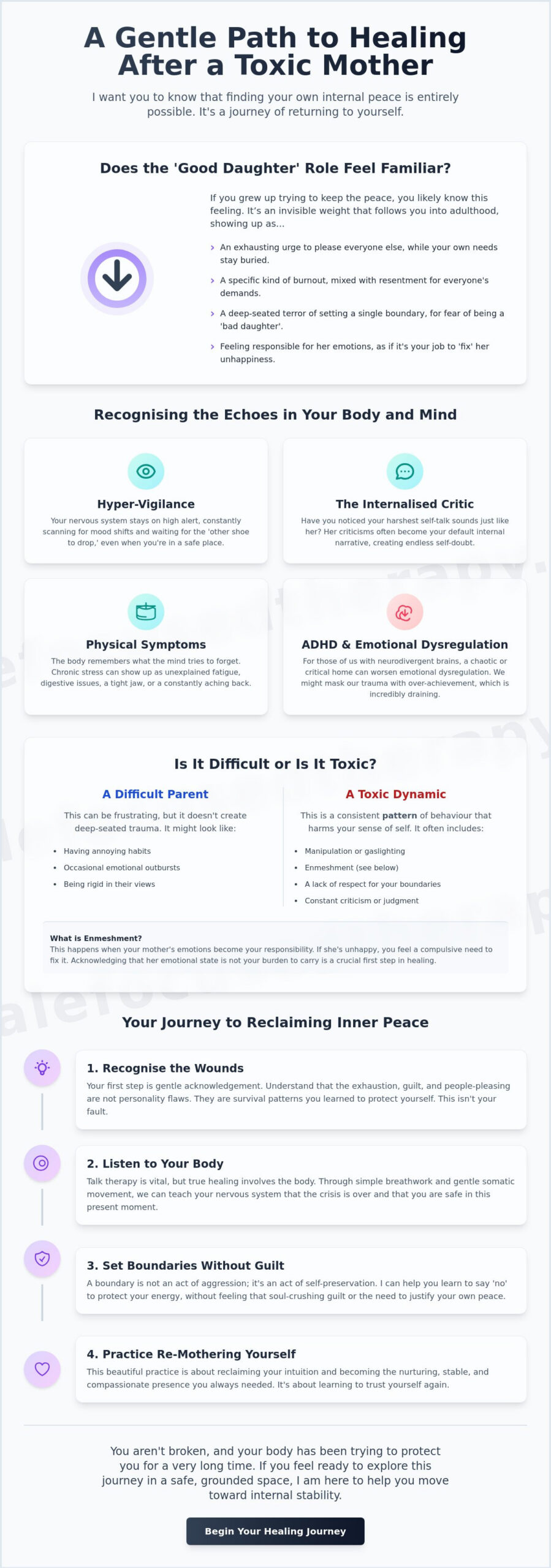
When you grow up in what is a dysfunctional family?, your survival often depends on being ‘good.’ This ‘Good Daughter’ syndrome follows many of us into adulthood. It manifests as chronic people-pleasing and a desperate need to keep the peace at any cost. Eventually, this leads to a specific kind of burnout where you feel resentful of everyone’s demands but terrified to set a single boundary.
It’s helpful to distinguish between a parent who is simply difficult and one whose behaviour is truly toxic. A difficult parent might have annoying habits or occasional outbursts. A toxic dynamic, however, is a consistent pattern of manipulation, gaslighting, or enmeshment. Enmeshment happens when your mother’s emotions become your responsibility; if she’s unhappy, you feel it’s your job to fix it. Recovering from a toxic mother begins with acknowledging that her emotional state is not your burden to carry.
The Internalised Critic: Her Voice in Your Head
Have you ever noticed that your harshest self-talk sounds exactly like her? Her criticisms often become your default internal narrative. When you try to assert your independence, you might fall into a ‘shame-spiral,’ feeling like a ‘bad daughter’ for simply wanting your own life. I work with clients to help them separate this external narrative from their true self. It starts with noticing the voice and gently reminding yourself, “This isn’t my truth; it’s hers.”
Toxic Parenting and the ADHD Connection
For those of us with neurodivergent brains, these dynamics feel even more intense. If you have ADHD, growing up in a chaotic or critical environment can significantly worsen emotional dysregulation. You might have learned to mask your trauma through extreme over-achievement, trying to prove your worth to a mother who was never satisfied. This constant state of ‘high-functioning’ masking is incredibly draining for the neurodivergent brain and often masks deep-seated relationship trauma.
The Body Remembers: Why Somatic Healing is Essential for Recovery
I’ve found that for many high-functioning women, the body is the only place where they can’t ‘mask’ their pain. While we’ve explored the emotional echoes of your upbringing, it’s vital to address the physical reality of your childhood. If you grew up in an environment where your mother’s moods were unpredictable, your nervous system likely stayed on high alert. This hyper-vigilance makes you feel like you’re always scanning for danger, waiting for the ‘other shoe to drop’ in your adult life.
This constant state of ‘red alert’ takes a heavy toll. The long-term effects of controlling parents aren’t just mental; they often manifest as chronic back pain, mysterious fatigue, or digestive issues. Your vagus nerve, which acts as the ‘brake’ for your stress response, can become less effective over time. This is why just ‘talking it out’ sometimes feels like you’re only scratching the surface. To truly heal, we have to involve the body.
Recovering from a toxic mother means teaching your body that the crisis is over. When we stay only in our heads, we miss the stored tension in our shoulders and the knot in our stomachs. Somatic healing allows us to process the trauma that talk therapy alone cannot reach. It’s about moving from a state of survival into a state of genuine internal safety.
Somatic Awareness: Listening to Your Body’s Story
I encourage you to start noticing where you carry ‘maternal stress.’ For many, it’s a tight jaw or a shallow, restricted breath. Simple breathwork can begin to signal to your nervous system that you are safe in this moment. When I integrate somatic movement into our work, it’s about helping you feel ‘at home’ in your own skin again. You don’t need to be a yoga master; you just need to be present with your own sensations.
Rest as Resistance in the Healing Process
In a toxic household, ‘doing nothing’ often felt dangerous or was labelled as laziness. I want to reframe rest as a radical act of self-preservation. Creating a physical ‘safe space’ in your home, where your mother’s voice cannot reach you, is a vital part of your restoration. If you feel ready to explore how your body can lead your healing, you can schedule a gentle introductory session with me to begin this work together.
Breaking the Cycle of Guilt: Setting Boundaries That Protect Your Peace
Setting boundaries often feels like an act of betrayal because we’ve been conditioned to believe the myth of the ‘Perfect Mother.’ You might feel like a ‘Bad Daughter’ for simply wanting space, but I want to reframe this for you. Boundaries aren’t a way to punish her. They are a way to preserve your own mental and physical health.
When you begin the process of recovering from a toxic mother, you might notice her behaviour gets worse initially. This is what we call an ‘extinction burst.’ It’s a desperate attempt to regain control when the old ways of manipulating you no longer work. You might also encounter ‘flying monkeys,’ family members who parrot her narrative and try to guilt-trip you back into the fold.
Staying grounded during these moments is incredibly difficult. It helps to remember that you aren’t responsible for their reactions or their refusal to understand your perspective. Your only responsibility is to your own peace. When we stop trying to manage her emotions, we finally have the energy to manage our own healing.
Practical Boundary Frameworks for Women
You get to choose the level of contact that feels safe for your nervous system. For some, ‘low contact’—limiting calls to once a month or only communicating via email—is enough to maintain a sense of self. For others, ‘no contact’ is the only way to truly break the cycle of hyper-vigilance and fear.
Having a script ready can help when you feel put on the spot by manipulative texts or calls. You don’t have to defend your choices or explain your ‘why.’ A simple, “I’m not available to discuss this right now,” is a complete sentence. If you’re struggling with the weight of these decisions, specialized support for relationship trauma and narcissistic abuse can provide the validation you need to hold your ground.
Managing the ‘Grief of the Living’
There’s a unique, heavy kind of sorrow in mourning a parent who is still alive. You’re grieving the mother you deserved but never had. It’s okay to feel deep anger about the childhood you missed out on. Anger is often a sign that you finally value yourself enough to know you deserved much better than what you received.
Closure rarely comes from the parent acknowledging the harm they caused. Most toxic parents will never take responsibility. Instead, closure comes from within you. It comes from accepting the reality of who she is and deciding that her narrative no longer has the power to define your worth or your future.
The Art of Re-Mothering: Restoring Your Internal Self-Trust
Recovering from a toxic mother involves a profound shift from looking outward for approval to looking inward for safety. After years of being gaslit or told your feelings were wrong, your internal compass might feel broken. Reclaiming your intuition is a slow, quiet process. It requires learning to listen to your gut feelings again without dismissing them as “crazy” or “dramatic.”
You might notice an immediate urge to apologise whenever you state a preference or a need. This is a survival strategy from a time when your needs were seen as an inconvenience or a threat to your mother’s ego. True self-care in this stage isn’t about surface-level treats. It’s about the deeper work of noticing that urge to shrink and choosing to take up space anyway.
Nurturing your self-trust means prioritising your own comfort over the expectations of others. This is often the hardest part of the journey. When you stop apologising for your existence, you send a powerful message to your nervous system that you are finally safe. You are allowed to have needs that don’t revolve around making someone else comfortable.
Nurturing Your Inner Child
Re-mothering is the act of providing yourself with the consistent validation, safety, and emotional attunement that you missed during your upbringing. To connect with this part of yourself, I often suggest simple visualisations. Imagine your younger self at an age when you felt most vulnerable. What did she need to hear? By offering those words to yourself now, you begin to repair the old wounds of neglect.
Play and spontaneity are also essential tools for restoration. Toxic environments are often rigid and performative, leaving little room for joy that isn’t “productive.” Giving yourself permission to be messy, silly, or unproductive is a powerful way to tell your inner child that she is safe. She is loved just as she is, without needing to earn it.
Building a Supportive ‘Chosen Family’
Recovering from a toxic mother often means building a new support system from the ground up. As you heal, you’ll start to recognise what healthy, reciprocal relationships actually look like. It’s common for survivors to unconsciously seek out “mother-figures” who repeat the same toxic patterns. Breaking this cycle requires a high level of self-awareness and a commitment to choosing people who respect your boundaries.
Finding a community that understands this specific journey can make all the difference. I encourage you to explore who I work with to see how other women are navigating these transitions. If you’re ready to start restoring your internal confidence, you can book a private session with me to explore these themes in a safe, boundaried space.
Walking the Path to Restoration: How Therapy Supports Your Journey
I know that the road to recovering from a toxic mother can feel lonely and exhausting. You’ve spent years managing someone else’s emotions, and the idea of opening up your own story might feel daunting. My role is to provide a steady, compassionate space where you don’t have to be ‘on’ or ‘perfect’ for anyone else.
In our sessions, we move away from the clinical and toward the human. We look at how your past has shaped your present, but we don’t stay stuck there. It’s about moving from a state of constant survival into a life where you feel grounded, confident, and truly at home in yourself. You deserve to move beyond the echoes of the past.
The transition from surviving to thriving isn’t a quick fix; it’s a series of small, intentional shifts. It starts with the realisation that you are no longer that vulnerable child. You are an adult woman with the power to choose who has access to your heart. Restoration is about reclaiming that power and building a life that feels authentic to you.
Finding a Safe Space to Unpack Your Story
I use an integrative approach that combines CBT with mindfulness and gentle somatic movement. This ensures we’re addressing the trauma stored in your body as well as the patterns in your mind. We work together to release the physical tension of hyper-vigilance while building new, healthy mental narratives.
Choosing online therapy allows you to do this deep work from the privacy and comfort of your own safe environment. You don’t have to carry this weight alone anymore. Having a professional guide can help you navigate the complex emotions of recovery without feeling overwhelmed or judged.
Your Invitation to Heal
Your past has been heavy, but it doesn’t get to define what comes next for you. You are capable of building a future filled with peace, self-trust, and genuine joy. I am here to hold space for your healing whenever you feel ready to begin that journey toward internal restoration.
If you’re not quite ready for a full session, my free therapy resources are a gentle way to begin exploring these themes at your own pace. They offer a soft entry point into the work of re-mothering and boundary setting. Every small step you take is a victory for your future self.
When you feel ready to take that next step toward restoration, you can visit my book now page to schedule a consultation. For today, I simply invite you to find five minutes of quiet. Sit with a cup of tea, breathe, and acknowledge the incredible strength it took to get here.
Taking Your First Steps Towards Internal Peace
We’ve explored how your body stores the echoes of the past and why somatic awareness is the key to letting go of hyper-vigilance. You’ve also seen that setting boundaries isn’t a betrayal; it’s an act of self-preservation that allows you to finally trust your own intuition and reclaim your space.
The process of recovering from a toxic mother is deeply personal, but you don’t have to navigate these complex layers in isolation. I understand the weight of ‘daughter-guilt’ and the exhaustion of chronic people-pleasing, and I’m here to support you in moving from survival into a state of genuine restoration.
As a registered integrative psychotherapist and a specialist in narcissistic abuse recovery, I offer a trauma-informed, gender-centric approach to help you reclaim your peace. If you’re ready to start your journey of internal restoration, you can book your consultation with me today.
You deserve a life that feels safe, grounded, and entirely your own. Trust that your past does not define your future, and that you have the strength to create the peace you’ve always needed.
Frequently Asked Questions
How do I know if my mother was actually toxic or just ‘difficult’?
Toxic dynamics involve a consistent, long term pattern of manipulation, emotional neglect, or control rather than occasional friction. Difficult parents might have annoying habits or stubborn streaks, but they generally respect your basic autonomy and your right to say no. A toxic mother often views you as an extension of herself and uses guilt or gaslighting to ensure you remain compliant with her needs.
Is it okay to go no contact with my mother if she makes me feel unsafe?
Yes, choosing to go no contact is a valid and sometimes necessary step for protecting your mental and physical health. You aren’t being cruel or ‘bad’ by stepping away; you’re simply choosing to stop the cycle of hyper-vigilance and emotional harm. If the relationship consistently leaves you feeling depleted or unsafe, prioritizing your own peace is an act of profound self-preservation.
Can a toxic mother ever truly change her behaviour?
While people are capable of change, it requires a level of self-awareness and accountability that many toxic parents are unwilling to face. True change involves more than a fleeting apology; it requires a consistent shift in behaviour and a genuine effort to repair the harm caused. Most women find that focusing on their own journey of recovering from a toxic mother is more productive than waiting for a change that may never come.
How do I deal with the overwhelming guilt of setting boundaries?
Guilt is a very natural response when you start breaking the old, unspoken rules of a dysfunctional family system. It’s often a sign that you’re doing something different, not that you’re doing something wrong. When that heavy feeling arises, try to notice where it sits in your body and remind yourself that your needs are just as important as anyone else’s.
How does having a toxic mother affect my own parenting style?
You might find yourself swinging between being overly permissive to avoid her harshness or becoming hyper-critical because that was the only model you had. Many survivors feel a deep fear of repeating the cycle, which often makes them incredibly empathetic and conscious parents. Therapy can help you quiet her critical voice so you can trust your own nurturing instincts with your children.
What are the most common signs of a narcissistic mother?
Common signs include a profound lack of empathy, a constant need for admiration, and a tendency to view your successes as her own achievements. She may frequently play the victim to gain attention or use ‘love-bombing’ followed by cold withdrawal to keep you emotionally off-balance. These patterns are designed to keep you dependent on her approval while she remains the centre of the family’s world.
Does therapy really help with childhood trauma even if it happened decades ago?
Absolutely, because trauma isn’t just a memory; it’s a physiological state stored in your nervous system and body. Recovering from a toxic mother involves working with how those old wounds continue to affect your health, relationships, and self-trust today. We use somatic and integrative tools to help your body finally feel that the old crisis is over, regardless of how many years have passed.
How can I explain my boundaries to other family members who don’t understand?
You don’t have to provide an exhaustive explanation or defend your choices to family members who aren’t ready to hear the truth. A simple, firm statement like, “I’m doing what I need to do for my health right now,” is a complete sentence. You cannot control their reaction or their loyalty to her, so your focus should remain on staying grounded in your own reality.

Article by
Cheryl Kennedy MacDonald MA BA (Hons) Pg. Dip. SAC BACP
Cheryl Kennedy MacDonald is a psychotherapist specialising in women’s mental health, relationships, and life transitions. She works with women navigating trauma, relationship breakdown, identity shifts, and midlife change, helping them rebuild self-trust, emotional stability, and a clear sense of who they are and what they want.
With over 20 years’ experience working with women internationally, Cheryl is the founder of YogaBellies, a global women’s yoga school, and the creator of the Birth ROCKS method. Her work sits at the intersection of psychotherapy and embodiment, integrating evidence-based therapeutic approaches with somatic, body-based practices that support deep, lasting change.
Known for her grounded and direct approach, Cheryl moves beyond surface-level insight to address the patterns held in the body and nervous system. Her work supports women to regulate, reconnect, and respond to their lives from a place of clarity, strength, and self-respect.
She is a published author in academic journals and has written multiple books on women’s health, pregnancy, and midlife wellbeing, available on Amazon and leading book retailers worldwide.