
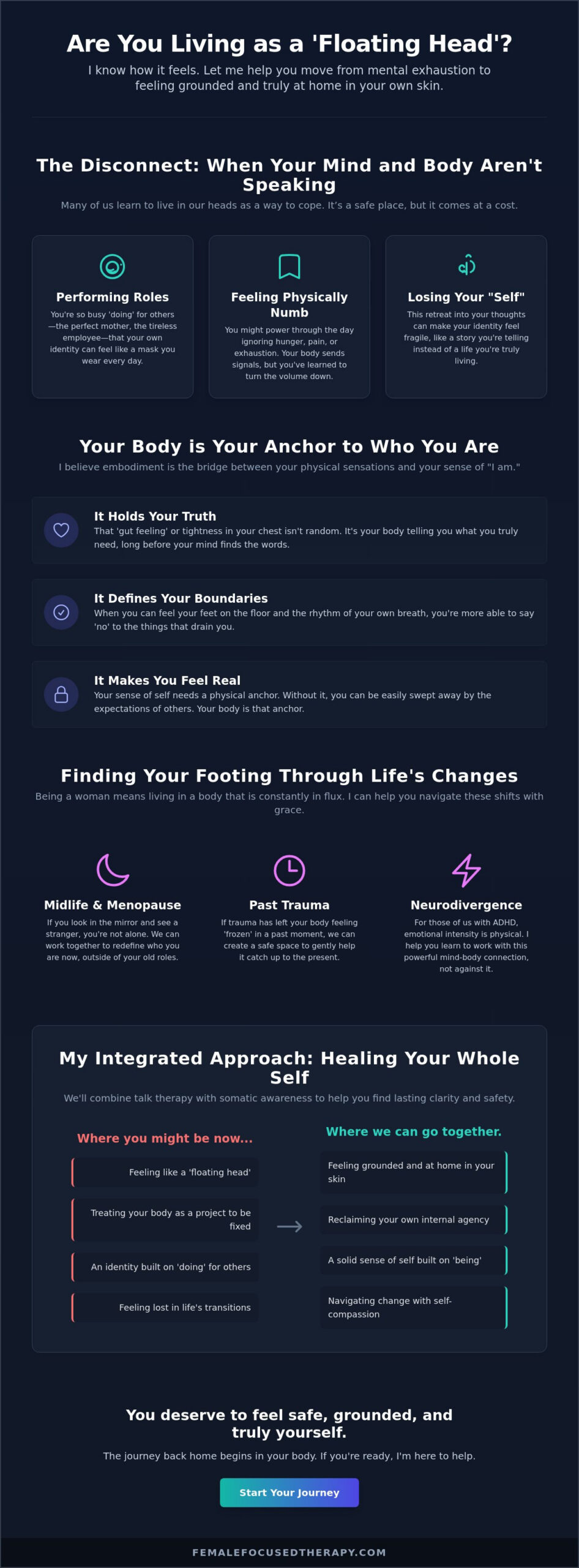
Have you ever felt like you are just a “floating head,” moving through your days while your body simply carries you from one task to the next? It’s an exhausting way to live, especially when we consider how embodiment and identity development in women are so deeply linked. You might find yourself constantly “doing” for everyone else while slowly losing the thread of who you actually are.
In this post, I’ll share how your physical sensations are actually a map leading back to your mental clarity and internal stability. We’ll explore how moving away from a life of constant performance can help you feel safe in your own skin again. You deserve to feel at home within yourself, and that journey begins with the body.
Key Takeaways
- I’ll show you how to move from feeling like a ‘floating head’ to truly inhabiting your skin so you can feel more grounded.
- I’ll help you navigate the identity shifts that come with menopause, moving through these transitions with more self-compassion.
- We’ll explore how to stop treating your body as a project to be fixed and start reclaiming your own internal agency.
- I’ll explain how the link between embodiment and identity development in women helps you build a self that isn’t just about ‘doing’ for others.
- I’ll share how combining talk therapy with somatic awareness can help you find the mental clarity and emotional safety you’ve been looking for.
What Does Embodiment Really Mean for Your Identity?
At its heart, embodiment is the simple, quiet act of feeling “at home” in your own skin. It’s not a complex theory or a goal to be achieved through intense exercise. It’s the experience of living inside your body rather than just observing it from the outside. When you’re embodied, you don’t just think about your life; you feel it happening as it unfolds.
In my psychotherapy practice, I often meet women who describe themselves as a “floating head.” They’re brilliant, capable, and get things done, but they feel like their body is just a vehicle that carries their brain from one meeting to the next. They’ve lost the connection to the neck down. Reclaiming that connection is where the real work of finding yourself begins.
Your body holds the truth of your identity long before your mind can find the words to speak it. Think of the “gut feeling” you get when something isn’t right, or the way your chest tightens when you aren’t being true to yourself. These aren’t just random physical glitches. They are your body’s way of telling you who you are and what you need.
The Disconnect: When We Live Only in Our Minds
Many of the high-functioning women I work with have become experts at being physically numb. You might find you can power through a twelve-hour day without noticing you’re hungry, tired, or in pain. This ability to “switch off” often starts as a way to stay safe. If life feels overwhelming or traumatic, retreating to our heads feels like a logical escape.
However, this retreat comes at a high price. When we live only in our thoughts, our identity often becomes a mask. We start performing roles for others; the perfect mother, the tireless employee, the supportive partner. We become so focused on “doing” that we forget how to “be.” This disconnect makes your identity feel fragile, like a story you’re telling rather than a life you’re living.
Why Your Body is the Key to Your Identity
Your physical sensations are the primary source of your boundaries and choices. When you can feel your own heartbeat or the weight of your feet on the floor, you’re more likely to say “no” to things that drain you. The theory of Embodied cognition suggests that our thinking isn’t just happening in our brains; it’s shaped by our entire physical being.
Embodiment and identity development in women are deeply intertwined because your sense of self needs a physical anchor to feel real. Without that anchor, you’re easily swept away by the expectations of others or the pressures of life transitions. When you learn to inhabit your body, you develop a self-identity that feels solid and unshakeable.
Embodiment is the bridge between your physical sensations and your sense of “I am.”
How Your Identity Changes Through Life’s Physical Transitions
Being a woman means living in a body that is constantly in flux. From the first stirrings of puberty to the final shift of menopause, our physical selves never truly stay still. This constant change is why embodiment and identity development in women is such a dynamic, ongoing process. It isn’t a one-time event we finish in our twenties; it’s a lifelong conversation between our hormones, our history, and our sense of self.
Sometimes, this conversation gets interrupted. If you’ve experienced trauma, your body might feel like it’s “frozen” in a specific moment of the past. This is where a developmental theory of embodiment becomes so helpful. It reminds us that our identity isn’t just in our thoughts. It’s woven into how we hold our shoulders, how we breathe, and how safe we feel in the world. When we experience major transitions, we need a trauma-informed space to help the body catch up with the present. This is vital for healthy embodiment and identity development in women who have spent years putting their own needs last.
Navigating Midlife and Menopause
There is a specific kind of unravelling that happens during the transition into midlife. You might look in the mirror and feel like a stranger is staring back at you. It isn’t just about the physical signs of ageing; it’s about the psychological shift of no longer being the person you were ten years ago. This period often triggers a deep need to redefine who you are outside of your roles as a mother, partner, or professional. If you’re struggling to find your footing, I offer menopause therapy for women in Singapore to help you navigate this change with grace and clarity.
Neurodivergence and the Embodied Self
For those of us with ADHD, the relationship with our bodies can feel even more complex. We often experience emotional intensity as a physical surge. This might be a wave of frustration that feels like heat in the chest, or excitement that feels like buzzing in the limbs. Before I understood my own ADHD, I often felt disconnected from these sensations or overwhelmed by them. Finally realising that your brain-body connection works differently can be a huge relief. It allows you to stop fighting your physical responses and start working with them. If you’re ready to explore your own unique journey, you can book a session with me to begin that work in a safe, supportive space.
Moving Beyond the ‘To-Do List’ Body to Reclaim Agency
Society often treats a woman’s body like a never-ending project. From a young age, we’re told to fix, tone, or hide parts of ourselves until our physical form feels like a “to-do” list rather than a home. This constant pressure to manage how we are perceived by others is utterly exhausting. It pulls our attention outward, leaving very little energy for our internal world.
When we live under this “external gaze,” we lose the ability to develop a true internal identity. You might spend so much time looking at your body in the mirror that you forget how to feel from within it. This shift is a core part of embodiment and identity development in women. It’s about moving from being an object to be seen to being a person who feels and acts with intention.
I’ve noticed that when women stop viewing their bodies as something to be managed, they start to reclaim their own space. It’s a move away from performance and toward presence. You begin to realise that your body isn’t there to be looked at; it’s the place where you live, breathe, and experience the world.
Reclaiming Your Internal Authority
Embodiment helps you trust your own intuition over all those external “shoulds” that life throws at you. Many feminist perspectives on embodiment highlight how we’ve been conditioned to ignore our internal signals to please others. Reclaiming your authority means learning to listen to your body’s wisdom again.
In my work with relationship trauma and narcissistic abuse recovery, I see how healing involves moving from a state of “being acted upon” to reclaiming your own agency. Trauma often makes us feel like our bodies aren’t our own. Recovery is the slow, gentle process of moving back in and realising that you have the right to decide what happens to your physical and emotional self.
The Power of Saying ‘No’ from the Body
Have you ever noticed how your stomach knots up when someone asks for a favour you don’t want to give? That “gut feeling” is a literal, physical boundary. Identity development involves knowing exactly where you end and where others begin. Your body is the most honest tool you have for marking that line.
When your boundaries are crossed, your body usually knows before your mind has the words to explain it. You might feel a sudden tightness in your throat or a heavy sensation in your chest. I encourage you to pay attention to these small physical cues. Honouring those reactions is a powerful way to protect your energy and build an identity that is truly yours.
Simple Ways I Help You Practise Embodiment Every Day
I often see women who approach healing like they approach their careers: with a checklist and a deadline. But embodiment isn’t another task to tick off your “to-do” list. It’s a way of existing. As both a yoga master and a psychotherapist, I’ve learned that the most profound shifts don’t happen when we’re pushing ourselves. They happen when we’re allowing ourselves to simply be.
This shift from “achieving” to “being” is essential for embodiment and identity development in women. If you’re always striving, you’re always looking toward the future. Embodiment requires you to land right here, in the messy, quiet reality of the present moment. Healing happens in the gaps between the busyness, in the small moments where you choose to listen to your breath instead of your inner critic.
I want to reassure you that you don’t need to spend hours on a yoga mat to find this connection. It’s about micro-moments of awareness. It’s noticing the temperature of the air on your skin or the way your weight shifts as you walk. These small acts of noticing are the building blocks of a grounded, authentic identity.
Breath and Movement as Anchors
A simple 30-second breath practice can be your quickest route back to yourself. Try placing one hand on your heart and one on your belly. Don’t try to change anything. Just feel the rise and fall. This isn’t about “proper” breathing; it’s about acknowledging that you’re alive and present. It’s a way of telling your nervous system that you’re safe.
I also use somatic movement and yoga for women to help release the emotional tension we often store in our hips and shoulders. Unlike traditional exercise, somatic movement isn’t about how you look. It’s about how you feel from the inside out. It’s a gentle way to shake off the day and return to your own internal rhythm.
The Importance of Rest in Identity Work
We live in a “hustle” culture that rewards us for being high-functioning and constantly busy. This pace keeps us disembodied. When we’re moving too fast, we can’t feel the subtle signals our bodies are sending us. I truly believe that “doing nothing” is often the most productive therapeutic work you can do. It’s in the stillness that your nervous system finally has a chance to settle.
Rest allows your mind and body to integrate the new parts of your identity that we explore in therapy. Without rest, you’re just collecting information without actually absorbing it. If you’re ready to slow down and reconnect, you can book a session with me to begin this gentle work together.
Healing the Whole You Through Integrative Psychotherapy
I’ve found that true healing happens when we address both the story you tell and the physical experience of living it. Standard talk therapy is wonderful for understanding your past, but it often stops at the neck. My integrative approach combines deep conversation with somatic awareness to ensure we’re tending to your whole self. We aren’t just looking for insights; we’re looking for a sense of restoration that you can feel in your bones.
For those looking to explore other avenues of personal transformation, Paramount Shift provides professional hypnotherapy services focused on emotional well-being.
Embodiment and identity development in women require this dual focus. We need to explore your thoughts and feelings while also noticing how they land in your body. I create a safe, grounded space where you can explore these themes without pressure. You don’t have to have all the answers right away. We’ll find them together at a pace that feels right for you, moving as slowly or as quickly as your nervous system allows.
I won’t ever ask you to perform or meet a specific goal. Instead, I’ll encourage you to trust your own rhythm. This journey back to yourself is deeply personal, and it’s okay if it feels uncertain at first. My role is to provide the steady anchor while you navigate the waves of change and self-discovery. Together, we can rebuild a version of “you” that feels solid and true.
What to Expect in Our Sessions
In my practice, I offer a warm but boundaried environment. This means you’ll feel supported and seen, but also safe within clear professional limits. I understand that life is busy and often overwhelming, which is why I offer online therapy. It allows you to engage in this deep work from a space where you already feel comfortable and secure.
We’ll work collaboratively to rebuild your internal confidence and self-reliance. This isn’t about me “fixing” you. It’s about me acting as a guide while you learn to trust your own intuition again. Every session is an opportunity to strengthen the link between your physical state and your mental clarity. We might talk about a difficult memory, then pause to notice where you feel that tension in your chest or shoulders.
Your Next Step Toward Restoration
The journey back to yourself doesn’t have to start with a grand gesture. Your next step can be as simple as taking a quiet moment of reflection right now. Close your eyes for a few seconds. Notice how you feel after reading these words. Is there a sense of relief, or perhaps a small spark of hope? Trust that feeling.
I invite you to reach out when you feel ready to be truly heard. Whether you’re navigating a major life transition or recovering from the exhaustion of a high-functioning life, I’m here to hold space for you. You can book a consultation with me to see how we might work together toward your restoration. You deserve to feel grounded, safe, and entirely yourself.
Stepping Into Your Authenticity
Reclaiming your sense of self isn’t about fixing a broken version of you. It’s about slowly, gently moving back into the home you’ve always lived in. By shifting your focus from how you look to how you feel, you create space for a version of yourself that is grounded and real. We’ve explored how embodiment and identity development in women is a lifelong journey, one that requires patience and a deep respect for your own physical rhythm.
As a Registered Integrative Psychotherapist and Yoga Master, I’ve seen how powerful it is when a woman finally trusts her own physical signals. Whether you’re navigating the shifts of menopause, the intensity of ADHD, or the recovery from relationship trauma, your body is your most honest guide. You don’t have to carry the weight of being “high-functioning” alone anymore. There is a different way to live, one that prioritises your internal peace over external performance.
I’m here to support you in finding that steady anchor within yourself. If you’re ready to explore what it means to feel safe and seen in your own skin, please book a consultation with me to begin your journey back to yourself. You deserve a life that feels as good on the inside as it looks on the outside.
Common Questions About Embodiment and Identity
What is the difference between embodiment and body image?
Body image is the mental picture or evaluation you have of your physical appearance, whereas embodiment is the internal, lived sensation of being in your body. While body image is often about how you look to others, embodiment is entirely about how you feel to yourself. It’s the difference between looking at your arm in a mirror and feeling the warmth of the sun on your skin.
How can embodiment help me if I have a history of trauma?
Trauma often causes us to “leave” our bodies to survive overwhelming events, which can lead to a long-term sense of numbness or being “checked out.” Embodiment work allows you to gently return to your physical self at a pace that feels safe. By learning to notice small, neutral sensations, you can begin to reclaim your body as a place of security rather than a source of distress.
Can embodiment practices help with ADHD symptoms in women?
Yes, these practices are very effective for managing the sensory overload and emotional intensity that often accompany ADHD. When you’re more connected to your physical state, you can catch the early signs of overstimulation or “brain fog” before they become overwhelming. This awareness is a vital part of embodiment and identity development in women who have spent years feeling “out of sync” with their own nervous systems.
Why do I feel so disconnected from my body during menopause?
Menopause involves significant hormonal shifts that can make your physical self feel like unfamiliar territory. When your body changes rapidly, it’s natural for your sense of identity to feel shaky or even unrecognisable. Embodiment helps you navigate this transition by allowing you to listen to what your body needs in its current state, helping you redefine who you are in this new season of life.
Do I need to be ‘good’ at yoga to practice embodiment?
You don’t need any special skills, flexibility, or athletic ability to practice embodiment; it’s about your internal experience, not your physical performance. While I draw on my background as a yoga master, the goal is never to achieve a perfect pose. It’s simply about noticing the feeling of your breath or the sensation of your feet on the floor as you move through your day.
How long does it take to feel ’embodied’ again?
Embodiment is a relationship you nurture over time rather than a destination you reach. You might feel a sense of grounding after just one session of focused breathing, but deeper shifts in your identity usually happen through consistent, small moments of awareness. I encourage you to focus on the quiet relief of feeling more present, rather than looking for a quick fix.
Is embodiment therapy different from regular talk therapy?
Traditional talk therapy primarily focuses on your thoughts and narratives, while embodiment therapy includes your physical sensations as a core part of the healing process. In my integrative practice, I treat your body as an equal partner in our sessions. We don’t just analyse your experiences; we notice how they live in your physical being and work to release tension there.
What if I feel overwhelmed when I try to pay attention to my body?
Feeling overwhelmed is a completely normal response, especially if you’ve been disconnected from your body for a long time to stay safe. If turning inward feels like too much, we pause and use external grounding tools until you feel steady again. We always move with care, ensuring you feel supported as we explore the link between embodiment and identity development in women at a pace that respects your boundaries.

Article by
Cheryl Kennedy MacDonald MA BA (Hons) Pg. Dip. SAC BACP
Cheryl Kennedy MacDonald is a psychotherapist specialising in women’s mental health, relationships, and life transitions. She works with women navigating trauma, relationship breakdown, identity shifts, and midlife change, helping them rebuild self-trust, emotional stability, and a clear sense of who they are and what they want.
With over 20 years’ experience working with women internationally, Cheryl is the founder of YogaBellies, a global women’s yoga school, and the creator of the Birth ROCKS method. Her work sits at the intersection of psychotherapy and embodiment, integrating evidence-based therapeutic approaches with somatic, body-based practices that support deep, lasting change.
Known for her grounded and direct approach, Cheryl moves beyond surface-level insight to address the patterns held in the body and nervous system. Her work supports women to regulate, reconnect, and respond to their lives from a place of clarity, strength, and self-respect.
She is a published author in academic journals and has written multiple books on women’s health, pregnancy, and midlife wellbeing, available on Amazon and leading book retailers worldwide.