
You are sitting on the sofa, close enough to reach out and touch his arm, yet you feel as though a vast, silent ocean sits between you. It isn’t that you’re fighting; it’s the heavy, hollow ache of emotional neglect in marriage. I know how exhausting it is to live in that space, wondering if you are simply being too needy or if your reality is slipping away.
This type of pain is often invisible because it’s defined by what is missing rather than what is there. I’ve sat with many women who feel invisible in their own homes, carrying a chronic loneliness that feels harder to explain than a loud argument. You aren’t imagining this, and your desire for connection is a fundamental human need, not a sign of weakness.
I will help you recognise these quiet signs of neglect and guide you back toward trusting your own intuition. We’ll explore whether your relationship can be restored and look at gentle ways to rebuild your self-worth from the inside out. I’ll also share how simple shifts in your breath and body awareness can help you feel grounded when the silence feels overwhelming.
Key Takeaways
- Learn how to identify the invisible gaps that define emotional neglect in marriage so you can finally trust your own feelings and reality.
- I will help you spot the specific red flags that show you are carrying the relationship’s emotional energy entirely by yourself.
- Discover how factors like undiagnosed ADHD might be contributing to the silence between you without excusing the lack of connection.
- Find out how coming back into your body through somatic awareness can help you stop “leaving” yourself to avoid the pain of being ignored.
- Gain the clarity you need to decide if your partnership can be restored or if you need to focus on your own healing and next steps.
The Invisible Wall: What Emotional Neglect Feels Like for Women
I often describe emotional neglect as the painful absence of emotional attunement and response. It isn’t the presence of something loud or aggressive, like a shouting match; instead, it’s the echoing void where a connection should be. When you ask yourself What is Emotional Neglect?, you might find clinical definitions that feel cold and detached. In your daily life, however, it feels like living with a ghost. You’re in the same room, perhaps even sharing a bed, but you’re entirely alone.
Many women I work with in my practice feel a deep, simmering sense of shame about their “neediness.” I want to tell you right now that your desire for connection isn’t a flaw or a symptom of being “too much.” It’s a natural, vital human desire for safety and belonging. Emotional neglect in marriage happens when that fundamental need is consistently met with a blank wall. It’s the silence that hurts the most because it suggests that your internal world simply doesn’t matter to the person you love.
The Chronic Loneliness of Being Unseen
There’s a specific, heavy ache that comes from being physically close to someone while feeling emotionally stranded. I’ve seen how this silence acts as a slow erosion of a woman’s internal confidence and joy. When your bids for attention go unanswered, you start to doubt your own reality. You might even feel a strange sense of guilt for being unhappy because, on paper, your life looks “fine.” You have the house, the career, and the family, yet you feel invisible. This chronic loneliness is a form of relationship trauma that settles into your bones, making you feel as though you’re disappearing bit by bit.
The Difference Between a Rough Patch and Chronic Neglect
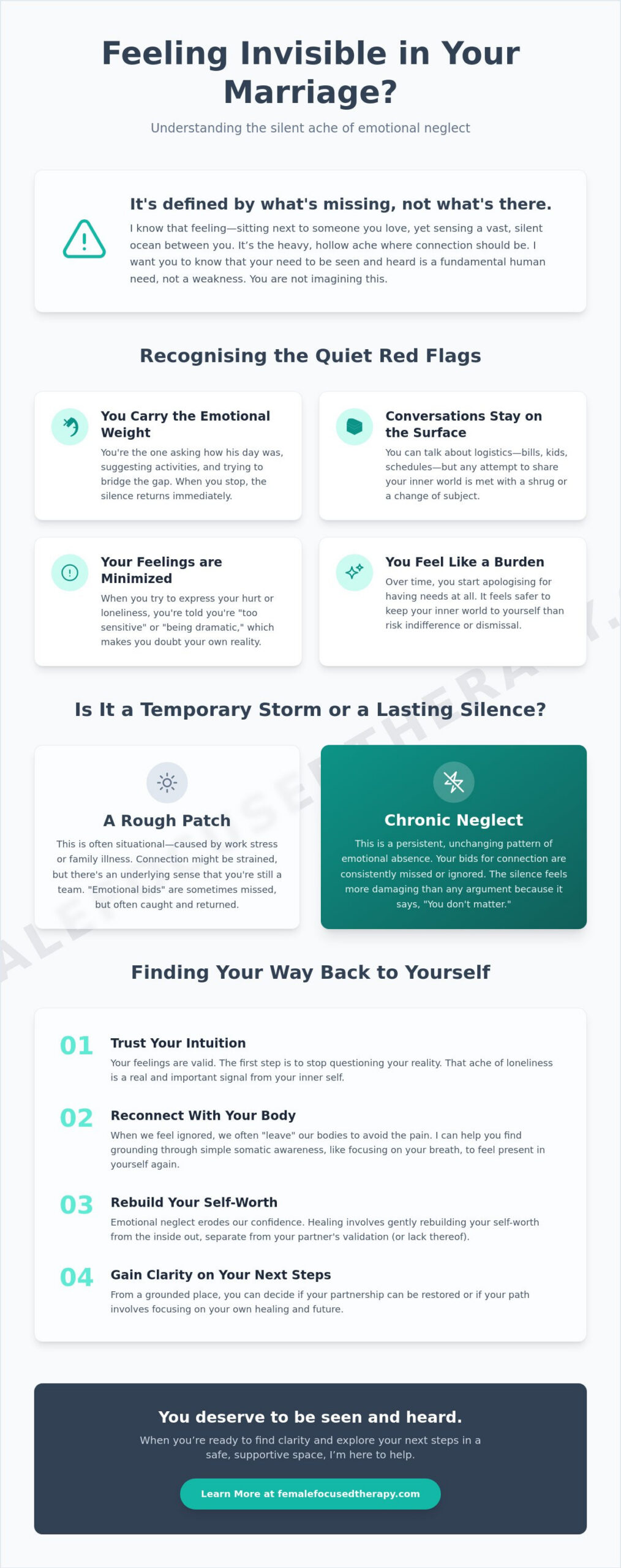
We all go through seasons of stress where we’re less available to our partners. Perhaps there’s a deadline at work or a family illness that takes up all the “emotional bandwidth.” However, chronic neglect is a persistent, unchanging pattern of absence. I look for how a partner responds to “emotional bids.” These are the small, everyday moments where you reach out, perhaps with a look, a touch, or a simple “Look at that bird outside.”
In a healthy partnership, those bids are caught and returned. In a marriage suffering from neglect, they’re consistently missed, ignored, or even met with annoyance. Statistics show that emotional intimacy scores can predict 69% of the variance in marital stability, which confirms what I see in my practice: the silence is often more damaging than the noise. If you feel like you’re managing the entire emotional energy of your home on your own, it’s a sign that the connection has shifted from a temporary rough patch into a state of chronic neglect. You might find that couples therapy is a helpful space to explore these patterns, provided both of you are willing to look at the silence honestly.
Recognising the Red Flags: Why You Feel Alone While Sitting Together
Recognising the signs of a failing connection isn’t always about what happens; it’s often about what doesn’t. I’ve identified several markers that suggest emotional neglect in marriage has taken root. One of the most exhausting experiences is feeling as though you’re managing the relationship entirely on your own emotional energy. You’re the one asking how the day was, the one suggesting a walk, and the one trying to bridge the gap. When you stop, the silence returns immediately.
Conversations in these relationships often stay surface-level. You might talk about the mortgage, the kids, or the weather, but any attempt at depth or vulnerability is met with a shrug or a change of subject. This is a primary indicator of emotional neglect in marriage. Over time, you simply stop sharing your wins or your hurts because the response is consistently lukewarm. It feels safer to keep your inner world to yourself than to have it met with indifference.
Eventually, you start to feel like a burden for having emotional needs at all. You might catch yourself apologising for feeling sad or lonely. This internalised belief that your feelings are “too much” is a heavy weight to carry, and it’s something we can work through together in a safe space.
The Pattern of Dismissal and Minimisation
I often hear clients say their feelings are labelled as “too sensitive” or “dramatic” when they try to speak up. This is a subtle form of “gaslighting-lite” where your emotional reality is constantly questioned. If you mention feeling lonely, you’re told you’re imagining things or that your partner “didn’t mean” to ignore you. In some cases, this pattern can overlap with Narcissistic Abuse in Marriage, where your needs are intentionally sidelined to keep the focus elsewhere. Being told a partner “didn’t mean it” is often used as a way to end a conversation rather than to resolve the pain.
The Weight of the Emotional Mental Load
The exhaustion of being the only one “checking in” on the relationship is profound. You become the emotional architect of a home that feels structurally sound but emotionally empty. You’re always monitoring the “vibe,” trying to ensure things stay peaceful while your own heart is starving for a genuine response. When you finally stop trying to bridge the gap, a “quiet withdrawal” happens. You stop asking, you stop reaching out, and you stop hoping for a different response. This isn’t about being petty; it’s about self-preservation. If this resonates with you, it might be time to book a session to explore your own experience and find a way back to your own strength.
Beyond the Surface: Is it Neglect, Neurodivergence, or Narcissistic Abuse?
I believe it’s vital to understand the “why” behind the silence without using it to excuse the “what.” The pain of being ignored is real, regardless of the reason. Finding yourself in a state of emotional neglect in marriage is devastating, but the path to healing depends heavily on whether your partner is struggling or if they are intentionally causing harm.
I want to help you distinguish between “I forgot” and “I am withholding.” One is a challenge of the mind; the other is a strategy of control. Understanding this distinction is the first step in deciding whether your marriage can be revitalised or if you need to focus on your own restoration.
Sometimes, the void isn’t born of malice. It can be a symptom of undiagnosed ADHD in a partner. I will explore how narcissistic abuse uses neglect as a tool for control and punishment, contrasting it with the unintentional lapses of a neurodivergent brain.
When ADHD Plays a Role in the Silence
I work with many neurodivergent women who recognise these patterns in their own lives. In an ADHD brain, something called “object permanence” can apply to emotions too. If you aren’t physically in the room, your partner’s brain might struggle to maintain the emotional thread of the connection. It’s often a case of “out of sight, out of mind,” which feels like abandonment to you.
An ADHD partner might struggle with emotional consistency. They might be hyper-focused on a hobby or work, leaving you feeling like you’ve disappeared. This isn’t because they don’t care; it’s because their brain is wired to follow the loudest stimulus. While this still results in emotional neglect in marriage, the solution involves systems and awareness rather than just “trying harder.”
The Darker Side: Neglect as a Power Dynamic
I want to help you see when silence is being used as a weapon. In narcissistic patterns, the “silent treatment” is a calculated tool used to punish you for having needs or for challenging their reality. This is vastly different from the distracted silence of ADHD. Here, the neglect is a way to maintain power and keep you in a state of anxiety.
Recognising the lack of empathy that characterises these patterns is crucial. If your partner is truly incapable of connection, they will show no genuine remorse for the pain their silence causes. They aren’t “forgetting” to check in; they are choosing to stay distant. Knowing if your partner is truly incapable of connection or simply unwilling is the hardest, yet most important, clarity you will find.
Restoring Your Internal Compass: Somatic Healing and Rebuilding Self-Trust
I believe that healing starts by coming back into your own body after years of neglect. When we experience emotional neglect in marriage, the silence isn’t just in the air; it’s in our muscles and our nervous systems. We often “leave” our bodies to avoid the sharp pain of being ignored. It’s a survival tactic, but it leaves us feeling untethered, numb, and deeply disconnected from our own intuition. You’ve spent so long looking to your partner for the “permission” to feel okay, but that permission can only be found within.
I will guide you through the importance of somatic movement and rest in reclaiming your power. Restoration isn’t just about understanding the problem intellectually; it’s about feeling safe in your own skin again. When your partner is emotionally absent, your body stays in a state of high alert, waiting for a response that never comes. Learning to rest and move with intention helps signal to your nervous system that you are safe, even when the relationship feels uncertain.
Listening to the Wisdom of Your Body
Neglect often shows up as physical tension that we’ve learned to ignore. I see it in the tight jaw, the heavy chest, or the constant knot in the stomach. These are your body’s ways of holding the emotions that your partner won’t acknowledge. I use simple breathwork techniques to help you stay grounded when the invisibility feels overwhelming. We also look for “glimmers,” which are small, micro-moments of joy you create for yourself. It could be the warmth of a morning tea or the rhythm of a short walk. These glimmers help you rebuild a sense of self that exists independently of your partner’s attention.
Reclaiming Your Voice and Your Reality
This shift is the foundation of setting boundaries around your own emotional energy and time. You stop over-functioning to “fix” the silence and start protecting your own peace. If you’re ready to stop feeling like a ghost in your own home, you can book an individual session with me to begin the journey of coming back to yourself.
Finding Your Way Back to Connection or Clarity
I am here to help you decide if this marriage can be revitalised or if you need to move on. This is a heavy crossroads, and I want you to know that you don’t have to rush the answer. Deciding the future of your relationship requires a quiet mind and a settled heart. Statistics show that about 70-75% of couples who go to therapy report improved relationship satisfaction. If both of you are willing to do the work and face the silence honestly, couples therapy can often bridge the gap that emotional neglect in marriage has created.
I also support many women through life transitions when a relationship has reached its natural end. Sometimes, the most compassionate thing you can do for yourself is to acknowledge that the connection is no longer sustainable. It’s a brave step to choose your own wellbeing. Research suggests that couples with high emotional intimacy report 2.5 times higher life satisfaction, and you deserve a life where your emotional needs are seen and met. Your healing is not dependent on your partner’s ability to change; you can find your way back to joy on your own terms.
On average, couples wait six years after problems begin to seek professional help. You don’t have to wait until you are completely depleted to ask for support. Whether you choose to work on the marriage or focus on your own path, the goal is to stop living in a state of chronic loneliness. Emotional neglect in marriage is a quiet erosion, but you can choose to stop the cycle today.
When to Seek Professional Support
I often suggest starting with individual therapy if you feel particularly fragile or if there are patterns of narcissistic traits in your relationship. It’s a space where you don’t have to worry about your partner’s reaction or “getting it right.” Finding a therapist in Singapore who understands the specific challenges of international life and gender-centric trauma can be a vital first step in your restoration.
When we work together, we’ll untangle the complex emotional knots that have kept you stuck. We’ll look at the parts of your story that have been silenced and find the words for what you’ve been carrying in your body. This isn’t about blaming; it’s about finding the clarity you need to make the best decision for your future self. I provide a neutral, safe space where your reality is never questioned.
Your Next Step Toward Emotional Safety
As a realistic next step, I invite you to try a simple exercise this week. Write down three specific times you felt “unseen” and describe exactly how it felt in your body. Did your chest tighten? Did your breath become shallow? Bringing awareness to these somatic markers is the beginning of reclaiming your own reality. I invite you to reach out when you are ready to begin your journey of restoration and find your voice again.
Stepping Toward Your Own Restoration
Living with emotional neglect in marriage is a heavy burden, but it doesn’t have to be your permanent reality. We’ve explored how to recognise those invisible red flags and how somatic awareness can help you return to your body when you feel unseen. Whether the silence stems from a partner’s neurodivergence or a more painful power dynamic, your priority must be your own internal restoration.
I am here to support you in finding that clarity. As a registered integrative psychotherapist, I offer a trauma-informed, gender-specific approach that honours your unique experience as a woman. Whether we meet for in-person sessions in Singapore or connect online globally, my goal is to help you rebuild the self-assurance you’ve lost.
You deserve to feel heard, valued, and emotionally safe. When you’re ready to stop managing the silence alone, I invite you to book a session with me to begin your journey of emotional restoration. You have the strength to trust your intuition again, and I would be honoured to walk that path with you.
Frequently Asked Questions
Is emotional neglect a form of emotional abuse in a marriage?
I view emotional neglect as a passive experience, whereas emotional abuse is often more active. While neglect is the absence of emotional response, it can become a tool for control, such as the silent treatment. Both create a feeling of unsafety in your body. If the neglect is intentional and used to punish you, it sits firmly within the spectrum of emotional abuse and requires careful support.
Can a marriage survive emotional neglect if only one person wants to change?
A marriage needs two active participants to thrive, so it’s incredibly difficult to bridge the gap alone. You can certainly change your own responses and build your self-worth, but you can’t force a partner to be emotionally present. I often find that when one person starts their own restoration, it either highlights the need for the partner to step up or provides the clarity needed to move on.
How do I explain emotional neglect to a partner who thinks everything is fine?
I suggest using “I” statements that focus on your internal experience rather than their failure. Instead of saying “You ignore me,” try saying “I feel invisible when we sit in silence, and it makes my chest feel tight.” Explaining that you miss the connection, rather than just complaining about their behaviour, can sometimes help a partner understand that the “fine” surface is hiding a very lonely reality.
What is the difference between childhood emotional neglect and neglect in marriage?
Childhood neglect occurs when your early caregivers fail to respond to your needs, which often shapes how you view yourself as an adult. Emotional neglect in marriage is an adult attachment issue where your primary partner is consistently absent. Often, these two overlap. If you experienced neglect as a child, you might find yourself more tolerant of a silent marriage because the loneliness feels familiar to your nervous system.
Can ADHD cause a partner to be emotionally neglectful without meaning to?
Yes, ADHD can absolutely lead to unintentional emotional neglect in marriage. An ADHD brain often struggles with “out of sight, out of mind,” meaning your partner might be deeply focused on a task and simply lose track of the emotional connection. It isn’t a lack of love, but a challenge with consistency and focus. Recognising this difference is vital for deciding how to move forward together with compassion.
How long does it typically take to heal from the effects of emotional neglect?
Healing is a deeply personal journey, so there is no fixed timeline for restoration. It often depends on how long the neglect lasted and whether you are still in the relationship. I find that as you start coming back into your body and trusting your own voice, the fog begins to lift. For some, this takes a few months of focused therapy; for others, it’s a longer process of rebuilding self-trust.
Will couples therapy work if my partner refuses to acknowledge my feelings?
Couples therapy relies on both partners being willing to look at the relationship with honesty. If your partner refuses to acknowledge that your feelings are valid, progress will be stalled. In these cases, I often recommend individual therapy first. It gives you a safe space to strengthen your own internal compass before trying to navigate the complex dynamics of a partnership that currently feels entirely one-sided and draining.
What should I do if I realise I have been emotionally neglecting my partner?
I believe the first step is a gentle, honest conversation where you acknowledge your absence. It takes courage to admit you’ve been distant. Start by making small, intentional bids for connection, like a soft touch or a genuine question about their day. Rebuilding that bridge requires consistency over time, showing your partner that you are once again a safe and present space for their internal world and emotions.

Article by
Cheryl Kennedy MacDonald MA BA (Hons) Pg. Dip. SAC BACP
Cheryl Kennedy MacDonald is a psychotherapist specialising in women’s mental health, relationships, and life transitions. She works with women navigating trauma, relationship breakdown, identity shifts, and midlife change, helping them rebuild self-trust, emotional stability, and a clear sense of who they are and what they want.
With over 20 years’ experience working with women internationally, Cheryl is the founder of YogaBellies, a global women’s yoga school, and the creator of the Birth ROCKS method. Her work sits at the intersection of psychotherapy and embodiment, integrating evidence-based therapeutic approaches with somatic, body-based practices that support deep, lasting change.
Known for her grounded and direct approach, Cheryl moves beyond surface-level insight to address the patterns held in the body and nervous system. Her work supports women to regulate, reconnect, and respond to their lives from a place of clarity, strength, and self-respect.
She is a published author in academic journals and has written multiple books on women’s health, pregnancy, and midlife wellbeing, available on Amazon and leading book retailers worldwide.