
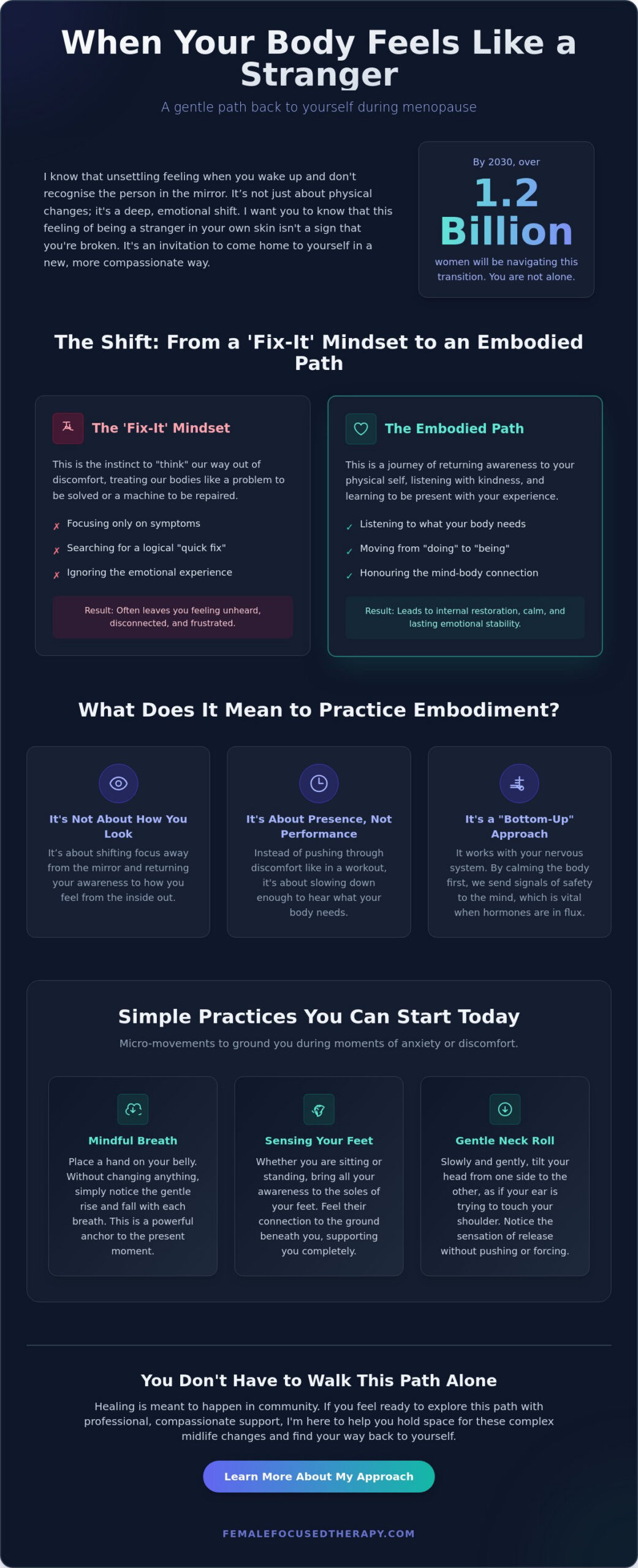
What if the feeling of being a stranger in your own skin isn’t a sign that you’re broken, but an invitation to finally come home? I know how it feels when your body suddenly starts playing by a different set of rules, leaving you with a sense of anxiety that seems to come out of nowhere. Statistics show that by 2030, over 1.2 billion women will be navigating this transition, yet many of us still feel completely alone in our struggle. I’ve spent years exploring how embodied practices help women navigate menopause, because I believe that reconnecting with your physical self is the most powerful way to steady your mind when the ground feels like it’s shifting.
I agree that the physical discomfort and emotional overwhelm can feel relentless, but you don’t have to stay adrift. My promise is to show you how somatic and mindful movement can help you reconnect with your changing body and find lasting emotional stability. In the following paragraphs, we will explore practical tools for internal restoration and how to build a sense of calm that stays with you through every flush and sleepless night. You deserve to feel understood and supported as you find your way back to yourself.
Key Takeaways
- Learn why feeling like a stranger in your own skin is a natural part of the menopausal identity shift and how to start recognising yourself again.
- Understand that embodiment isn’t about how your body looks to others, but about returning your awareness to how you feel on the inside.
- Discover how embodied practices help women navigate menopause by moving away from a stressful “fix-it” mindset and towards true internal restoration.
- Explore simple, effective micro-movements you can use anywhere to ground yourself during sudden moments of anxiety or physical discomfort.
- Find out why healing is meant to happen in community and how professional support can help you hold space for these complex midlife changes.
When Your Body Feels Like a Stranger During Menopause
I know that feeling of waking up and not recognising the person in the mirror. It isn’t just about the new lines on your face or the way your clothes fit differently. It’s the unsettling sense that the person you’ve been for forty or fifty years has suddenly become a stranger. Menopause is a profound shift in our identity. It’s an evolution that touches every part of who we are, yet we’re often told by society that it’s simply a matter of managing a few hot flashes and moving on. This dismissive attitude ignores the deep psychological transition we’re actually living through.
When we feel this disconnect, our first instinct is often to try and “think” our way out of the discomfort. we look for a logical “fix” or a clinical solution that treats our bodies like machines in need of repair. However, exploring how embodied practices help women navigate menopause reveals that the answers aren’t always found in a medical checklist. Traditional clinical approaches can leave us feeling unheard and unsupported because they focus on the symptoms while ignoring the person. You aren’t a collection of data points; you’re a woman navigating a major life threshold that requires more than just a prescription.
I’ve seen so many women feel like they’re failing because they can’t just “snap out of” the anxiety or the fatigue. This transition is a biological and psychological recalibration. It’s a time when the roles we’ve played as mothers, partners, and professionals often feel like they no longer fit. This isn’t a failure of your will; it’s an invitation to inhabit your body in a whole new way.
The Emotional Weight of Hormonal Transitions
The sudden spikes in anxiety and that disorienting brain fog are more than just inconveniences. They are heavy, emotional experiences that can make you feel raw and vulnerable. These hormonal shifts can even stir up old wounds or make you feel like you’ve lost your emotional anchor. I see this frequently in my life transitions therapy with women in Singapore. We work together to validate these feelings, acknowledging that your struggle isn’t “all in your head” but is a real, felt experience in your body that deserves patience and kindness.
Why Thinking Isn’t Enough for Healing
Your nervous system is speaking a language that logic simply cannot translate. You might have a high-functioning mind that’s used to solving every problem, but your body is currently overwhelmed and doesn’t care about your to-do list. This is the core of Embodied cognition; the idea that our mental processes are deeply rooted in our physical experiences. When we learn how embodied practices help women navigate menopause, we start to bridge the gap between the mind and the physical self. We need to move from “fixing” to “listening.” It’s about finding a way to be present with the discomfort rather than running from it, allowing for a genuine journey of restoration.
What Does It Mean to Practice Embodiment in Midlife?
Embodiment is a word that gets used a lot lately, but at its heart, it’s the simple act of returning your awareness to your physical self. It’s not about how your body looks in a pair of leggings or how well you can hold a yoga pose. Instead, it’s about how you feel from the inside out. In my work, I find that how embodied practices help women navigate menopause is by creating a vital bridge between your mind and your spirit. It’s the space where you stop thinking about your life and start actually living it again.
This is quite different from a standard gym workout or a fast-paced class where the goal is often to push through discomfort. Somatic practices are about slowing down enough to hear what your body is trying to say. We’re looking for a sense of ease rather than a “burn.” Understanding how embodied practices help women navigate menopause means shifting our focus from performance to presence. It’s a way of being with yourself that doesn’t require you to change or “fix” anything.
The Science of the Nervous System
Our nervous systems are incredibly sensitive to fluctuating oestrogen levels during midlife. When these levels drop, our “fight or flight” response can trigger more easily, leading to sudden spikes of anxiety. This is why “bottom-up” approaches, which move from the body to the mind, are so effective. Proprioception is our internal sense of where we are in space. Research into Mind-body therapies for menopausal symptoms confirms that these practices can significantly lower stress and improve our overall sense of well-being.
Embodiment as a Form of Self-Trust
Many women tell me they feel as though their body has betrayed them. It’s hard to trust a body that feels hot, tired, or achy without warning. Rebuilding this relationship is a slow, gentle process of restoration. By using somatic movement and yoga, you can begin to reclaim a sense of agency and internal stability. You aren’t just a passenger in a failing vehicle; you’re the inhabitant of a changing, wise home. If you’re feeling ready to explore these connections more deeply, you might find it helpful to book a space to talk.
Moving Beyond the “Fix It” Mindset for Menopausal Symptoms
I’ve spent many hours listening to women describe the sheer exhaustion of trying to manage their lives while their hormones are in flux. It often feels like a full-time job, doesn’t it? You’re tracking your temperature, monitoring your moods, and perhaps trying every supplement on the shelf. While wanting relief is completely natural, I’ve noticed that the constant search for a “cure” can sometimes increase our internal stress levels. We treat our bodies like broken machines that need a mechanic, rather than a living, breathing home that’s going through a renovation.
When we approach our symptoms with a “fix it” mindset, we stay in a state of hyper-vigilance. This keeps our cortisol levels high, which ironically can make symptoms like hot flashes and insomnia even worse. I invite you to consider a different path: being with the change instead of against it. This is exactly how embodied practices help women navigate menopause; they offer a way to relate to your discomfort without the added layer of judgment or panic. By shifting your perspective from control to connection, you signal to your brain that you aren’t in immediate danger, allowing your system to finally settle.
I recently listened to a Duke University expert on NPR’s Embodied podcast who touched on these very themes of reframing our experience. When we stop fighting the reality of our changing biology, we often find that the emotional volume of our symptoms begins to turn down. It’s a journey of internal restoration that starts with a single, compassionate breath.
The Myth of the “Perfect” Menopause
There’s so much pressure to be the “zen” woman who glides through midlife without a hair out of place. I want you to know that it’s okay to find this messy. Accepting the unpredictability of perimenopause as a natural, though difficult, part of your story is a powerful act of self-kindness. Self-compassion is the most important practice you can ever adopt. It’s the soft place to land when the “brain fog” hits or the anxiety feels too loud.
Rest as a Radical Act
In a world that demands we keep going at all costs, choosing to rest is an act of rebellion. For a jittery menopausal nervous system, restorative movement and stillness signal that you are safe. I prioritise “being” over “doing” in my integrative therapy sessions because I know that healing doesn’t happen when we’re constantly rushing. Taking ten minutes to simply feel the weight of your body on a chair can be more transformative than an hour of forced exercise. You’re allowed to slow down.
Simple Somatic Practices You Can Start Today
I want to reassure you that you don’t need a yoga mat, a special outfit, or even a quiet room to begin. These are small, micro-movements designed to ground you in those specific moments of overwhelm. I use these myself when my ADHD-brain feels too loud or when a sudden hot flash makes my body feel like it’s vibrating. The beauty of how embodied practices help women navigate menopause is that they meet you exactly where you are, even in the middle of a busy day.
Instead of worrying about the “right” technique, focus on the sensation of your breath. It isn’t about counting seconds; it’s about feeling the air move through you. When we focus on sensation rather than performance, we stop judging our experience and start inhabiting it. This shift in attention is a powerful tool for internal restoration.
The 5-Minute Grounding Breath
During a hot flash, try to gently lengthen your exhale. This simple act settles your heart rate and signals to your nervous system that you aren’t in danger. A longer exhale tells your brain you are safe. As you breathe, notice the weight of your body against the chair or the floor. Allow yourself to feel “held” by the surface beneath you, letting go of the need to carry yourself for just a moment.
Gentle Movement for Joint Ease
A Moment of Mindful Stillness
Sometimes, the most profound thing you can do is place one hand on your heart and the other on your belly. This physical connection allows you to offer yourself a simple phrase of validation: “I am here, and I am safe.” It’s a way of acknowledging how embodied practices help women navigate menopause through direct self-compassion. If you’d like more guided support, you can explore my free therapy resources at any time.
If you find that these moments of stillness bring up difficult emotions or if you’re struggling to find your footing, I’m here to help. You don’t have to navigate this transition alone. You can book an individual session with me to explore a personalised path toward calm and restoration.
How We Can Walk This Path of Restoration Together
Healing from the disorienting shifts of midlife doesn’t have to be a solo journey. We are biologically and emotionally wired to be in community, yet menopause often feels like a lonely island. I believe that when we share our experiences, the shame and confusion begin to dissolve. My role is to walk alongside you, offering a safe space where your mind and body are treated as one rather than separate parts in conflict.
My background as an integrative psychotherapist and yoga master allows me to hold space for the full complexity of your experience. We don’t just talk about the anxiety; we look at how that anxiety lives in your breath and your posture. This is a core part of how embodied practices help women navigate menopause. By combining clinical insight with somatic wisdom, we create a path for deep, lasting change that goes beyond just “coping” with symptoms. We’re working toward a genuine sense of internal peace.
I want you to hear this clearly: you are not broken. You aren’t a problem to be solved or a patient to be cured. You are in a powerful, albeit challenging, state of becoming. This transition is a shedding of old skins, making room for a version of yourself that is more grounded and self-assured than ever before. It is a homecoming to a wiser, more resilient you.
Integrative Therapy for Midlife
In my work with women, I focus on the complex emotions that bubble up during this transition. We use individual psychotherapy to explore identity, relationships, and the unique psychological weight of midlife. A session with me isn’t just sitting and talking. We might pause to notice a tightness in your chest or use a gentle breathing technique to settle your nervous system mid-conversation. This multidisciplinary approach ensures we are addressing the hormonal transition from every angle, respecting your lived experience.
Taking Your First Step Toward Calm
It’s perfectly okay to start exactly where you are today, even if you feel completely overwhelmed. Reaching out for support isn’t a sign that you’ve failed to cope; it’s a sign of immense strength and self-awareness. You’ve spent so much of your life looking after others. Now, it’s time to turn that care inward and prioritise your own restoration.
I understand how embodied practices help women navigate menopause because I’ve lived through the noise of an ADHD brain and the heat of hormonal change myself. If you feel ready for a deeper conversation about your own journey, I am here to listen. You deserve to feel like yourself again, and that journey back home starts with a single, gentle step toward support.
Taking Your Next Step Toward Internal Calm
We’ve explored how returning to your physical self can act as an anchor during the stormy seasons of midlife. By moving away from the exhaustion of a “fix it” mindset and embracing simple somatic tools, you can begin to restore your sense of internal stability. I’ve seen firsthand how embodied practices help women navigate menopause by bridging the gap between a restless mind and a changing physical self. This transition is a profound invitation to trust your own intuition and listen to the wisdom your body has always held.
As a Registered Integrative Psychotherapist and Yoga Master, I’ve dedicated my work to holding space for these delicate female focused life transitions. You don’t have to carry the weight of this change alone. If you’re ready to find your way back home to a body that feels safe and familiar, I invite you to book a discovery call with me to explore how we can support your journey. You’re doing better than you think, and a sense of calm is much closer than it feels right now.
Frequently Asked Questions
Is it normal to feel sudden anxiety during menopause even if I never had it before?
It’s completely normal to experience new or heightened anxiety during this transition, even if you’ve always felt emotionally stable. Research shows that fluctuating oestrogen levels directly impact the brain’s emotional regulation centres. This shift can leave you feeling unusually raw or hyper-vigilant.
I often see this in my practice, where women feel blindsided by a sense of dread that has no obvious external cause. It’s a physiological response to a changing internal environment, not a personal failing.
Can yoga really help with physical menopause symptoms like hot flashes?
Yoga can be incredibly effective for managing physical symptoms like hot flashes by calming the autonomic nervous system. When you practice restorative poses and slow breathing, you lower your core stress response. This can reduce the frequency and intensity of vasomotor symptoms.
This is a key example of how embodied practices help women navigate menopause by addressing the physical and emotional self as one integrated system. It’s about soothing the jittery signals your brain is sending to your body.
How do I start a somatic practice if I have never done yoga or meditation?
You don’t need any prior experience to begin; you can start by simply noticing the sensation of your feet on the floor. Somatic practice is about internal awareness rather than achieving a specific pose or reaching a state of “zen.”
Try sitting quietly for two minutes and feeling the weight of your hands in your lap. This small act of returning to your body is the foundation of embodiment. It’s accessible to everyone, regardless of their fitness level or background.
What is the difference between mindfulness and embodiment for menopause?
Mindfulness involves observing your thoughts and feelings from a distance, while embodiment is about feeling your experience from the inside out. In menopause, mindfulness helps you notice a hot flash is happening without judgment.
Embodiment allows you to feel the actual texture of the heat and find a sense of internal space and safety within that physical sensation. Both are valuable, but embodiment focuses more on the “felt sense” within your tissues and bones.
Do I need to see a doctor or a therapist for my menopausal mood swings?
It’s often beneficial to consult both a medical professional and a therapist to ensure you’re supported from all angles. A doctor can help with the physiological aspects, while a therapist who specialises in life transitions can help you navigate the profound identity shifts.
How long does it take to see the benefits of embodied practices?
You might feel a sense of immediate relief after just five minutes of grounding breath, but the deeper benefits are cumulative. Consistent practice helps rewire your nervous system to be more resilient over time.
Most women I work with report a noticeable shift in their internal stability and symptom management after a few weeks of regular, gentle engagement. It’s about steady, manageable restoration rather than a temporary quick fix.
Can somatic movement help if I also have ADHD and find it hard to sit still?
Somatic movement is actually ideal for the ADHD brain because it doesn’t require you to be perfectly still. I find that “micro-movements,” like swaying or gentle rocking, can be much more grounding than forced stillness for neurodivergent women.
This approach is central to how embodied practices help women navigate menopause, as it allows you to work with your natural energy levels. You can find calm through movement rather than fighting against your need to fidget.
What should I do if I feel too overwhelmed to even start a 5-minute practice?
If five minutes feels like too much, I suggest starting with just one single, conscious breath. You don’t have to “do” a formal practice; you can simply acknowledge that you’re feeling overwhelmed and place a hand on your heart.
This tiny moment of self-validation is a practice in itself. Healing happens in small, manageable increments. There’s no pressure to do more than you’re capable of right now, and even the smallest connection counts.

Article by
Cheryl Kennedy MacDonald MA BA (Hons) Pg. Dip. SAC BACP
Cheryl Kennedy MacDonald is a psychotherapist specialising in women’s mental health, relationships, and life transitions. She works with women navigating trauma, relationship breakdown, identity shifts, and midlife change, helping them rebuild self-trust, emotional stability, and a clear sense of who they are and what they want.
With over 20 years’ experience working with women internationally, Cheryl is the founder of YogaBellies, a global women’s yoga school, and the creator of the Birth ROCKS method. Her work sits at the intersection of psychotherapy and embodiment, integrating evidence-based therapeutic approaches with somatic, body-based practices that support deep, lasting change.
Known for her grounded and direct approach, Cheryl moves beyond surface-level insight to address the patterns held in the body and nervous system. Her work supports women to regulate, reconnect, and respond to their lives from a place of clarity, strength, and self-respect.
She is a published author in academic journals and has written multiple books on women’s health, pregnancy, and midlife wellbeing, available on Amazon and leading book retailers worldwide.