
What if not knowing exactly what to say is enough to begin? Preparing for your first counselling session can bring up questions: Do you need to explain everything clearly? How much of your story should you share? And what if meeting a therapist, in person or online, feels awkward at first?
It makes sense to feel nervous when you’re stepping into a conversation that matters. I’m Cheryl Kennedy MacDonald, a registered psychotherapist, and I’ve spent over 20 years supporting women through difficult and changing times. You don’t need to arrive with a polished account of your life, or decide in advance what you’re ready to talk about.
I’ll help you approach that first conversation gently, with a clearer sense of what you might share and what can wait. I’ll also explore what you can ask, how to settle into the session, and why uncertainty is a valid place to start. Whether you’re meeting me in person in Singapore or online, you can take things at your own pace.
Key Takeaways
- Preparing for your first counselling session doesn’t mean rehearsing your whole life story; a few words about what’s on your mind can be enough.
- You can choose what to share, ask about how I work, and leave some things for another time.
- For an online session, a comfortable, private space for meeting on Zoom may help you feel more settled.
- After the conversation, give yourself time to notice how it felt without expecting a particular reaction.
- Counselling isn’t about fixing you; it can support greater understanding and trust in yourself.
Preparing for Your First Counselling Session When You Feel Unsure
You may know that something feels difficult, yet still struggle to explain what’s going on. Perhaps your thoughts feel tangled, or you’ve been managing so much for so long that you’re not sure where to start. Wanting support doesn’t mean you need to arrive with a clear account of everything that has happened.
Preparation can mean noticing what matters, not rehearsing everything. You don’t need a polished story or a prepared explanation before we meet. I’m interested in what feels important to you now, even if you’re still finding the words. You can begin with a feeling, a question, or simply the fact that you’re unsure.
If you’d like a broad introduction to the field, Counseling psychology offers an overview of its history and common areas. You don’t need to read it before coming to counselling, though. What you bring from your own life matters more than learning the right terms.
If you’re worried you won’t know what to say
You can begin with the uncertainty itself. You might say, “I’m nervous and I’m not sure where to start,” or “I’ve been feeling overwhelmed, but I can’t explain it yet.” Those are real ways to open a conversation, not signs that you’ve prepared badly. I can meet you in that starting place without expecting you to have everything worked out.
You may also need a moment before answering a question. A pause doesn’t mean you’re doing anything wrong. You can say that you need time to think, or that you’re not ready to talk about something yet. I can’t promise exactly how a session will unfold, but you don’t have to perform confidence or fill every silence.
What preparing can mean when you feel overwhelmed
If everything feels like too much, try noticing what has been weighing on you lately. Is there a conversation you keep replaying, a change you’re adjusting to, or a feeling that’s been hard to set aside? You don’t have to decide what it means. Simply noticing what keeps returning can give you a gentle place to begin.
If it feels helpful, keep one thought or question nearby, perhaps on a note in your phone or on paper. It could be as simple as, “I don’t feel like myself,” or “How do I know what kind of support might help?” You can bring it, leave it, or change your mind. Preparing for your first counselling session can be as small as giving yourself permission to arrive without the whole story.
I work with women using a trauma-informed, feminist and integrative approach. You can share at a pace that feels manageable to you, and you can let me know when you need to slow down or stay with what feels easier to say. For now, one honest sentence about how you’re feeling may be enough to keep nearby.
How to Prepare for Counselling Without Rehearsing Your Whole Story
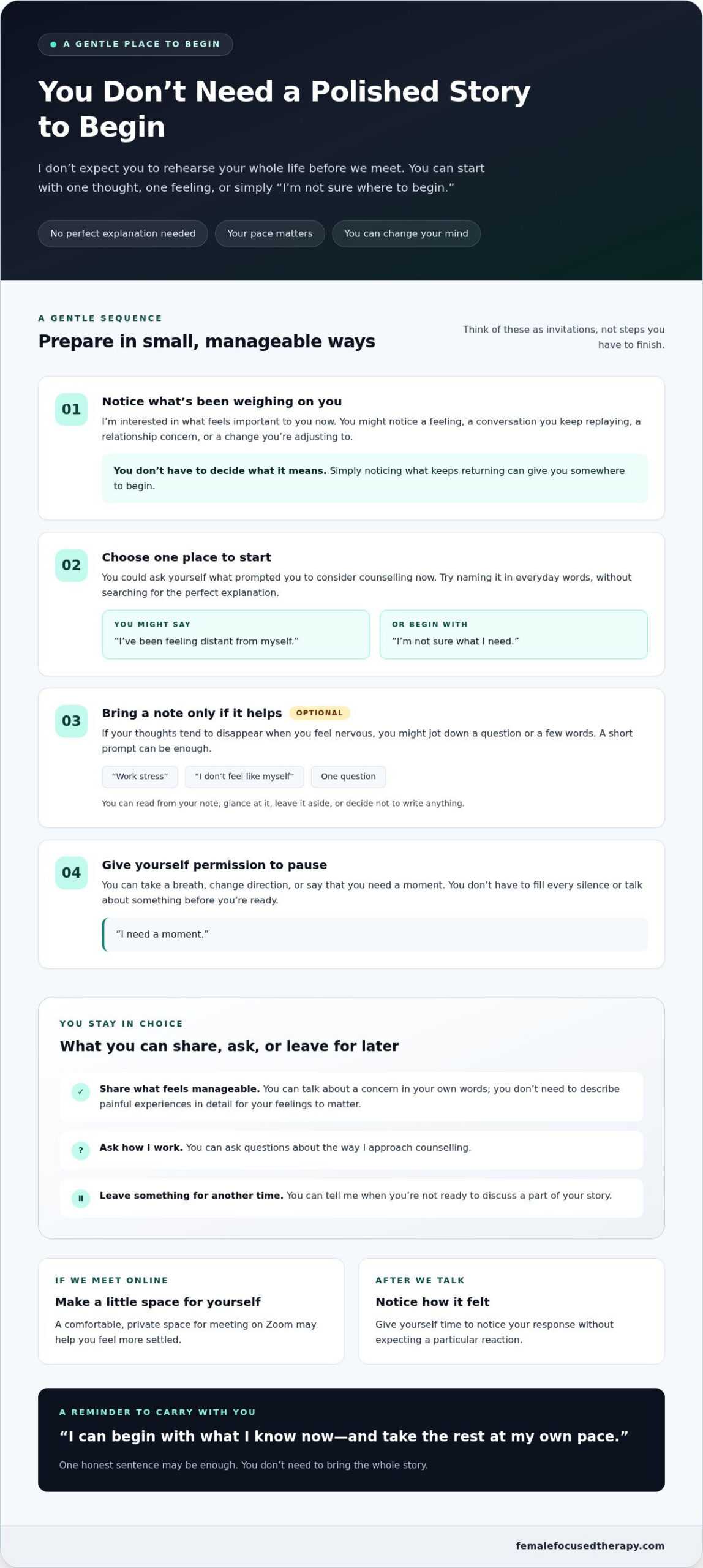
It can be tempting to plan every detail before you go, especially if you’re used to keeping things organised for everyone else. But preparing for your first counselling session doesn’t need to become another task you have to get right. A gentler approach is to notice what’s present, choose one place to begin, jot down a prompt if it helps, and let yourself pause whenever you need to.
A helpful prompt gives you somewhere to start; it doesn’t need to become a perfect account. You might arrive with one concern, such as feeling worn down by work or uncertain about a relationship, rather than a full timeline of your life. You can let the conversation develop from there.
Choose one place to begin
You could ask yourself what prompted you to consider counselling now. Perhaps there’s a feeling you keep returning to, a relationship concern that’s taking up space, or a life change you’re still adjusting to. Try naming it in everyday words, without searching for the perfect explanation.
For example, you might say, “I’ve been feeling distant from myself,” or “I’m finding a change at home harder than I expected.” Your first concern can shift as you talk. You’re allowed to follow what feels more important once you’ve had a moment to settle in.
Bring notes only if they help you feel steadier
If your thoughts tend to disappear when you feel nervous, you might jot down a question or a few words to keep nearby. A short note such as “work stress” or “I’m not sure what I need” may be enough. You don’t have to write a full history or describe anything in detail before you’re ready.
You can glance at your notes, read from them, or leave them aside once you’re there. They’re for your support, not something you have to complete or hand over. If writing makes you feel more pressured, it’s fine not to do it.
Think of the sequence as an invitation, not a set of steps you must finish. Notice what’s been asking for your attention. Choose one thread that feels possible to name. Jot down a prompt only if that would help. Then give yourself permission to pause. You can take a breath, change direction, or say, “I need a moment.” Your pace matters more than having every detail ready.
If you’re considering counselling with me, you can book a first appointment when it feels right for you. You don’t need to arrive with a complete story. One small starting point is enough.
What You Can Share, Ask, or Leave for Another Time
You get to choose what you share, in your own words and at a pace that feels manageable. You might talk about a relationship concern, a life transition, or simply feeling overwhelmed. You don’t have to describe painful experiences in detail for your feelings to matter. You can also tell me that there are parts of your story you’re not ready to discuss.
I work with women around concerns including relationships, trauma, ADHD, menopause and midlife changes. You can explore the range of concerns I support in my guide to who I work with. You don’t need to decide which heading fits you before we speak, or explain someone else’s behaviour. We can begin with what you’re experiencing and what feels important to you.
You can begin with what feels manageable
A starting point might be, “I’m finding things difficult at home,” or “I’ve felt overwhelmed since a recent change.” You can speak generally at first. I won’t need you to give a detailed account of painful experiences before you’re ready, and you can pause or change the subject if you need to.
You may also be unsure how to describe a relationship. You can focus on what you notice in yourself, such as feeling tense before a conversation or doubting your own needs, without trying to label or diagnose your partner or a family member. I’m here to understand your experience with you.
Questions you may want to ask me
You’re welcome to ask how I work and what my trauma-informed, feminist and integrative approach means in practice. In simple terms, I draw on different ways of working and tailor our conversations to you, rather than expecting one approach to suit everyone.
You might ask what a first meeting could involve, how we’ll decide what to focus on, or how confidentiality works in my practice. I’d rather you ask directly than feel you have to guess. I can explain my approach and answer your questions, while the shape of the conversation can depend on what you bring and what feels useful to explore.
If you’re thinking about fit, you might ask yourself whether you feel able to speak openly, whether my approach makes sense to you, and whether you feel listened to. Preparing for your first counselling session can include bringing questions like these, but you don’t have to ask them all at once.
- “How do you usually work with concerns like mine?”
- “What might our first conversation involve?”
- “Can you explain how confidentiality works in your practice?”
- “What can I do if I’m not ready to discuss something?”
There’s no requirement to cover everything in one meeting. You can answer in a few words, ask me to clarify something, or leave a subject for another time. Your questions and boundaries are part of the conversation, too.
How to Make the First Session Feel More Manageable
There are two different things to prepare for: the practical arrangements and how you feel about meeting. You might have the time and setting sorted, yet still feel nervous. Or you may feel ready to talk but unsure about the details. Neither needs to be perfect before you begin. Preparing for your first counselling session can simply mean making the practical parts a little easier, while letting your feelings be as they are.
Getting ready for an online or in-person meeting
I meet women in person in Singapore and online through Zoom. As you think about your chosen setting, you might consider what would help you feel present there. For an online meeting, that could mean choosing a place where you can sit comfortably. For an in-person meeting, it may help to give yourself a quiet moment before we begin. These are options, not requirements.
You don’t need to create an ideal setting. Life may be busy, and your space may not feel perfectly calm. You can focus on what’s within reach, such as having a drink nearby or putting aside a few minutes to arrive without rushing, if that suits you. I don’t expect you to arrange everything just right before we speak.
Practical preparation can reduce small distractions, but it can’t promise that you’ll stop feeling anxious. You might still notice nerves as the meeting approaches or once we start talking. That doesn’t mean you’ve done anything wrong. You can let me know how you’re feeling, and we can begin from there.
Let your body and mind arrive at their own pace
Before the conversation, you might take a moment to notice how you’re arriving. Is your jaw tight? Are your shoulders lifted? Is your breathing quick, slow, or simply hard to notice? There’s no need to change anything or aim for a particular feeling. A little attention can help you recognise what’s happening for you in that moment.
If it feels comfortable, let your next breath come and go without trying to control it. You could also feel your feet on the floor or notice the chair beneath you. These small points of contact aren’t a test or a technique you have to get right. They’re simply ways of giving yourself a moment to settle before speaking, if that feels useful.
You may find that your mind is still busy once the meeting begins. That’s all right. You can listen, take your time, or tell me you need a moment. I won’t expect you to feel calm before we talk, or to have every thought in order. The practical details can be ready while your emotions take their own time to catch up.
If you’d like to meet with me, you can book a Clarity session and take the next step when it feels right for you.
What You Can Do After Your First Counselling Session
After a first conversation, you might feel lighter, thoughtful, tired, unsure, or a mixture of things. You don’t need to decide straight away what the session meant. Give yourself a little space to notice how it sits with you, without judging your reaction or expecting to feel a particular way.
Counselling isn’t about fixing you. I see it as a space to understand more about what you’re experiencing and to strengthen your trust in your own perspective. My work with women is trauma-informed, feminist and integrative. Depending on what feels relevant to you, I may draw on approaches such as ACT, CBT, psychodynamic therapy, somatic practices or mindfulness. These are ways of supporting reflection, not promises of a particular outcome.
Notice what felt useful or difficult
When you have a quiet moment, you might ask yourself what you want to remember from the conversation. Perhaps something felt easier to say than you expected, or a question came up that you’d like to return to. You might also have felt uncertain or found part of the conversation difficult. Mixed feelings don’t prove that the meeting went well or badly. They’re simply part of what you can notice.
You could write down one thought for next time, or leave it until you feel ready. A small next step might be giving yourself an unhurried evening, having a cup of tea, or carrying on with a familiar routine. Choose what feels kind and manageable for you, rather than adding another task to your day.
Choose whether you’d like to continue
You’re allowed to consider whether my approach and the conversation felt right for you. You might reflect on whether you felt listened to, whether you could speak in your own way, and whether the pace felt comfortable enough to continue exploring. You don’t need to make a final judgement based on one feeling in one moment. You can take time to think about what matters to you.
If you’d like to understand more about my work before deciding, my therapy practice homepage shares more about the support I offer women. Preparing for your first counselling session may have taken courage; there’s no need to turn what comes next into another test of whether you’re doing it right.
I also offer a bookable Clarity session as an introductory option. If you feel ready to take that step, you can book an appointment. There’s no urgency. You can move at a pace that feels right for you.
Let Your First Step Be a Gentle One
You don’t need to wait until you feel completely ready. If you’re preparing for your first counselling session, it may help to remember that you can begin with whatever feels possible today, even if that’s simply admitting you’d like support.
I offer female-focused, trauma-informed, feminist and integrative psychotherapy and counselling. I’m registered with BACP and SAC, and I bring over 20 years of experience to my work with women. You can take time to decide whether speaking with me feels like the right next step. There’s no need to have every answer before you begin.
If you’d like an introductory conversation, I offer a Clarity session. You’re welcome to book a Clarity session when it feels right for you. One small step is enough. You can arrive as you are, and let the conversation begin there.
If you’d like to find out more about working with Cheryl Kennedy MacDonald, you can email her at cheryl@femalefocusedtherapy.com or go ahead and book an appointment here: https://www.femalefocusedtherapy.com/book-now/ or lifestyle and yoga progammes, visit YogaBellies on www.yogabellies.com
Frequently Asked Questions
What if I don’t know what to say in my first counselling session?
You could begin with a question rather than a story: “Can you help me work out what feels most important?” I can ask gentle questions to understand what you’d like support with, and you can correct me if I’ve misunderstood. If words feel hard to find, you might describe what you hope could feel different in your everyday life, even if you’re not sure how to get there.
Should I write down what I want to talk about before counselling?
Only if writing suits you. If you do make a note, you could capture one question you’d like answered, or a moment when a concern tends to show up, such as before a particular conversation. Keep it brief and for your own reference. You don’t need to organise your thoughts into a clear account, and you can decide on the day whether the note is useful.
Can I talk about something difficult in my first counselling session?
Yes. You can describe how something is affecting you now without giving a detailed account of what happened. For example, you might say that a memory is making it hard to sleep or that a situation leaves you doubting yourself. I’ll listen without asking you to share more than feels manageable. You can also tell me that you’d like to return to the subject another time.
What happens if I feel emotional during my first counselling session?
You don’t need to manage your feelings in a particular way for my sake. If you notice emotion rising, you might name it in simple words, such as, “I feel exposed talking about this.” That can help me understand what’s happening for you without requiring you to explain everything. You can decide what you want to do next, including changing the subject or taking some time.
Is online counselling different from an in-person first session?
The conversation is still about what you want support with, but you may have different preferences about the setting. I offer sessions in person in Singapore and online globally via Zoom. You might consider whether you find it easier to speak from a familiar place or to have a separate setting for the conversation. Either preference is valid, and you can tell me what feels more comfortable.
Do I need to know what kind of therapy I want before my first session?
No. You don’t need to research therapy approaches or choose a label before we meet. If you come across a term that’s unfamiliar, you can ask me to explain it in everyday language. You might also ask what a particular way of working could look like for the concern you bring. The choice isn’t an exam, and you can tell me if something doesn’t make sense to you.
How do I know whether I want to continue after a first counselling session?
You can take time to decide. If you’re unsure, it may help to write down what you’d want clarified before making a choice, such as how future conversations might focus on your concerns. I offer a bookable Clarity session as an introductory option. You can consider whether that feels useful, without treating uncertainty as a reason you must decide immediately.

Article by
Cheryl Kennedy MacDonald MA BA (Hons) Pg. Dip. SAC BACP
Cheryl Kennedy MacDonald is a psychotherapist specialising in women’s mental health, relationships, and life transitions. She works with women navigating trauma, relationship breakdown, identity shifts, and midlife change, helping them rebuild self-trust, emotional stability, and a clear sense of who they are and what they want.
With over 20 years’ experience working with women internationally, Cheryl is the founder of YogaBellies, a global women’s yoga school, and the creator of the Birth ROCKS method. Her work sits at the intersection of psychotherapy and embodiment, integrating evidence-based therapeutic approaches with somatic, body-based practices that support deep, lasting change.
Known for her grounded and direct approach, Cheryl moves beyond surface-level insight to address the patterns held in the body and nervous system. Her work supports women to regulate, reconnect, and respond to their lives from a place of clarity, strength, and self-respect.
She is a published author in academic journals and has written multiple books on women’s health, pregnancy, and midlife wellbeing, available on Amazon and leading book retailers worldwide.