
If you’re searching for perimenopause depression, you may be feeling low, emotionally unsettled or distant from yourself while still keeping up with work, family and everyday demands. Being told it’s “just hormones” may not feel like enough of an answer.
You might wonder whether perimenopause is connected, or whether something else is happening. You don’t need to know yet. I believe your feelings deserve attention without being reduced to a life stage or fitted into a label.
I’m Cheryl Kennedy MacDonald, a registered integrative psychotherapist. Through my work at Female Focused Therapy, I help women make room for what they’re experiencing, without expecting them to have it all figured out.
Key Takeaways
- Notice what feels different without deciding that every change in mood means depression.
- Consider how perimenopause depression may sit alongside changes in your body and pressures in your life.
- Give your feelings room beyond a hormone explanation, including the context of what you’re carrying.
- Begin gently by naming what feels different, then consider what kind of support feels manageable.
- Explore how trauma-informed, feminist, integrative psychotherapy can help you make sense of your experience without trying to fix you.
When perimenopause depression makes you feel unlike yourself
I know how unsettling it can feel when your usual sense of yourself becomes less steady. You might feel low, more easily moved, or simply not quite like you. Then you may wonder whether it’s perimenopause, the pressures of life, or something else. Not knowing can be its own kind of strain.
I use the phrase perimenopause-related low mood to describe a dip in mood during the years of change around menopause. It doesn’t explain the whole story, and it doesn’t mean every difficult day is depression. Perimenopause and mood can be connected, but I don’t believe a label alone can explain your experience. A broad overview of perimenopause and depression can offer background, while your own story remains individual.
You can take a feeling seriously without being certain what it means.
The feeling that something has shifted
Perhaps you’re making breakfast or answering a familiar message, and notice you’re doing it all on autopilot. The ordinary moment hasn’t changed, but your feelings inside it have. You may wonder where your usual patience, interest or ease has gone.
Life doesn’t necessarily pause while you try to understand that shift. You might still be working, caring for family or keeping plans moving, while privately feeling less connected to yourself. That contrast can be confusing, especially when you’re carrying on as usual on the outside.
Your experience may look different from anyone else’s. I’d begin with a simple observation: something feels different, and you’re allowed to be curious about it. You don’t need to turn that feeling into a checklist or a conclusion.
You don’t need to know the cause yet
You may be trying to work out whether hormones, sleep, a demanding season of life or a mix of things is affecting how you feel. I wouldn’t expect you to know straight away. Perimenopause depression can describe something you’re wondering about, not deliver a verdict on what’s happening to you.
Uncertainty doesn’t make your feelings less worthy of attention. You don’t need to prove your mood is serious enough, or decide whether it has a name, before giving yourself room to notice it. Sometimes it’s enough to say, “I don’t feel quite like myself, and I’m not sure why.”
If perimenopause is part of what you’re trying to understand, I share more about menopause and midlife transitions. You can read at your own pace. For now, you don’t have to reach a conclusion or make a plan. You can begin by noticing what feels different, with kindness rather than pressure.
How perimenopause and low mood can overlap
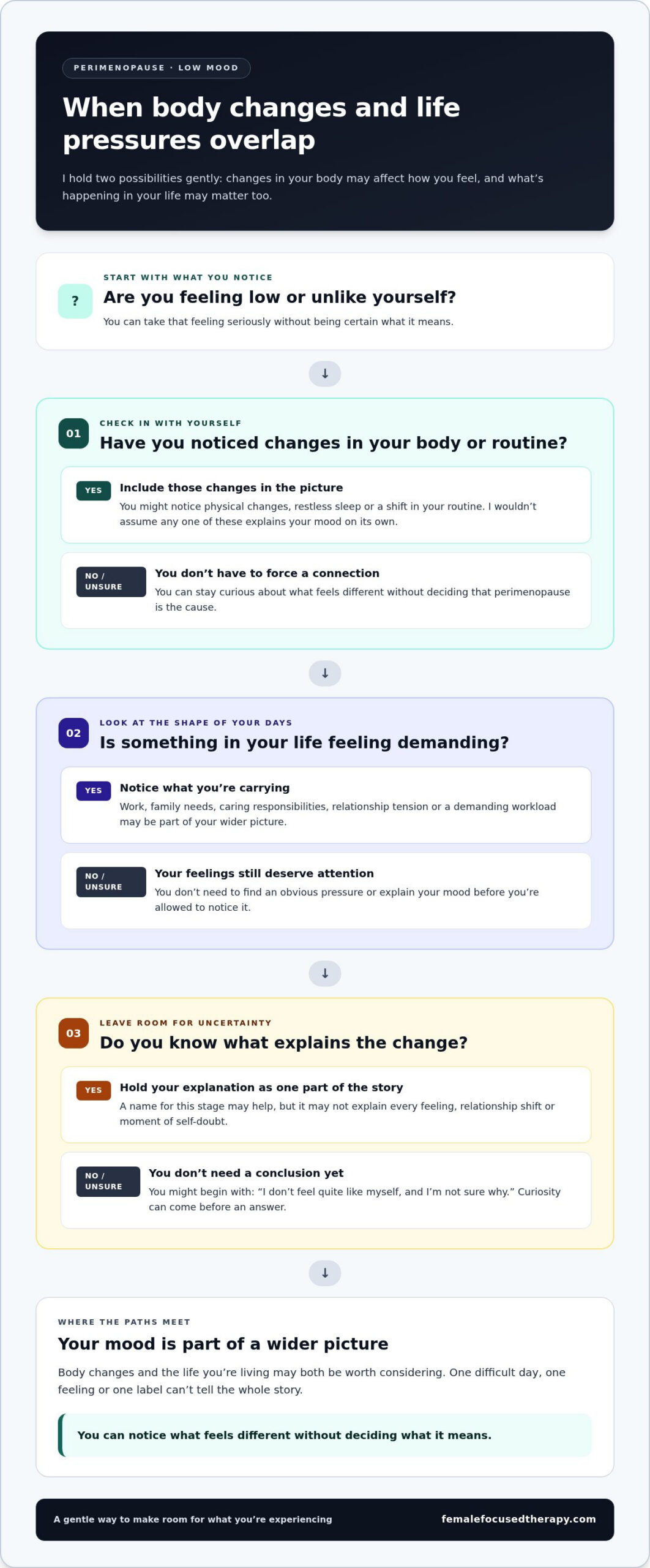
I find it helpful to hold two possibilities gently: changes in your body may affect how you feel, and what’s happening in your life may matter too. I wouldn’t assume one explanation accounts for everything you’re experiencing.
I see your mood as part of a wider picture, shaped by your body and the life you’re living.
When we explore perimenopause depression together, I don’t try to identify a cause from one feeling or moment. I’m interested in what you notice and what feels relevant to you. We can make room for uncertainty rather than rushing towards a simple answer.
When body changes meet the pressures of daily life
You might have a restless night, then wake to a day full of work, family needs or decisions that can’t wait. I can understand how you might feel more stretched or emotionally tender that day. I wouldn’t take one difficult day as proof of what’s causing your mood.
You may be managing physical changes while also facing tension in a relationship, caring responsibilities or a demanding workload. I’d be curious about how these things sit alongside each other for you, without assuming they affect everyone in the same way.
If you’ve slept poorly, a familiar task might feel harder, or a small frustration might land more heavily. I can’t tell from that alone why you feel low. I can help you notice that your body and the shape of your day may both be worth considering.
Why your experience may not fit a neat explanation
I know your feelings may not follow a tidy pattern. You might feel more settled one day and weighed down the next. You may welcome parts of midlife while grieving a change, or feel that your circumstances are affecting you more than bodily changes. I’ll make room for mixed feelings rather than ask you to choose one explanation.
You may find that a conversation, a better night’s rest or a change in what you’re carrying shifts how the next day feels. I wouldn’t use that variation to dismiss your experience. I’d see it as part of the picture we can explore together.
If you’re trying to understand what’s happening, you could gently ask yourself what has felt demanding lately, or what has changed in your body or routine. I don’t expect you to answer every question or work out the cause. I’d rather begin with curiosity than turn your reflection into a test.
If you’d like to explore how midlife changes may be affecting you, I share more about menopause and life transitions. If talking together feels manageable, you can also book a session with me. I’ll meet you where you are, without asking you to have everything figured out.
Why your feelings deserve more than a hormone explanation
A name for this stage can be useful. It may help you make sense of changes in your body or mood. But if you hear “it’s perimenopause” as though that explains everything, you may be left feeling that the rest of your story hasn’t been heard.
I don’t want to dismiss the possibility that hormonal changes are part of what you’re experiencing. I also don’t want to assume they explain every feeling, relationship shift or moment of self-doubt. The phrase perimenopause depression can name a concern, but it can’t describe all the things that make your experience yours.
Your feelings can have more than one thread, and you don’t have to untangle them all at once.
A life stage can be part of the picture, not the whole story
You might be going through physical changes while also adjusting to a child becoming more independent, a changing relationship, or a new sense of what you want from work. These things can sit alongside each other. Their timing may matter to you, but it doesn’t prove that one caused another.
Past experiences may also shape how a present change feels. A shift in closeness with someone you love, for example, might touch an older fear of being overlooked. That doesn’t mean your reaction is wrong or points to a disorder. It may simply be part of the meaning this moment holds for you.
I’d make room for the ordinary details of your life, too. Perhaps you’re carrying more responsibility than you’d like, or trying to adapt to a role that no longer feels like a fit. These pressures don’t need to be treated as evidence of illness. They’re part of the context you deserve to explore with care.
Making room for your own meaning
You could gently ask yourself: what feels different in how I relate to the people around me? Do I feel more distant, more protective of my time, or unsure of what I need? You don’t have to share anything you’d rather keep private. Even noticing the question may help you find words that feel true.
You might also notice whether the change feels connected to your sense of identity. Perhaps an old role has become uncomfortable, or you’re not sure what you want now that other people’s needs have taken up so much space. I wouldn’t rush to interpret that. Curiosity can be enough for the moment.
When you’re trying to understand perimenopause depression, you deserve more than a quick explanation that makes your personal circumstances disappear. You can hold the possibility of a body change and still take seriously what’s happening in your relationships, memories and daily life. Nothing has to be dramatised, minimised or resolved today. You’re allowed to begin with, “There’s more going on for me, and I’m still finding the words.”
A gentle way to respond when low mood feels hard to hold
When your mood feels heavy, it can be tempting to search for the right explanation before saying anything aloud. I’d begin more gently. You can name what feels different, then notice what kind of support might feel manageable. You don’t have to work out whether perimenopause is the cause before your feelings are worth talking about.
Finding words for what you’re carrying
You might start with a simple sentence: “I haven’t felt quite like myself lately.” If that feels too broad, you could name one small change. Perhaps a usual part of the day feels harder, or you find yourself needing more quiet than before. You don’t need to record, score or explain these moments.
Let the words be yours. You might ask yourself, “What feels different today?” or “What’s taking up the most space in my mind?” You can answer in a few words, keep the answer private, or leave the question for another time. This isn’t a test or a way to diagnose yourself. It’s simply a chance to listen without demanding a complete account.
Sometimes the first thing you notice may be physical: tension, tiredness or a wish to pause. You can include that in your description if it feels relevant. Your experience involves more than finding the perfect label for your mood.
Letting someone close know what you need
If there’s someone you trust, you could share only what feels comfortable. You might say, “I’ve been feeling low. I’m not sure why, but could you listen for a while?” Or perhaps you’d prefer company without a serious conversation. Asking for what would help in that moment doesn’t require you to prove a cause.
You may not feel ready to speak to anyone. Privacy can feel important, and you’re allowed to take your time. There’s no rule that says reflection must lead to a conversation, or that you need to share more than you want. Even noticing that you’d rather have space is useful information about what feels manageable right now.
I wouldn’t turn this into another task to get right. You can pause at the first step, return to it later, or choose a small kindness that feels within reach, such as taking a quiet moment before moving on with your day. None of this promises that your mood will change. It offers a way to meet what you’re feeling with a little more care.
If you’d like a space to talk without needing to arrive with a clear explanation, I can explore your experience with you in psychotherapy. You can book a session with me if and when that feels manageable.
How I can support you through perimenopause depression
If you’re feeling low or unlike yourself, you don’t need a clear explanation before we talk. I offer trauma-informed, feminist, integrative psychotherapy for women, where we can explore what’s happening at a pace that feels manageable to you. The aim isn’t to fix you or fit your experience into a label. It’s to make room for your feelings and the wider story around them.
Perimenopause depression may be part of what you’re trying to understand. I won’t assume that hormones explain everything or decide what your experience means for you. We can look together at what has changed, what feels difficult and what matters most in your life right now. I don’t diagnose or prescribe medication. I offer space to reflect, with care for your choices and your own understanding of yourself.
Making space for your whole experience
I draw on different approaches depending on what feels useful to you. These may include ACT, CBT, psychodynamic therapy, somatic and mindfulness-based practices, Coherence Therapy, and Depth-Oriented Brief Therapy. I won’t expect you to know these names or choose a method. I’ll stay curious with you about what fits your needs and the questions you bring.
Our conversations can include both your thoughts and what you notice in your body. You might talk about a change in a relationship, a feeling you can’t quite name, or the way tension shows up as you describe a demanding day. We can take time to notice these things without treating them as proof of a particular cause.
I believe your mind and body belong in the same conversation. That doesn’t mean I’ll push you towards movement or any practice that doesn’t feel right. It means I’m interested in your whole experience, including what feels hard to put into words. You remain part of the conversation about what we explore and how.
I offer in-person psychotherapy sessions in Singapore and online therapy for women globally. You can find out more about my work with menopause and midlife changes if you’d like to understand how I approach this life stage.
Beginning with a Clarity session
If starting therapy feels like a big step, I offer a bookable Clarity session as an introduction. You can share what you feel ready to share and consider what kind of support might suit you. You don’t need to prepare a full account or know exactly what you want from therapy. It’s fine to begin with uncertainty.
You can book a Clarity session if it feels like a helpful next step. There’s no pressure to have everything figured out first. Your experience deserves to be met with patience, and we can begin with what feels possible for you now.
Take one gentle step towards feeling understood
You don’t need to solve the whole picture before you honour what you’re feeling. Perimenopause depression may be part of what’s happening, but your experience is yours, with its own history, relationships and pressures. You can begin by noticing what you’d like to feel heard about, even if you’re still unsure how to describe it.
I offer a trauma-informed, feminist and integrative space to explore your experience without reducing you to a life stage or expecting you to have everything figured out. I’m registered with BACP and SAC, and I’ll meet you with care and curiosity, not a ready-made answer.
If a first conversation feels like a helpful next step, you’re welcome to book a Clarity session. There’s no need to arrive with perfect words. You can start where you are, and take things at a pace that feels right for you.
Frequently Asked Questions
Can perimenopause depression affect my relationships?
It can affect how you feel and respond in relationships, though it won’t look the same for everyone. You might have less energy for conversation, feel more easily hurt by a comment, or want more time alone than usual. If you choose to talk with someone close, you could explain what would help in a specific moment, such as a little quiet or a chance to finish speaking without advice.
Is it possible to feel low without knowing whether perimenopause is involved?
Yes. You can feel low without knowing what’s contributing to it, and you don’t need to settle on a cause before taking your feelings seriously. It may help to describe what you’ve noticed in everyday terms, such as “I’m finding it harder to enjoy my evenings.” You can share that uncertainty with me in therapy too. We can explore your experience without deciding on an explanation straight away.
Can anxiety and low mood happen alongside perimenopause?
Yes, you may notice anxiety and low mood at the same time, or find that one feeling is more present than the other on different days. That combination alone doesn’t tell you why you feel this way or establish a diagnosis. If you speak with me, you can describe each feeling in your own words, including what tends to be happening around you when it feels stronger.
Will therapy help if I think hormones may be part of how I feel?
Therapy can offer space to explore how you’re feeling while leaving room for the possibility that bodily changes matter. You don’t have to choose between acknowledging hormones and talking about your emotional life. I can help you consider what feels difficult, what support you want and what you’d like to understand better. Therapy isn’t a medical assessment or a promise that your mood will change.
Can I have online therapy if I live outside Singapore?
Yes, I offer online therapy for women globally, so you can work with me while living outside Singapore. You can begin by thinking about what you’d like space to talk through, even if your thoughts still feel unfinished. You don’t need to prepare a detailed account. A simple starting point, such as “I’ve been feeling unsettled lately,” is enough to begin a conversation.
What can I say if I want support but don’t know where to begin?
You could begin with the words you have, rather than waiting for a complete explanation: “I’m feeling low, and I’m not sure what’s behind it.” You might add what you hope for in that moment, such as “I’d like you to listen” or “I’m not ready to talk about details.” You can share only what feels comfortable and let the conversation unfold at your pace.
If you’d like to find out more about working with Cheryl Kennedy MacDonald, you can email her at cheryl@femalefocusedtherapy.com or go ahead and book an appointment here: https://www.femalefocusedtherapy.com/book-now/ or lifestyle and yoga progammes, visit YogaBellies on www.yogabellies.com

Article by
Cheryl Kennedy MacDonald MA BA (Hons) Pg. Dip. SAC BACP
Cheryl Kennedy MacDonald is a psychotherapist specialising in women’s mental health, relationships, and life transitions. She works with women navigating trauma, relationship breakdown, identity shifts, and midlife change, helping them rebuild self-trust, emotional stability, and a clear sense of who they are and what they want.
With over 20 years’ experience working with women internationally, Cheryl is the founder of YogaBellies, a global women’s yoga school, and the creator of the Birth ROCKS method. Her work sits at the intersection of psychotherapy and embodiment, integrating evidence-based therapeutic approaches with somatic, body-based practices that support deep, lasting change.
Known for her grounded and direct approach, Cheryl moves beyond surface-level insight to address the patterns held in the body and nervous system. Her work supports women to regulate, reconnect, and respond to their lives from a place of clarity, strength, and self-respect.
She is a published author in academic journals and has written multiple books on women’s health, pregnancy, and midlife wellbeing, available on Amazon and leading book retailers worldwide.