
What if I told you that your struggle to leave a relationship that hurts you has nothing to do with a lack of strength or character? I see this so often in my clinic; women who are brilliant and self-aware, yet feel completely stuck in a cycle of confusion and exhaustion. You might feel like you’re losing your mind or your intuition, but what you’re experiencing is actually a biological survival mechanism known as trauma bonding.
I know how heavy the cognitive dissonance feels when the person who causes you pain is also the one you crave for comfort. It’s a physical and emotional loop that wears you down until you don’t recognise yourself anymore. I want to help you make sense of why it feels so impossible to walk away and how you can begin to rebuild your internal compass. In this article, I’ll explain the signs of this bond and why your nervous system is reacting this way. Most importantly, I want to offer you the hope that healing is possible, and you can find your way back to a life of stability and self-trust.
Key Takeaways
- Recognise that your struggle to leave is a biological survival response, not a sign of weakness or a lack of intelligence.
- Understand how trauma bonding functions like a chemical addiction in your brain, explaining that intense pull you feel toward someone who hurts you.
- Identify the specific stages of the push-pull cycle so you can stop questioning your reality and start trusting your own observations again.
- Learn why detoxing your nervous system is a vital step in breaking the attachment and allowing your mind to find clarity.
- Discover how integrative therapy helps you move beyond just talking about the past to physically and emotionally returning to yourself.
That Confusion You Feel Has a Name
I want to start by telling you that you are not crazy, and you are not weak. I’ve spent over 20 years working with women who are incredibly high-functioning and intelligent, yet find themselves caught in a loop they can’t seem to break. You might be wondering how you ended up here, or why you still feel a desperate need for the approval of someone who treats you poorly. This specific type of emotional attachment, often referred to as traumatic bonding, happens when a relationship is defined by a cycle of intense highs and devastating lows.
It’s a state of deep cognitive dissonance. You see the “good” in them because you’ve experienced it firsthand; maybe it was the way they looked at you in the beginning or the grand gestures they made. Because that person exists, you find yourself dismissing the harm they cause as an aberration or a mistake. You feel trapped in a cage, yet you’re the one holding the key, unable to turn it because your sense of safety has become tied to their presence. It’s a confusing, exhausting place to be.
The Intermittent Reinforcement Trap
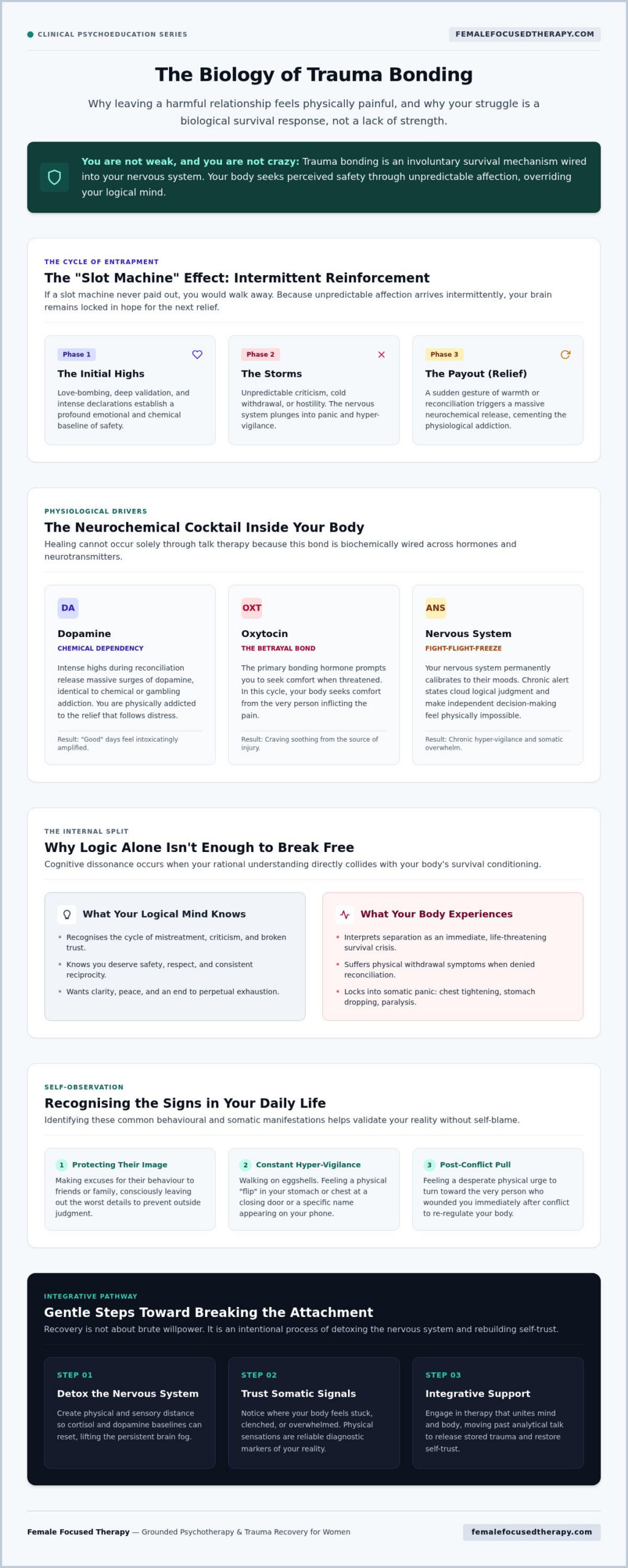
In my practice, I often describe this as the “slot machine” effect. If a machine never paid out, you’d walk away. But because it pays out occasionally and unpredictably, you keep pulling the lever. This is intermittent reinforcement. In the context of a relationship, a partner might use “love-bombing” early on to create a powerful initial bond. When the “storms” of criticism or neglect hit, your brain fixates on the “calm” moments of the past, hoping they’ll return. You’re essentially waiting for the next payout of affection to soothe the pain of the current mistreatment.
Recognising the Signs in Your Daily Life
Identifying this pattern is the first step toward healing from relationship trauma. You might notice these signs in your own life:
- You find yourself making excuses for their behaviour to friends or family, often leaving out the worst details to protect their image.
- You live in a state of constant hyper-vigilance, feeling that you are walking on eggshells to avoid the next explosion or withdrawal of love.
- You feel a physical pull toward them immediately after a conflict, seeking the very person who hurt you to help you feel regulated again.
Ultimately, it’s helpful to remember that trauma bonding is a biological survival response to unpredictable affection. It isn’t a character flaw; it’s your nervous system’s way of trying to find safety in an unsafe environment.
The Biology of the Bond: Why Your Body Won’t Let Go
I believe that the mind and body are one. Healing from a difficult relationship isn’t just a “talking” process because the trauma bonding is literally wired into your nervous system. When you’re caught in this cycle, your brain isn’t just processing emotions; it’s managing a complex chemical cocktail that makes leaving feel physically painful.
Dopamine plays a massive role here. During those intense “highs” of reconciliation, your brain receives a surge of dopamine that creates a powerful chemical dependency. It’s the same mechanism found in gambling or substance use. You aren’t weak for staying; you’re navigating a physiological addiction to the relief that follows the pain. This is why the “good” days feel so intoxicatingly better than they actually are.
We also have to look at oxytocin, often called the bonding hormone. When we feel threatened or hurt, our bodies naturally seek comfort to feel safe again. In the context of signs and biological drivers of trauma bonding, the person causing the distress is often the only person you turn to for soothing. This creates a “betrayal bond” where your body seeks comfort from the very source of your pain. Over time, your fight-flight-freeze response becomes permanently calibrated to their moods, leaving you in a state of constant hyper-vigilance.
The Nervous System on High Alert
You might recognise the physical sensation of the “flip” from safety to terror. It’s that sudden lurch in your stomach or the tightening in your chest when you hear a door close or see a specific name on your phone. Chronic stress like this clouds your judgment and makes it incredibly hard to make decisions. I often ask my clients to notice where they feel “stuck” in their own bodies, as these physical sensations are often the first clues that your nervous system is overwhelmed and struggling to reset.
Why Logic Isn’t Enough to Break Free
I hear women say all the time, “I know he’s bad for me, so why can’t I just leave?” The answer lies in your physiology. You can “know” the relationship is harmful with your logical mind, but still “feel” unable to move because your body is tethered to the perpetrator for perceived survival. It is a primal, reflexive response. Your body is trying to protect you, even when its methods feel self-destructive. If you’re ready to start untangling these physical knots, booking a session can be a gentle first step toward restoration.
Recognising the Push-Pull Cycle in Your Life
I’ve spent years listening to women describe the specific rhythm of their relationships, and it almost always follows a predictable arc. This cycle is the engine that keeps trauma bonding alive. It starts with tension building; you feel that familiar tightening in your chest as you try to anticipate their every mood. Then comes the incident, followed by the honeymoon phase. This third stage is the most dangerous because it’s filled with apologies, affection, and the promise that “this time it will be different.” It’s the relief your nervous system has been begging for, which makes it incredibly hard to see the harm clearly.
Gaslighting is often the tool used to maintain this cycle. When your partner constantly questions your memory or tells you that you’re “too sensitive,” your sense of reality begins to erode. You stop trusting what you see and hear, and you start relying on their version of events just to keep the peace. Over time, you might realise you’ve lost the “self” you used to be. You’ve spent all your energy serving the needs of the relationship instead of your own. It’s a slow disappearing act that leaves you feeling hollow and dependent.
The Erosion of Your Intuition
I often talk about the internal compass we all possess. In a healthy relationship, your intuition is a guide; in a bonded one, it’s something you’ve learned to ignore. You’ve likely been told that your basic needs are “selfish” or “demanding” so many times that you’ve started to believe it. This is a core part of relationship trauma and narcissistic abuse. You stop listening to that quiet voice in your gut because the cost of acknowledging the truth feels too high. Rebuilding that trust in yourself is a journey, but it starts with acknowledging that your feelings have always been valid.
The Isolation Factor
Secrecy is where these bonds thrive. You might find yourself editing the stories you tell your friends or family because you’re ashamed of what’s happening behind closed doors. This isolation isn’t usually an accident. Many abusers work to separate you from your support network, making you feel that they are the only person who truly understands or loves you. Breaking this silence is a vital part of overcoming trauma bonds. When you begin to share your reality with safe people, the bond starts to lose its power over your life.
Gentle Steps Toward Breaking the Attachment
I want you to understand that breaking away from trauma bonding isn’t like a standard breakup. It’s often a slow, messy process of detoxing your system from a chemical addiction. Because your brain has been wired to seek relief from the person causing the pain, walking away can feel like physical withdrawal. This is why “No Contact” or “Low Contact” is so vital. It isn’t about being unkind; it’s about giving your brain the silence it needs to reset and stop the constant flood of stress hormones and dopamine spikes.
One practical tool I often suggest is building a “reality log.” When gaslighting has made you doubt your own memory, having a private, safe record of what was actually said and done can be life-saving. You might simply write down the date and a brief sentence about an event. It acts as an external anchor for your truth when the internal fog feels too thick, helping you stay grounded in what you know to be real.
Coming Back into Your Body
Healing isn’t just about understanding the cycle with your mind. We have to address the way your body has been holding onto the stress of the relationship. I often guide women through the simple practice of noticing. This means becoming present in your body again, even for just a few seconds. You might notice the weight of your feet on the floor or the way your shoulders soften when you exhale.
A key tool for your nervous system is the breath. I always suggest making your exhale longer than your inhale; it’s a direct signal to your brain that you are safe in this moment. If you feel ready to explore this further, I incorporate somatic movement and therapy into my work to help you release what the mind can’t yet put into words.
Gathering Your Support Circle
I’ve seen time and again that women often heal better when they are in connection with other women. There is something profoundly restorative about being in a safe space where you don’t have to explain or justify your experience. You need people who can hold the truth for you when you feel too tired to hold it yourself, allowing you to rest in the knowledge that you aren’t alone.
While friends are wonderful, professional support provides the boundaried space needed to navigate the complex layers of the bond. It’s about having a guide who understands the biological pull and can help you rebuild your internal compass at a pace that feels manageable for you. If you’re ready to take that step, you can book a session to start your recovery and begin the journey of returning to your own strength.
Rebuilding Your Inner Compass with Therapy
I believe that healing from the cycle of a difficult relationship is ultimately a journey of returning to yourself. When you’ve spent months or years focused on someone else’s moods, your own internal compass can feel broken or lost. My approach to therapy is designed to help you find that needle again. It’s about more than just surviving; it’s about internal restoration and rebuilding the self-trust that was eroded during the years you spent in survival mode.
Because I work integratively, our sessions address both the stories your mind tells and the trauma your body holds. We know that trauma bonding isn’t just a mental hurdle; it’s a physiological state. By combining traditional talk therapy with somatic awareness, we can start to untangle the knots of the past. You don’t have to do this alone. I am here to hold a safe, boundaried space for your healing, allowing you to process your experiences without fear of judgment or pressure.
What to Expect in Our Sessions
I provide a warm and empathetic environment where your confidentiality and safety are the highest priorities. We will work at a pace that feels manageable and steady for you, ensuring you never feel overwhelmed by the process of looking back. Whether we are discussing relationship patterns or noticing how your breath changes when you speak, the focus remains on your stability. If you’re looking for specialised Individual Psychotherapy for women, I offer a space that understands the unique challenges we face in these dynamics.
Taking the First Step
Sometimes, the hardest part is simply recognising that you deserve better. I want you to know that wanting to leave, or simply wanting to feel like yourself again, is enough of a reason to seek help. You don’t need to wait for a crisis to begin the work of recovery. Reaching out is an act of courage and the first step toward a quiet rebuilding of your life.
I promise that a renewed sense of self-assurance is possible. You are entirely capable of a life that feels safe, grounded, and authentically yours. When you’re ready to start, I’m here to guide you back to your own intuition. You can find more resources on my homepage to see how we can work together to reclaim your peace.
If you’d like to find out more about working with Cheryl Kennedy MacDonald, you can email her at cheryl@femalefocusedtherapy.com or go ahead and book an appointment here: https://www.femalefocusedtherapy.com/book-now/ or lifestyle and yoga progammes, visit YogaBellies on www.yogabellies.com
Returning to Your Own Strength
You’ve spent a long time looking for safety in a place that only offered confusion. I want you to remember that the physical and emotional pull of trauma bonding is a biological response, not a sign that you’re weak or broken. By understanding the chemical cycles in your brain and learning to listen to your body’s signals again, you’ve already started the process of reclaiming your autonomy and rebuilding your self-trust.
Rebuilding your internal compass takes patience and a gentle, multidisciplinary approach that honours both your mind and your nervous system. As a Registered Integrative Psychotherapist with over 20 years of experience, I’m here to offer the professional, mind-body approach you need to navigate this transition safely. You are entirely capable of a life that feels safe, grounded, and authentically yours.
If you’d like to find out more about working with Cheryl Kennedy MacDonald, you can email her at cheryl@femalefocusedtherapy.com or go ahead and book an appointment here or lifestyle and yoga progammes, visit YogaBellies on www.yogabellies.com
Frequently Asked Questions
What is the difference between trauma bonding and a healthy connection?
I often explain that a healthy connection is built on consistency, mutual respect, and a genuine sense of safety. You feel free to be yourself without fear of reprisal. In contrast, trauma bonding relies on a cycle of intense highs and devastating lows. Affection is unpredictable and used as a reward for compliance. While a healthy partner encourages your growth, a bonded relationship uses intermittent reinforcement to keep you tethered to their approval for your emotional survival.
Can a trauma bond be one-sided?
Yes, a bond like this is almost always one-sided in its impact. While both people are part of the cycle, the attachment itself is a physiological and emotional survival strategy felt by the person being mistreated. It isn’t a mutual bond built on shared love; it’s a profound power imbalance. One person uses a mix of harm and kindness to control the other’s nervous system, sense of reality, and internal stability.
How long does it take to break a trauma bond?
I tell my clients that there is no fixed timeline for recovery because every woman’s experience is deeply personal. Breaking the attachment is a process of physical and emotional detox that usually takes several months of consistent work. It often requires periods of no contact to allow your brain’s dopamine levels to reset from the constant push-pull cycle. With dedicated therapy, you can begin to rebuild your internal compass and find a sense of peace at a pace that feels manageable.
Is trauma bonding the same as Stockholm Syndrome?
They are very similar concepts used in different settings. Stockholm Syndrome was originally used to describe hostages who developed positive feelings for their captors as a way to survive. Trauma bonding is the psychological term we use for this same “betrayal bond” within interpersonal or domestic relationships. Both involve a power imbalance where you seek safety from the person causing the harm because your nervous system has become conditioned to their unpredictable kindness.
Why do I feel physically ill when I try to leave the relationship?
You are likely experiencing a physiological withdrawal. Your body has become addicted to the dopamine spikes that occur during the reconciliation or “honeymoon” phase of the relationship. When you try to leave, your system loses that chemical “fix” and reacts with intense symptoms like nausea, heart palpitations, or total exhaustion. It’s a clear sign that the bond is held in your body, which is why I believe healing must involve both the mind and the nervous system.
Can you be trauma bonded to a parent or a friend?
Yes, you can. These bonds can form in any relationship where there is a cycle of mistreatment followed by affection. I often work with women who recognise these patterns from their childhood, where they had to “earn” a parent’s love through silence or perfection. These early experiences can deeply impact your internal sense of safety and often set a template for how you navigate adult relationships, making it harder to trust your own intuition later in life.
What happens in the brain during a trauma bond?
Your brain becomes caught in a powerful loop of dopamine and cortisol. Cortisol floods your system when you’re walking on eggshells, keeping you in a state of high alert. When your partner offers kindness or an apology, your brain receives a massive spike of dopamine. This creates a chemical dependency similar to a gambling addiction. You aren’t weak; your brain has simply been conditioned to crave the relief of their affection to soothe the fear they created.
How can therapy help me if I am not ready to leave yet?
Therapy isn’t about forcing you to make a decision before you’re ready. My goal is to provide a safe, non-judgmental space where you can begin to clear the fog of gaslighting and rebuild your self-trust. We focus on regulating your nervous system and helping you return to your own body. When you feel more grounded and stable within yourself, you’ll naturally find the clarity needed to make the choices that are right for your future.

Article by
Cheryl Kennedy MacDonald MA BA (Hons) Pg. Dip. SAC BACP
Cheryl Kennedy MacDonald is a psychotherapist specialising in women’s mental health, relationships, and life transitions. She works with women navigating trauma, relationship breakdown, identity shifts, and midlife change, helping them rebuild self-trust, emotional stability, and a clear sense of who they are and what they want.
With over 20 years’ experience working with women internationally, Cheryl is the founder of YogaBellies, a global women’s yoga school, and the creator of the Birth ROCKS method. Her work sits at the intersection of psychotherapy and embodiment, integrating evidence-based therapeutic approaches with somatic, body-based practices that support deep, lasting change.
Known for her grounded and direct approach, Cheryl moves beyond surface-level insight to address the patterns held in the body and nervous system. Her work supports women to regulate, reconnect, and respond to their lives from a place of clarity, strength, and self-respect.
She is a published author in academic journals and has written multiple books on women’s health, pregnancy, and midlife wellbeing, available on Amazon and leading book retailers worldwide.