
What if the person you’ve become isn’t who you are, but simply how you’ve survived? Perhaps you’re wondering if there’s a simple step 1? to clearing the heavy fog that has settled over your daily life. It’s incredibly draining to live in a state of constant second-guessing, where your own reality feels like it’s shifting beneath your feet. You might feel physically exhausted from walking on eggshells, sensing that the vibrant woman you once were has slowly faded into the background while you focus on simply getting through the day.
I understand this quiet struggle, and I’m here to tell you that your feelings are valid. I’ll help you make sense of the confusion, name your emotional experience, and show you how to begin reclaiming your self-trust after narcissistic abuse. We’ll look at the powerful connection between your mind and body to understand why you feel so depleted. Together, we can find a safe, non-judgemental path toward rebuilding your internal stability and finding your way back to yourself.
Key Takeaways
- Understand that the persistent confusion and self-doubt you feel are natural responses to emotional manipulation, validating that your experience is real.
- Identify the specific stages of the abuse cycle, which often serves as the vital step 1? in untangling the complex web of a trauma bond.
- Recognise how your body stores unspoken trauma through physical signals like tension and fatigue, highlighting the importance of a mind-body approach to recovery.
- Learn to begin the quiet work of rebuilding your internal foundation by slowly reconnecting with your intuition and learning to trust your gut again.
- Discover how a safe, professional therapeutic space can provide the stability needed to process your experiences and reclaim the woman you used to be.
Recognising the Fog: What Narcissistic Abuse Feels Like
If you find yourself constantly questioning your own reality, I want to start by telling you something vital: you are not “crazy.” I often speak with women in Singapore who describe a heavy, persistent cloud hanging over their lives. They feel lost, yet they can’t quite put their finger on why. This is “the fog.” It is the hallmark of narcissistic abuse, a pattern of emotional manipulation that slowly erodes your sense of self until you no longer recognise the person looking back at you in the mirror.
Many women ask me for a clear step 1? when they first arrive in therapy, hoping for a quick way to see through the haze. The truth is that this erosion doesn’t happen overnight. It’s a slow, methodical process where your boundaries are tested and then dismantled. Because it happens so gradually, it is often difficult to pinpoint exactly when the warmth of the relationship turned into a cold, confusing distance. You aren’t imagining the shift; you’re experiencing a calculated withdrawal of emotional safety.
The Invisible Weight of Emotional Manipulation
In my work, I frequently meet high-functioning women who are leaders in their professional lives but feel completely stuck in their personal ones. Subtle comments about your competence, your appearance, or your memory can lead to a total loss of confidence over time. You might find yourself “walking on eggshells” in your own home, carefully monitoring your tone and words to avoid a conflict you don’t fully understand. This is a core element of relationship trauma and narcissistic abuse, leaving you in a state of chronic, quiet exhaustion.
Why It Is So Hard to Name Your Experience
Part of the confusion stems from intermittent reinforcement. There are still “good times” or moments of the old connection that keep you hoping for a permanent change. You might feel over-responsible for the relationship’s success, wondering if things would improve if you just tried harder or stayed more patient. Understanding Narcissism as a personality trait helps clarify that these patterns aren’t about your failings or your lack of effort. Your discomfort is a valid signal. Even if you aren’t ready to use a specific label yet, your feeling that something is fundamentally “off” is a truth worth listening to. Is there a definitive step 1? to finding your way back? It begins by acknowledging that your experience is real, even if it has been denied by others for a long time.
The Cycle of Narcissistic Abuse and the Trauma Bond
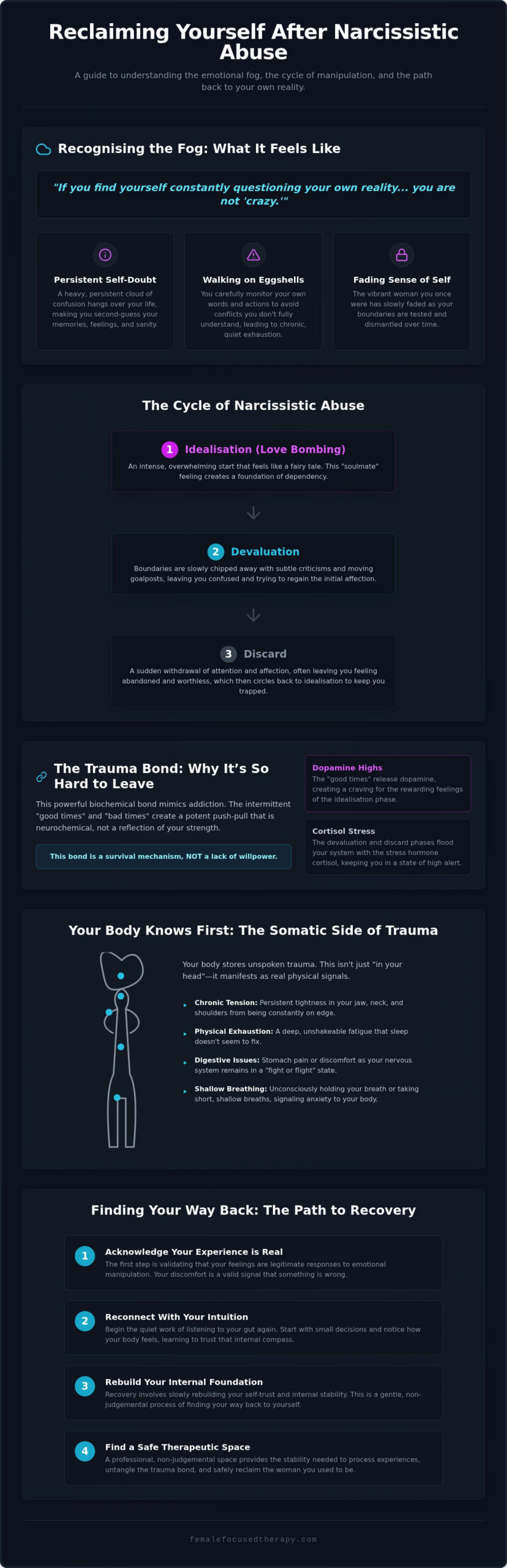
I’ll walk you through the three main stages that define this painful experience: idealisation, devaluation, and discarding. It’s a repetitive loop that keeps you off balance and unsure of where you stand. For many women, identifying these stages is the essential step 1? for anyone trying to make sense of a relationship that feels like a rollercoaster. This cycle isn’t your fault; it’s a structural part of a dysfunctional dynamic designed to maintain control.
From Love Bombing to Devaluation
The cycle often begins with “love bombing,” an intense, overwhelming start that feels like a fairy tale. I’ll explain how this initial “soulmate” feeling is used to create a foundation of dependency. It’s intoxicating to feel so seen and adored. However, this is quickly followed by the devaluation phase, where your boundaries are slowly chipped away. You might notice subtle criticisms or moving goalposts regarding your worth. For example, a partner might say, “I love how independent you are,” only to later remark, “It’s a shame your career makes you so selfish with your time.” This shift is a key part of the dynamic of Narcissism and Abuse, leaving you confused and desperate to return to those early, golden days.
Understanding the Trauma Bond
The most difficult part of this cycle is the trauma bond. This is the reason why leaving feels physically painful, almost like a withdrawal. The neurochemistry of the bond mimics addiction. The intermittent “good times” release dopamine while the “bad times” flood your system with cortisol. This creates a powerful biological anchor that ties you to the person causing you pain. I often tell my clients that this bond is a survival mechanism, not a lack of strength or willpower. It’s why “just leaving” is never as simple as people on the outside think. If you find yourself trapped in this addictive loop, reaching out for specialised therapy can provide the tools to begin breaking the cycle safely. You aren’t weak for staying; you’ve been surviving a complex psychological storm that has rewritten your internal reward system. Rebuilding takes time, but understanding this bond is the first step 1? toward your restoration.
Why Your Body Knows First: The Somatic Side of Trauma
In my work, I’ve found that the body often holds what the mind isn’t ready to say. While you might still be searching for a clear step 1? to mentally processing your experiences, your body has likely been speaking to you for a long time. Chronic stress doesn’t just stay in your thoughts; it manifests as physical symptoms that can feel unrelated to your relationship struggles. You might find yourself dealing with persistent digestive issues, a clenched jaw that never quite relaxes, or a heavy fatigue that no amount of sleep can fix. These aren’t just random ailments. They are signals that your nervous system has been forced into a state of “high alert.”
Healing must involve the body. It’s not enough to simply talk about the past or analyse the logic of what happened. Because the trauma of narcissistic abuse is stored in your tissues and your nervous system, true restoration requires a mind-body approach. Recognising these physical signals is often the first moment of genuine validation for many women.
The Nervous System in Survival Mode
Living with a narcissistic partner often means living in a state of hyper-vigilance. You are constantly scanning for shifts in mood or tone, waiting for the next devaluation. This constant stress is a hallmark of relationship trauma. When your body is stuck in fight or flight, your sleep becomes fragmented and your ability to regulate emotions feels thin. Recognising the Fog: What Narcissistic Abuse Feels Like often starts with acknowledging these physical tolls. If you feel like your body is failing you, please know it’s actually trying to protect you by staying prepared for a threat.
Learning to Sense and Breathe Again
I invite you to take a moment right now to notice where you are holding tension in your body. Is it in your shoulders? Your belly? Simply noticing this tension without judgement is a helpful step 1? toward reclaiming your sense of self. In my practice, I use an integrative approach to help you move from survival back to safety. We focus on tools like the exhale, which is vital for calming your nervous system. By lengthening your breath, you send a physical signal to your brain that the immediate danger has passed. This somatic awareness allows you to rebuild internal stability from the ground up, helping you feel grounded and safe within your own skin once more.
Reclaiming Your Self-Trust and Setting Boundaries
Healing is not a quick fix; it’s a quiet, intentional rebuilding of your internal foundation. After years of having your reality denied, the path back to yourself can feel uncertain. You might be searching for a clear step 1? to stop the constant second-guessing that has become your default state. Reclaiming your self-trust begins with the brave act of listening to your own inner voice once more, even when it feels like a whisper.
In my practice, I see many high-achieving women who have learned to ignore their instincts to keep the peace. Rebuilding this trust is a journey of restoration, not a race. It involves learning to distinguish between the voices in your head and the truth in your heart. This process is central to who I work with, as we focus on helping women find their voice and their agency after it has been suppressed.
Learning to Trust Your Intuition
Trusting yourself again requires learning the difference between your “anxious voice” and your “wise voice.” Your anxious voice is often conditioned by the abuse; it’s loud, frantic, and filled with “shoulds” and fears of repercussions. In contrast, your wise voice is calm and grounded. It’s that quiet gut feeling that tells you when something is off, even if you can’t explain why. I suggest starting with small, low-stakes decisions to practice this. Choosing what to eat or which path to take on a walk without asking for outside validation is a powerful step 1? toward reclaiming your autonomy.
The Power of the Boundary
Setting boundaries is often the most challenging part of recovery because you’ve been taught that your needs are secondary. It’s vital to remember that a boundary is not about changing the other person, but about protecting your own peace. When you say “No,” you are performing an act of self-love. This is especially important when dealing with “hoovering,” which are the manipulative attempts to pull you back into the toxic cycle through false apologies or manufactured crises.
For situations where contact is unavoidable, the “Grey Rock” method can be a useful tool. This involves becoming as uninteresting and non-responsive as a grey rock, giving the other person nothing to feed on. Protecting your energy is your right. If you feel ready to begin this quiet rebuilding in a supportive environment, you can book a session to explore how we can work together to restore your internal stability.
Finding Your Way Back: How Therapy Supports Recovery
Finding your way back after a toxic relationship is a deeply personal journey of internal restoration. Therapy provides the safe, boundaried space you need to process the “unspoken” trauma that often lingers long after the relationship has ended. In our sessions, we focus on rebuilding your emotional stability through an integrative approach that combines evidence-based psychotherapy with somatic awareness. This multidisciplinary perspective is vital because narcissistic abuse impacts both your mind and your body. Being seen and validated by a professional who truly understands these specific behavioral patterns is often the turning point in recovery. It’s the moment you realise that the confusion wasn’t your fault, and that your reactions were natural survival responses to an unnatural situation.
The life waiting for you on the other side is one of calm, grounded clarity. It is a life that belongs entirely to you, free from the exhausting need to manage someone else’s volatile emotions or unpredictable moods. You might be asking yourself, what is the best step 1? to making this vision a reality? The answer is often simpler than you think: it’s the decision to prioritise your own internal restoration. Together, we can create a path that moves at a manageable speed, ensuring you feel supported every step of the way.
A Safe Space to Unpack the Confusion
We work together to untangle the complex layers of gaslighting that have made you doubt your own mind. My goal is to help you feel empowered and self-reliant, rather than just “fixed.” We peel back the layers of the fog at a pace that feels comfortable for you, ensuring that you always feel in control of the process. For those who feel they need more concentrated support to address deep-seated trauma, I offer focused intensive therapy options. These sessions are designed to provide a sturdy internal foundation, allowing us to hold space for difficult emotions while moving toward lasting change.
Small Steps Toward Internal Restoration
You don’t have to do this alone. Restoration happens in small, quiet moments that build over time. I suggest one tiny next step you can take today: simply focus on a longer exhale. This physical act signals to your nervous system that you are safe in this moment. It is a gentle reminder that you are in control of your own body and your own breath. When you feel ready to start your journey of reclamation, I invite you to book a session. Whether you are looking for a clear step 1? or are further along in your healing, I am here to walk beside you as you find your way back to the woman you were always meant to be.
Your Path to Lasting Internal Restoration
Healing from narcissistic abuse isn’t about finding a quick fix; it’s a gentle, steady process of reclaiming the parts of yourself that were lost in the fog. We’ve explored how your body often holds the first clues to trauma and why rebuilding self-trust is the essential step 1? for moving forward. As a Registered Integrative Psychotherapist with over 20 years of experience, I’ve helped many women in Singapore and around the world navigate these difficult transitions and find their internal stability once more.
You don’t have to carry this weight alone. Whether we work together in person or online, I provide a compassionate, trauma-informed space where your experience is heard and your intuition is restored. If you feel ready to start rebuilding your self-trust in a safe, empathetic space, you can book a session with me here. Your journey back to yourself is a path worth taking, and I’m here to support you with every breath and every step toward a calmer, more grounded future.
Frequently Asked Questions
What is the most common sign of narcissistic abuse?
The most common sign is often a persistent feeling of confusion and self-doubt, commonly referred to as “the fog.” You might find yourself constantly second-guessing your memory or reality. This emotional manipulation erodes your confidence over time. Identifying this pervasive sense of unease is often the vital step 1? in acknowledging that something is fundamentally wrong in the relationship dynamic and beginning your journey back to yourself.
How do I know if I am being gaslighted?
You are likely being gaslighted if you frequently feel the need to record conversations or provide “proof” of things that happened. It involves the other person denying your reality, telling you that you’re “too sensitive,” or claiming events never occurred. Over time, this leads to a loss of self-trust. You might feel like you’re losing your mind because your internal truth is being systematically invalidated by someone you trust.
Can a narcissist ever change their behavior?
While change is theoretically possible, it is statistically rare because it requires the individual to acknowledge a deep-seated flaw in their personality. Most people with these traits don’t believe they have a problem, so they rarely seek or commit to therapy. Instead of waiting for them to change, it’s often more empowering to focus on your own healing and setting firm boundaries to protect your emotional well-being.
Why do I still feel a connection to my abuser?
This connection is usually a trauma bond, which is a powerful psychological and biological attachment formed through intermittent reinforcement. The cycle of intense “good times” followed by devaluation creates a neurochemical addiction in your brain. It feels physically painful to stay away because your nervous system is seeking the relief of the “high” that follows the “low.” Understanding this bond is a crucial part of the quiet rebuilding process.
How long does it take to heal from narcissistic abuse?
There is no fixed timeline for healing, as every woman’s journey is unique. Some might feel a sense of relief quickly, while others need years to process the deep-seated trauma. Restoration happens in layers, involving both the mind and the body. In my practice, I focus on a steady, manageable pace that respects your individual needs. The goal isn’t a quick fix, but a sustainable return to your authentic self.
Will therapy help me trust my own judgment again?
Yes, therapy is designed to help you rebuild the internal foundation that was dismantled during the abuse. Through a supportive, integrative approach, we work on distinguishing your “wise voice” from the “anxious voice” created by gaslighting. This is a primary step 1? in reclaiming your agency. We use somatic awareness to help you reconnect with your gut instincts, ensuring you feel grounded and capable of making decisions for yourself again.
What is the difference between a difficult relationship and an abusive one?
A difficult relationship involves two people who may have communication issues but still respect each other’s reality. In an abusive relationship, there is a clear imbalance of power and a pattern of control. Abuse involves the systematic erosion of your self-esteem and the denial of your autonomy. If you feel like you’re walking on eggshells or that your partner’s love is conditional on your compliance, the dynamic has moved beyond “difficult.”
How can I explain narcissistic abuse to my friends and family?
Explaining this type of “invisible” trauma can be challenging because it’s often subtle. Instead of focusing on the abuser’s specific actions, try describing the impact on your well-being. You might explain that you’ve been in a relationship where your reality was constantly denied, leading to chronic exhaustion and a loss of self. Focus on your need for safety and validation rather than trying to prove the other person’s diagnosis to them.

Article by
Cheryl Kennedy MacDonald MA BA (Hons) Pg. Dip. SAC BACP
Cheryl Kennedy MacDonald is a psychotherapist specialising in women’s mental health, relationships, and life transitions. She works with women navigating trauma, relationship breakdown, identity shifts, and midlife change, helping them rebuild self-trust, emotional stability, and a clear sense of who they are and what they want.
With over 20 years’ experience working with women internationally, Cheryl is the founder of YogaBellies, a global women’s yoga school, and the creator of the Birth ROCKS method. Her work sits at the intersection of psychotherapy and embodiment, integrating evidence-based therapeutic approaches with somatic, body-based practices that support deep, lasting change.
Known for her grounded and direct approach, Cheryl moves beyond surface-level insight to address the patterns held in the body and nervous system. Her work supports women to regulate, reconnect, and respond to their lives from a place of clarity, strength, and self-respect.
She is a published author in academic journals and has written multiple books on women’s health, pregnancy, and midlife wellbeing, available on Amazon and leading book retailers worldwide.