
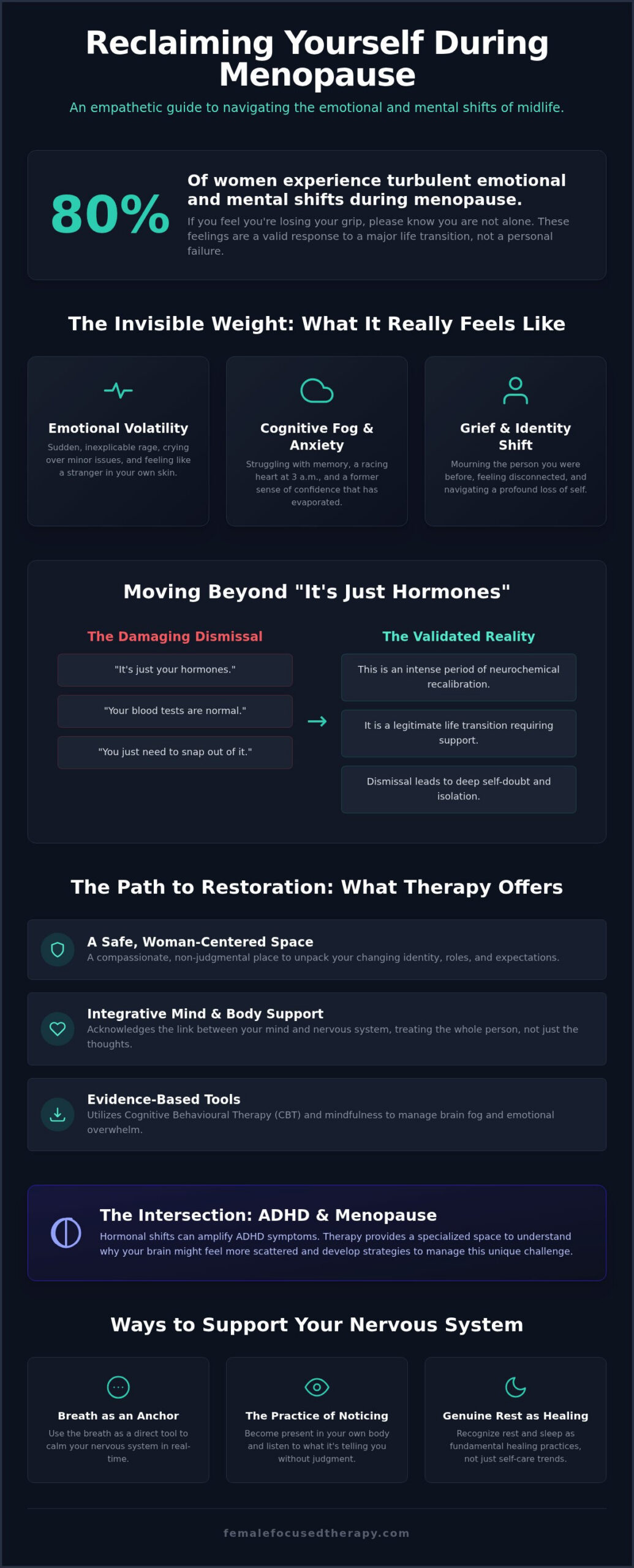
You wake up at 3 a.m. with a racing heart, only to find yourself gripped by a sudden, inexplicable rage at the breakfast table a few hours later. It feels as though the person you used to be has been replaced by a fog-filled version of yourself who struggles to remember simple details or maintain the confidence you once held so easily. If you feel like you’re losing your grip on your identity, please know that you aren’t alone. Around 80 per cent of women experience these turbulent shifts, yet many feel dismissed or misunderstood by the world around them. This is why seeking therapy for menopause is such a vital step in your journey toward healing.
I agree that the mental load of midlife can feel overwhelming, especially when your internal compass feels broken. I promise to help you navigate these emotional waves, providing a safe and compassionate space where you can reclaim your sense of self. In this article, I will explore how I can support you in moving through the fog to find the emotional stability and clarity you deserve.
Key Takeaways
- Understand that the sudden rage and loss of identity you’re feeling are valid responses to a major life transition, not a personal failure.
- Discover how therapy for menopause provides a dedicated, integrative space to restore your internal confidence and navigate midlife with clarity.
- Explore the specific intersection of ADHD and hormonal shifts to understand why your brain might feel more scattered than usual.
- Learn practical, body-focused tools to soothe your nervous system and manage the weight of emotional waves in real-time.
- Realise that you don’t have to walk this path alone and that reclaiming your sense of self is entirely possible with the right support.
The Invisible Weight of the Menopausal Transition
It’s a heavy, unidentifiable presence that sits in the room with you, even when your life looks “fine” on paper. Maybe you’ve found yourself crying over a minor inconvenience or feeling a surge of white-hot rage because a colleague’s tone felt slightly off. You might feel like a stranger in your own skin, watching your former confidence evaporate. Many women I see in Singapore have been told their blood tests are “perfectly normal,” yet they feel anything but. This disconnect creates a profound sense of isolation. Seeking therapy for menopause allows you to validate these feelings as a legitimate part of your transition rather than a personal failure.
While Menopause is a biological milestone, the emotional flux it triggers is distinct from clinical depression. It is a period of intense neurochemical recalibration that requires more than just a clinical label. It’s about acknowledging the unexplained sadness or loss that often accompanies this stage of life. When your brain chemistry is in flux, your emotional baseline shifts. This isn’t something you can simply “snap out of,” and it’s certainly not all in your head.
Moving Beyond the ‘Just Hormones’ Narrative
Society often reduces this complex stage of life to a handful of physical symptoms. This dismissal as “just hormones” is incredibly damaging. It leads to deep self-doubt, making you wonder if you’re simply losing your mind. I’ve seen how this narrative pushes women into isolation. A 10-minute GP visit focuses on the physical, but it doesn’t have the capacity to hold your emotional reality. Specialized therapy for menopause provides the space to explore the internal shifts that medicine often overlooks. It’s a place where your experience is the priority, not just your lab results.
The Grief of the ‘Former Self’
There’s a specific kind of grief that comes with midlife. It’s the quiet mourning of the person you were before the fog rolled in. You might miss your sharp memory, your steady patience, or your unwavering confidence. In our sessions, we honour that former self while recognising the person you are becoming. This isn’t about “fixing” a broken version of you; it’s about internal restoration. When you look at who I work with, you’ll see that this journey of rebuilding self-assurance is a central part of the therapeutic process. We work together to find your footing again, ensuring you feel like “me” once more.
What Does Therapy for Menopause Actually Look Like?
Many people assume that talk therapy is simply a place to vent about “mood swings.” In reality, therapy for menopause is a specialized, woman-centred space designed for internal restoration. It’s about more than just coping; it’s about rebuilding the self-assurance that often feels eroded by hormonal shifts. I use an integrative approach that combines evidence-based psychological modalities with holistic practices to address the whole person. This means we don’t just look at your thoughts. We look at how your body is responding to this transition and how we can bring you back to a state of balance.
Within this safe and confidential space, I utilize Cognitive Behavioural Therapy (CBT) and mindfulness to help you manage the cognitive load of midlife. If you’re struggling with brain fog or feeling constantly overwhelmed, these tools provide practical ways to ground yourself when the mental load feels impossible. We also adopt a trauma-informed perspective. Midlife often brings old wounds to the surface, and it’s essential to handle these with the utmost care and professional support. Seeking Menopause symptoms and relief through therapy ensures that your mental well-being is prioritized alongside your physical health.
A Space to Unpack Your Changing Identity
Midlife often involves a massive shift in roles. You might be navigating the “empty nest” as children leave home, reaching the peak of your career, or caring for ageing parents. For years, you’ve likely put everyone else’s needs before your own. In our sessions, I help you finally listen to yourself. It’s a place of radical empathy and zero judgment where you can explore who you are now, outside of these societal expectations. We work together to ensure you don’t just survive this stage, but move through it with a renewed sense of purpose.
Integrative Support for Mind and Body
I believe that the mind and body are intrinsically linked; they are not separate entities. You can’t effectively treat the anxiety of perimenopause without acknowledging the physiological changes happening in your nervous system. My approach to life transitions and menopause therapy focuses on this vital connection. By integrating mindfulness with psychological support, we work toward a sense of internal stability that feels sustainable for the long term.
If you’re ready to start this journey of restoration, you can book a session with me to begin reclaiming your sense of self.
The Intersection of ADHD and Menopause
For many women, the transition into perimenopause feels like their ADHD has suddenly been put on steroids. If you’ve spent your life managing to “keep it together” through sheer force of will, you might find that those old coping mechanisms simply stop working. This happens because estrogen plays a critical role in the production and regulation of dopamine in the brain. As estrogen levels decline, so does your executive function. This leads to a sharp increase in emotional changes during menopause, leaving you feeling scattered, forgetful, and deeply overwhelmed.
As an adult woman with ADHD myself, I understand this struggle on a personal level. I’ve seen how decades of masking symptoms to fit into societal or professional expectations in Singapore leads to profound midlife burnout. You aren’t failing at being an adult; your brain is simply navigating a significant neurochemical shift. This is where specialized therapy for menopause becomes essential. It’s about understanding how your unique brain works during this flux and finding ways to support it rather than punishing it.
Recognising Late-Onset ADHD Symptoms
It’s common to first notice ADHD traits in your 40s. Perhaps you were never hyperactive as a child, but now the internal restlessness and emotional intensity feel impossible to ignore. Rejection sensitivity can spike, making every perceived slight feel like a crushing blow. In our sessions, I help you reframe these experiences. We look at how to harness your neurodivergent strengths, like hyperfocus and creativity, while providing a soft landing for the days when the mental load feels too heavy. We move away from the “broken” narrative and toward one of internal restoration.
Managing Overwhelm and Stress Regulation
The goal of ADHD therapy for women during this stage is to reduce the crushing weight of shame. When you “drop the ball” at work or home, the internal critic can be ruthless. We work on practical, body-focused strategies to regulate your nervous system and manage the cognitive load. By integrating these neurodivergent-friendly tools into therapy for menopause, we create a sustainable path forward. You don’t have to fight your brain anymore. We can learn to work with it together, restoring your confidence and self-reliance along the way.
Ways to Support Your Nervous System Today
When your hormones are in flux, your nervous system often feels like it’s on high alert. Therapy for menopause isn’t just about talking; it’s about learning how to soothe this internal alarm. You can start by simply noticing what’s happening in your body. This “Sensing” is about observing the tightness in your chest or the heat in your face without judging it. It’s just information. Breathing is your most immediate tool for regulation. By intentionally lengthening your exhale, you send a direct signal to your brain that you are safe. This simple act helps lower the cortisol spikes that often accompany midlife anxiety.
Movement is equally vital. Somatic practices allow you to release the tension and “unsaid” emotions that the mind can’t always process. Whether it’s a gentle stretch or a more rhythmic flow, moving helps shift the stagnant energy of the menopausal transition. I often suggest somatic movement and yoga for women to help you reconnect with a body that might feel unfamiliar. Finally, rest must be prioritised. In a high-pressure environment like Singapore, sleep is often viewed as a luxury. In reality, it’s a genuine healing tool. Rest allows your nervous system to recalibrate and your brain to clear the literal and metaphorical fog.
The Power of the Somatic Connection
I integrate breath and movement into the therapeutic process because I believe healing happens in both the mind and the body. When you feel uncomfortable in your own skin, becoming present can be daunting. However, the mind-body link is the foundation of recovery; it allows you to process trauma and stress where it lives: in your physical form. By learning to inhabit your body safely, you begin to rebuild the self-trust that menopause often strips away.
Finding Community and Connection
Women often heal more effectively when they feel seen and heard by others walking a similar path. There’s immense power in sharing your story and steping out of the isolation that midlife can bring. One small, realistic step you can take today is to acknowledge one thing your body has done well, even if it’s just carrying you through a difficult morning. You don’t have to carry this heavy world alone.
If you’re ready to explore these tools in a supportive environment, you can book a session with me today.
Starting Your Journey of Internal Restoration
I want you to know that you don’t have to carry the weight of this transition by yourself. When you choose to begin therapy for menopause with me, you are stepping into a space that is entirely your own. I provide a calm, measured environment where your experiences are validated and your voice is truly heard. I’ve spent over 20 years working with women. I understand that midlife is a time of profound flux. My role is to act as your guide, helping you find the clarity that the hormonal fog has obscured.
When you book a session, I focus on creating a supportive partnership. I don’t offer quick fixes or generic advice. Instead, I use an integrative approach to help you rebuild your internal confidence from the ground up. We look at the specific challenges you face, whether that is the impact of ADHD on your symptoms or the grief of losing your former self. I am based in Singapore for in-person sessions, but I also provide global online therapy for women living elsewhere. This flexibility ensures that you can access professional support regardless of your schedule or location.
The goal of our work is internal restoration. This means helping you move forward with a renewed sense of self-assurance and stability. I use evidence-based frameworks to help you manage the mental load of midlife while honouring the physical changes happening in your body. It is about trusting your own intuition again. I am here to hold space for your difficult emotions and to celebrate your progress as you reclaim your sense of self.
Is Now the Right Time for Therapy?
If you feel tired, capable, but emotionally overwhelmed, I am here for you. You might feel like you should be able to “handle” this on your own, but investing in your mental health is the best gift you can give your future self. It is an act of self-care that ripple out to every area of your life. You can book a consultation with me today to begin this important work. Taking this first step is a powerful way to signal to yourself that your well-being matters.
A Final Thought on Reclaiming Your Power
I believe that menopause is an opportunity for reinvention rather than an end. It is a time to shed old expectations and rediscover who you are. My commitment is to help you find your way back to yourself, grounded and empowered. You have the strength to navigate this heavy world; I am simply here to help you find the tools to do so. Book your session now to start your journey of restoration.
Reclaiming Your Sense of Self
You’ve spent this time exploring why your internal world feels so heavy right now. From the invisible weight of hormonal shifts to the way midlife can feel like “ADHD on steroids,” it’s clear that this transition requires more than just medical management. It requires space for internal restoration. Seeking therapy for menopause isn’t about fixing something broken; it’s about honouring the woman you’re becoming while processing the grief of who you were before the fog rolled in.
As a Registered Integrative Psychotherapist with over 20 years of experience, I specialise in supporting women through trauma, ADHD, and these significant life transitions. I’m here to help you regulate your nervous system and rebuild your self-trust. If you’d like to find out more about working together, you can email me at cheryl@femalefocusedtherapy.com or simply book an appointment here to begin.
You don’t have to navigate these emotional waves alone. You deserve to feel like “me” again, and that journey starts with a single, compassionate step toward your own healing and clarity.
Frequently Asked Questions
Can therapy actually help with physical menopause symptoms like hot flashes?
Yes, research shows that specific psychological approaches can significantly reduce the perceived severity of hot flashes and night sweats. While I don’t provide medical treatment, therapy for menopause helps you manage the distress and stress that often make physical sensations feel much worse. By regulating your nervous system through mindfulness and CBT, we can lower your body’s overall stress response, making these physical transitions feel more manageable and less intrusive.
How do I know if I need therapy or just a hormone specialist?
It isn’t an “either-or” situation; most women find that an integrated approach works best. A hormone specialist addresses the physiological decline, but they often don’t have the time to help you navigate the loss of confidence or identity shifts. If you feel emotionally overwhelmed, anxious, or like a stranger in your own skin, therapy provides the internal restoration that medication alone cannot achieve. Both paths can support your healing journey.
Is it common to feel more anxious or angry during perimenopause?
It is incredibly common to experience heightened anxiety or sudden rage during this transition. Your fluctuating hormones directly affect neurotransmitters like serotonin and GABA, which are responsible for keeping you feel calm and stable. Many women in Singapore describe feeling a “short fuse” that they’ve never had before. I help you understand these neurochemical shifts and provide practical tools to soothe your nervous system so you can feel back in control.
What happens if I’ve never been to therapy before and I’m in my 50s?
It is never too late to begin your journey toward emotional clarity. Many of my clients are in their 50s and are accessing support for the first time as they navigate this profound life change. I provide a safe, compassionate, and non-judgmental space where we work at a pace that feels right for you. You don’t need any previous experience with therapy to benefit from this work of reclaiming your self-assurance.
Can you help me if I think my ADHD is getting worse with menopause?
Yes, I specialise in ADHD-focused therapy for women and understand this intersection deeply. Dropping estrogen levels can make ADHD symptoms like forgetfulness and overwhelm feel much more intense, often described as “brain fog.” As an adult woman with ADHD myself, I help you develop neurodivergent-friendly strategies to manage your executive function. We focus on reducing shame and finding ways to work with your brain during this challenging hormonal shift.
How many sessions will I need to start feeling like myself again?
Every woman’s experience is unique, so there is no fixed number of sessions required. However, many clients report a significant sense of relief and validation after just the first few appointments. We work collaboratively to set goals for your internal restoration, ensuring the process supports change at a speed that feels sustainable and empowering. My aim is to help you build the self-reliance needed to navigate midlife with lasting confidence.
Do you offer online therapy if I’m not based in Singapore?
Yes, I offer online therapy for women who are not based in Singapore or who simply prefer the convenience of sessions from home. I work with a global clientele, providing the same trauma-informed and integrative support that I offer in my in-person practice. This ensures that you can access specialised therapy for menopause regardless of your geographical location, helping you find your way back to yourself from wherever you are.
What is the difference between menopause therapy and regular counselling?
Menopause-focused therapy is a specialised, gender-centric approach that accounts for the specific biological and life-stage challenges you face in midlife. Unlike general counselling, it integrates an understanding of how hormonal transitions affect the brain and nervous system. My approach combines evidence-based psychological modalities with a 20-year mind-body perspective. This ensures we are addressing the root causes of your emotional flux rather than just looking at your symptoms in isolation.

Article by
Cheryl Kennedy MacDonald MA BA (Hons) Pg. Dip. SAC BACP
Cheryl Kennedy MacDonald is a psychotherapist specialising in women’s mental health, relationships, and life transitions. She works with women navigating trauma, relationship breakdown, identity shifts, and midlife change, helping them rebuild self-trust, emotional stability, and a clear sense of who they are and what they want.
With over 20 years’ experience working with women internationally, Cheryl is the founder of YogaBellies, a global women’s yoga school, and the creator of the Birth ROCKS method. Her work sits at the intersection of psychotherapy and embodiment, integrating evidence-based therapeutic approaches with somatic, body-based practices that support deep, lasting change.
Known for her grounded and direct approach, Cheryl moves beyond surface-level insight to address the patterns held in the body and nervous system. Her work supports women to regulate, reconnect, and respond to their lives from a place of clarity, strength, and self-respect.
She is a published author in academic journals and has written multiple books on women’s health, pregnancy, and midlife wellbeing, available on Amazon and leading book retailers worldwide.