
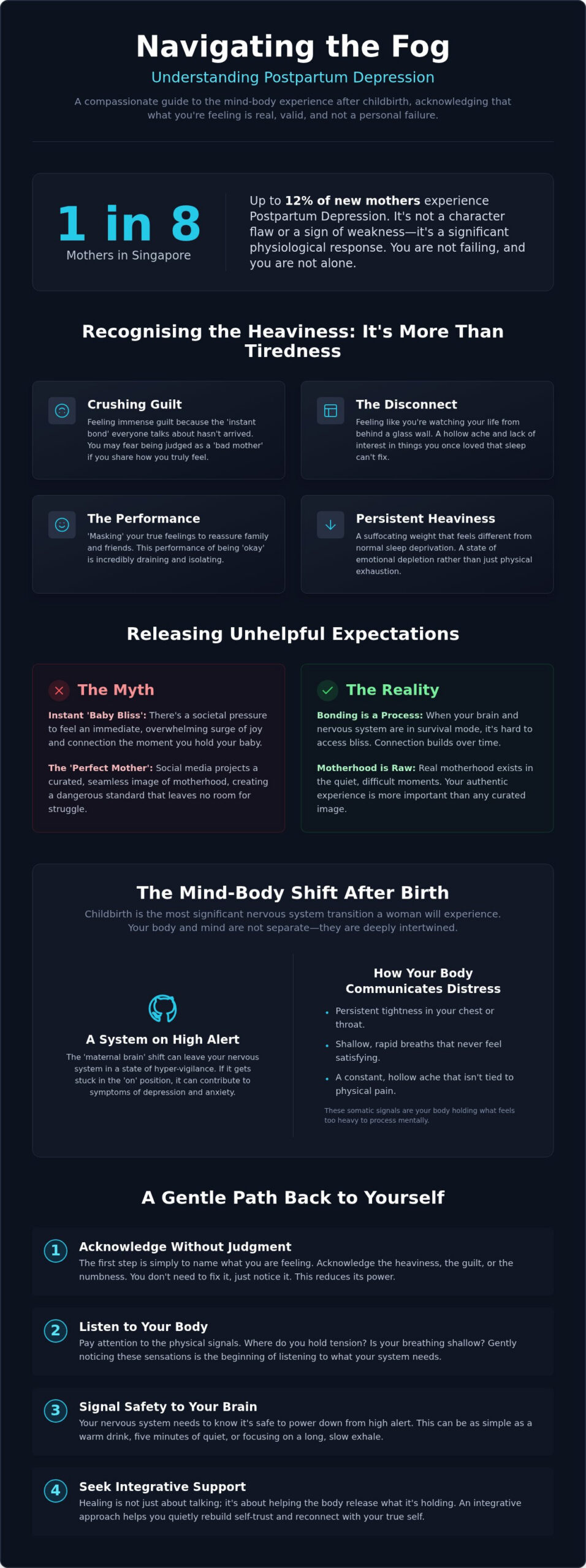
You are sitting in the quiet of a Singapore night, the air-con humming, yet you feel a coldness that has nothing to do with the temperature. While your baby sleeps, you are awake with a heaviness that feels deeper than any sleep deprivation could ever explain. You might feel a crushing guilt because that instant bond everyone spoke about hasn’t arrived; perhaps you’re terrified that if you share how you really feel, you’ll be judged as a bad mother. It’s a lonely place to be, especially when research suggests that up to 12% of mothers in Singapore are navigating postpartum depression alongside you.
I understand that the fog feels permanent right now, but I want to reassure you that this is not a failure of your character. It’s a physiological signal from a system that needs safety and restoration. I will help you understand the weight you’re carrying and gently guide you toward reclaiming your emotional stability and your sense of self. I’ll share practical ways to calm your nervous system and outline a steady, manageable path to feeling like yourself again.
Key Takeaways
- Understand that what you are feeling is real and that postpartum depression is a physiological response rather than a personal failure.
- I will explain how your body and mind are working to recalibrate after the significant nervous system transition of childbirth.
- Learn to dismantle the myth of the ‘perfect mother’ so you can release the guilt that often follows birth.
- I’ll share gentle, immediate ways to support your nervous system and signal safety to your brain today.
- Explore how my integrative approach helps you quietly rebuild self-trust and return to your true self.
Why the ‘Baby Bliss’ Might Feel Out of Reach Right Now
I want to start by telling you that what you are feeling is real. It is not a secret you need to hide, nor is it a sign that you are failing as a parent. Many women expect a surge of instant joy after birth, but instead, they find a persistent, suffocating heaviness. While the ‘baby blues’ are common and usually fade within two weeks, Postpartum Depression is a different experience entirely. It is a physiological response to an overwhelming transition that affects your entire nervous system. It does not mean you don’t love your baby; it means your system is currently overtaxed and needs gentle support to find its way back to balance.
The myth of instant bonding is one of the most damaging narratives new mothers face. Societal pressure suggests that the moment your child is placed in your arms, everything else should fall away. When that doesn’t happen, the resulting guilt can feel like an anchor. I want to dismantle that expectation right now. Bonding is a process, and when your brain is in a state of survival, it’s incredibly difficult to access feelings of bliss. You aren’t ‘broken’, you are navigating a significant biological and emotional shift.
The weight of the ‘Perfect Mother’ expectation
In Singapore, the pressure to maintain a certain image is intense. Social media often turns motherhood into a performance. You might scroll through feeds and see curated images of glowing mothers in cafes, making the transition look seamless and aesthetic. This creates a dangerous standard that leaves little room for the raw, difficult reality of emotional struggle. I have seen so many women carry the silent shame of feeling disconnected from their baby, convinced they are the only ones who aren’t ‘thriving’. This burden is too heavy to carry alone, and it often prevents women from seeking the help they deserve. Real motherhood is often found in the quiet, difficult moments that don’t make it to Instagram.
Recognising the ‘heaviness’ in your daily life
Understanding the difference between being tired and being depleted is vital. Physical exhaustion is expected with a newborn, but emotional depletion feels like a hollow ache that sleep cannot fix. You might notice a total lack of interest in activities you once loved, or find yourself ‘masking’ your true feelings to reassure your family. This performance of being ‘okay’ is incredibly draining. If you feel like you are watching your life from behind a glass wall, please know that this is a common symptom of the struggle. In my practice, I focus on who I work with to help them step out from behind that wall and reconnect with their own needs. Acknowledging this heaviness is the first step toward reclaiming your sense of self.
Understanding the Mind-Body Shift After Birth
Childbirth is often discussed as a physical recovery process, yet it is arguably the most significant nervous system transition a woman will ever experience. I believe the body and mind are not separate entities; they are deeply intertwined, each reflecting the state of the other. When you give birth, your brain undergoes a process of neuroplasticity, often referred to as the ‘maternal brain’. While this shift is designed to help you care for your newborn, it can also leave your system in a state of hyper-vigilance or over-protection. If your nervous system remains stuck in this ‘on’ position, it can contribute significantly to the symptoms of postpartum depression.
This period of recalibration is also a time of extreme vulnerability. It is common for past experiences or relationship trauma to resurface as you navigate your new role. The total dependency of a baby can mirror old wounds, making the emotional landscape feel even more treacherous. Understanding that your body is trying to protect you, even if the result feels like despair, is a vital part of the healing journey. Whether you are navigating this in the heart of Singapore or as an expat in Bali, the feeling of losing your footing is a deeply human experience.
How your body holds what your mind cannot say
Your body often communicates distress long before your mind has the words to describe it. You might notice a persistent tightness in your chest or a tendency to take shallow, rapid breaths that never quite fill your lungs. These somatic signals are not just ‘side effects’ of stress; they are your body’s way of holding onto what feels too heavy to process. Healing often begins with simply noticing these sensations without judgement. By paying attention to where you hold tension, you can start to listen to what your system is trying to tell you about your need for safety and rest.
The impact of identity loss on internal stability
Moving from the identity of ‘woman’ to ‘mother’ involves a massive shift that often feels like a profound loss. You are not just gaining a child; you are, in many ways, grieving the person you were before birth. This upheaval can shake your internal stability and self-reliance, leaving you feeling untethered. My work focuses on internal restoration, helping you rebuild that sense of self-assurance from the ground up. If you feel lost in this transition, you might find it helpful to schedule a session to explore these shifts in a safe, supportive space. For more context on risk factors and symptoms, you can review this Postpartum Depression Information. Reclaiming your identity is a quiet, steady process of returning to yourself.
Moving Past the Guilt and Myths of Maternal Mental Health
I want to dismantle the idea that being depressed means you do not love your baby. This is perhaps the most painful myth of all. When you are in the thick of postpartum depression, your brain’s ability to process joy is physically restricted. It is a biological hurdle, not a moral failing. The myth of the ‘perfect mother’ is a dangerous standard that serves no one. It creates an impossible bar that leaves you feeling like a failure before you’ve even had a chance to find your rhythm. Reaching out for support is an act of profound strength, not weakness. It takes courage to look at the fog and say, “I need a hand to find my way out.”
I want you to understand that your feelings today do not dictate your future as a parent. This is a season, not a life sentence. As you look into the Symptoms and Causes of Postpartum Depression, you’ll see that this condition affects the entire family unit. This makes your recovery a gift to everyone you love. Healing is not about trying harder to be happy; it is about allowing yourself the grace to be supported while your system recalibrates.
You are not ‘broken’ or ‘ungrateful’
I often work with women in Singapore who struggled with fertility for years before finally conceiving. When depression hits after such a long wait, the guilt can be paralysing. You might feel like you aren’t ‘allowed’ to be sad because you fought so hard for this baby. I am here to tell you that these two truths can exist at once. It is possible to love your child with everything you have and still find the daily reality of motherhood exhausting and isolating. You are not ungrateful; you are human, and your system is currently overtaxed. Acknowledging your pain doesn’t diminish your love for your child.
Dealing with the fear of judgement
A common anxiety I hear is the fear that others will judge your capability as a mother. You might worry that if you speak up, family or professionals will see you as unfit. This fear often leads to ‘masking’, where you perform wellness while crumbling inside. Learning how to speak to your partner about what you are really going through is a vital step, but it can be daunting. Finding a safe, confidential therapy space allows you to be completely honest without the weight of external expectations. In this space, we can quietly rebuild your self-trust away from the noise of public opinion.
Gentle Ways to Support Your Nervous System Today
Healing from postpartum depression is rarely about one giant leap. Instead, it’s a series of small, compassionate choices you make for yourself each day. When your nervous system is stuck in a state of high alert or deep depletion, your brain needs constant signals that you are safe. One of the most effective ways to do this is through ‘the long exhale’. By making your out-breath longer than your in-breath, you physically stimulate the vagus nerve, telling your body it can step out of survival mode and begin to soften.
I often remind the women I work with that rest is a form of genuine healing, not a luxury you have to earn. In our fast-paced Singapore environment, the pressure to ‘bounce back’ and be productive is immense. But your system is recalibrating after a massive transition. Finding your circle of other women is also essential; we weren’t meant to navigate this journey in isolation. Shared experience acts as a balm for the nervous system, reducing the sense of being alone in the struggle.
The power of breath and somatic noticing
You can begin with a simple practice: noticing your breath without trying to change it. Just observe where it lands in your body. If you feel ‘stuck’ or heavy, somatic movement can be a gentle way to release that stored energy without needing to talk through the pain. Today, I invite you to choose just one small act of self-kindness, such as sitting by a window for three minutes or letting a phone call go to voicemail.
Creating a ‘Safety Plan’ for your emotions
A safety plan isn’t about preventing difficult feelings; it’s about knowing how to hold them when they arrive. Start by identifying your ‘glimmers’. These are the tiny moments, like the smell of fresh coffee, the feel of a soft blanket, or a patch of sunlight on the floor, that feel just a little bit lighter. Pair this with clear boundaries. If certain social media accounts or well-meaning relatives increase your overwhelm, it’s okay to step back and protect your energy.
I recommend a daily rhythm of ‘Sense, Breathe, Move’. Find one thing you can smell or touch, take three long exhales, and gently stretch your neck or shoulders. This simple loop can anchor you when the waves of emotion feel too high. If you feel ready to build a more personalised plan for your recovery, you can book a psychotherapy session here to begin that work. Reclaiming your stability happens one breath at a time.
How Integrative Therapy Helps You Return to Yourself
I offer a space focused entirely on your experience as a woman, acknowledging that the transition into motherhood is as much about your internal world as it is about the new life in your arms. In my practice, I don’t view postpartum depression as a clinical checklist to be managed, but as a complex interplay between your history, your biology, and your current reality. My integrative approach combines traditional talk therapy with a deep understanding of the body, ensuring that we address the somatic signals of distress alongside your emotional narrative. This multidisciplinary perspective is vital because your recovery depends on both your mind and your nervous system finding their way back to a state of safety.
We work together to quietly rebuild your self-trust, which often feels shattered after the upheaval of birth. Therapy acts as a steady container where you can explore your feelings without the weight of societal expectations or the fear of being judged. Whether you are based here in Singapore or navigating life as an expat elsewhere, online therapy can be a vital bridge to your recovery. It allows you to access specialised support from the comfort of your own home, making the path to healing accessible even when your energy feels at its lowest. Reclaiming your sense of self is a gradual process, and I am here to guide you through each step of that restoration.
A trauma-informed approach to motherhood
Focusing on your past can often help clear the path for your future. Often, the intensity of new motherhood can act as a trigger for earlier life transitions or unresolved family dynamics. By taking a trauma-informed lens, I help you understand how these threads are woven into your current experience. The benefit of working with someone who understands the intersection of mind and body is that we can address “stuck” emotions where they live. You can learn more about the range of support I provide by looking at who I work with. This comprehensive view ensures that your healing is deep, lasting, and respectful of your unique journey.
Taking the first step toward healing
I know how hard it is to send that first email when you feel exhausted and emotionally depleted. The simple act of reaching out can feel like an enormous task when you are already carrying so much. I want you to know that a first session with me is designed to be a soft landing. It is a space of safety, validation, and absolutely no pressure to “have it all together”. You do not have to do this alone; I am here to hold that space for you while you find your footing again. Taking this step is not a sign of defeat, but a powerful commitment to your own well-being and the health of your family.
Reclaiming Your Path to Self-Trust
You have carried this heaviness with quiet courage, but you don’t have to walk through the fog alone. Remember that postpartum depression is a physiological signal from a system that needs safety, not a reflection of your love for your baby or your capability as a parent. By listening to your body’s somatic signals and dismantling the myth of the ‘perfect mother’, you can begin the steady process of internal restoration. This journey is not about a quick fix, but about a gentle return to the woman you know yourself to be.
As a Registered Integrative Psychotherapist with over 20+ years of experience in women’s wellness and maternal transitions, I am here to hold a compassionate, confidential space for your healing. My approach combines talk therapy with mind-body practices to help you rebuild your self-reliance at a manageable pace. If you’re ready to find your way back to emotional stability, you can email me at cheryl@femalefocusedtherapy.com or book your individual psychotherapy session here to begin your journey. The light you feel you’ve lost is still there; it’s simply waiting for the fog to lift at a speed that feels safe for you.
Frequently Asked Questions
Is postpartum depression different from the ‘baby blues’?
Yes, it is significantly different. While the ‘baby blues’ affect up to 80% of new mothers and typically resolve within two weeks, postpartum depression is a more persistent and intense experience. It involves a deeper sense of hopelessness and can interfere with your ability to care for yourself or your child. In Singapore, where the prevalence is estimated at 10 to 12%, recognising this difference is the first step toward getting the specific, professional support you deserve.
Will having postpartum depression mean I will definitely have it with my next baby?
Having it once does not guarantee you will experience it again, though your risk is statistically higher. However, you are now equipped with greater awareness and can create a proactive support plan. By working with an integrative psychotherapist, you can build emotional resilience and self-trust before your next birth. Early intervention and a strong support network in Singapore or Bali can make a significant difference in your future experience and overall well-being.
Can therapy really help if my hormones are the main cause of my depression?
Yes, therapy is highly effective even when hormonal shifts are a primary trigger. While hormones play a role, the way your nervous system processes these changes determines your emotional stability. My integrative approach helps you regulate your body’s response to these transitions, providing practical tools to calm your system. I focus on the mind-body connection to ensure you aren’t just managing symptoms but are actually rebuilding your internal sense of safety and self-reliance.
Is it safe to do psychotherapy while breastfeeding?
Psychotherapy is completely safe and highly recommended while breastfeeding. Unlike medication, which may involve considerations about milk supply or transfer, therapy is a non-invasive way to support your mental health. It provides a dedicated space to process the intense demands of early motherhood. Many mothers find that the emotional regulation they learn in sessions actually makes the physical experience of breastfeeding feel more manageable and less overwhelming for their nervous system.
How do I tell my partner that I am struggling when I am ‘supposed’ to be happy?
Sharing your struggle with your partner can feel daunting, but it’s often the most important conversation you’ll have. Start by explaining that you are experiencing a physiological response to birth, not a lack of love for your family. Use ‘I’ statements to describe the heaviness or the exhaustion you feel. Focus on the fact that you need support to return to yourself. Most partners want to help but simply don’t know how until you speak up.
What if I feel disconnected from my baby right now?
Feeling disconnected is a very common symptom of postpartum depression and is not a reflection of your character or your bond. When your brain is in survival mode, it often ‘shuts down’ certain emotional responses to protect your system from overwhelm. This disconnection is temporary and often resolves as you begin to feel safer and more supported. I offer a non-judgmental space to explore these feelings so you can gently find your way back to your child.
Can I have therapy online if I am too tired to travel to a clinic in Singapore?
Absolutely. I offer online therapy specifically for women who find travel difficult or live in different geographical contexts. Whether you are in a quiet corner of Singapore or living as an expat in Bali, you can access professional support from your own home. This removes the stress of commuting and childcare, allowing you to focus entirely on your recovery. It’s a convenient, safe bridge to the healing and restoration you need during this vulnerable time.
How long does it usually take to start feeling better?
The timeline for healing is unique to every woman, but many clients begin to feel a shift in their internal state within a few sessions. Once you feel seen and validated, your nervous system can start to move out of its high-alert state. I work at a pace that feels steady and manageable for you. The goal isn’t a quick fix, but a quiet rebuilding of your self-trust and emotional stability that lasts for the long term.

Article by
Cheryl Kennedy MacDonald MA BA (Hons) Pg. Dip. SAC BACP
Cheryl Kennedy MacDonald is a psychotherapist specialising in women’s mental health, relationships, and life transitions. She works with women navigating trauma, relationship breakdown, identity shifts, and midlife change, helping them rebuild self-trust, emotional stability, and a clear sense of who they are and what they want.
With over 20 years’ experience working with women internationally, Cheryl is the founder of YogaBellies, a global women’s yoga school, and the creator of the Birth ROCKS method. Her work sits at the intersection of psychotherapy and embodiment, integrating evidence-based therapeutic approaches with somatic, body-based practices that support deep, lasting change.
Known for her grounded and direct approach, Cheryl moves beyond surface-level insight to address the patterns held in the body and nervous system. Her work supports women to regulate, reconnect, and respond to their lives from a place of clarity, strength, and self-respect.
She is a published author in academic journals and has written multiple books on women’s health, pregnancy, and midlife wellbeing, available on Amazon and leading book retailers worldwide.