
I understand the heavy weight of unexplained irritability and the quiet grief that comes with losing emotional intimacy. It’s particularly difficult if you’re also noticing ADHD symptoms worsening, making every small task feel like a mountain to climb. You deserve to feel validated in this struggle rather than feeling like you’re simply being ‘difficult’ for the people you love.
I’ll help you understand these emotional shifts and provide gentle, somatic tools to reconnect with yourself and your partner. We’ll explore the ‘invisible load’ of hormones, how to redefine intimacy, and how to use your breath to calm the internal storm. Together, we can find a path back to a relationship that feels safe, grounded, and restorative.
Key Takeaways
- I’ll help you understand why menopause and relationships often feel under pressure and why this shift is a biological transition rather than a personal failure.
- You’ll learn how declining oestrogen levels can unmask ADHD symptoms, adding a complex layer of emotional overwhelm to your daily life.
- I’ll show you how to move away from trying to “fix” your sex life and instead focus on rebuilding a foundation of emotional safety.
- Discover gentle somatic tools to help you manage “menopause rage” by soothing your nervous system through breath and mindful movement.
- We’ll explore how to navigate this transition through internal restoration, helping you move from feeling invisible to feeling grounded and seen.
When the Shift Happens: Why Your Closest Connections Feel Different Now
Have you noticed your fuse getting shorter lately? Maybe you find yourself snapping at your partner for something as small as leaving a tea spoon on the side, or feeling an inexplicable urge to walk out the door when your family asks what’s for dinner. It’s a jarring shift. For years, you might have been the glue holding everything together, but suddenly, the glue feels like it’s drying up.
This shift in menopause and relationships isn’t a sign that you’ve failed or that your marriage is broken. It’s a biological and emotional transition that requires a new kind of grace. I like to think of this midlife transition as a period of internal restoration where your body and mind are asking you to prioritise your own needs. It’s a safe space to acknowledge that the way you’ve always functioned is changing. Menopause-related relationship strain is a natural evolution of needs, where your internal landscape is shifting to demand more space for yourself.
The Unspoken Irritability: It’s Not Just You
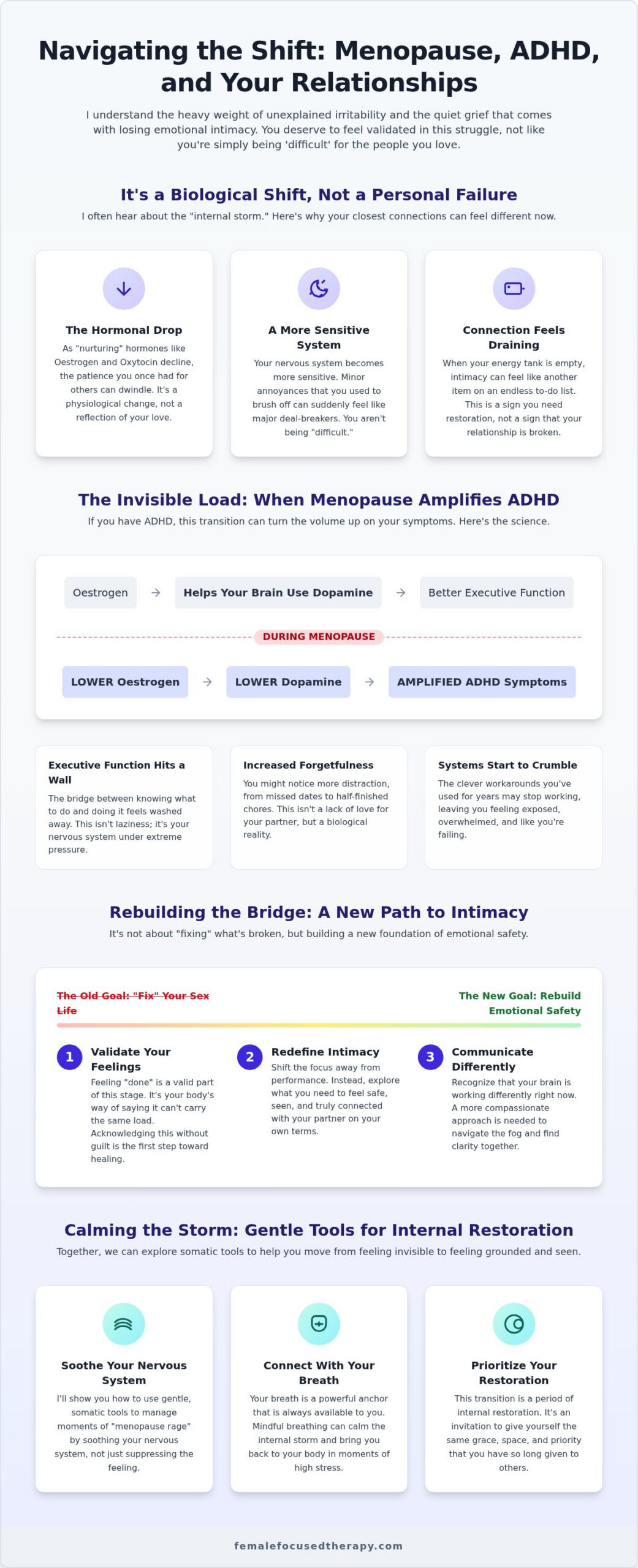
In my practice, whether I’m speaking with women in Singapore or online, I often hear about the “internal storm.” It’s that feeling where a minor annoyance becomes a major deal-breaker in seconds. You aren’t being “difficult”; your nervous system is simply more sensitive right now. Understanding Menopause involves recognising that these mood shifts are deeply rooted in hormonal changes.
Many women tell me they feel “done,” and while that’s a frightening thought, it’s a very common part of this stage. It’s your body’s way of saying it can’t carry the same load anymore. Validating this feeling of being finished with certain dynamics is the first step toward healing. You aren’t losing your mind; you’re simply outgrowing a version of yourself that put everyone else first.
Why Connection Feels Like an Extra Chore
Connection requires mental and emotional energy, and right now, your tank might be empty. As our “nurturing” hormones like oestrogen and oxytocin decline, the patience we once had for others can dwindle. This doesn’t mean you’ve stopped loving your family. It just means that the biological drive to constantly please and care for others is taking a backseat.
When intimacy feels like just another item on an endless to-do list, it’s a sign you need professional support. If you’re struggling to find your way back to your partner, life transitions and menopause therapy can help you navigate these feelings without the guilt. We can work together to rebuild that connection on your own terms, focusing on what you need to feel safe and seen again.
The Invisible Load: Hormones, ADHD, and Emotional Overwhelm
For women who have navigated life with ADHD, the transition into perimenopause can feel like the volume on your symptoms has suddenly been turned up to a deafening level. You might have spent decades developing clever workarounds and systems to keep things moving. But as your hormones shift, those systems often start to crumble, leaving you feeling exposed and overwhelmed.
When we explore the link between menopause and relationships, we must acknowledge the cognitive load. Research like the Seattle Midlife Women’s Health Study shows how these symptoms interfere with our daily interactions. If you can’t remember where you put your keys, let alone what your partner asked you to do ten minutes ago, it’s easy for tension to build in the home.
When Your Executive Function Hits a Wall
As an adult woman with ADHD myself, I know that ‘offline’ feeling all too well. It’s like the bridge between knowing what you need to do and actually doing it has been washed away. In a relationship, this often looks like missed dates, half-finished chores, or getting ‘stuck’ on your phone when you meant to be connecting. It isn’t laziness; it’s a nervous system under extreme pressure.
This executive dysfunction can make you feel like you’re failing at being a partner, a mother, or a professional. But this overwhelm is a shared experience for many of us in midlife. Recognising that your brain is working differently right now is the first step toward finding a more compassionate way to live.
Finding Clarity Amidst the Fog
The science behind this is straightforward: oestrogen helps your brain produce and use dopamine. When oestrogen levels drop during menopause, your dopamine levels follow, which makes ADHD symptoms feel much louder. This means your forgetfulness or distraction isn’t a lack of love for your partner. It’s a biological reality that requires a different approach to communication.
If you’re feeling lost in the fog, ADHD therapy for women can help you understand these shifts. You might find it helpful to book a session to talk through your experience and find ways to manage the overwhelm. Understanding the ‘why’ behind your brain fog can take the sting out of the daily struggles you’re facing.
Rebuilding the Bridge: Communication and Intimacy Beyond the Fog
Talking about physical changes can feel incredibly vulnerable. When your libido shifts or your body feels unfamiliar, it’s natural to worry that the spark in your marriage is fading. But I want to remind you that menopause and relationships don’t have to break apart just because the physical dynamic is changing. Instead of trying to “fix” your sex life, we can focus on rebuilding the emotional safety net that allows you to feel secure and loved exactly as you are right now.
You have the right to set boundaries around your own body and needs. This transition is a profound time of internal restoration, and that includes honouring your physical limits. When we move away from viewing intimacy as a performance or a chore, we create space for a connection that feels restorative rather than draining.
Redefining Intimacy on Your Own Terms
Intimacy is often misunderstood as being solely about physical acts. In my practice, I encourage women to see intimacy as the simple act of “being seen.” If you’re feeling “touched-out” after a long day of sensory overload, physical contact might feel like a demand rather than a comfort. This sensation is common, especially if you’re navigating the double-load of ADHD symptoms alongside hormonal shifts.
It’s okay to seek non-physical ways to connect when you aren’t ready for more. You might try sitting quietly together, sharing a slow breath, or simply making eye contact for a few moments. These small acts of presence can help quiet the fear that you’re “no longer enough” for your partner. You are enough, even when your body needs rest and space.
Scripts for a Softer Conversation
Having the “menopause talk” doesn’t have to feel like you’re delivering a medical report. I’ve found that using “I” statements to share your internal experience can prevent your partner from feeling blamed or defensive. It’s about inviting them into your world rather than explaining a problem. Using simple, clear language helps bridge the gap when brain fog makes communication feel like a struggle.
Try using these gentle phrases to express your needs:
- “I love being near you, but I need some quiet space to feel like me again right now.”
- “My body feels a bit overwhelmed today, so I’d love to just sit together without any pressure.”
- “I’m finding it hard to focus, but it isn’t because I’m not listening; my brain just feels a bit offline.”
Sometimes, these conversations feel too heavy to navigate alone. If you’re finding it difficult to bridge the gap, couples therapy in Singapore provides a grounded, safe space to explore these shifts together. We can work on building a new language of connection that respects your transition and strengthens your bond.
Calming the Storm: Somatic Tools for Relationship Harmony
Often, when we talk about menopause and relationships, we focus entirely on what we say or think. But the “rage” or irritability you might feel isn’t a personality flaw; it’s your nervous system reacting to hormonal shifts. Healing happens in both the body and the mind, and learning to soothe your physical self is a vital part of finding harmony with those you love.
When you’re in the middle of a hormonal surge, your body can feel like it’s under attack. This physical tension makes it almost impossible to communicate calmly with your partner. By using somatic tools, you can learn to regulate your system before a small disagreement turns into a major conflict. It’s about finding a way to feel safe in your own skin again.
The Power of the Pause
I’ve spent years as a yoga master, and I’ve learned that our physical state dictates our emotional response. When a conflict starts brewing, your body often goes into “fight or flight” before you even speak. You can interrupt this cycle with a simple 3-step pause that brings you back to the present moment.
- First, stop moving and consciously drop your shoulders away from your ears.
- Second, place one hand on your heart and one on your belly to ground yourself.
- Third, take three slow breaths, making each exhale slightly longer than the inhale.
This simple shift in posture and breath signals to your brain that you aren’t in immediate danger. It moves you from a place of reactive rage to a space where you can choose how to respond to your partner. These small somatic shifts are often more effective than any “perfect” argument you could prepare.
Movement as Medicine
Midlife can leave you with a lot of “stuck” emotions that feel heavy in your chest or tight in your jaw. Gentle, somatic movement and yoga for women allows you to process these feelings without needing to find the perfect words. It’s about moving to release tension, not to achieve a specific pose or fitness goal.
Rest is also a radical and necessary part of relationship maintenance. If you’re chronically exhausted, you simply don’t have the capacity for empathy or patience. Giving yourself permission to rest isn’t selfish; it’s an investment in the longevity of your connection. When you’re physically regulated, you can show up for your loved ones with more clarity and kindness.
If you’re struggling to find this internal stability on your own, I’m here to help you navigate the fog. You can book a psychotherapy session to explore how somatic tools and integrative therapy can support your relationship during this transition.
Reclaiming Your Spark: How We Can Navigate This Transition Together
Reclaiming your spark doesn’t mean returning to exactly who you were before menopause began. It’s about finding a new version of yourself that feels grounded, confident, and internally stable. I know how easy it is to feel that the tension in your marriage or family is entirely your fault, but this transition is a shared biological reality. Navigating the complex landscape of menopause and relationships requires patience, but most importantly, it requires you to trust your own intuition again.
I believe that healing isn’t a quick fix or a medical checklist. It’s a journey of internal restoration where you learn to hold space for your own needs without the crushing weight of guilt. You deserve to move from a place of constant overwhelm to one where you feel steady and seen. This work is about helping you find your way back to a life that feels authentic and connected.
A Space Just for You
When you step into a session with me, you’ll find a space that is warm, boundaried, and deeply validating. I don’t just look at the symptoms; I look at you as a whole person. We might talk about the way your ADHD symptoms are clashing with your hormones, or we might use somatic tools to help you find quiet within your own body. My goal is to help you rebuild the self-assurance that life transitions can often strip away.
You don’t have to wait for your partner to be “on board” to start this work. While I offer support for couples, it is perfectly okay to seek help just for yourself. Many of the women I work with in Singapore and across the globe find that as they become more internally stable, their menopause and relationships naturally begin to shift too. You have the power to change the dynamic by first changing how you relate to yourself.
Your Next Gentle Step
I want you to remember that you don’t have to “fix” everything today. Healing happens at a manageable, steady speed. If you feel ready to explore these shifts in a safe environment, I invite you to book a session with me. We can take this one step at a time, finding the path that feels right for your unique life and your specific needs.
If you aren’t quite ready for a session, that’s okay too. You can explore my free therapy resources to begin understanding your experience at your own pace. The most important thing is that you’ve started to acknowledge that your needs matter. You aren’t invisible, and you don’t have to navigate this fog alone.
Finding Your Way Back to Connection
This transition isn’t a sign that your relationship is failing; it’s an invitation to build a new foundation based on who you are today. We’ve explored how the invisible load of ADHD and declining hormones can create a storm of irritability and brain fog. By using somatic tools to soothe your nervous system and redefining intimacy on your own terms, you can move from a state of constant overwhelm to one of internal restoration.
Navigating the intersection of menopause and relationships is a journey that doesn’t have to be walked alone. As a registered integrative psychotherapist and a specialist in ADHD and midlife transitions, I offer a warm, personal, and boundaried approach to help you find your steady ground again. You deserve to feel seen, understood, and supported during this significant life change.
If you’re feeling overwhelmed by the shifts in your life and relationships, I’m here to help. You can book a session with me here to begin your journey toward clarity and connection. Remember, you don’t have to fix everything at once. Taking one small, gentle step for yourself is enough for today.
Frequently Asked Questions
Can menopause cause my relationship to break down?
Yes, it can certainly put a strain on things. When you’re dealing with night sweats and irritability, it’s natural for the dynamic with your partner to shift. Many women I work with find that their tolerance for old patterns disappears; while this feels like a breakdown, it’s often an opportunity to rebuild more honestly.
How do I explain my menopause symptoms to my partner without feeling like I’m complaining?
Focus on sharing your internal landscape rather than listing a set of problems. I suggest using “I” statements to explain how you feel in your body and mind. You might say, “I’m feeling very overwhelmed today, and my brain feels a bit offline.” This invites your partner into your experience instead of making them feel like they need to “fix” you.
Why am I so angry at my husband lately? Is it menopause?
It’s very likely a biological response to shifting hormones. This “menopause rage” is often your nervous system reacting to a drop in oestrogen, which can make you feel more sensitive to irritations you used to ignore. In my practice, I help women understand that this anger isn’t a personal failure. It’s a sign that your body needs more rest and space than it did before.
Is it normal to lose interest in sex during menopause?
Yes, it’s a very common experience. Declining hormones can affect your libido and make physical intimacy feel like just another demand on your time. I encourage you to shift your focus from “fixing” your sex life to rebuilding emotional safety. Intimacy can be as simple as sitting together or sharing a slow breath. You have the right to set boundaries that honour your body’s changing needs.
How can therapy help me through these changes?
Therapy provides a safe, grounded space for internal restoration. I use an integrative approach that combines psychotherapy with somatic tools like breath and movement. This helps you understand the emotional shifts you’re experiencing while giving you practical ways to manage overwhelm. My goal is to help you rebuild your self-assurance so you can navigate this transition with clarity.
What if my partner doesn’t understand what I’m going through?
It’s incredibly painful to feel invisible or misunderstood by the person you love. If they don’t understand, it doesn’t mean your experience isn’t real. I often work with women individually to help them find their own steady ground first. Sometimes, as you become more internally stable and learn to communicate your needs clearly, the relationship dynamic naturally begins to shift too.
Can menopause make my ADHD symptoms harder to manage in my marriage?
Absolutely, and this is something I see frequently in my practice. Oestrogen helps regulate dopamine, so when it drops, your ADHD symptoms can feel much louder. This often leads to more brain fog and executive dysfunction, which can create tension at home. Understanding this link is vital for moving away from self-blame and finding new strategies that work for your neurodivergent brain.

Article by
Cheryl Kennedy MacDonald MA BA (Hons) Pg. Dip. SAC BACP
Cheryl Kennedy MacDonald is a psychotherapist specialising in women’s mental health, relationships, and life transitions. She works with women navigating trauma, relationship breakdown, identity shifts, and midlife change, helping them rebuild self-trust, emotional stability, and a clear sense of who they are and what they want.
With over 20 years’ experience working with women internationally, Cheryl is the founder of YogaBellies, a global women’s yoga school, and the creator of the Birth ROCKS method. Her work sits at the intersection of psychotherapy and embodiment, integrating evidence-based therapeutic approaches with somatic, body-based practices that support deep, lasting change.
Known for her grounded and direct approach, Cheryl moves beyond surface-level insight to address the patterns held in the body and nervous system. Her work supports women to regulate, reconnect, and respond to their lives from a place of clarity, strength, and self-respect.
She is a published author in academic journals and has written multiple books on women’s health, pregnancy, and midlife wellbeing, available on Amazon and leading book retailers worldwide.