
What if the feeling of hitting a wall in your sessions isn’t a sign that you’re failing, but a signal from your body that you’ve reached a new edge of growth? You might find yourself sitting on the sofa, heart sinking as you realise you’re about to tell the same story for the fourth week in a row. It’s incredibly frustrating to ask yourself, “why do I feel stuck in therapy?” when you’re putting in the work and paying the fees, yet your emotional state isn’t catching up with what your brain already knows.
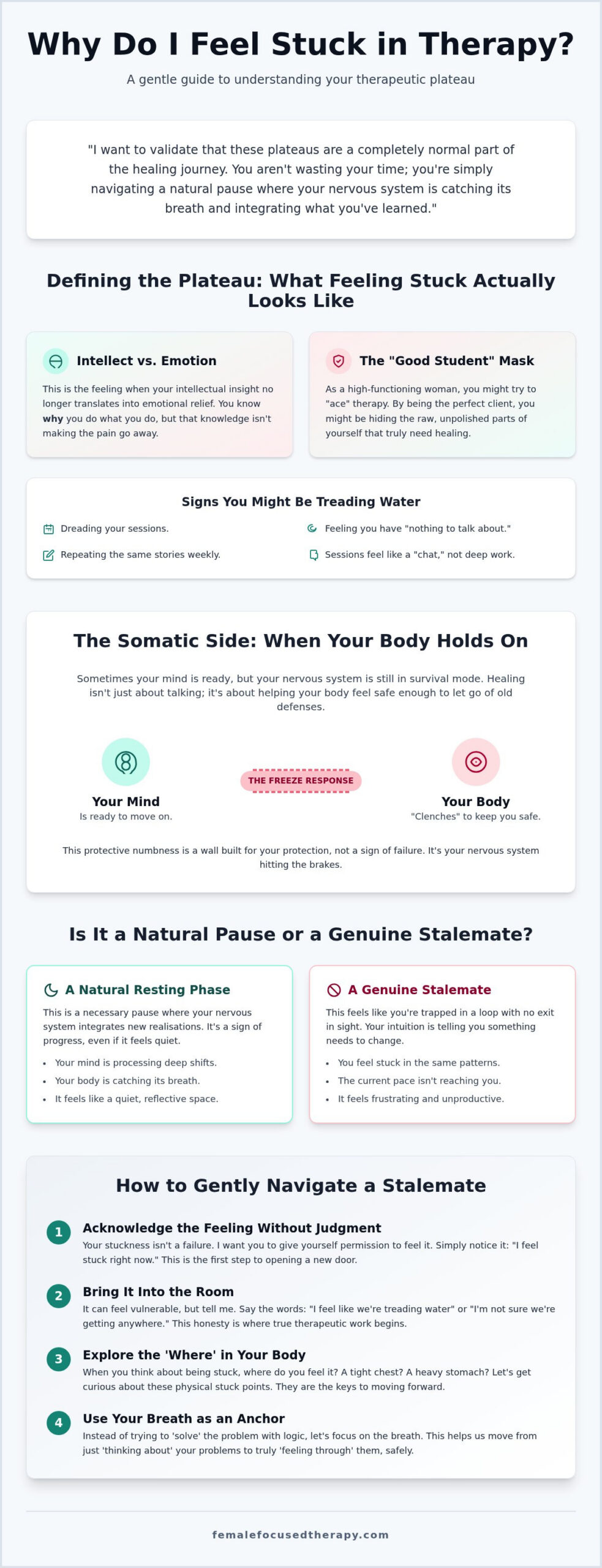
I understand how heavy that guilt can feel, especially when you’re an intelligent, self-aware woman who just wants to feel better. I want to validate right now that these plateaus are a completely normal part of the healing journey. You aren’t wasting your time; you’re simply navigating a natural pause where your nervous system is catching its breath and integrating what you’ve learned.
I will help you understand why your therapeutic journey has reached this plateau and how we can gently restart your growth. We’ll look at a clear framework to help you decide if you should stay or leave your current therapist, alongside practical ways to deepen the work through both the mind and the body.
Key Takeaways
- I’ll help you see that feeling stalled is a natural part of healing where your mind’s insights are waiting for your heart to catch up.
- I’ll explain the somatic reasons behind “why do I feel stuck in therapy?” and how your nervous system might be “clenched” against change.
- Use my framework to help you decide if you’ve reached a temporary plateau or if it’s time to seek a different therapist.
- I’ll share practical tools to help you bring your feelings of stagnation into the room and restart your growth.
- Explore how my integrative, female-focused approach can move you beyond repeating old stories and toward true internal restoration.
Defining the plateau: what feeling stuck actually looks like
I want to start by telling you that feeling stalled is a very common, and often necessary, part of the healing process. It can feel incredibly disheartening to sit on the sofa and wonder, “why do I feel stuck in therapy?” when you’re genuinely trying. I define therapeutic stuckness as a period where your intellectual insight no longer translates into emotional relief. You know exactly why you do what you do, but that knowledge isn’t making the pain go away.
Sometimes you might feel like you’re “performing” therapy. This usually looks like saying what you think I want to hear rather than what you feel in your body. While Psychotherapy relies on a collaborative relationship, we often default to being “the good client” when we hit a wall. This is a protective mechanism, but it keeps us on the surface.
It’s vital to recognise the difference between a “resting phase” and a genuine block. A resting phase is a necessary pause where your nervous system integrates new realisations. A stalemate, however, feels like you’re trapped in a loop with no exit in sight. When you ask yourself, “why do I feel stuck in therapy?”, it’s often your intuition telling you that the current pace isn’t reaching the parts of you that need to heal.
The signs you might be treading water
You might start dreading your sessions or feeling like you have “nothing to talk about” this week. This is often a sign that we’ve reached a layer of your experience that feels too big or too scary to name. It’s your mind’s way of keeping you safe from the deeper work.
If you notice that the same patterns in your relationships or ADHD overwhelm aren’t shifting, it’s a signal. You might feel like you and your therapist are just “having a chat” about your week. This social interaction is pleasant, but it isn’t the transformative work you came for.
Why your ‘Good Student’ mask might be the culprit
I often see high-functioning women try to “ace” therapy by being the perfect, compliant client. You’re used to being the one who has it all together, so you show up prepared and articulate. You’ve spent your life being the one who “gets it,” and that doesn’t stop at the therapy room door.
Ironically, being “easy to work with” can prevent us from reaching the messy, painful parts of trauma. If you’re too busy being a good student, you might be hiding the raw, unpolished parts of yourself. We can’t heal what we aren’t willing to show.
You might also feel a quiet fear of disappointing your therapist by not being “better” yet. In my integrative practice, I want to reassure you that you don’t need to perform for me. Your stuckness isn’t a failure; it’s simply a doorway we haven’t opened yet.
The somatic side: how your body holds onto safety
Sometimes your mind is ready to move forward, but your nervous system is still stuck in survival mode. This disconnect is often the hidden answer to why do I feel stuck in therapy? In my work with somatic movement and yoga, I see how the body “clenches” against change. Your physical self is trying to protect you from the unknown, even when the unknown is a healthier way of living.
Healing isn’t just about talking. It’s about helping your body feel safe enough to let go of old defences. If you’ve experienced relationship trauma, “stuckness” can be a form of protective numbness. You might find yourself asking, “why do I feel stuck in therapy?” while your body is simply shielding you from feelings it isn’t yet ready to hold. It’s a wall built for your protection, not a sign of failure.
When your nervous system says ‘no’
The “freeze” response plays a massive role in therapy plateaus. When we approach a painful memory, your nervous system might hit the brakes to keep you safe. For women with ADHD, sensory overload can make deep emotional work feel physically threatening. I’ll help you notice where you feel “stuck” in your body, whether it’s a tight chest or a heavy stomach. These physical stuck points are the real keys to moving forward.
Using the breath to bypass the intellectual mind
I integrate mindfulness and breathwork to help you move past mental blocks. When we focus on the breath, we stop trying to “solve” the problem with logic. This allows us to move from “thinking about” your problems to “feeling through” them. Resting is often the most productive part of your therapy, giving your body space to process deep shifts. If you’re ready to try this integrated approach, you can book a session with me to begin.
Is it a natural pause or time for a new approach?
I want to help you distinguish between a temporary plateau and a therapist who is no longer the right fit for your journey. Sometimes the “stuck” feeling is actually where the real work begins. It’s the resistance we need to explore together rather than avoiding it. This friction often signals that you’re getting close to something important.
You might find yourself wondering “why do I feel stuck in therapy?” just as you’re about to touch on something profound. This is what the Austen Riggs Center on why therapy stalls describes as unconscious resistance. It’s not a sign that the process is failing. Instead, it’s often your mind working hard to protect you from a difficult truth you aren’t quite ready to face alone.
When it’s about the therapeutic relationship
Are you holding back because you don’t feel truly safe or seen in the room? The importance of a female-focused lens is vital, especially when dealing with narcissistic abuse recovery. If you feel you have to explain the basic dynamics of power and control to your therapist, you aren’t being supported. You’re being forced to educate them instead of being held.
I believe the “click” between us is just as important as the clinical techniques I use. If that connection isn’t there, the work will always feel like uphill treading. You deserve a space where you don’t have to translate your female experience or justify your emotional reactions. When the relationship feels flat, the progress usually follows suit.
When it’s time to try something different
ADHD-focused therapy requires a different pace and structure than traditional talk therapy. ADHD brains crave novelty and depth. Traditional talk therapy can sometimes feel like a repetitive loop that lacks the stimulation or structure we need. If your therapist doesn’t understand the unique ways ADHD intersects with trauma, you might feel like you’re speaking different languages.
I often hear women ask, “why do I feel stuck in therapy?” when they have simply outgrown their current practitioner. This is especially true during big life transitions like menopause or career shifts. If weekly sessions feel too slow, the benefits of focused intensive therapy options can be life-changing. Changing therapists or approaches isn’t a failure. It’s a sign of your own growth and self-advocacy. You are finally listening to what you need.
Five steps to navigate a stalemate with your therapist
I know it feels daunting, but bringing your “stuckness” into the session is often the key to breaking it. When you find yourself wondering “why do I feel stuck in therapy?”, the answer often lies in the unspoken tension between us. I encourage you to see this moment as a pivot point rather than an end. It is a chance to deepen our work by being radically honest about your experience.
Start by journaling your feelings before our next meeting. Ask yourself: what exactly feels stagnant right now? Is it the repetition of old stories, or a sense that you’re “performing” for me? Use “I” statements like “I feel frustrated that I’m not seeing change in my daily life” to share your experience. This helps you own your feelings without feeling like you’re attacking the process. It’s the most effective way to address the question of why do I feel stuck in therapy? without creating unnecessary conflict.
How to start the ‘I feel stuck’ conversation
I encourage you to be direct in the room. You might say, “I feel like we’ve been circling the same topic lately, and I’m not sure how to move past it.” Naming the elephant in the room is a courageous act of self-trust. Notice how your body reacts as you say those words. If your therapist’s reaction doesn’t feel supportive or validating, it’s a vital sign that you might need a different space. A truly trauma-informed therapist will welcome this honesty as a significant breakthrough in your healing.
Reviewing your journey and adjusting the sails
Take a moment to look back at where you started several months ago. We often discount our progress because we’re so focused on the remaining mountain. Adjusting the frequency of your sessions or the “homework” we do together can provide the shift you need. For women with ADHD, I find that adding more structure, visual aids, or creative elements can reignite the process when things feel flat. It’s about making the therapy work for your brain, not the other way around.
Finally, let’s set new goals together. What does “moving forward” actually look like for you today? It might be vastly different from what you needed when we first met. If you feel ready to have this honest conversation in a safe, supportive environment, you can book a session with me to explore these steps together.
Rebuilding momentum through integrative support
My goal is never to “fix” you. I see you as a whole person, not a set of symptoms to be managed or a problem to be solved. I want to help you find your own way back to internal stability and confidence. If you’ve been asking yourself “why do I feel stuck in therapy?”, it might simply be that your current path has served its purpose and you’re ready for a different perspective.
I invite you to explore how an integrative, female-focused approach can offer the fresh insight you need. Whether it’s navigating a midlife transition or healing from past trauma, your pace is the right pace. I want you to leave our work feeling empowered to trust your own intuition again, rather than looking for external validation.
A safe space for your whole self
I combine traditional psychotherapy with mindfulness and somatic awareness to create lasting change. This multidisciplinary approach ensures we aren’t just talking in circles or intellectualising your pain. We look at how your thoughts, your body, and your nervous system interact to keep you safe. By addressing these layers together, we can move through the question of why do I feel stuck in therapy? and find genuine relief.
I understand the unique intersection of being a woman and being neurodivergent. It’s a specific experience that requires a specialised, compassionate lens. I am here to hold space for the “stuck” parts of you as much as the growing parts. Both are equally valid and important to your story. When you feel seen in your entirety, the pressure to “perform” begins to melt away, allowing real restoration to begin.
I believe that true healing happens when we stop fighting our resistance and start listening to what it has to tell us. This shift in focus can be the catalyst for the internal restoration you’ve been seeking. We work together to rebuild that sense of self-reliance that trauma or life transitions can often strip away.
Your next gentle step
I suggest taking a moment today to simply breathe and acknowledge that you are doing your best. You’ve been carrying a lot, and that weight deserves recognition. Acknowledging that you’re feeling stalled is actually a sign of deep self-awareness, not a failure. It means you’re ready for something more.
If you feel ready to explore a different way of working, I would be honoured to support you. You don’t have to have all the answers to start moving again. Sometimes, the smallest shift in perspective is all it takes to find your flow. Healing is a journey of restoration, not a race to a finish line. Trust that your intuition led you here for a reason, and I am ready to walk beside you whenever you feel ready.
Finding your way back to growth
Feeling stalled isn’t a sign that you’ve failed; it’s often your nervous system asking for a different kind of safety. I want you to remember that asking why do I feel stuck in therapy? is actually a brave first step toward realigning your healing journey. Whether you need to bring this honesty to your current session or explore a new path, you’re finally listening to your own intuition.
As a Registered Integrative Psychotherapist, I’ve seen how a trauma-informed and ADHD-specialist approach can break through these plateaus. By combining talk therapy with somatic awareness, we can move past intellectual insight and into true emotional restoration. My practice provides a warm, boundaried, and female-focused environment where your whole self is welcome and understood.
You don’t have to stay in this stalemate alone. If you’re ready to find a fresh perspective and restart your progress at a pace that feels right for you, I’m here to help. Book a consultation with me to find your path forward. You deserve to feel like you’re moving toward the internal stability you’ve worked so hard to achieve.
Frequently Asked Questions
Is it normal to feel like therapy isn’t working after a few months?
Yes, it is very common. Plateaus usually happen when the initial “honeymoon phase” ends and you reach deeper, more resistant layers of your experience. It’s often a sign that your mind is integrating what you’ve learned. I see this as a “resting phase” rather than a failure. If you are asking yourself why do I feel stuck in therapy? after several months, it is usually an invitation to deepen the work.
How do I know if I’ve outgrown my therapist?
You might have outgrown your therapist if you feel you are teaching them more than they are helping you. If you’ve moved through a specific life transition or crisis and your therapist’s modality no longer feels challenging or relevant, it’s okay to move on. Growth often requires different guides at different stages. I believe that choosing a new practitioner is a powerful act of self-advocacy and a sign of your own progress.
Can ADHD make me feel more ‘stuck’ in the therapeutic process?
ADHD can absolutely impact how you experience the therapeutic process. Our brains crave novelty and rapid progress, so the slow, steady nature of traditional talk therapy can feel physically restless or stagnant. You might find yourself wondering why do I feel stuck in therapy? simply because the session structure lacks the stimulation or creative engagement your brain needs to stay focused. I find that adding more somatic or structured elements helps us stay present.
What should I do if I’m afraid to tell my therapist I’m bored?
I encourage you to be honest about your boredom; it is actually a vital clinical data point. Boredom often masks a deeper resistance or a sense that we are avoiding the “real” topic. By naming it, we can explore whether the current approach is too surface-level or if your mind is using boredom as a shield. I won’t be offended; I’ll be grateful for the chance to adjust our sails together and find more depth.
Is a therapy plateau a sign that I’m getting worse?
A plateau is rarely a sign that you are getting worse. In fact, it often means you have reached a level of stability where your mind feels safe enough to pause and process. Healing isn’t a linear upward line; it’s more like a spiral. Sometimes we have to circle back or rest before we can move to the next level of restoration and internal confidence. Trust that your body knows when it needs to pause.
How can somatic movement help when talk therapy feels stalled?
Somatic movement helps by bypassing the “thinking” brain and speaking directly to your nervous system. When talk therapy feels stalled, it’s often because your body is still holding onto a survival response that words can’t reach. I integrate gentle movement and breathwork to help release that physical “clench.” This allows your body to feel safe enough to process the emotions your mind already understands intellectually, creating a bridge between thought and feeling.
Should I take a break from therapy if I feel stuck?
Sometimes a planned break is exactly what you need to integrate your growth. If “stuckness” feels like genuine exhaustion rather than resistance, stepping away for a few weeks can give you perspective. I suggest discussing this with me first so we can make it a “therapeutic pause” with a clear intention. This prevents the break from feeling like an avoidance tactic or a failure of the process; it becomes part of the work.
How do I bring up narcissistic abuse if my therapist doesn’t seem to ‘get’ it?
If your therapist doesn’t understand the specific dynamics of narcissistic abuse, it is very difficult to feel safe. You shouldn’t have to explain concepts like gaslighting or trauma bonding to a professional. If you feel misunderstood, I recommend seeking a therapist who specialises in relationship trauma. You deserve a female-focused space where the reality of your experience is validated without you having to defend it or educate the person helping you.

Article by
Cheryl Kennedy MacDonald MA BA (Hons) Pg. Dip. SAC BACP
Cheryl Kennedy MacDonald is a psychotherapist specialising in women’s mental health, relationships, and life transitions. She works with women navigating trauma, relationship breakdown, identity shifts, and midlife change, helping them rebuild self-trust, emotional stability, and a clear sense of who they are and what they want.
With over 20 years’ experience working with women internationally, Cheryl is the founder of YogaBellies, a global women’s yoga school, and the creator of the Birth ROCKS method. Her work sits at the intersection of psychotherapy and embodiment, integrating evidence-based therapeutic approaches with somatic, body-based practices that support deep, lasting change.
Known for her grounded and direct approach, Cheryl moves beyond surface-level insight to address the patterns held in the body and nervous system. Her work supports women to regulate, reconnect, and respond to their lives from a place of clarity, strength, and self-respect.
She is a published author in academic journals and has written multiple books on women’s health, pregnancy, and midlife wellbeing, available on Amazon and leading book retailers worldwide.