
Why Your Childhood Wounds Feel More Intense Now You Are a Mum
What if the intense overwhelm you feel today isn’t actually about your child’s behaviour, but a signal from your own past? You might find yourself reacting with a level of distress that feels out of proportion to the moment, leaving you worried that you’re failing as a parent. It’s an exhausting cycle of guilt and confusion.
I know how heavy it feels to carry the fear that you might pass your own unhealed wounds down to your children. You want to be the calm, grounded presence they need, but instead, you feel emotionally dysregulated. This experience of childhood trauma resurfacing in motherhood is much more common than many of us realise.
I’ll help you understand why your past is resurfacing now and how we can work together to find peace and restore your internal confidence. We’ll explore the reasons behind your triggers and look at practical, mind-body tools to help you stay grounded. My hope is to guide you toward a sense of internal restoration and self-trust.
Key Takeaways
- I’ll help you understand why motherhood acts as a mirror, bringing buried memories to the surface so they can finally be processed and healed.
- I’ll show you how to recognise when “origin pain” and the pressure to be perfect are signs of childhood trauma resurfacing in motherhood.
- I’ll share why somatic tools like breath and movement are vital when your nervous system feels stuck in a cycle of intense emotional triggers.
- I’ll guide you through moving past the shame of reacting, allowing you to restore your internal confidence and trust your own intuition.
- I’ll explain how individual psychotherapy offers you a gentle, professional space to work through these deep life transitions at your own pace.
Why Motherhood Is the Ultimate Mirror for Your Childhood Trauma
In my practice, I often sit with women who are suddenly “hit” by memories they thought were long buried. You might have spent years building a successful life, only to find that having a child has cracked open a door you thought was locked. This experience of childhood trauma resurfacing in motherhood isn’t a sign that you’re failing; it’s often a side effect of the profound transition you’re navigating.
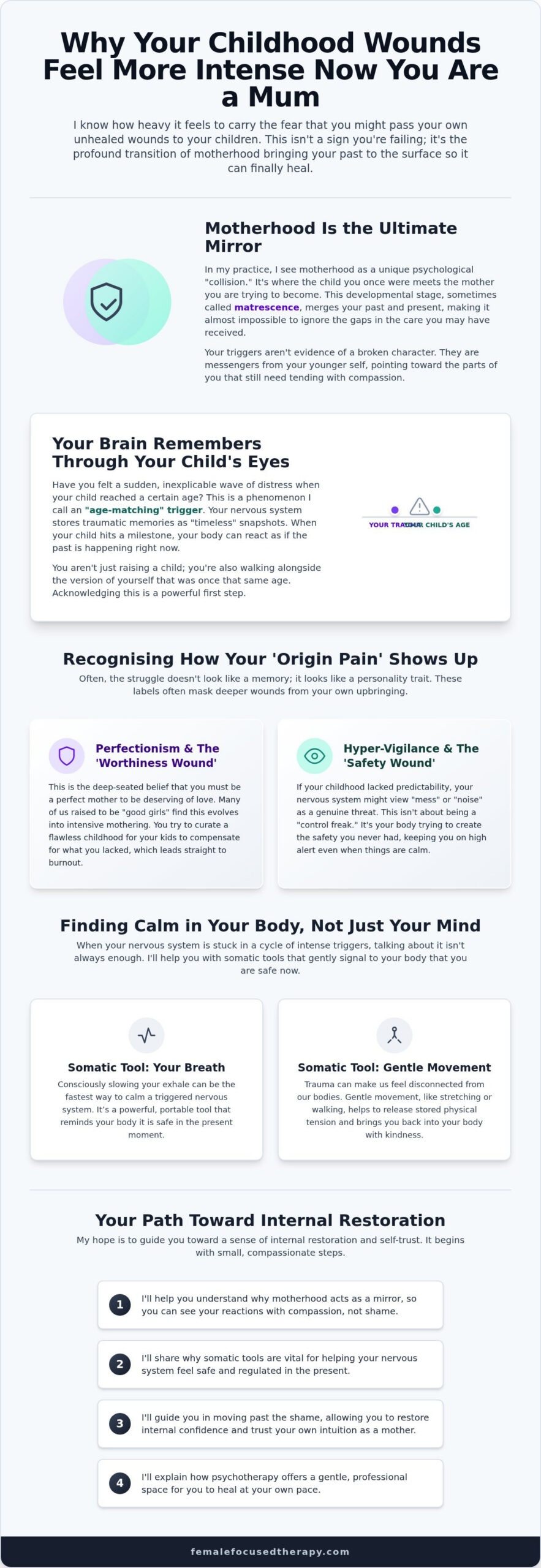
I see motherhood as a unique psychological “collision.” It’s where the child you once were meets the mother you are trying to become. This developmental stage is sometimes called matrescence. It’s a time when your past and present merge, making it almost impossible to ignore the gaps in the care you received. A deeper understanding childhood trauma can help you see that these resurfacing feelings are a natural, if painful, part of this growth.
The ‘Collision’ of Identities
Becoming a caregiver naturally forces you to look back at the care you were given. For many high-functioning women I work with, this is where the pressure of perfectionism starts to feel heavy. You might find that the harder you try to be the “perfect mum,” the more your past pushes back with force.
I want you to try reframing these moments. Your triggers aren’t evidence of a broken character. They are actually messengers from your younger self, pointing toward the parts of you that still need tending. It’s a significant life transition that requires a lot of self-compassion and space to breathe.
Why Your Child’s Age Matters
Have you ever felt a sudden, inexplicable wave of distress when your child reached a certain age? This is a phenomenon I call “age-matching” triggers. Your brain often “remembers” through your child’s eyes. When they reach the age you were when your own trauma occurred, your internal alarm system might start ringing.
Your nervous system stores traumatic memories as “timeless” snapshots rather than stories with a beginning and end. When your child hits a milestone, your body can react as if the past is happening right now in the present moment.
It’s common to feel a sense of “origin pain” during these years. You aren’t just raising a child; you’re also walking alongside the version of yourself that was once that same age. Acknowledging this can be the first step toward finding a sense of internal restoration.
Recognising the Signs: How Your ‘Origin Pain’ Shows Up in Parenting
I want to help you identify the subtle ways your past is speaking to you today. Often, the struggle doesn’t look like a memory; it looks like a personality trait or a parenting style. You might call yourself a “perfectionist” or “highly sensitive,” but these labels often mask deeper wounds from your own upbringing. Childhood trauma resurfacing in motherhood frequently presents as a constant, low-level anxiety that you aren’t doing enough.
I often talk about the “Worthiness Wound” with the women I support. This is the deep-seated belief that you must be a perfect mother to be deserving of love or respect. It makes every tantrum feel like a personal failure. Research from the University of Michigan highlights how trauma resurfaces in pregnancy and beyond, often manifesting as heightened stress responses that linger long after the baby is born.
Perfectionism and the ‘Good Girl’ Legacy
I recognise how exhausting it is to maintain the facade of having it all together while you feel broken inside. Many of us were raised to be “good girls” who prioritised others’ needs. In motherhood, this people-pleasing evolves into intensive mothering. You try to curate a flawless childhood for your kids to compensate for what you lacked, which leads straight to burnout.
For those of us with neurodivergent brains, this pressure is even more intense. I often see how this intersects with the ADHD experience of emotional overwhelm. When your executive function is already stretched, the added weight of trauma-driven perfectionism can make daily life feel impossible. You aren’t lazy or failing; you’re simply carrying too much.
Hyper-Vigilance and the Need for Control
Does a messy kitchen or a loud toy make your skin crawl? This is often the “Safety Wound” in action. If your childhood lacked predictability, your nervous system might view “mess” or “noise” as a genuine threat. You stay on edge, waiting for the other shoe to drop even when things are calm.
- Hyper-vigilance: Feeling like you must monitor every mood in the house to stay safe.
- Control: Using rigid routines to manage your internal anxiety.
- Postnatal Rage: Sudden, intense outbursts that are actually a “fight” response from a flooded nervous system.
These wounds inevitably impact your boundaries. You might struggle to say no to your children or find yourself resenting your partner for not “seeing” the work you do. Recognising these patterns is the first step toward internal restoration. If you feel ready to explore these triggers in a safe space, you can book a session with me to begin your healing journey.
Breaking the Cycle: You Are Not Your Trauma
I want to reassure you: having triggers does not make you a “damaged” mother. It’s easy to feel like your past has permanently marked you, but your capacity for healing is much stronger than your history of pain. When you experience childhood trauma resurfacing in motherhood, it’s often a sign that you finally feel safe enough in your current life to address what was once too heavy to carry.
Many women I work with carry deep shame when they “react” with intensity instead of “responding” with the calm they desire. This shame can be a barrier to healing, making you feel isolated in your struggle. Understanding why motherhood triggers past trauma helps shift the narrative from “What is wrong with me?” to “What happened to me, and how can I soothe my nervous system now?”
Grieving the Mother You Didn’t Have
I will guide you through the idea that it’s okay, and even necessary, to feel sad for your younger self. Grieving the childhood you deserved but didn’t receive isn’t about staying stuck in the past. It’s about validating your own experience so it no longer has to scream for your attention through emotional outbursts.
I often help women navigate these complex life transitions with compassion. By allowing yourself to mourn what was missing, you actually create more emotional space to hold for your own child. You learn that you can be a wonderful, present mother while still being a person who is actively healing her own “mother wound.”
The Power of ‘Reparenting’ Yourself
In addition to the tools we discuss here, you can also discover Michelle McMillan for personalized therapy strategies that empower women and families to heal together.
Reparenting is the practice of giving yourself the safety, validation, and boundaries you lacked as a child. It’s about becoming the wise, supportive mentor for your own inner child that you are already becoming for your children. This simple shift changes your parenting DNA because you’re no longer operating from a place of deficit.
Instead of chasing the “perfect mother” myth, I want to encourage you to aim for “good enough” parenting. This concept allows for mistakes, repairs, and human moments. Internal restoration isn’t about never being triggered again; it’s about knowing how to find your way back to yourself when you are. Trusting your intuition starts with being kind to the woman you are today.
Somatic Healing: Finding Calm in Your Body and Mind
In my work, I believe healing happens in the body just as much as the mind. When you experience childhood trauma resurfacing in motherhood, your nervous system often reacts before your conscious mind can catch up. This is why “talking it out” can sometimes feel insufficient. If your body is in a state of high alert, logic alone won’t always calm the storm.
I integrate somatic movement and yoga to help women find their centre. When your nervous system is triggered, it’s often responding to a past threat rather than the present reality. By focusing on the body, we can bypass the “thinking” brain and speak directly to the parts of you that feel unsafe.
Breath and Movement as Anchors
I want to share a simple practice for when your child is having a meltdown and you feel your own distress rising. Try an “extended exhale” by breathing in for four counts and out for eight. This simple shift signals to your brain that the immediate danger has passed. It’s a practical tool you can use right in the middle of a difficult parenting moment.
Movement helps shift stored emotional energy out of the body. For trauma survivors, rest is often a radical act of healing. I encourage you to see stillness not as “doing nothing,” but as a vital part of your restoration process. It’s about teaching your body that it’s finally safe to let its guard down.
Creating a Safe Internal Space
Mindfulness helps you recognise the “shimmer” of a memory before it becomes an explosion. This shimmer is that tiny physical sensation, perhaps a tightness in your chest or a heat in your neck, that precedes a trigger. Catching it early allows you to use your grounding tools before you feel completely overwhelmed.
I use an integrative approach to help you build an internal “safe house.” This is a mental and physical state of security that we cultivate together. My identity as both a yoga master and a therapist allows me to offer a unique blend of clinical insight and somatic wisdom. We don’t just talk about the past; we work to release its grip on your present.
If you’re ready to move beyond just talking and want to feel truly grounded in your own skin, I’m here to help. You can book a session with me to start building your own path toward internal restoration and peace.
Taking the First Step Toward Internal Restoration
I am here to help you navigate this complex, emotional journey. You’ve already taken the bravest step by acknowledging that something needs to change. Childhood trauma resurfacing in motherhood can feel like a heavy weight, but you don’t have to carry it alone. I want to offer you a supportive hand as you move through this transition.
My approach through Individual Psychotherapy provides the boundaried, safe space you need to heal. We aren’t looking to “fix” you, because you aren’t broken. Instead, we’re working toward a journey of restoration and rebuilding your internal confidence. We focus on helping you feel steady in your own skin again.
I want you to feel reassured that simply being here and reading these words is part of the hard work. It takes immense strength to look at your past while simultaneously showing up for your children every day. You’re already breaking cycles just by being aware of them. Give yourself credit for that awareness.
Why Focused Therapy Is Different
Traditional therapy sometimes misses the nuances of a mother’s experience. I offer trauma-informed care that ensures you aren’t re-traumatised during our sessions. We move at a pace that feels manageable for your nervous system, respecting the somatic signals your body sends when things feel like too much.
My work is deeply informed by an understanding of relationship trauma and narcissistic abuse. I know how these experiences can make you doubt your own intuition and parenting abilities. My goal is to help you reclaim that inner voice and trust your decisions without the constant shadow of the past.
I offer both online therapy and sessions at my Singapore-based practice. Whether you are dealing with childhood trauma resurfacing in motherhood or navigating a different life transition, I provide flexible options. I know how busy life as a mum can be, so we find a rhythm that works for your schedule.
Your Realistic Next Step
I invite you to take a slow breath right now and acknowledge your own courage. You’ve spent a long time looking after everyone else’s needs and monitoring everyone else’s moods. Now, it’s okay to make a small amount of space for your own healing and restoration.
Your next step doesn’t have to be a giant leap or a life-altering decision. I suggest we start with a simple, quiet conversation. You can book a consultation with me to see if we’re a good fit for one another.
I’m here to hold space for you whenever you feel ready to talk. You deserve to feel grounded, confident, and at peace within your own home and your own mind. I look forward to supporting you on this path toward finding your way back to yourself.
Reclaiming Your Peace and Trusting Your Journey
You’ve explored how your child’s milestones can act as mirrors for your own past, and why your nervous system might be stuck in a state of high alert. Recognising these patterns is the beginning of internal restoration. It’s not about being a perfect parent; it’s about being a present one who is kind to her own history.
When you find childhood trauma resurfacing in motherhood, remember that your body holds the wisdom to heal. Through a blend of psychotherapy and somatic movement, we can work together to release the weight of these old wounds. As a registered integrative psychotherapist and yoga master, I specialise in helping women navigate relationship trauma and ADHD with compassion.
You don’t have to navigate this life transition alone. If you’re ready to move from reacting to responding, I invite you to reach out. You can Book Your Consultation with Cheryl Kennedy MacDonald today. You’re already doing the brave work of breaking cycles, and I’m here to support you in finding your way back to your true, grounded self.
Frequently Asked Questions
Why is my childhood trauma coming back now that I’m a mum?
Motherhood is a profound life transition that acts as a mirror to your own childhood. When you care for your child, your brain naturally compares your current experience with the care you once received. This psychological collision can cause buried memories to rise to the surface. It’s often called matrescence; a developmental stage where your past and present merge, making childhood trauma resurfacing in motherhood a common, though challenging, experience.
Can my past trauma affect my bond with my baby?
Your past can influence how you connect, but it doesn’t mean your bond is broken. Trauma often creates a “Safety Wound,” making you feel hyper-vigilant or emotionally guarded. This might make it harder to feel relaxed during skin-to-skin contact or play. However, by working through these triggers in individual psychotherapy, you can learn to stay present. Your baby needs a “good enough” mother, not a perfect one without a history.
How do I know if I’m triggered or just experiencing normal parenting stress?
Parenting stress usually feels like tiredness or frustration about the task at hand. A trigger, however, feels like a sudden, intense emotional “explosion” that seems out of proportion to the situation. You might feel a heat in your neck, a racing heart, or a deep sense of shame. If a messy room feels like a threat to your safety rather than just a chore, you’re likely experiencing a trauma trigger.
Is it possible to heal from childhood trauma while raising young children?
Yes, it is absolutely possible to heal while parenting. In fact, raising children often provides the motivation and the “live” environment to practice new grounding tools. While it feels exhausting to do this work alongside sleepless nights, it’s a powerful way to break intergenerational cycles. I focus on manageable steps and internal restoration, ensuring the healing process supports your daily life rather than overwhelming it further.
What should I do if I feel ‘postnatal rage’ related to my past?
Postnatal rage is often a “fight” response from a flooded nervous system. If you feel this rising, the first step is to ensure your child is safe and then physically move your body. Step into another room, splash cold water on your face, or use an extended exhale. Recognising that this rage is a signal of childhood trauma resurfacing in motherhood allows you to treat yourself with compassion instead of shame.
How can somatic therapy help with resurfacing memories?
Somatic therapy addresses the fact that trauma is stored in your body, not just your thoughts. When a memory resurfaces, it often brings a physical sensation like tightness or trembling. By using breath, movement, and mindfulness, I help you release this stored emotional energy. I work to build an internal “safe house” so your body learns it is no longer in danger, even when old memories feel vivid.
Will my children be affected by my unresolved trauma?
Children are sensitive to our emotional states, but they are also incredibly resilient. The fact that you’re asking this question shows you are already self-aware, which is the biggest protector against passing trauma down. Healing doesn’t require you to be perfect; it requires you to be able to “repair” after a difficult moment. Your children benefit most from seeing a mother who is actively caring for her own mental health.
How do I explain my emotional triggers to my partner?
Start by explaining that your reactions aren’t about them or the children, but about an old internal alarm system. Use “I” statements to describe the physical sensation, such as, “When the house is loud, my body feels like it’s in danger because of my past.” This helps your partner understand that you need support and grounding, not criticism. Clear, boundaried communication helps build a team approach to your healing journey.

Article by
Cheryl Kennedy MacDonald MA BA (Hons) Pg. Dip. SAC BACP
Cheryl Kennedy MacDonald is a psychotherapist specialising in women’s mental health, relationships, and life transitions. She works with women navigating trauma, relationship breakdown, identity shifts, and midlife change, helping them rebuild self-trust, emotional stability, and a clear sense of who they are and what they want.
With over 20 years’ experience working with women internationally, Cheryl is the founder of YogaBellies, a global women’s yoga school, and the creator of the Birth ROCKS method. Her work sits at the intersection of psychotherapy and embodiment, integrating evidence-based therapeutic approaches with somatic, body-based practices that support deep, lasting change.
Known for her grounded and direct approach, Cheryl moves beyond surface-level insight to address the patterns held in the body and nervous system. Her work supports women to regulate, reconnect, and respond to their lives from a place of clarity, strength, and self-respect.
She is a published author in academic journals and has written multiple books on women’s health, pregnancy, and midlife wellbeing, available on Amazon and leading book retailers worldwide.