
You’re standing in your kitchen, looking at a minor mistake, and suddenly that familiar, sharp voice in your head begins its critique. It’s a weight you’ve carried for years, making you feel like you’re constantly performing for a grade that never arrives. For many adult daughters of critical parents: rebuilding self-worth starts with recognising this voice isn’t yours.
I understand the roots of this persistent self-doubt and want to help you find a gentle path toward internal confidence. We’ll explore why you feel the need to be flawless and how to finally trust your own intuition.
By the end of this article, you’ll have realistic steps to quiet that inner critic and establish boundaries that protect your peace. It’s time to move toward a version of yourself that feels worthy of love without having to earn it.
Key Takeaways
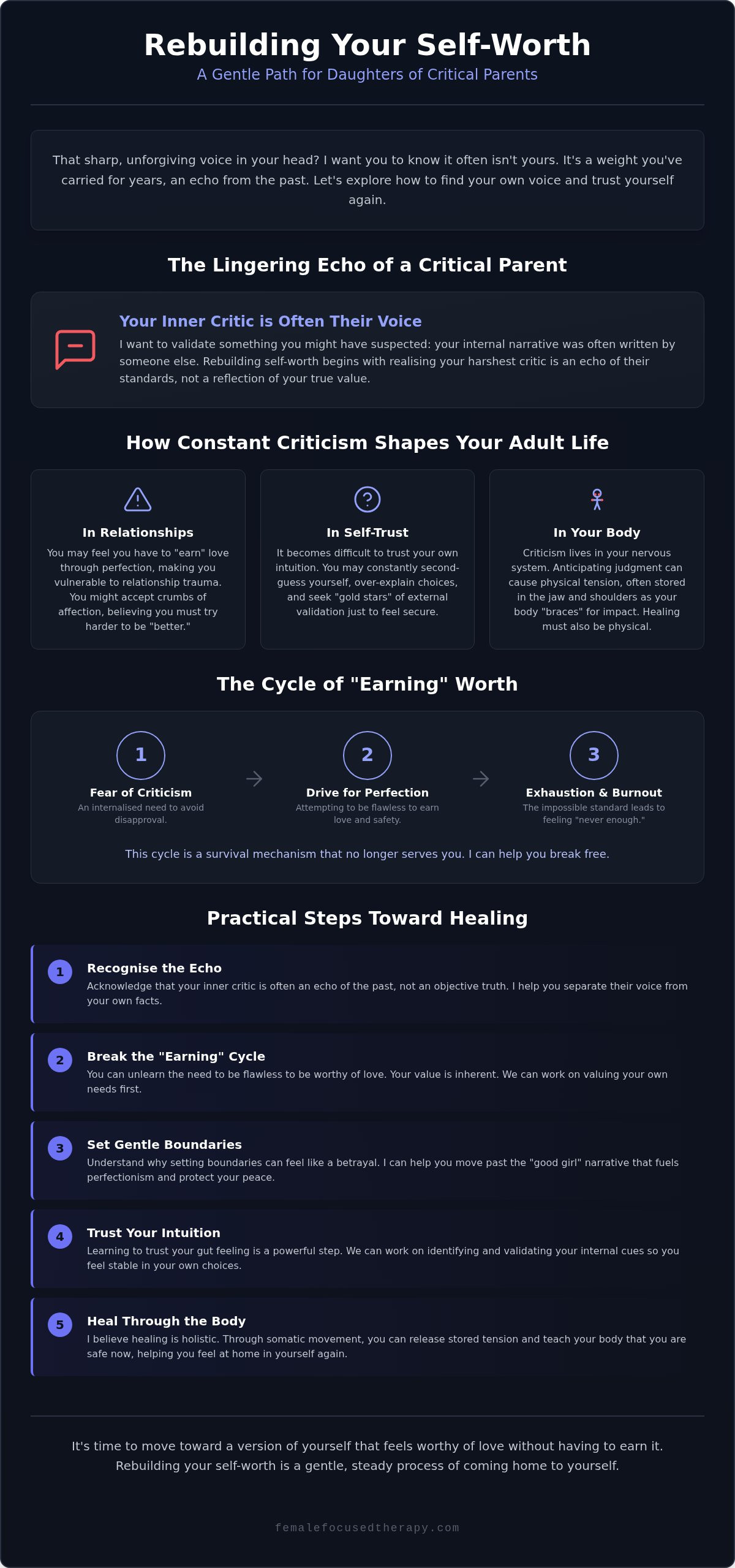
- Recognise that the harsh inner critic you hear is often an echo of the past, not a true reflection of your actual capabilities or value.
- Understand how to break the cycle of ‘earning’ love through perfection, a common challenge for adult daughters of critical parents: rebuilding self-worth starts with valuing your own needs.
- Uncover why setting boundaries often feels like a betrayal and how to move past the ‘good girl’ narrative that drives chronic perfectionism and burnout.
- Identify practical ways to separate your parent’s opinions from your own facts, helping you to finally trust your intuition and internal stability.
- Discover how integrating somatic movement with traditional therapy can help you release stored tension and feel safe in your own body again.
The Lingering Echo of a Critical Parent in Your Adult Life
I want to start by validating something you might have suspected for a long time. That sharp, unforgiving voice in your head often isn’t actually yours. For many Adult Daughters of Critical Parents: Rebuilding Self-Worth begins with the startling realisation that your internal narrative was originally written by someone else.
You have spent years viewing your successes and failures through a lens of criticism that was never meant for you to carry. It’s a confusing way to live. You might feel “too much” when you express your needs, yet simultaneously feel “never enough” when you look at your achievements. This paradox is a hallmark of a critical upbringing.
Acknowledging this impact isn’t about casting blame. It is about gaining the clarity you need to see yourself accurately. When we understand how these patterns formed, we can begin the process of unlearning them. In my work supporting Adult Daughters of Critical Parents: Rebuilding Self-Worth involves separating your parent’s voice from your own.
Recognising the ‘Inner Critic’ as a Mirror
I often see women who mistake their parent’s high standards for their own core values. You might think you value working late every night, but it’s often the ghost of a parent’s disapproval driving you. Understanding Self-Criticism helps us see that this inner voice is actually a protective survival mechanism. It is outdated, but it once served a purpose.
This voice tries to criticise you first so that no one else can catch you off guard. It’s a way of staying safe in an unpredictable environment. However, as an adult, this voice now limits your world. It affects your daily decisions, from the career risks you avoid to the way you second-guess what you wear before leaving the house.
The Physical Weight of Childhood Criticism
Criticism doesn’t just live in your thoughts; it lives deep within your nervous system. When you feel judged, or even when you anticipate judgment, your body reacts instantly. I invite you to notice where you hold tension in these moments. It is often in the jaw or the shoulders.
These are areas where your body stores the “bracing” needed to withstand a verbal blow. I believe that healing must involve listening to what your body is telling you. Your physical sensations are often the first signals that your old “critic” has taken the wheel.
By integrating somatic movement into your recovery, you can begin to release this stored tension. It’s about teaching your body that you are safe now, even if you make a mistake.
How Constant Criticism Shapes Your Relationships and Self-Trust
Growing up in a household where love felt conditional often changes how you navigate intimacy as an adult woman. I want to talk about how a critical upbringing can make you vulnerable to relationship trauma. When you are used to “earning” love through perfection, you may find yourself accepting crumbs of affection from partners who mirror that early dynamic. You might feel that if you just try harder or become “better,” the criticism will stop and the warmth will finally arrive.
This pattern is deeply rooted in how our brains develop. Research from Binghamton University highlights how criticism shapes emotional processing, often making it harder for us to trust our own internal cues. For adult daughters of critical parents: rebuilding self-worth means learning that your gut feeling is valid. Without that self-trust, it becomes incredibly difficult to spot red flags. You might find yourself over-explaining your choices or mistakes, desperately trying to avoid a perceived criticism that hasn’t even happened yet.
The Search for External Validation
I often see women who are high-achievers in their careers but feel like they are constantly auditioning for their own lives. You might find yourself seeking “gold stars” from partners or bosses just to feel secure for a few hours. This leads to a profound sense of exhaustion. Trying to be the “perfect” partner or employee isn’t just tiring; it’s a way of hiding your true self. I help women realise that they don’t need to perform to be worthy of care. You are allowed to be imperfect and still be held with kindness. For many, finding support through a community like the Worthy Women Movement can be a vital step in balancing professional growth with true self-worth.
Breaking the Cycle of Narcissistic Dynamics
There is a strong link between critical parenting and the habit of tolerating narcissistic abuse. If you were raised to believe that your feelings were “wrong” or “too sensitive,” you might stay in toxic situations longer than you should. Reclaiming your power starts with trusting your “felt sense” again. This is that physical sensation in your body, perhaps a flutter in your stomach or a tightening in your chest, that tells you when something isn’t right.
Rebuilding the internal boundary that says, “This is not my shame to carry,” is a vital part of the journey. For many adult daughters of critical parents: rebuilding self-worth involves a slow, steady restoration of self-reliance. If you feel ready to explore these patterns in a safe, supportive space, I offer individual psychotherapy sessions designed to help you reconnect with your own voice and trust your own intuition again.
Unlearning the Perfectionism and Guilt You Carried for Years
I often find that my clients feel a deep, heavy guilt when they try to put themselves first. It feels like a betrayal of the family dynamic you were raised in, where your primary role was often to stay small or stay perfect. For many adult daughters of critical parents: rebuilding self-worth involves unlearning the belief that your value is tied to how well you manage other people’s discomfort.
This “good girl” narrative is a heavy coat to wear, and eventually, it leads to occupational burnout. You might find yourself applying the same relentless pressure to your professional life that you once felt at the dinner table. It is okay to admit that your parent’s way of “loving” you was actually quite painful; validation is the first step toward restoration. You don’t need to justify their behaviour to acknowledge your own hurt.
Most importantly, I want you to know that “fixing” your parent is not a requirement for your own restoration. You might spend years waiting for them to finally understand your pain or offer an apology that never comes. Your healing cannot be held hostage by their ability to change. You have the power to rebuild your internal world regardless of their current perspective.
Letting Go of the ‘Perfect Daughter’ Burden
Recognising that you are not responsible for your parent’s emotional regulation is a radical act of self-care. If they are unhappy, disappointed, or critical, it isn’t your job to perform “perfection” to fix their mood. I encourage you to see your sensitivity as a strength, not a flaw to be corrected. It is often what makes you a compassionate friend and a deeply intuitive woman.
When family interactions turn into guilt-trips, you can use these practical ways to protect your energy:
- Remind yourself: “I am responsible for my reaction, not their emotion.”
- Keep your responses brief and neutral to avoid feeding the critical loop.
- Give yourself permission to end a call or leave the room if the criticism becomes harmful.
Challenging the Need to Be Flawless
Perfectionism acts as a shield against the fear of being criticised. If you are perfect, you feel safe from the verbal blows you experienced as a child. However, this shield is exhausting to carry. Binghamton University research suggests that parental criticism actually changes how our brains process emotional information, often making us hyper-aware of potential mistakes.
Embracing the reality that “good enough” is a place of safety and rest gives you permission to exist without the constant threat of failure looming over you. Learning to embrace “messy” emotions, like anger or confusion, is vital for adult daughters of critical parents: rebuilding self-worth. You are allowed to be imperfect and still be completely worthy of love and respect without having to “earn” it through flawless performance.
Practical Steps to Rebuild Self-Worth and Stability
I want to offer you some gentle, realistic ways to start trusting yourself again. For many adult daughters of critical parents: rebuilding self-worth is a quiet, daily practice of choosing your own truth over the familiar echoes of disapproval. It starts with reclaiming your narrative. You can begin by separating your parent’s opinions from the actual facts of your life. If they say you are “unreliable” but you successfully manage a team and a household, their opinion is simply not a fact.
Small, daily acts of self-trust build up over time. This might look like choosing a meal because you actually want it, rather than because it’s the “right” choice. In my practice, I find that confidential therapy provides the safe mirror you need to see these strengths clearly. It is a space where you can practice being seen without the fear of immediate judgment or correction. This is a key part of the journey for adult daughters of critical parents: rebuilding self-worth.
Creating Internal and External Boundaries
Learning how to say “no” to a critical comment without starting a war is a skill that takes time to develop. I often suggest “low-information” sharing as a way to protect your peace. You don’t have to share your deepest dreams or latest successes with someone who will only find a way to poke holes in them. Internal boundaries are just as vital. They help you stop the parent’s voice from becoming a 24/7 internal monologue, allowing your own intuition to finally speak up.
- The “Pause” Technique: When you hear a critical comment, take five seconds before responding.
- Limit-Setting: Decide in advance how long a phone call or visit will last.
- Self-Validation: Write down three things you know to be true about yourself that contradict your parent’s old criticisms.
Somatic Practices for Emotional Grounding
When you feel the familiar sting of judgment, your body likely enters a state of fight or flight. You can use your breath to signal safety to your nervous system. Simple somatic movement can help release the physical grip that criticism leaves in your muscles, particularly in the jaw and shoulders. It’s about moving the energy of that “bracing” out of your system.
For the daughter of a critical parent, rest is often a radical act of self-worth. You’ve likely been conditioned to believe you only have value when you are producing or achieving. Giving yourself permission to simply “be” is a powerful way to reclaim your body. If you are ready to begin this collaborative journey of restoration, you can book a session with me to start rebuilding your internal stability.
Moving Toward Restoration with Integrative Therapy
I believe that healing happens best in a space where you feel truly seen and heard. For many adult daughters of critical parents: rebuilding self-worth isn’t about being “fixed” by an expert, but about a collaborative journey of restoration. It’s a process of unlearning the harsh internalised voices and replacing them with a sense of steady, quiet confidence.
My integrative approach combines the “why” with the “how.” We use evidence-based psychological modalities like CBT to understand the roots of your patterns, but we also integrate mindfulness and somatic work. This ensures that the progress you make isn’t just intellectual. It’s a change you can feel in your body and your breath.
We don’t just talk about the past. While it’s vital to acknowledge the impact of your upbringing, our work focuses on how you can feel stable and assured today. Rebuilding self-worth is ultimately a journey of coming home to yourself. It’s about learning to trust your own intuition again, without needing to check in with a critical voice first.
Why a Female-Focused Approach Matters
Women often face unique social pressures to be “agreeable” and “perfect.” When this is layered on top of a critical childhood, the weight can feel unbearable. I provide a boundaried but deeply warm space for you to explore these themes. We look at how these expectations have shaped your life and how you can begin to let them go.
Our work together is about rebuilding your internal restoration and self-reliance. I want you to feel empowered to make choices that serve your own well-being, rather than choices made to avoid someone else’s disapproval. This gender-centric framing ensures that the specific challenges you face as a woman are at the heart of our therapeutic process.
Your First Step Toward Healing
You don’t have to carry this weight alone anymore. The exhaustion of perfectionism and the sting of self-doubt can be replaced with a grounded sense of peace. I invite you to book a consultation if you’re ready to start this journey toward restoration. It is a brave step, and I’m here to support you through it.
I want to reassure you that you are already enough, exactly as you are. You don’t need to “earn” your place in the world or achieve a certain standard to be worthy of care. Healing isn’t about becoming a “better” version of yourself; it’s about peeling back the layers of criticism to reveal the woman who was always there.
Your Path to Internal Restoration and Self-Trust
Healing from a critical upbringing is a deeply personal process of reclaiming your right to exist without the constant pressure of perfection. We have explored how that harsh inner voice is often an echo of the past and how somatic grounding helps you release the physical tension of judgment. You now have the tools to begin separating your parent’s opinions from your own facts, allowing your intuition to finally lead the way.
For adult daughters of critical parents: rebuilding self-worth is less about fixing a flaw and more about restoring the self-trust that was always meant to be yours. As a registered integrative psychotherapist specialising in relationship trauma and narcissistic abuse, I provide a safe, warm space for this work. Whether we meet for online therapy or in-person sessions in Singapore, my goal is to help you feel stable and assured.
Please remember that you don’t have to carry the weight of “never enough” anymore. You are already enough. You are worthy of love and respect, exactly as you are today.
Frequently Asked Questions
Is it possible to rebuild self-worth after decades of being criticised?
I believe it is absolutely possible to restore your sense of self, no matter how long you have lived with criticism. Your brain has an incredible capacity for change, which we call neuroplasticity.
By intentionally practicing self-compassion and somatic grounding, you can create new, kinder internal pathways. It is a process of slowly replacing that old, borrowed voice with one that is truly your own and reflects your actual value.
How do I set boundaries with a mother who is constantly critical?
Setting boundaries with a critical mother often starts with ‘low-information’ sharing. You don’t have to share your vulnerable dreams or latest successes with someone who might dismiss them.
If she begins a critical loop, you can kindly but firmly end the conversation. Remember, boundaries are not about changing her behaviour, but about protecting your own emotional energy and mental space. It is a way of saying your peace is a priority.
Why do I feel so guilty for being angry at my parents?
It is very common to feel guilty for being angry, especially if you were raised to be the ‘good girl’ who never caused trouble. This guilt is often a learned response to keep you compliant.
Anger is actually a helpful signal from your body that a boundary has been crossed. It is a protective emotion that shows you value yourself. I help women see that they can acknowledge this anger without it making them a ‘bad’ person.
Can critical parenting lead to ADHD symptoms or emotional overwhelm?
The chronic stress of growing up with criticism can certainly lead to emotional overwhelm and worsen ADHD symptoms. When your nervous system is constantly ‘bracing’ for a verbal blow, your executive function suffers.
This makes it much harder to focus or manage daily tasks. I work with many women to calm this fight-or-flight response, allowing the mind to feel clearer and less burdened by the weight of potential judgment or the need to be perfect.
What is the difference between ‘helpful feedback’ and ‘toxic criticism’?
Helpful feedback is specific and supportive, usually focusing on an action you can improve. It leaves you feeling capable and respected. Toxic criticism, however, is often unsolicited and attacks your character or worth as a person.
It uses shaming language and leaves you feeling small or ‘not enough.’ Learning to recognise the difference is a vital step in trusting your own intuition and rejecting voices that do not belong to you.
How does childhood criticism affect my career and adult friendships?
Childhood criticism often follows us into our professional lives as imposter syndrome or a crippling fear of failure. You might over-work to avoid any possibility of being ‘found out’ or judged by your peers.
It is incredibly painful when a parent won’t acknowledge the hurt they’ve caused, but your healing doesn’t depend on their validation. You can practice radical acceptance of their limitations while still prioritising your own needs.
Reclaiming your narrative means deciding that your experience is true, even if they never offer an apology. You have the power to create a stable, peaceful life for yourself regardless of whether they choose to change their behaviour or not.
How long does it take to ‘heal’ the inner critic?
Healing isn’t a race or a project with a fixed deadline. It is a gentle, layered process of unlearning and restoration. You will likely notice that the inner critic becomes less loud over several months of consistent support.
Some days will feel easier than others, and that is perfectly okay. The goal is not to never hear the voice again, but to reach a place where you can hear that old voice and choose not to believe it.
For more information on psychotherapy and women’s wellness, please visit Female Focused Therapy and YogaBellies. You can also contact Cheryl Kennedy MacDonald directly to discuss Individual Psychotherapy Sessions or Online Therapy options.

Article by
Cheryl Kennedy MacDonald MA BA (Hons) Pg. Dip. SAC BACP
Cheryl Kennedy MacDonald is a psychotherapist specialising in women’s mental health, relationships, and life transitions. She works with women navigating trauma, relationship breakdown, identity shifts, and midlife change, helping them rebuild self-trust, emotional stability, and a clear sense of who they are and what they want.
With over 20 years’ experience working with women internationally, Cheryl is the founder of YogaBellies, a global women’s yoga school, and the creator of the Birth ROCKS method. Her work sits at the intersection of psychotherapy and embodiment, integrating evidence-based therapeutic approaches with somatic, body-based practices that support deep, lasting change.
Known for her grounded and direct approach, Cheryl moves beyond surface-level insight to address the patterns held in the body and nervous system. Her work supports women to regulate, reconnect, and respond to their lives from a place of clarity, strength, and self-respect.
She is a published author in academic journals and has written multiple books on women’s health, pregnancy, and midlife wellbeing, available on Amazon and leading book retailers worldwide.