
What if the circular arguments you keep having aren’t a sign that your relationship is failing, but simply a signal that your current way of communicating has reached its limit? Many women I see in my Singapore practice ask me: how does marriage counselling work, and can it actually help us find our way back to each other? You might feel exhausted by the repetitive disagreements and terrified that therapy will only result in being blamed.
I agree that it’s natural to feel guarded when your heart feels bruised. I’m here to tell you that therapy isn’t about judging who is right or wrong. Instead, it’s about creating a safe container to transform the “dance” between you. I understand that fear of being “exposed” or feeling like the session will only make things worse; my goal is to provide the opposite experience.
I will guide you through this gentle, collaborative process to help you rebuild trust and intimacy together. We’ll explore the tools you need for clear communication and create a sense of emotional safety. Finally, we’ll look at your relationship through a trauma-informed lens to understand how your connection can be restored and how to move forward with stability.
Key Takeaways
- You’ll discover how we focus on your relationship as its own entity, creating a collaborative space where neither of you is blamed.
- We’ll explore the answer to “how does marriage counseling work?” by identifying the repetitive “dance” that keeps you both feeling stuck.
- I’ll explain how a trauma-informed approach prioritizes your emotional safety, ensuring our sessions always feel grounded and secure.
- You’ll learn about co-regulation and how your nervous systems interact, helping you understand why your body reacts so strongly to conflict.
- I’ll outline the steady, unhurried journey of restoration so you can understand the realistic steps toward rebuilding trust at a manageable pace.
What to expect when you first step into the room
Walking into a therapy room for the first time, whether it’s in my Singapore office or our shared digital space, can feel incredibly daunting. You might be carrying a heavy weight of expectation or the fear that I’ll tell you it’s too late. I want to reassure you that I view couples therapy in Singapore as a collaborative, safe space where we explore your relationship dynamic together without judgment.
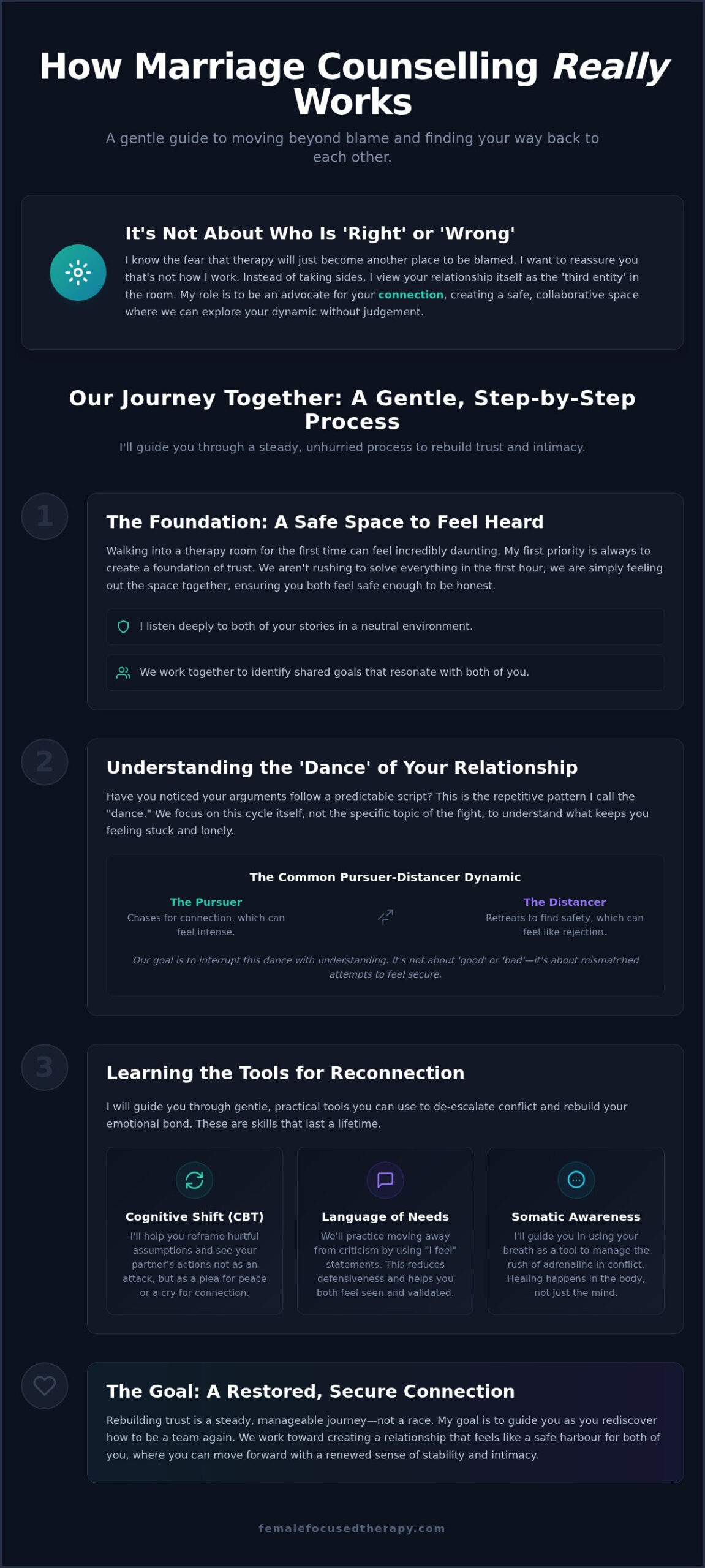
One of the biggest shifts for people is understanding that I don’t point fingers. In our work, I focus on the “third entity,” which is the relationship itself. Instead of choosing a “right” or “wrong” person, we look at how you both interact and where those interactions have become frayed. This perspective helps lower the temperature in the room and reduces the fear of being “exposed.”
People often ask, how does marriage counseling work differently from my own individual sessions? In individual work, I’m your advocate. In Couples therapy, I’m the advocate for your connection. Our first session is entirely about building a foundation of trust. I’m not here to fix you; I’m here to guide you both as you rediscover how to be a team again.
The initial assessment and feeling out the space
During our initial assessment, I listen deeply to both of your stories. It’s often the first time in a long while that both partners feel heard in a neutral, professional environment. Whether we meet in person here in Singapore or via online therapy, the goal is the same: to create a steady rhythm where you both feel safe enough to be honest. We aren’t rushing to solve everything in hour one; we’re simply feeling out the space.
Setting goals that resonate with both of you
We’ll work together to identify what success actually looks like for your unique partnership. It’s easy to stay stuck in vague unhappiness, but I’ll help you move toward specific, achievable emotional milestones. We ensure that both of your needs are represented in our plan. Success might mean learning to de-escalate an argument before it turns into a days-long silence, or it might mean finding small ways to reconnect after a long day at work.
Understanding the ‘dance’ of your relationship
Have you ever noticed that your arguments follow a predictable script? Most couples I see in my practice are exhausted by what I call the “dance” of their relationship. This is the repetitive pattern where one person’s reaction triggers the other’s defense, leading to a cycle that feels impossible to break. It’s a exhausting loop that leaves both of you feeling lonely even when you’re in the same room.
When people ask, how does marriage counseling work, they often expect me to act as a judge for their specific disagreements. However, we don’t spend much time on the “he said, she said” details of your latest fight. Instead, we look at the cycle itself. By focusing on the conflict pattern rather than the topic, we use emotional intelligence to de-escalate moments before they turn into full blown confrontations.
I often use Cognitive Behavioural Therapy (CBT) to help you reframe how you see your partner’s intentions. When you’re stuck in a negative cycle, it’s easy to assume your partner is being purposefully hurtful. This mindset keeps your nervous system on edge. By shifting your perspective to see that their withdrawal might actually be a plea for peace, or their anger a cry for connection, we begin the work of restoration.
Identifying the communication triggers
I’ll help you recognise the exact moment a conversation shifts into a confrontation. Often, couples fall into a “pursuer-distancer” dynamic. One partner chases for connection or answers, while the other retreats to find safety. This isn’t because anyone is “bad”; it’s just a mismatched way of seeking security. Learning to pause and breathe in these moments is a vital somatic tool we’ll practice together to manage that sudden rush of adrenaline.
Learning the language of needs
We’ll work on moving away from criticism, which usually hides a deep, unmet need. I’ll guide you in using “I feel” statements to reduce defensiveness. For example, “You never help” becomes “I feel overwhelmed and I’d love some support.” This shift, combined with active listening, ensures you both feel seen and validated. If you’re ready to start identifying these patterns in your own life, you can schedule a time to talk with me to begin your journey.
When trauma and narcissistic abuse enter the dynamic
The most common question I hear from women in my practice is: “Is it actually safe to do this if there has been abuse?” It’s a vital question. If you’ve been living in a state of high alert, the idea of sitting in a room to discuss your relationship can feel like stepping into a minefield. You might worry that the sessions will simply provide more ammunition for your partner to use against you later.
My trauma-informed approach prioritises your physical and emotional safety above everything else. How does marriage counseling work when trust has been shattered by control or manipulation? It works by moving slowly. I don’t follow a rigid checklist; instead, I listen to the subtle cues in your body and the room. If I sense that the environment is becoming unsafe or that a conversation is heading toward re-traumatisation, I step in immediately to ground the space.
There are times when we must acknowledge that couples work isn’t the right first step. If active physical harm is present or if the emotional toll is too great, I may suggest individual therapy alongside or instead of joint sessions. This ensures you have a private space to rebuild your internal strength and self-reliance before navigating the complexities of a shared dynamic.
Navigating high-conflict and narcissistic patterns
In cases involving high-conflict or narcissistic patterns, I set very firm boundaries in the room. I won’t allow the session to become a platform for blaming or shaming. Together, we identify destructive behaviours like gaslighting in real-time. By naming these patterns as they happen, we strip away their power. If you’re struggling with these specific challenges, we can explore how to heal from relationship trauma and narcissistic abuse in a way that feels protective and restorative.
Healing the impact of childhood trauma on your marriage
Our early experiences often act as a blueprint for our adult lives. I help you understand how your childhood attachment styles might be influencing your current marriage. When your partner pulls away, it might trigger a deep-seated fear of abandonment that you’ve carried since you were small. By recognising these triggers, we can create what I call a “corrective emotional experience.” This is a moment in our session where you experience a different, safer outcome than the one your trauma expects, allowing your nervous system to finally begin to settle.
Bringing the body into the conversation
We often think of therapy as a purely intellectual exercise, but your body is a vital part of the conversation. I help you understand the concept of co-regulation, which is the way your nervous systems constantly affect each other. If your partner is anxious or defensive, your own body likely picks up on that energy, often before a single word is even spoken. This is why you might feel “on edge” the moment they walk through the door.
Your body often reacts with a “fight or flight” response before your logical mind can process a conflict. When you’re in the middle of a heated argument, your heart might race or your chest might tighten. This is your nervous system trying to protect you, but it also makes it impossible to communicate effectively. I integrate somatic practices into our work to help you release this physical tension that has been stored in your relationship for years.
How does marriage counseling work when you’re both too overwhelmed to speak? We use mindfulness to help you stay grounded. By staying present in your body, you can share difficult emotional disclosures without spiralling into a state of panic. It’s about creating a calm, steady space where your mind and body can finally work together to find a way forward.
Somatic tools for de-escalation
I share simple breathing techniques that you can practice together right in the room. We also discuss the vital importance of rest and “time-outs” for your nervous system. Sometimes the most productive thing you can do during a conflict is to pause and step away until your body feels safe again. If you’re interested in how this works on an individual level, I also offer somatic movement and yoga for women to help you reconnect with your own internal rhythm.
Rebuilding intimacy through physical awareness
Rebuilding intimacy starts with understanding your own body’s signals. When you recognise what your body needs to feel safe, you can communicate those needs to your partner more clearly, improving both emotional and sexual connection. I guide you in reconnecting with your intuition so you can learn to trust the healing process. We use movement to shift stagnant energy and foster a sense of shared play, which is often the first step toward rediscovering joy in each other’s company.
If you’re ready to move beyond circular arguments and start healing from the inside out, you can book your first session with me today.
Your journey toward restoration and next steps
Healing is a steady, unhurried process. I often tell the couples I work with that we aren’t looking for a quick fix that will crumble under the first sign of pressure. Instead, we’re building a foundation that lasts. You might be wondering about the logistics of our time together. Typically, we meet weekly or fortnightly, allowing enough space for you to integrate the tools we discuss into your daily life.
As we move forward, our focus naturally shifts. We start with crisis management, addressing the immediate pain of circular arguments or broken trust. Over time, we transition into long-term maintenance. This is where the real magic happens. We’re no longer just surviving; we’re thriving. I’m here to support you as a wise, empathetic mentor, holding space for your growth without judgment.
How does marriage counseling work in the long run? It works by empowering you both to become your own therapists. By the time we finish our work, you’ll have a deep understanding of your relationship’s unique rhythm and the confidence to navigate future challenges together. I’ll help you understand how does marriage counseling work as a long-term investment in your shared joy and stability.
My commitment is to guide you until you feel steady enough to walk the path alone. We move at a pace that feels manageable for both of you, ensuring that neither partner feels rushed or left behind. This journey is about reclaiming the intimacy that may have felt lost for a long time.
Preparing for the transition out of therapy
Preparing for the transition out of therapy is just as important as the first session. We’ll know you’re ready when you have the tools to continue the journey on your own. We create a “relationship toolkit” together, which includes de-escalation techniques and communication strategies tailored to your specific needs. If you’re looking for couples therapy in Singapore, my goal is always to help you find your own internal stability and connection.
Taking the first gentle step today
I invite you to book a consultation when you feel ready to be heard. You don’t have to carry the weight of your relationship alone. It’s okay to ask for help, and it’s okay to take things one step at a time. Restoration is possible, even when things feel heavy and overwhelming. You deserve a space where you can be yourself and feel truly understood by your partner.
One realistic next step you can take today is to reflect on one pattern you’d like to change. You don’t have to solve it right now. Just notice it. This simple act of awareness is the first gentle step toward a different way of being together. When you’re ready to explore this further, I’ll be here to walk alongside you.
Reclaiming your connection and finding your way back
We’ve explored how shifting the focus from individual blame to the “third entity” of your relationship can lower the temperature in your home. By understanding your conflict patterns and listening to your nervous system, you can move from exhaustion to shared understanding.
As a Registered Integrative Psychotherapist specialising in relationship trauma, I provide a compassionate space where your safety is the priority. You might still wonder, how does marriage counselling work for your specific situation? The answer lies in our collaborative work, blending cognitive insights with somatic grounding.
You don’t have to walk through these heavy transitions or repetitive arguments by yourself. I’m here to act as your guide, helping you rebuild internal confidence and relational stability at a pace that feels right. There is hope for restoration, and it begins with a single, gentle step toward clarity.
Book your consultation with me today
Frequently Asked Questions
How long does marriage counselling usually take to see results?
You’ll typically begin to feel a shift within 8 to 12 sessions. Deeper restoration for trauma or long-standing conflict can take 20 sessions or more.
Some couples notice relief after just three meetings once they have the tools to de-escalate. We’ll work at a steady pace that respects your unique needs.
What if my partner refuses to come to therapy with me?
I can still support you individually if your partner isn’t ready. When you change your part of the “dance,” the dynamic between you naturally shifts.
This individual work builds the internal confidence you need to navigate the relationship with more clarity, even without their immediate participation.
Is marriage counselling covered by insurance in Singapore?
Coverage varies significantly depending on your specific provider and policy. Some international health plans or corporate programmes include mental health support.
Most local basic plans do not cover it. I recommend contacting your insurer directly to ask if sessions with a registered integrative psychotherapist are reimbursable.
Can marriage counselling work if we have already filed for divorce?
Yes, therapy can be a valuable space even if legal steps have been taken. We can use our time for “discernment counselling” to find a path forward.
My goal is to ensure you both feel heard and safe as you make these significant life decisions for your future and your family.
Will the therapist take sides or tell us who is wrong?
I never take sides because my primary client is the relationship itself. I focus on the patterns between you rather than individual blame.
I provide a neutral, compassionate space where both of you can feel validated without fear of being told you are “wrong” or at fault.
How do we prepare for our very first session together?
You don’t need to bring any formal notes or “evidence.” Arrive with a willingness to be honest and a curiosity about your partner’s experience.
We’ll spend that initial time building a foundation of trust and safety so you both feel comfortable sharing your stories in a supportive environment.
Is online marriage counselling as effective as in-person sessions?
Research shows that online therapy is just as effective as in-person sessions for most couples. It allows you to participate from your own home.
Many of my clients in Singapore find the digital space more convenient and less stressful than navigating the city’s busy transport links.
What happens if we realise during therapy that we should separate?
If you decide that separation is the healthiest path, I will support you in navigating that transition with kindness and dignity.
Therapy isn’t always about staying together. It’s about finding the most restorative outcome and maintaining your internal stability throughout the process.

Article by
Cheryl Kennedy MacDonald MA BA (Hons) Pg. Dip. SAC BACP
Cheryl Kennedy MacDonald is a psychotherapist specialising in women’s mental health, relationships, and life transitions. She works with women navigating trauma, relationship breakdown, identity shifts, and midlife change, helping them rebuild self-trust, emotional stability, and a clear sense of who they are and what they want.
With over 20 years’ experience working with women internationally, Cheryl is the founder of YogaBellies, a global women’s yoga school, and the creator of the Birth ROCKS method. Her work sits at the intersection of psychotherapy and embodiment, integrating evidence-based therapeutic approaches with somatic, body-based practices that support deep, lasting change.
Known for her grounded and direct approach, Cheryl moves beyond surface-level insight to address the patterns held in the body and nervous system. Her work supports women to regulate, reconnect, and respond to their lives from a place of clarity, strength, and self-respect.
She is a published author in academic journals and has written multiple books on women’s health, pregnancy, and midlife wellbeing, available on Amazon and leading book retailers worldwide.