
You might look back at your childhood and see a roof over your head and parents who were physically present, yet you still carry a heavy, quiet emptiness. It’s often difficult to spot the marks of neglect because it isn’t about what happened, but rather what was missing. I see many women who feel like an emotional void exists inside them, even when their life looks perfectly fine to everyone else.
I know how exhausting it is to live with chronic self-doubt and a harsh inner critic. You’ve likely struggled to identify your own needs because you grew up learning that your feelings weren’t a priority. Validating these experiences is the first step toward understanding that your current anxiety has a tangible root in your past. I want to help you identify the Signs You Experienced Emotional Neglect as a Child so you can begin to heal.
I’ll help you uncover these quiet wounds and show you how to begin rebuilding your self-trust. We’ll explore a gentle path toward restoration, blending psychological insight with a mind-body approach. This is about helping you feel grounded, secure, and finally seen in your own life.
Key Takeaways
- Understand why emotional neglect is often the “white space” in your history-it is about what was missing rather than what happened, making it difficult yet vital to name.
- Recognise the specific Signs You Experienced Emotional Neglect as a Child, such as feeling like an “invisible wall” separates you from others or struggling with a constant fear of being a burden.
- Discover how your body stores the weight of what was missing through physical tension and learn to identify if you are living in a state of “functional freeze.”
- Learn why you might be trapped in a cycle of people-pleasing and how to begin the gentle process of identifying and expressing your own personal needs.
- Explore a compassionate path toward internal restoration by learning to re-parent your inner child and rebuild a grounded sense of self-trust.
Understanding the Invisible Wound of Childhood Emotional Neglect
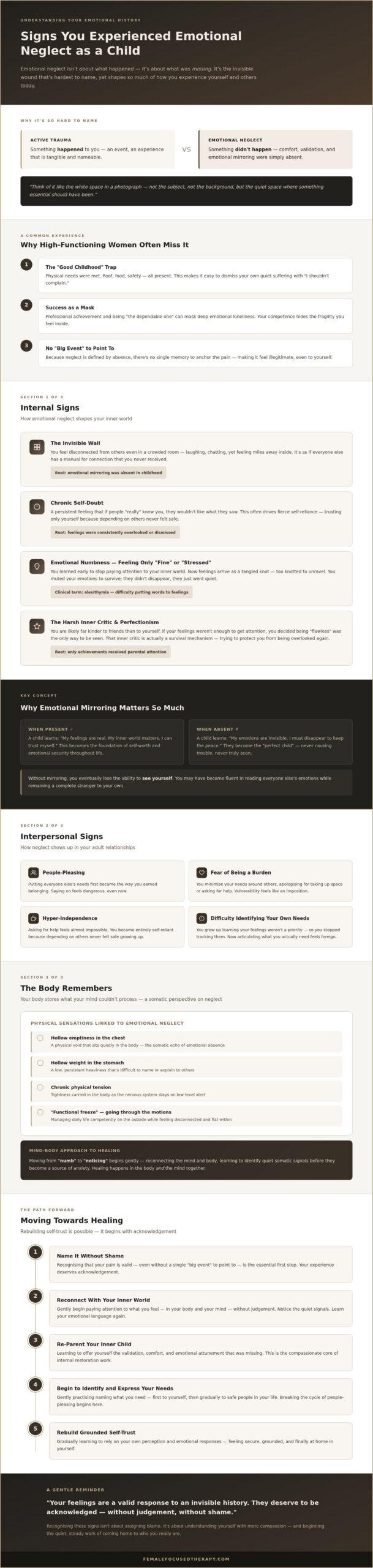
I often describe emotional neglect as the “white space” in a photograph. It isn’t the subject or the background, but the quiet space where something essential should have been. I see many women who struggle to name their pain because their childhoods looked fine on the surface.
You likely had a roof over your head and your physical needs were met. Yet, you carry a heavy, persistent feeling of being an emotional void. It’s so hard to spot because neglect is an invisible wound, defined by what failed to happen.
There’s a profound difference between active trauma and neglect. Neglect is the comfort you didn’t receive when you were small and scared. It’s the absence of emotional validation that leaves you feeling “guilty” for your current distress.
If you’ve felt this way, your feelings are a valid response to an invisible history. These are common Signs You Experienced Emotional Neglect as a Child. They deserve to be acknowledged without judgement or shame.
The Role of Emotional Mirroring
When a parent fails to “see” your emotions, you eventually lose the ability to see yourself. If your parents only responded to your achievements, you learned that your messy feelings weren’t worth noticing.
Emotional mirroring is the foundation of self-worth. It tells a child that their internal world is real and matters. Without it, you might have become the “perfect” child who never caused trouble, essentially disappearing to keep the peace.
Why High-Functioning Women Struggle to Recognise It
Many of the women who I work with are incredibly successful. They are the high-flyers and the dependable ones in their social circles.
However, professional success can often be a mask for deep-seated emotional loneliness. You might fall into the “I had a good childhood” trap, dismissing your own quiet suffering. Your competence hides the fragility you feel inside.
Internal Signs: How You Experience Your Emotional World
Living with the “Invisible Wall” means you feel disconnected from others even in a crowded room. You might be at a social event here in Singapore, laughing and chatting, but inside you feel miles away. It’s as if everyone else has a manual for connection that you never received.
Chronic self-doubt often follows this disconnection. You might have a persistent feeling that if people “really” knew you, they wouldn’t like what they saw. This often leads women to become fiercely self-reliant to a fault, believing they are the only ones they can depend on.
This hyper-independence makes asking for help feel almost impossible. It’s a lonely way to live, but it was once your only way to feel safe. You may also find it difficult to identify what you actually feel beyond “fine” or “stressed” because you learned to stop paying attention to your inner world.
Now, your feelings might feel like a tangled knot that’s too difficult to unravel. When your emotions weren’t validated as a child, you muted them to survive. This emotional muting is one of the common Signs You Experienced Emotional Neglect as a Child that we can explore together.
The Harsh Inner Critic
You are probably much kinder to your friends and colleagues than you are to yourself. This adult perfectionism is often a direct result of childhood neglect. If your feelings weren’t enough to get attention, you might have decided that being “flawless” was the only way to be seen.
Your inner critic is actually a survival mechanism from the past. It tries to protect you by making sure you never give anyone a reason to overlook or reject you again. It’s a heavy burden to carry, but it’s one we can gently begin to set down in therapy.
Alexithymia and the Emotional Void
It is common to struggle with putting words to your internal sensations, a state sometimes called alexithymia. You might feel a physical “emptiness” in your chest or a hollow weight in your stomach that you can’t quite explain. These are the somatic echoes of what was missing.
In my practice, I help women move from “numb” to “noticing” by gently reconnecting the mind and the body. We work together to identify these quiet somatic signals before they become a source of anxiety. This helps you build the internal security you’ve been searching for.
If you are ready to start understanding these internal patterns in a supportive space, you can book a session with me to explore how we can work together on your restoration.
Interpersonal Signs: Neglect in Your Adult Relationships
If you grew up in a home where your emotions were ignored, you likely became an expert at reading the room. You learned to manage your parents’ moods to ensure your own safety or comfort, often at the expense of your own needs. This often evolves into a lifelong “people-pleasing” trap where you feel responsible for the happiness of everyone around you, even strangers.
These relational patterns are common Signs You Experienced Emotional Neglect as a Child. You might find yourself constantly apologising or staying quiet to avoid “making a scene.” You have a deep-seated fear of being a burden, so you never ask for help, even when you’re clearly drowning in responsibilities. It’s a lonely way to live, but it’s a strategy you developed when your voice didn’t seem to matter.
This history often leads women to be attracted to emotionally unavailable partners who mirror their childhood environment. It feels familiar to work hard for the attention of someone who can’t quite meet you emotionally. If you’ve struggled with relationship trauma, you know how painful it is to keep choosing people who reinforce the idea that you aren’t worth the effort.
Boundaries or Walls?
Many women I work with in Singapore confuse emotional withdrawal with healthy boundaries. Because saying “no” feels like a threat to your safety, you might shut down entirely instead of expressing a limit. I work with women to gently explore these relationship patterns, helping them move from self-protection to true connection. We look at how to build bridges that allow people in, rather than walls that keep everyone out.
The Impact of Narcissistic Parenting
Sometimes, neglect is a symptom of a parent’s own narcissistic traits. In these families, children are often cast into roles like the “Golden Child,” who must be perfect to reflect well on the parent, or the “Invisible Child,” who is simply ignored. If you were the invisible one, your needs were always secondary to the parent’s ego. This type of neglect leaves a specific kind of scar that requires a nuanced approach to healing.
My work in narcissistic abuse recovery focuses on helping you reclaim the space you were never allowed to occupy. We work on validating your reality and rebuilding the self-trust that was eroded by years of being overlooked. It’s about finally giving yourself permission to exist without needing to be “useful” or “perfect” for someone else.
The Body Remembers: A Somatic Perspective on Neglect
While we have looked at your internal thoughts and your relationships, it’s just as important to look at your physical self. Your body often keeps a record of what your mind tries to forget. Emotional neglect frequently manifests as chronic tension in the jaw, a tightness across the shoulders, or a breath that never quite reaches the belly. These physical cues are often overlooked Signs You Experienced Emotional Neglect as a Child, yet they tell the story of a nervous system that learned to stay on high alert to protect itself.
You might find yourself living in a state of “functional freeze.” This is a subtle survival state where you can still go to work and manage your family here in Singapore, but you feel emotionally numb and physically heavy. You aren’t “lazy” or “unmotivated”; your nervous system has simply decided that staying still is the safest option. Talk therapy is a wonderful tool, but sometimes it isn’t enough to reach these “quiet” parts of neglect where there are no words, only sensations. This is why I integrate breath and movement into my practice to help you release that stored emotional weight.
Restoring the Mind-Body Connection
Listening to your body starts with small moments of noticing. You might notice your breath hitch when you’re asked a question, or your stomach tighten before a meeting. Developing a “safe container” within yourself means learning that your body is a place where you can belong. It involves moving from seeing your body as a “problem to be solved” to seeing it as a source of wisdom. I often use somatic movement and yoga to help women rebuild this vital connection to their physical selves at a manageable pace.
Breath as a Tool for Regulation
A simple 1-minute practice can shift your state when you feel overwhelmed. Try exhaling for twice as long as you inhale; this sends a direct signal to your brain that you are safe in this moment. For many women who were neglected, resting feels like a dangerous task because your worth was tied to your “usefulness” or your ability to stay invisible. Breathwork acts as a gentle bridge, connecting the quiet child of the past to the resilient woman of the present. It allows you to anchor yourself in the now, even when the echoes of the past feel loud.
If you’re ready to move beyond just talking about your past and want to start feeling safer and more grounded in your own skin, I invite you to book a session with me.
Moving Towards Healing and Rebuilding Self-Trust
The first step toward restoration is always acknowledgement. It’s vital to realise that you are not “broken” or “flawed” in some permanent way. You are simply responding to what was missing during your formative years. When you recognise the Signs You Experienced Emotional Neglect as a Child, you can begin to shift from a place of self-blame to one of deep, necessary self-compassion.
Healing involves learning to “re-parent” your inner child with the warmth and kindness you deserved but didn’t receive. This means noticing your own feelings and treating them as important data rather than inconveniences to be pushed aside. It’s about becoming the supportive mentor you needed, giving yourself permission to exist without being “useful” or “perfect” all the time.
In our sessions, I provide the “mirroring” that was absent during your childhood. By seeing and validating your experiences in real-time, we begin to repair the internal disconnect that has kept you feeling lonely. This collaborative process helps you rebuild the fundamental belief that your needs and feelings are not just valid, but essential for a healthy life.
Re-parenting also means listening to your body’s signals and giving yourself permission to rest or say “no” without the heavy weight of guilt. This internal restoration is what allows you to finally trust your own intuition. You’ve spent years looking outward for validation; now, we work on finding that stability and certainty within yourself.
What to Expect in Our Work Together
I provide a warm, boundaried space for you to explore these “quiet” wounds at a pace that feels manageable for your nervous system. Recognising the Signs You Experienced Emotional Neglect as a Child is the start of a transition from merely surviving to truly thriving in your daily life. We use a blend of talk therapy and somatic tools to ensure your healing is grounded in both mind and body. A realistic next step for your restoration is booking a consultation to see if we are a good fit.
A Message of Hope
I want you to know that it is possible to feel “full” and connected again. You don’t have to carry the weight of that “invisible wall” or the hollow emptiness in your chest forever. Healing isn’t about fixing the past, but about changing your relationship with yourself in the present moment. You have the capacity to rebuild your internal confidence and live a life that feels authentically yours. Book your consultation with me here to begin your journey toward emotional restoration.
Beginning Your Journey of Internal Restoration
Understanding the quiet, invisible marks of your past is the first step toward a different future. We’ve explored how the “white space” in your childhood created patterns of people-pleasing and self-doubt, but these don’t have to define you forever. By acknowledging the Signs You Experienced Emotional Neglect as a Child, you’re already starting to bridge the gap between that lonely past and a more grounded, self-trusting present.
As a Registered Integrative Psychotherapist specialising in relationship trauma and narcissistic abuse, I’m here to provide the compassionate mirroring you missed. Whether we meet for online sessions here in Singapore or globally, we’ll work together to move through the “functional freeze” in your body to find genuine emotional safety. You deserve a space where your needs are finally the priority and your voice is heard.
Book your introductory therapy session with me today to begin rebuilding your internal confidence. You’ve spent long enough taking care of everyone else; it’s finally time to come home to yourself.
Frequently Asked Questions
Is childhood emotional neglect the same as emotional abuse?
Neglect and abuse are distinct experiences, though they often overlap in a child’s life. While emotional abuse involves active harm, like criticism or yelling, neglect is about the absence of emotional response. It is the “nothing” that happened when you needed comfort or validation. Both leave deep marks, but neglect is often harder to name because there are no specific memories of “bad” events to point to.
Can I have experienced neglect if my parents were ‘good’ people?
Yes, you can certainly have experienced neglect even if your parents provided a stable, comfortable home. Many well-meaning parents simply didn’t have the emotional tools to mirror their children’s feelings. They might have been overwhelmed by their own work or personal struggles. This is one of the common Signs You Experienced Emotional Neglect as a Child that leads to feelings of guilt, as you feel you “should” be more grateful.
How do I know if my current anxiety is related to my childhood?
If your anxiety feels like a constant, quiet humming in the background of your life, it may be rooted in your past. This often manifests as a fear of being a “burden” or a feeling that your needs don’t matter. When you grow up without emotional validation, your nervous system stays on high alert. We look at these patterns together to see how your current distress links to those early missing pieces.
Is it possible to heal from emotional neglect as an adult woman?
It is absolutely possible to heal and find a sense of internal fullness as an adult. Your brain and nervous system have an incredible capacity for change through what we call neuroplasticity. Healing from the Signs You Experienced Emotional Neglect as a Child isn’t about rewriting your history, but about changing how you relate to yourself today. By providing yourself with the compassion you missed, you can rebuild an authentic life.
What does a therapy session for emotional neglect actually look like?
A session with me is a warm, boundaried space where we move at your pace, whether we meet online here in Singapore or globally. We don’t just talk about your history; we notice how your body responds in the present moment. I might help you identify a physical sensation in your chest or guide you through a simple breath practice. It’s a collaborative process of validating the feelings you’ve spent a lifetime pushing away.
Can emotional neglect lead to ADHD-like symptoms in women?
Yes, emotional neglect can often mimic or exacerbate ADHD-like symptoms such as distractibility and emotional dysregulation. When your environment wasn’t emotionally stable, your brain may have adapted by staying constantly “on” or scanning for threats. This can make it very difficult to focus or stay present in the now. As a therapist with ADHD myself, I help you distinguish between your neurodivergence and your response to past neglect.
How long does it typically take to see progress in therapy for CEN?
Progress is a personal journey and varies for every woman I see. Some clients feel a sense of relief after just a few sessions, simply because their pain finally has a name. However, rebuilding deep self-trust and changing lifelong relationship patterns usually takes more time. We focus on steady, manageable shifts rather than a quick fix, ensuring that your healing is sustainable and integrated into your daily life.

Article by
Cheryl Kennedy MacDonald MA BA (Hons) Pg. Dip. SAC BACP
Cheryl Kennedy MacDonald is a psychotherapist specialising in women’s mental health, relationships, and life transitions. She works with women navigating trauma, relationship breakdown, identity shifts, and midlife change, helping them rebuild self-trust, emotional stability, and a clear sense of who they are and what they want.
With over 20 years’ experience working with women internationally, Cheryl is the founder of YogaBellies, a global women’s yoga school, and the creator of the Birth ROCKS method. Her work sits at the intersection of psychotherapy and embodiment, integrating evidence-based therapeutic approaches with somatic, body-based practices that support deep, lasting change.
Known for her grounded and direct approach, Cheryl moves beyond surface-level insight to address the patterns held in the body and nervous system. Her work supports women to regulate, reconnect, and respond to their lives from a place of clarity, strength, and self-respect.
She is a published author in academic journals and has written multiple books on women’s health, pregnancy, and midlife wellbeing, available on Amazon and leading book retailers worldwide.