
You find yourself checking the voice memos on your phone just to prove to yourself that the conversation actually happened the way you remember it. It’s a lonely, disorienting place to be when the person who should be your partner makes you feel like you’re losing your mind. This isn’t just emotional stress; it’s a physical weight that leaves you exhausted and constantly on edge.
I know how much courage it takes to even search for how to leave a narcissistic husband when you’re worried about the fallout. You’re likely facing a mix of fear about his reaction and deep concern over the legal or financial path ahead. I want you to know that your intuition is right, and you deserve a life where you feel safe and heard.
I’ll help you navigate the emotional and practical complexities of leaving with a focus on your safety and self-trust. We’ll explore how to create a secure exit plan while using gentle somatic tools to help your body feel grounded during the process. By reclaiming your reality, you can move toward a future where you finally feel like yourself again.
Key Takeaways
- Recognise why the trauma bond feels so magnetic and how your body uses physical symptoms to signal that it’s time for a change.
- Discover the essential quiet steps for how to leave a narcissistic husband, allowing you to prepare your heart and head without alerting him.
- Learn the practical logistics of a safe exit, from securing your digital footprint to gathering your most important personal documents.
- Find out how to navigate the emotional aftershocks of leaving while slowly rebuilding your sense of self outside of the relationship.
- Explore how integrating somatic movement and breath can help your nervous system finally step out of survival mode and into a state of rest.
I see you: understanding why leaving feels so impossibly hard
If you feel like you’re walking through a thick, grey fog every day, I want you to know I see you. It’s incredibly disorienting when your own intuition feels broken. You might find yourself constantly second-guessing your memories or wondering if you’re “too sensitive.” This isn’t a flaw in your character; it’s the result of living in a state of emotional erasure.
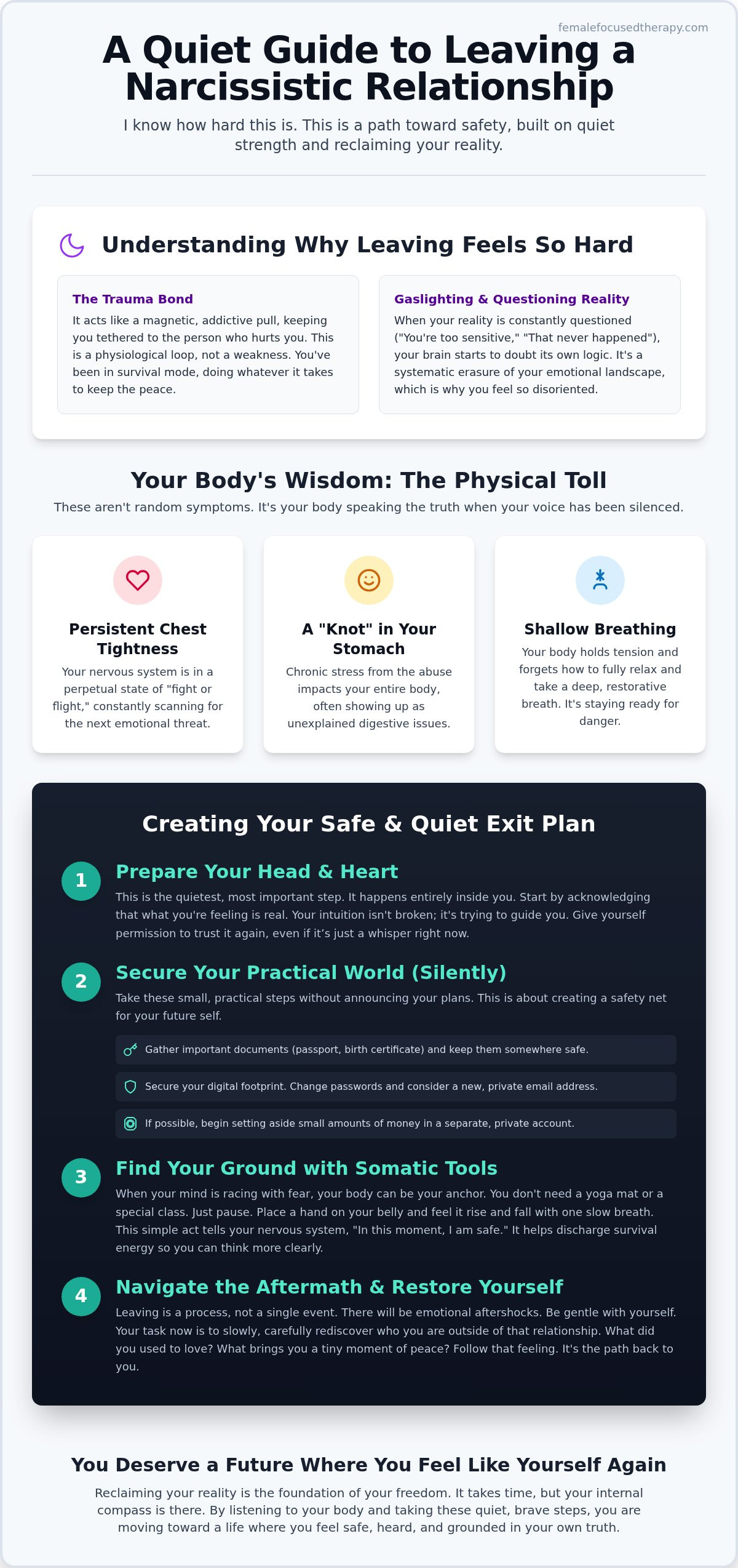
Narcissistic abuse is the systematic erasure of your emotional landscape, where your needs, feelings, and very identity are slowly replaced by his demands and whims. When you’re trying to figure out how to leave a narcissistic husband, the “trauma bond” acts like an addictive pull. It’s a physiological loop that keeps you tethered to the person who hurts you. You aren’t weak for staying; you’ve been in a survival state, doing whatever is necessary to keep the peace.
Gaining a deeper sense of Understanding Narcissistic Personality Disorder can sometimes help you realise that his behaviour isn’t about you. It’s a rigid pattern that has nothing to do with your worth. In my work with women facing relationship trauma and narcissistic abuse, we focus on clearing that fog so you can trust your own eyes again.
You might feel physically exhausted, as if your body is carrying a weight you can’t quite name. This is because your nervous system is constantly scanning for danger, even during the quiet moments. Understanding that your brain is trying to protect you can be the first step toward self-compassion. You’re not losing your mind; you’re simply responding to an impossible environment.
The confusion of the ‘love bombing’ cycle
In the beginning, he likely made you feel like the most important person in the world. This “love bombing” creates a powerful memory of a man who was kind and attentive. When things turn cold, you find yourself chasing that ghost. He uses those “good times” as a weapon, making you feel that if you just “fixed” yourself, that version of him would return. It’s painful to realise, but that person was often just a mask designed to win you over.
When you’re caught in this cycle, it’s natural to try and adjust your own behaviour to keep him happy. You might find yourself apologising for things you didn’t do or changing your personality to avoid his anger. Recognising that you cannot “fix” his behaviour by changing yourself is a vital part of learning how to leave a narcissistic husband. The mask he wore was his creation, not a reflection of your failure.
When your reality is constantly questioned
Long-term gaslighting erodes your ability to make even small decisions. When he tells you that you didn’t see what you saw, or that your feelings are “crazy,” your brain starts to shut down its own logic to avoid conflict. He might have isolated you from friends or family who could offer a reality check, leaving you alone with his version of the truth. This isolation makes the exit feel even more daunting.
In our sessions, I offer a safe container where your perspective is the only one that matters. We work on restoring your internal compass so you can finally feel grounded in your own reality again. Rebuilding that self-trust takes time, but it’s the foundation of your future freedom. You deserve to live in a world where your thoughts and feelings are respected and heard.
Your body’s wisdom: the physical toll of narcissistic abuse
I often hear from women who describe a persistent tightness in their chest or a “knot” in their stomach that never seems to go away. You might notice your breath is always shallow, or perhaps you’re struggling with sudden digestive issues that doctors can’t quite explain. These aren’t just random symptoms; they are your body’s way of speaking the truth about the environment you’re living in.
Your nervous system is designed to protect you, but in a narcissistic relationship, it stays in a perpetual state of “fight or flight.” Even when things are quiet or he seems kind, your body is still scanning for the next shift in mood. This chronic stress keeps your cortisol levels high, which can leave you feeling physically and emotionally drained every single day.
I believe that before you can focus on the practicalities of how to leave a narcissistic husband, you must first help your body feel grounded. Somatic movement is a powerful tool for this, as it allows you to discharge that built-up survival energy. When your body is finally allowed to rest, your mind can begin to clear, making it possible to think about the future with a steady heart.
Understanding the ‘freeze’ response
You might find yourself staring at a suitcase, feeling physically unable to pack a single item. This is the “freeze” response, a state where your system is so overwhelmed that it simply shuts down to protect you. It’s not a sign of weakness or indecision; it’s a physiological barrier that your brain has put up.
In my sessions, I use mindfulness to help you gently come back into your body without feeling overwhelmed. We use small, gentle movements to help you reclaim your physical boundaries and remind your nervous system that you are in control of your own space. This physical reclamation is often the first step toward emotional independence.
Creating a sense of internal safety
Learning to use your breath as an anchor can be life-changing when you’re still living under the same roof. Simple breathwork techniques can help calm the rising panic when he enters the room or starts a conflict. It’s a way of creating a “micro-sanctuary” within yourself that he cannot touch or influence.
I also find that somatic movement and yoga for women helps process the emotions that have become “stuck” in your muscles and joints. As you move, you might find that repressed anger or grief finally begins to shift. This process is essential for creating a personalized safety plan that feels manageable rather than terrifying.
If you’re feeling physically stuck or exhausted, I’m here to help you find your way back to yourself through individual psychotherapy sessions. Together, we can work on calming your nervous system so you can plan your next steps from a place of grounded strength.
Preparing your head and heart: the quiet steps to readiness
Leaving starts long before you actually walk out the front door. It begins with an internal shift, a quiet decision that you can no longer live in a world where your reality is constantly denied. I want you to know that you don’t need to tell him you’re thinking of going. In fact, keeping your intentions to yourself is often the safest and most empowering thing you can do.
I often suggest building an internal “secret garden” during this time. This is a mental space where your thoughts, plans, and dreams are entirely your own. He has spent years occupying your mind; this is the first step in reclaiming that territory. Keeping your plans private protects your emotional energy from his manipulation and ensures you aren’t talked out of your own truth.
When you’re navigating how to leave a narcissistic husband, the preparation is as much about your heart as it is about your logistics. You’re slowly untangling the emotional knots that have kept you bound to his needs. This quiet phase is about gathering your strength and reminding yourself that a different life is possible, even if it feels distant right now.
Reconnecting with your support system
Isolation is a powerful tool used by narcissistic partners to keep you under control. You might feel a sense of shame or embarrassment about reaching out to friends you’ve neglected, but please remember that those who love you will understand. They’ve likely been waiting for the moment you felt ready to reconnect. Reaching out is a way of reminding yourself that you have a world outside of his influence.
Finding a professional who truly understands relationship trauma and narcissistic abuse is another vital step. You need a space where your experience is validated without judgment. A specialised therapist can help you decode the “therapy-speak” or manipulation tactics he might be using, providing the clarity you need to move forward with confidence.
Testing your own intuition
Your intuition has likely been trying to protect you for years, even if you’ve learned to silence it to survive. Start by making small, independent decisions without seeking his approval. Whether it’s what you eat for lunch or how you spend an hour of your time, these tiny acts of autonomy help rebuild the self-trust he worked so hard to erode.
I highly recommend journaling as a way to anchor yourself in the truth. When he tries to rewrite history, your written words serve as a physical record of what actually happened. This practice is a fundamental part of a safety plan for leaving an abusive relationship. Trusting that “niggle” in your gut again is how you reclaim your life, one small step at a time.
Creating a safe exit plan while holding onto your peace
Moving from the quiet phase of internal readiness to the practical steps of leaving can feel overwhelming. I want to help you break this down into manageable actions that prioritise your safety and your sanity. When you’re figuring out how to leave a narcissistic husband, having a clear, logical map helps quiet the panic and keeps you focused on the finish line.
Your first step is securing your digital life. Change every password to something he can’t guess, and check your devices for location tracking or shared accounts. Next, gather your “Go-Bag” of essential documents. This includes your passport, birth certificate, and financial records. Keep these with a trusted friend or in a secure spot outside the home.
Financial independence is your lifeline. Open a separate bank account that he cannot access, and begin diverting small amounts of money if it’s safe to do so. In the Singapore context, I also recommend consulting a lawyer who specialises in high-conflict divorces. They can help you understand your rights regarding assets and maintenance before you make your move.
Finally, plan the physical exit for a time when he is naturally away from the house. This isn’t about being “sneaky”; it’s about minimising a high-conflict confrontation that could put you at risk. Choosing a quiet window allows you to move with a sense of calm and ensures you have the space to breathe as you close that door for the last time.
Protecting your emotional energy during the move
Once you’ve left, protecting your peace becomes a full-time job. You might find that “Grey Rocking” (becoming as boring and unresponsive as a pebble) is the best way to handle necessary communication. He may try “hoovering,” which is the term for his attempts to suck you back into the relationship with sudden apologies or grand promises of change.
I often have women ask about couples therapy in Singapore as a last resort. However, I usually advise against it in cases of narcissistic abuse. Traditional therapy often relies on both partners being honest and vulnerable, which a narcissist can use as a weapon against you. Your energy is better spent on your own individual restoration.
Safety for children and pets
If you have children, the transition requires extra gentleness. Focus on their need for stability without speaking ill of their father, which helps avoid accusations of “parental alienation” in legal proceedings. In Singapore, you can explore a Personal Protection Order (PPO) if there is a threat of violence or harassment, providing a legal layer of safety for your new household.
Don’t forget to include your pets in your safety plan, as they are often used as emotional leverage in high-conflict breakups. Ensure their microchip details are updated and that you have a safe place for them to stay. If you’re feeling overwhelmed by these logistics, I can support you in creating a “safe container” for your transition through online therapy sessions where we can map out your exit together.
Restoring your sense of self and finding your way forward
Once the door is locked and the immediate threat has passed, a different kind of challenge begins. You might expect to feel instant relief, but it’s common to experience a wave of “aftershocks.” This often includes deep-seated anger at what you’ve endured and a surprising sense of grief for the life you thought you were building.
Navigating how to leave a narcissistic husband is a massive feat, but reclaiming your identity is where the true healing lives. For years, you’ve seen yourself through his distorted lens. Now, you get to decide who you are when no one is there to criticise or diminish you. It’s a process of meeting yourself again, perhaps for the first time in decades.
I believe that therapy is essential during this stage to ensure you don’t carry the heavy weight of trauma into your next chapter. We work together to process the manipulation so it no longer has power over your choices. Internal restoration feels like finally being able to exhale, knowing that your thoughts and boundaries are once again your own.
The journey of internal restoration
Rebuilding your life is about learning to hear your own voice again. It takes time to silence the echoes of his criticism that might still play in your head. I focus on helping women rebuild their self-reliance and emotional stability, moving from a state of survival to one of genuine confidence. We look at how the body has stored the stress and how to release it.
My approach is deeply personal because I understand the complexities of being a high-functioning woman while feeling emotionally erased. You can learn more about Cheryl Kennedy MacDonald and how my background as a psychotherapist and yoga master informs this work. We focus on restoring the connection between your mind and your body so you can trust your intuition again.
One realistic next step
It’s okay if you don’t have the next ten years figured out today. In fact, trying to plan that far ahead can lead to more overwhelm. Right now, your only job is to do the “next right thing” for your wellbeing. This might be taking a long nap, going for a walk, or simply sitting in the quiet without anyone demanding your attention.
If you feel ready to start untangling the past, I invite you to a quiet, confidential conversation. You don’t have to navigate this transition alone. Reaching out is a brave act of self-care that signals to yourself that your healing is finally a priority. Your future is waiting, and it’s much brighter than the past you’ve left behind.
Step into your new chapter
Reclaiming your life isn’t about having every single detail figured out today. It’s about finally trusting that quiet, persistent voice inside you that says you deserve to feel safe and heard. We’ve explored how to listen to your body’s wisdom and the practical logistics of a safe exit. Rebuilding your sense of self takes patience, but it’s the most vital work you’ll ever do for your wellbeing.
Understanding how to leave a narcissistic husband is just the first step on your path toward internal restoration. As a registered integrative psychotherapist, I provide specialised trauma-informed care for women navigating these exact transitions. I offer confidential sessions both in-person in Singapore and online, providing a safe container for you to process your experience and find your grounded strength again.
You’ve carried the heavy weight of this relationship for long enough. It’s time to set it down and move toward a future where you are the author of your own story. I am here to support you in a safe, grounded space; book your confidential consultation with me today.
Frequently Asked Questions
Is it safe to leave a narcissistic husband without professional help?
Safety depends on your specific situation, but professional guidance is highly recommended for creating a secure exit plan. If there is a risk of physical harm, you should contact local emergency services or a domestic abuse hotline immediately. Professionals provide a safe container and help you navigate the high conflict reactions that often follow a separation, ensuring you don’t have to carry the burden of planning alone.
How do I know if my husband is a narcissist or just difficult?
The key difference lies in the pattern of empathy and control. A difficult person can usually acknowledge your feelings and compromise, even if it’s a struggle. A narcissistic partner typically lacks genuine empathy and uses gaslighting to erase your reality. If you feel like you’re constantly walking on eggshells or losing your sense of self, these are significant indicators of a more toxic dynamic.
What if I can’t afford to leave him right now?
If financial control is keeping you stuck, the focus shifts to a long term quiet phase of preparation. Start by gathering information on local legal aid and opening a secret, separate bank account if it’s safe to do so. I often work with women in this stage to build their internal resilience and self reliance while they slowly secure the resources they need. You don’t have to leave tonight; you can start by planning for a safer tomorrow.
How do I explain the separation to our children?
Keep your explanation simple, age appropriate, and focused on their stability. You can explain that you and their father are going to live in different houses so that everyone can be more peaceful. Avoid sharing the complex details of his behaviour, as this protects them from adult conflict and prevents legal claims of parental alienation. Your priority is ensuring they feel loved and safe throughout the transition.
Why do I feel so guilty about leaving him when he treats me poorly?
This guilt is often a result of the trauma bond and years of being told his happiness is your responsibility. In a narcissistic relationship, you are conditioned to put his needs first and blame yourself for any problems. My work in psychotherapy focuses on helping you release this unearned guilt. It’s a natural part of the healing process to realise that your only responsibility is your own safety and peace.
Can a narcissistic husband ever change through therapy?
Change is rare because it requires a level of self reflection and empathy that most narcissistic individuals are unwilling or unable to access. While some may learn the language of therapy to appear improved, this is often just another tool for manipulation. I generally advise women that they cannot fix their husband. Healing usually happens when you focus on your own restoration rather than his potential for change.
What is the ‘Grey Rock’ method and when should I use it?
The ‘Grey Rock’ method involves becoming as uninteresting and unresponsive as a plain pebble. You use it when you must communicate with him but want to avoid triggering a high conflict reaction. By giving short, factual answers and showing zero emotional response, you stop providing the supply he craves. It’s an effective tool for protecting your energy while you are still navigating how to leave a narcissistic husband.
How do I find a therapist in Singapore who understands narcissistic abuse?
Look for a registered integrative psychotherapist who specialises in trauma informed care and gender specific issues. It’s important to find someone who understands the nuances of narcissistic abuse rather than traditional marriage counselling. I offer these specialised sessions in Singapore and online, providing a safe, confidential space where your perspective is the priority. Finding a guide who validates your experience is the first step toward your internal restoration.

Article by
Cheryl Kennedy MacDonald MA BA (Hons) Pg. Dip. SAC BACP
Cheryl Kennedy MacDonald is a psychotherapist specialising in women’s mental health, relationships, and life transitions. She works with women navigating trauma, relationship breakdown, identity shifts, and midlife change, helping them rebuild self-trust, emotional stability, and a clear sense of who they are and what they want.
With over 20 years’ experience working with women internationally, Cheryl is the founder of YogaBellies, a global women’s yoga school, and the creator of the Birth ROCKS method. Her work sits at the intersection of psychotherapy and embodiment, integrating evidence-based therapeutic approaches with somatic, body-based practices that support deep, lasting change.
Known for her grounded and direct approach, Cheryl moves beyond surface-level insight to address the patterns held in the body and nervous system. Her work supports women to regulate, reconnect, and respond to their lives from a place of clarity, strength, and self-respect.
She is a published author in academic journals and has written multiple books on women’s health, pregnancy, and midlife wellbeing, available on Amazon and leading book retailers worldwide.