
I know that feeling of sitting in a quiet office in Orchard or Raffles Place, nodding along while your mind feels like a browser with fifty tabs open, all playing different music. You’ve spent years becoming an expert at “masking,” showing the world a composed, high-achieving woman while internally you’re drowning in a sea of sensory overload. I’ve found that searching for ADHD therapy for women Singapore can feel like just another daunting task on an already overflowing list. If you’ve ever felt that life is simply too loud, too fast, or too much, I want you to know that you aren’t broken.
I’ve walked this path myself, and I understand that your neurodivergence isn’t a defect to be fixed, but a unique rhythm that needs a different kind of support. This journey is about more than just managing a to-do list; it’s about reclaiming your sense of self and finding true internal restoration. In this article, I’ll share a compassionate perspective on navigating ADHD as a woman in our high-pressure environment. We’ll explore how to move away from constant overwhelm and toward a place of calm, learning to work with your brilliant brain instead of fighting against it every single day.
Key Takeaways
- I’ll help you understand why your experience of ADHD probably doesn’t look like the common stereotypes and why it often feels like an internalised whirlwind.
- You’ll learn how Rejection Sensitive Dysphoria (RSD) shapes your emotional world and why I believe these feelings are often more exhausting than practical forgetfulness.
- I’ll show you how the high-pressure environment of our city impacts your neurodivergent brain and how my adhd therapy for women singapore helps you stop simply surviving.
- We’ll explore how I use somatic awareness and mind-body techniques to help you settle your nervous system and reduce the constant emotional noise in your life.
- I’ll share the first steps toward your internal restoration, moving away from the need to “mask” and toward a place where you feel truly seen.
Understanding the ‘Invisible’ Struggle of ADHD in Women
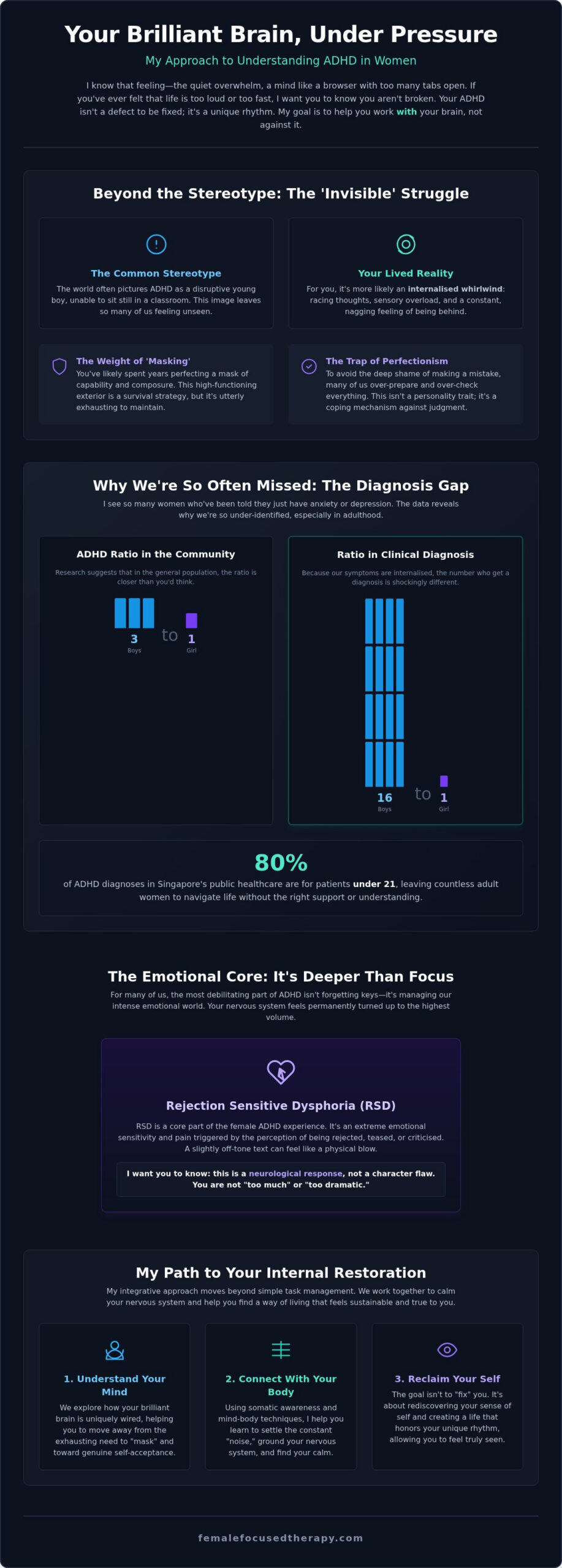
I want to start by validating that your experience of ADHD probably doesn’t look like the stereotypes you see in films or textbooks. For many of us, it isn’t about being a disruptive child in a classroom. Instead, it’s an internalised whirlwind of racing thoughts, impossible to-do lists, and a constant, nagging feeling of being behind. This internal noise is often what leads women to seek adhd therapy for women singapore, as they look for a way to finally quiet the storm.
At its heart, Adult attention deficit hyperactivity disorder is a fundamental difference in how your brain is wired. It affects your executive function and, crucially for women, your emotional regulation. In Singapore, public healthcare institutions see about 1,200 patients diagnosed with ADHD annually, but over 80% of those are under 21. This means many women are not identified until adulthood, often when a major life transition makes their existing coping mechanisms crumble.
Why our symptoms are so often missed
I see so many women who have spent years being told they just have anxiety or depression. While those feelings are very real, they’re often secondary to the underlying neurodivergence. From a young age, we’re socially conditioned to be the “good girl,” the organised student, and the effortless caregiver. We learn to mask our struggles to appear capable and composed. This mask often holds firm until hormonal shifts, such as during pregnancy or menopause, make previously manageable symptoms feel suddenly impossible.
Research suggests that while the community ratio for ADHD is closer to 3:1, the clinical diagnosis ratio can be as high as 16:1. This tells me that girls and women are significantly under-identified. You might have been the student who did well but felt like you were working twice as hard as everyone else. This hidden effort is exhausting and is a primary reason why specialized adhd therapy for women singapore is so vital for our long-term wellbeing.
The weight of the ‘perfectionist’ mask
I understand the sheer exhaustion of maintaining an outward image of success while feeling like things are falling apart behind the scenes. Many of us use perfectionism as a survival strategy. We over-prepare and over-check every email to avoid the deep shame of making a mistake. This creates a painful link between ADHD and the feeling of being an imposter in your own life. You might be high-achieving in your career, yet you feel like a fraud because you know the chaos that lives just beneath the surface.
This perfectionism isn’t a personality trait; it’s a coping mechanism designed to keep you safe from judgment. However, it comes at a high price to your nervous system. By acknowledging the reality of this “invisible” struggle, we can begin the process of internal restoration. You don’t have to keep performing. We can work together to understand your brain’s unique rhythm and find a way of living that feels sustainable and true to who you really are.
Why ADHD Feels Different for Us: The Emotional Connection
In my practice, I find that the emotional side of ADHD is often far more debilitating than the “typical” symptoms like forgetfulness or losing your keys. While the world focuses on how we manage our time, we’re often struggling just to manage our feelings. For many women, ADHD feels like having a nervous system that’s permanently turned up to the highest volume.
One of the most profound aspects of this is Rejection Sensitive Dysphoria, or RSD. It’s a core part of the female ADHD experience that rarely gets enough attention. While Singapore’s Ministry of Health highlights the prevalence of the condition, official data doesn’t always capture the raw, physical pain of perceived rejection. A small piece of feedback from a boss or a slightly off-tone text from a friend can feel like a physical blow to your chest.
Navigating Rejection Sensitive Dysphoria (RSD)
I want to help you understand that your sensitivity is a neurological response, not a character flaw. You aren’t “too much” or “too dramatic.” Your brain is simply wired to perceive social threats more intensely. This often leads to a state of hyper-vigilance where you’re constantly scanning the moods of others to ensure you’re still safe and accepted.
In our work together, we focus on building a foundation of self-trust. When you understand that your brain is just trying to protect you, other people’s opinions start to carry less weight. We move away from the cycle of emotional intensity and the inevitable crash that follows. This is a key part of adhd therapy for women singapore; finding a steady ground within yourself where the emotional noise begins to quiet down.
The link between ADHD and relationship trauma
I often see a significant crossover between neurodivergence and relationship trauma or narcissistic abuse. Our naturally intense nature and our desire to please can sometimes make us vulnerable to unhealthy dynamics. Because we’re used to feeling like we’re “the problem” due to our ADHD, we might stay too long in situations where our boundaries are being ignored.
Therapy helps you recognise these patterns and understand that your needs are valid. We work on setting boundaries that protect your energy and your heart. If you feel like you’re constantly exhausted by the emotional noise of your life, you might find it helpful to explore these feelings in a safe space. You deserve to feel secure in your relationships and, most importantly, in your own mind.
High-Functioning but Overwhelmed: The Singapore Context
Living in a city as fast-paced as Singapore adds an extra layer of pressure to the ADHD brain. Between the constant hum of the CBD and the relentless pace of digital connectivity, your nervous system rarely gets a chance to truly rest. The sensory overload of our urban environment, the bright lights of malls, the noise of the MRT, and the humidity, contributes to a deep, daily fatigue that many people simply don’t understand.
Then there’s the “kiasu” culture. This ingrained fear of losing out can be incredibly damaging to our self-esteem. When your brain already struggles with executive function, the expectation to be “always on” and perfectly efficient feels like an impossible standard. I believe that ADHD therapy in Singapore must account for these unique cultural stressors to be truly effective.
The pressure to ‘do it all’ in a high-pressure city
I see so many women juggling demanding careers and family expectations with almost zero room for error. You might be leading a team by day but feel completely unable to manage your laundry or life admin by night. Traditional hustle advice, the kind that tells you to “just wake up earlier” or “grind harder,” often leads directly to neurodivergent burnout.
In our sessions, we look at how to create a slower internal pace even when the world around you is moving at breakneck speed. It’s about learning that your worth isn’t tied to your productivity. We work on practical strategies that respect your energy levels rather than trying to force you into a neurotypical mould of “success.” This is a cornerstone of effective adhd therapy for women singapore.
Finding a safe, grounded space in the CBD
I understand that your schedule is likely packed, which is why I offer both in-person sessions in Singapore and online therapy to suit your lifestyle. Having a confidential, female-focused environment allows you to finally drop the mask and untangle your thoughts without fear of judgment. It’s a space where you don’t have to explain why things feel so hard.
My Integrative Approach: Mind, Body, and Systems
I don’t believe in just giving you another checklist to fail at. If you’ve been searching for adhd therapy for women singapore, you’ve likely already tried every planner and app available. The reason those systems often fail is that they only address the mind. I focus on involving your whole self in the healing process, acknowledging that ADHD is a physiological experience as much as a cognitive one.
In our work, I integrate traditional psychotherapy with somatic awareness to help settle your nervous system. When you’re in a state of ADHD overwhelm, your body is often in a “fight or flight” response. Your heart might race, or your breath might become shallow. By using specific somatic techniques, we can signal to your brain that you are safe, allowing the emotional noise to quiet down.
I also want to help you reclaim rest as a productive strategy. For many women I see, sitting still feels like a moral failing. We work together to embrace rest without the crushing weight of guilt. Learning to pause is not a sign of laziness; it is an essential part of internal restoration that allows your brain the space it needs to function effectively.
Somatic movement and the ADHD brain
I often weave in somatic movement and yoga to help my clients reconnect with their physical selves. When you learn to listen to your body’s subtle signals, you can often catch the signs of an impending ADHD meltdown before it happens. It might be a tightness in your jaw or a restless energy in your legs.
You can use simple techniques even during a busy workday in the CBD. A few minutes of intentional breathwork or a specific grounding movement can help you find your centre when a meeting feels too much. These tools aren’t about “fixing” your brain, but about giving you a way to navigate the world that feels kinder and more sustainable.
Building systems that feel kind, not restrictive
I help you create routines that work with your natural energy ebbs and flows rather than fighting against them. We focus on identifying “low-demand days” and planning for them in advance. This means having a pre-set plan for when your executive function is low, so you don’t fall into a cycle of shame and self-criticism.
We move away from shame-based productivity and toward interest-based engagement. Your ADHD brain thrives on novelty and passion, so we build systems that honour that. If you’re ready to stop fighting your own nature and start working with it, you can book an individual session with me to begin this journey toward a more grounded life.
Starting Your Journey Toward Internal Restoration
I want you to know that you don’t have to keep struggling in silence or simply “trying harder.” For many women, the exhaustion of ADHD comes from the belief that if they just found the right system, they wouldn’t feel so overwhelmed. But the truth is that internal restoration doesn’t come from a new planner; it comes from understanding and accepting your unique brain. Seeking out adhd therapy for women singapore is a brave choice to stop performing and start living.
The first step is often just allowing yourself to be seen and understood without judgment. In our sessions, you don’t have to explain why you’re late or why your mind is racing. I already understand because I’ve been there too. When you book a consultation with me, we’ll spend time exploring your world in a safe, grounded space. We’ll look at how your neurodivergence is a part of you, but it doesn’t have to define your suffering.
Is now the right time for therapy?
I encourage you to listen to that quiet nudge that says things could be different. You might be waiting for a “crisis” or a formal diagnosis to justify seeking help. Please know that whether you have an official report or just a strong suspicion based on your lived experience, you are welcome here. We can tailor our work to your specific needs, whether that’s intensive support during a transition or ongoing sessions to find your steady ground.
I’ve seen women in their 20s and their 60s find a new sense of peace through adhd therapy for women singapore. It’s never too late to start working with your brain rather than against it. We’ll focus on your specific life stages and challenges, ensuring you feel supported through every shift. You deserve a life that feels manageable and a mind that feels like a safe place to be.
Your next small step
I suggest one realistic next step for you today. Take just five minutes to sit quietly and notice your breath. You don’t need to change it or “fix” it. Just observe the sensation of the air entering and leaving your body. This tiny act of somatic awareness is the beginning of reconnecting with yourself and settling your nervous system.
If you feel ready for more support, reach out for a chat to see if we’re a good fit for your journey. You aren’t alone in this, and you don’t have to navigate the high-pressure world of Singapore without a guide. There is a path to feeling grounded, capable, and truly at home in your own mind again. I look forward to supporting you as you move toward a place of internal restoration.
Reclaiming Your Rhythm and Finding Peace
We’ve explored how ADHD for us isn’t just about misplaced keys or messy desks; it’s the emotional weight of masking and the physical exhaustion that comes with living in a high-pressure city. By understanding the reality of Rejection Sensitive Dysphoria and the power of somatic awareness, you can move away from the crushing cycle of burnout and toward a place of genuine internal restoration. You don’t have to keep performing a version of yourself that leaves you depleted at the end of every day.
As a Registered Integrative Psychotherapist specialising in neurodivergence and trauma, I offer a warm, empathetic space where your experience is validated rather than managed. Choosing to explore adhd therapy for women singapore is about more than just finding new systems; it’s about finally allowing yourself to breathe and trust your own intuition. I’m here to act as a grounded guide as you learn to work with your brilliant brain instead of fighting against it.
If you’re ready to set down the mask and discover a way of living that feels sustainable and true to you, I invite you to book a consultation with me to start your journey of restoration. You are not alone in this, and there is a path toward feeling capable and calm. I look forward to holding space for you and supporting you as you step into this next chapter of your life.
Frequently Asked Questions
Do I need a formal ADHD diagnosis before I start therapy with you?
No, you don’t need a formal diagnosis to begin working with me. Many women I see in my practice are self-diagnosed or have a strong suspicion that their brain works differently. We focus on your lived experience and the specific challenges you face rather than waiting for a clinical report. My goal is to provide a safe space where you feel understood, regardless of where you are in your diagnostic journey.
How is ADHD therapy for women different from general counselling?
This type of work is specifically tailored to the neurodivergent experience. While general counselling is valuable, adhd therapy for women singapore addresses the unique ways your brain processes information and emotions. We look at things like “masking,” executive function, and the sensory overload of our fast-paced city. It’s about building a life that respects your wiring rather than trying to force you into a neurotypical mould of productivity.
Can you help me with the emotional intensity and mood swings associated with ADHD?
I can certainly help you navigate the emotional intensity that often comes with ADHD. For many women, the “mood swings” are actually a result of a sensitive nervous system being constantly overwhelmed. I use somatic techniques and breathwork to help you find your centre when emotions feel too big. We work on settling your system so you don’t feel like you’re at the mercy of every internal storm.
What is Rejection Sensitive Dysphoria and can therapy help with it?
Rejection Sensitive Dysphoria is the intense physical and emotional pain we feel when we perceive rejection or criticism. It’s a common part of the female ADHD experience. In therapy, we work on building internal restoration and self-trust. By understanding the neurological roots of these feelings, you can learn to respond to them with more kindness. This helps reduce the power that other people’s opinions have over your wellbeing.
Do you offer online sessions if I cannot make it to your Singapore office?
I offer both in-person sessions in Singapore and online therapy to suit your lifestyle. I know that for many high-functioning women, finding time to travel to an office can be another source of stress. Online sessions allow you to stay in a comfortable, familiar environment while we do this deep work. It’s about making support accessible and sustainable for you, no matter how busy your schedule might be.
How long does it usually take to feel a difference in my daily overwhelm?
There is no set timeline, but many women feel a sense of relief after just a few sessions. This often comes from the validation of finally being seen and understood. We focus on steady, manageable changes rather than rushing for a quick fix. My aim is to help you reduce the daily noise at a pace that feels safe and grounded for your nervous system.
Will we focus on my childhood trauma as well as my current ADHD challenges?
We can absolutely explore childhood trauma alongside your current ADHD challenges. As an integrative psychotherapist, I specialise in trauma-informed care. I understand that neurodivergence and trauma are often deeply entwined. We’ll work at your pace to untangle these experiences, helping you build a stronger sense of self-reliance. Our goal is to create a safe space where every part of your story is held with compassion.
Can therapy help me manage ADHD symptoms during menopause or perimenopause?
I specialise in supporting women through the hormonal shifts of perimenopause and menopause. These transitions can significantly worsen ADHD symptoms as oestrogen levels drop. My approach to adhd therapy for women singapore includes looking at how these life stages impact your brain and body. We use somatic movement and systems that feel kind to your changing energy, ensuring you feel supported through this significant transition.

Article by
Cheryl Kennedy MacDonald MA BA (Hons) Pg. Dip. SAC BACP
Cheryl Kennedy MacDonald is a psychotherapist specialising in women’s mental health, relationships, and life transitions. She works with women navigating trauma, relationship breakdown, identity shifts, and midlife change, helping them rebuild self-trust, emotional stability, and a clear sense of who they are and what they want.
With over 20 years’ experience working with women internationally, Cheryl is the founder of YogaBellies, a global women’s yoga school, and the creator of the Birth ROCKS method. Her work sits at the intersection of psychotherapy and embodiment, integrating evidence-based therapeutic approaches with somatic, body-based practices that support deep, lasting change.
Known for her grounded and direct approach, Cheryl moves beyond surface-level insight to address the patterns held in the body and nervous system. Her work supports women to regulate, reconnect, and respond to their lives from a place of clarity, strength, and self-respect.
She is a published author in academic journals and has written multiple books on women’s health, pregnancy, and midlife wellbeing, available on Amazon and leading book retailers worldwide.