
Have you ever paused after another heartbreak and wondered, ‘Why does this always happen to me?’ You may be here because you feel exhausted and confused by a cycle of painful relationships, often blaming yourself when things fall apart. It can feel incredibly lonely to be stuck in this loop, choosing partners who seem to echo past hurts. This frustrating pattern is often a sign of something much deeper: unknowingly repeating childhood trauma in relationships.
If this resonates, please know you are not alone, and you are not broken. Healing is possible, and it begins with gentle understanding. This guide is designed to be a compassionate resource, helping you navigate the unconscious patterns driving your choices. Together, we will explore a clear path toward breaking the cycle, rebuilding self-trust, and finally creating the secure, loving connections you truly deserve.
Key Takeaways
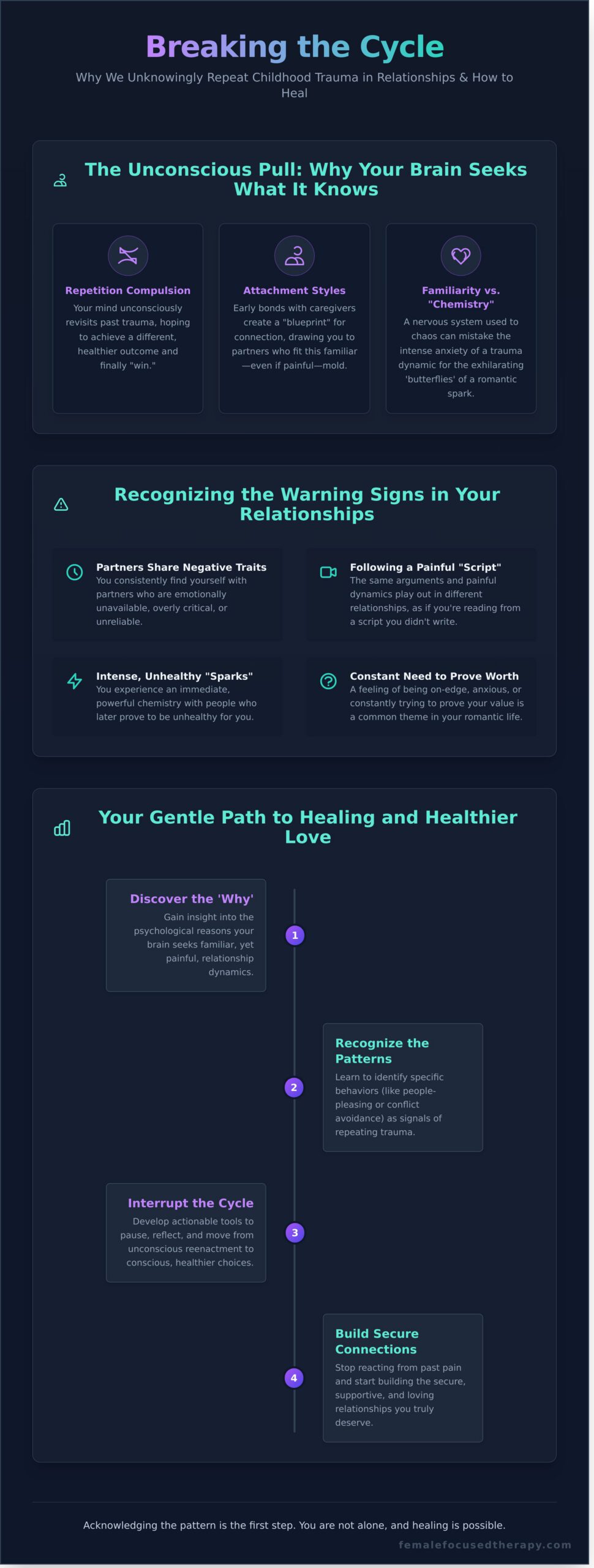
- Discover the key psychological reason your brain seeks familiar dynamics, helping you understand why you might feel ‘stuck’ in painful relationship cycles.
- Learn to recognise specific, common patterns-from people-pleasing to conflict avoidance-that signal you are repeating childhood trauma in relationships.
- Uncover a gentle, actionable path to interrupt the cycle, allowing you to move from reenactment to conscious, healthier choices in love.
- Gain the insight needed to stop reacting from a place of past pain and start building the secure, supportive connections you deserve.
That Familiar Feeling: Recognizing the Cycle of Repeating Trauma
You may be here because you’ve noticed a painful pattern. Another relationship has ended, leaving you with the same hollow feeling of being misunderstood, unseen, or unappreciated. You might be wondering, “How did I end up here again?” This sense of confusion is deeply valid. The truth is, we are often drawn not to what is healthy, but to what feels familiar. This isn’t a conscious choice; it’s a deep, unconscious pull towards dynamics that echo our earliest experiences.
Signs You Might Be Recreating Past Wounds
Recognizing the cycle is the first step toward breaking it. This pattern can show up in subtle yet powerful ways. See if any of these feel true for you:
- You consistently find yourself with partners who share similar negative traits, such as being emotionally unavailable, overly critical, or unreliable.
- The same arguments and painful dynamics seem to play out in different relationships, as if you’re following a script you didn’t write.
- You experience an intense, immediate “spark” or chemistry with people who later prove to be unhealthy for you.
- A feeling of being on-edge, anxious, or constantly trying to prove your worth is a common theme in your romantic life.
‘Why Do I Keep Choosing the Wrong Person?’ It’s Not Your Fault
If you’re asking this question, please know this: the pattern is not a flaw in your character. It’s a survival map your younger self created to navigate a difficult emotional world. The challenge of repeating childhood trauma in relationships is that your brain is trying to gain mastery over an old wound. It unconsciously seeks out similar scenarios, hoping for a different, better outcome this time. This drive is so common it’s a well-documented psychological concept of repetition compulsion, where we are compelled to reenact our past.
Simply by reading this and recognizing yourself in these words, you are already taking the most powerful step. Acknowledging the pattern is how we begin to reclaim our story, rebuild self-trust, and learn to navigate relationships with new clarity and confidence.
The Psychology of Repetition: Why Your Brain Seeks What It Knows
If you find yourself in similar relationship dynamics time and again, it’s not because you are broken or destined to be unhappy. It’s often a sign of your mind’s profound and resilient attempt to heal. Understanding the psychology behind this pattern is the first step toward creating lasting change. This isn’t self-sabotage; it’s a deeply human, unconscious drive to find resolution and wholeness.
Repetition Compulsion: Your Mind’s Unconscious Attempt to Heal
At the heart of repeating childhood trauma in relationships is a concept called repetition compulsion. Think of it as your mind’s attempt to revisit an unresolved past experience to finally ‘win’ or get a different, healthier outcome. This powerful, unconscious drive, which leading trauma expert Dr. Bessel van der Kolk calls a compulsion to repeat the trauma, is not a flaw. For example, if you grew up with a critical parent whose approval felt impossible to earn, you might unconsciously choose a partner who is also critical. Your younger self is still hoping that this time, you can finally be good enough to win their love and validation.
How Attachment Styles Shape Your Relationship Blueprint
Our earliest bonds with caregivers create an internal blueprint for how we connect with others. If your needs were met inconsistently, you may have developed an anxious attachment style, constantly fearing abandonment and seeking reassurance. Conversely, if your caregivers were emotionally distant, you may have an avoidant style, fearing intimacy and equating closeness with being overwhelmed. We are then drawn to partners who fit this blueprint, confirming our deeply held beliefs about love-even when those beliefs are painful.
When Familiarity Feels Like Chemistry
For a nervous system accustomed to chaos, the anxiety and unpredictability of a familiar trauma dynamic can be easily mistaken for the exhilarating ‘butterflies’ of romantic chemistry. The tension, the push-and-pull, and the emotional highs and lows feel potent and alive. In contrast, a calm, secure, and consistently loving partner can feel ‘boring’ or lacking a spark. A significant part of healing is learning to recalibrate your nervous system, so that the gentle warmth of safety feels like home, not the storm of unresolved pain.
Common Patterns: How Childhood Wounds Appear in Your Adult Relationships
Recognising these patterns is the first, most compassionate step toward healing. The act of repeating childhood trauma in relationships is not a conscious choice, but a deeply ingrained attempt by our psyche to find resolution. It’s part of a powerful psychological phenomenon of repetition compulsion, where we are drawn to familiar dynamics in the hope of finally achieving a different, more healing outcome. Below are some common ways these childhood wounds manifest, each driven by a valid, unmet need.
The People-Pleaser: A Fear of Abandonment
If you grew up feeling you had to earn love, keep the peace, or be ‘good’ to avoid conflict, you might find yourself in a people-pleasing role. This can look like saying ‘yes’ when you mean ‘no,’ hiding your own needs to avoid being a ‘burden,’ or feeling wholly responsible for your partner’s happiness. The underlying wound is a quiet, persistent belief: ‘I am only lovable when I am useful or make others happy.’
Attracting the Emotionally Unavailable: Recreating a Distant Parent
When a primary caregiver was physically or emotionally absent, we can internalise the belief that love is something scarce that must be earned. As an adult, this often means being drawn to partners who are non-committal, inconsistent, or emotionally distant-an unconscious recreation of that early dynamic. You might find yourself constantly chasing connection, believing that if you just work hard enough, you can finally prove your worthiness of their love. Learn more about healing from relationship trauma and narcissistic abuse.
The Rescuer or Fixer: Over-Functioning to Feel in Control
Growing up in a chaotic environment or being ‘parentified’-tasked with adult responsibilities too early-can lead to a pattern of rescuing others. You might choose ‘project’ partners who you believe you can fix, take on all the emotional labour in the relationship, and feel perpetually drained. This emotional over-functioning is a way to feel in control and needed, but it stems from the wound: ‘My value comes from my ability to care for others and solve their problems.’
Breaking the Cycle: A Gentle Path to Healing and Healthier Love
Understanding why you are repeating childhood trauma in relationships is a monumental first step. Now, we gently turn towards the how of healing. This journey isn’t about a quick fix; it’s a compassionate process of reconnection with yourself, paced in a way that feels safe and sustainable. Below are the foundational steps you can begin to take to navigate your way toward the secure, loving connections you deserve.
Step 1: Cultivate Awareness with Self-Compassion
The first step is simply to notice the patterns without the heavy weight of judgment. When you feel a familiar surge of anxiety or a pull towards an old, unhelpful reaction, just observe it. Self-criticism only reinforces the original trauma; compassion is the true antidote. You can start by gently asking yourself:
- When did I feel that familiar ache of not being enough today?
- What situation made me feel small or unheard?
Meeting these moments with kindness, rather than frustration, begins to soften the hold they have on you.
Step 2: Identify Your Core Wounds and Triggers
Look deeper into the feelings that are being recreated. Are you often left feeling abandoned, criticised, or responsible for others’ emotions? By connecting these present-day feelings to their origins in your childhood, you start to understand your triggers. Recognising, “This feeling of panic is linked to when I felt alone as a child,” reduces the trigger’s immediate power. This clarity helps separate the past from the present, giving you space to choose a new response.
Step 3: Begin to Build and Hold Boundaries
Boundaries are not an act of selfishness; they are a profound act of self-respect and a vital part of healing. They are the loving lines you draw to protect your energy and wellbeing. Start small. It might be saying, “I can’t talk right now, but I can in an hour,” or clearly stating a need like, “I need some quiet time.” This will likely feel uncomfortable at first, especially if you’re used to people-pleasing, and that’s perfectly okay. Every small boundary you set helps rebuild self-trust.
Step 4: Seek Professional, Trauma-Informed Support
Untangling the deep roots of repeating childhood trauma in relationships is challenging work to do alone. A trauma-informed therapist provides a safe, confidential relationship where you can explore these patterns without fear of judgment. In this supportive space, you can learn to build a secure attachment with yourself, offering the validation and safety you may not have received. We are here to help you navigate this path with expertise and genuine care.
If you’re ready to break the cycle and cultivate healthier love, you can book a confidential consultation with a specialist at Female Focused Therapy.
Your Path Forward: From Repetition to Reconnection
Understanding the echoes of the past in your present is a profound act of self-awareness. It’s vital to remember that these cycles are not a reflection of your worth, but your brain’s deep-seated pull toward the familiar. Recognizing how these old wounds surface is the first, most powerful step toward change. Breaking free from the cycle of repeating childhood trauma in relationships isn’t about erasing your history; it’s about learning to navigate your future with clarity and self-compassion.
As a specialist in relationship trauma for women, I offer a warm, confidential, and trauma-informed approach to help you on this journey. With online therapy available worldwide, support is accessible no matter where you are. If you recognize yourself in these patterns, you are not alone. Take the first step toward healing and book a confidential therapy session today.
A future filled with healthier, more fulfilling love is not just possible-it is waiting for you.
Frequently Asked Questions About Healing Relationship Patterns
Can I break these relationship patterns on my own?
While self-awareness is a courageous first step, navigating these deep-seated patterns alone can be incredibly challenging, as they often operate on an unconscious level. Working with a therapist provides a safe, supportive space to explore these dynamics without judgment. A professional can offer objective insights and tailored strategies that self-help resources may not provide, helping you gently untangle the roots of these behaviours and build a new foundation for healthier connections.
What if my childhood wasn’t ‘that bad’ but I still see these patterns?
This is a very common and valid feeling. Trauma isn’t always about major, overt events; it can also stem from more subtle experiences like emotional neglect, inconsistent care, or having your feelings repeatedly dismissed. These wounds can still deeply impact our attachment styles and how we learn to seek love and validation. Therapy helps you honour all your experiences-no matter their scale-and understand their profound influence on your present-day relationships.
How does trauma-informed therapy specifically help with this cycle?
Trauma-informed therapy creates a foundation of safety, recognising that your patterns are coping mechanisms, not character flaws. Instead of just focusing on changing behaviour, we gently explore its origins. We use an integrative approach, combining talk therapy with somatic (body-based) practices to help regulate your nervous system. This holistic method helps you not only understand the cycle of repeating childhood trauma in relationships but also to feel safe enough within yourself to create lasting change.
Somatic modalities like Craniosacral Therapy can be particularly effective in this holistic approach. For those exploring such options, the Upledger Institute Greece is a leading educational body in this field.
Will I have to stop dating while I work on healing?
This is a personal decision, and there is no single right answer. Some women find it empowering to take a pause from dating to focus entirely on their own healing journey and rebuild self-trust. Others find that dating can be a space to mindfully practice new relational skills with support. Together in therapy, we can explore what feels most aligned and sustainable for you, ensuring you navigate this process at a pace that feels safe and right for you.
How long does it take to change these deeply ingrained relationship patterns?
Healing is a deeply personal journey, not a race with a finish line. Because these patterns were formed over many years, unlearning them requires patience and self-compassion. Meaningful change happens gradually as you build new neural pathways and strengthen your self-trust. While some shifts in perspective can happen quickly, the deeper work of integration unfolds over time. The focus is always on sustainable growth rather than a quick fix, honouring your unique pace.
What’s the difference between a bad habit and trauma repetition?
A bad habit, like leaving clothes on the floor, is often a conscious behaviour we struggle with. In contrast, the act of repeating childhood trauma in relationships is a much deeper, unconscious compulsion. It’s driven by a powerful, unresolved need to ‘fix’ the past or finally achieve a different outcome. This repetition often feels confusing and out of your control, as if you are drawn to familiar unhealthy dynamics despite your best intentions.