
Does it ever feel like you are a magnet for emotionally draining relationships? One after another, you find yourself with people who leave you feeling misunderstood, manipulated, and questioning your own reality. It’s an exhausting cycle that can lead you to a painful, isolating place, wondering if there is something fundamentally wrong with you. If you’re tired of asking yourself the difficult question, why I attract narcissists, please know this: you are not alone, and it is not your fault. There are often deeper, unseen patterns at play that make compassionate and empathetic individuals more susceptible to these dynamics.
This guide is here to offer you clarity and support. Together, we will gently navigate the hidden reasons behind this recurring pattern. We will help you learn to recognise the earliest red flags, begin to rebuild your self-trust, and provide you with actionable steps to break the cycle for good. It is entirely possible to stop attracting these individuals and start building the healthy, reciprocal, and fulfilling relationships you truly deserve, filled with genuine warmth and kindness.
Key Takeaways
- The pattern of attracting narcissists is not your fault, but rather a dynamic ‘lock and key’ fit between your inherent strengths and their needs.
- Discover how your most compassionate qualities, such as deep empathy and a desire to nurture, can unintentionally create a vulnerability to manipulative dynamics.
- Understanding why I attract narcissists often involves gently exploring past relationship patterns that made this dynamic feel familiar, even if it isn’t healthy.
- Learn actionable steps to shift your focus from fixing others to reconnecting with yourself, rebuilding self-trust, and attracting healthy, reciprocal love.
The Unseen Dynamic: It’s Not Your Fault, It’s a ‘Lock and Key’ Fit
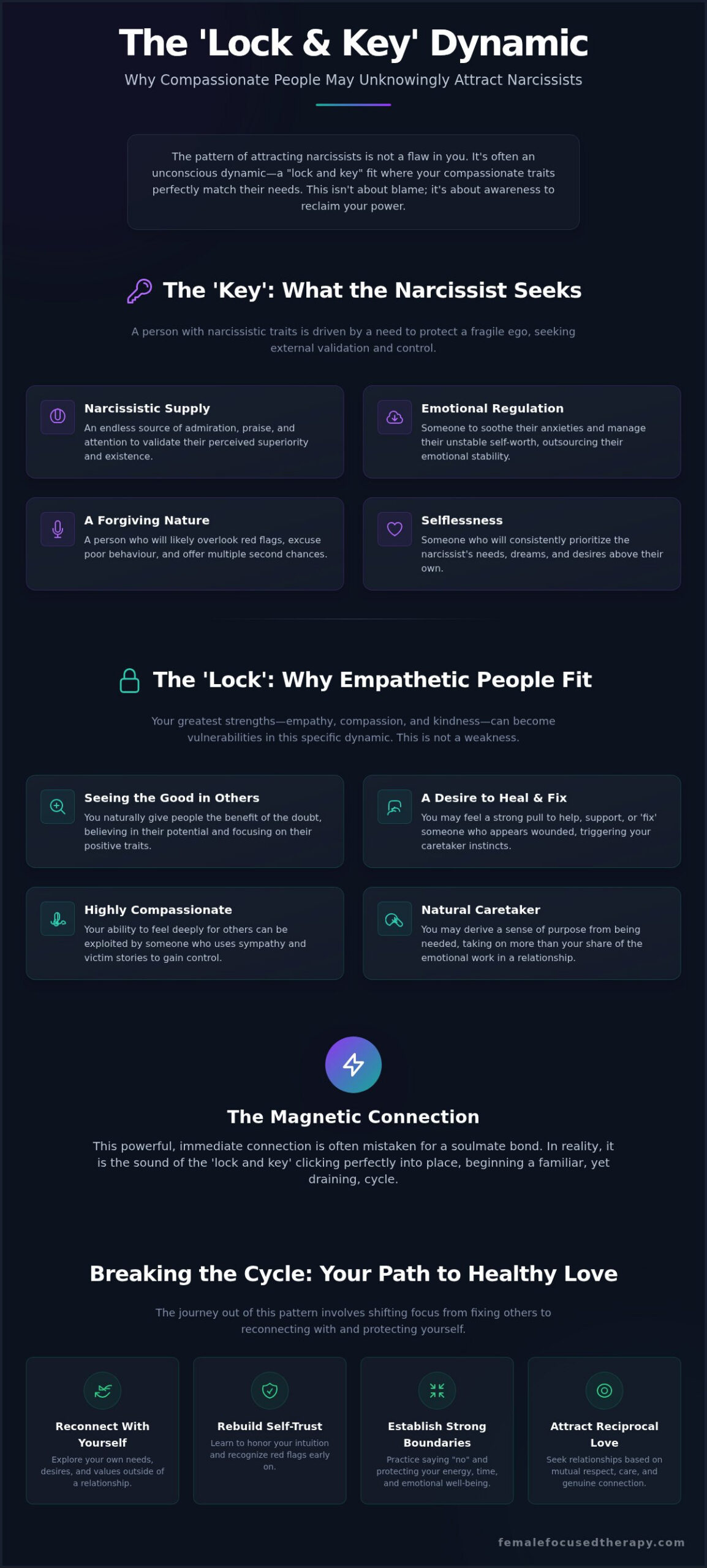
If you find yourself asking, “why I attract narcissists?”, please hear this first: you are not alone, and the emotional exhaustion you feel is completely valid. It’s a painful cycle that can leave you questioning your own judgment and worth. However, the answer isn’t that you are flawed or broken. Instead, it’s helpful to view this pattern as a ‘lock and key’ dynamic-an unconscious fit between two people’s traits.
This is not about blame. It’s about gently bringing awareness to the pattern so you can gain clarity, reclaim your power, and begin to navigate relationships with a stronger sense of self-trust. A narcissist seeks specific qualities in a partner to maintain their fragile sense of self, needing admiration, control, and what is known as narcissistic supply.
What the Narcissist is Looking For (The ‘Key’)
A person with narcissistic traits is often searching for an external solution to their internal emptiness. Their behaviour is driven by a deep-seated need to protect a fragile ego. For a deeper clinical perspective, Understanding Narcissistic Personality Disorder provides a comprehensive overview of the condition. In a partner, they are specifically seeking:
- Narcissistic Supply: An endless source of admiration, praise, and attention to validate their existence and perceived superiority.
- Emotional Regulation: Someone to soothe their anxieties and manage their unstable self-worth, essentially outsourcing their emotional stability.
- A Forgiving Nature: A person who is likely to overlook red flags, excuse poor behaviour, and offer multiple second chances.
- Selflessness: Someone who will consistently prioritise the narcissist’s needs, dreams, and desires above their own.
Why Empathetic People Can Be the ‘Lock’
Your greatest strengths-your empathy, compassion, and kindness-can, in this specific dynamic, become vulnerabilities. If you are a naturally caring person, you may fit the narcissist’s ‘key’ without realising it. This is not a weakness; it is a testament to your capacity for connection. Empathetic individuals often:
- See the Good in Others: You naturally give people the benefit of the doubt, believing in their potential and focusing on their positive traits.
- Have a Desire to Heal: You may feel a pull to help, support, or ‘fix’ someone who appears wounded or misunderstood.
- Are Highly Compassionate: Your ability to feel deeply for others can be exploited by someone who uses sympathy to gain control.
This dynamic often feels incredibly intense and magnetic at first. That powerful, immediate connection is frequently mistaken for a soulmate bond when it is actually the sound of a ‘lock and key’ clicking into place.
Exploring Your Inner World: Traits That May Unknowingly Attract Narcissists
If you find yourself asking, “why I attract narcissists?”, the answer is not a flaw within you. In fact, it often lies in your greatest strengths. Many of the women I work with in Singapore and beyond discover that their most compassionate qualities are the very things that can create a vulnerability to manipulation. This isn’t about changing who you are; it’s about learning to protect your beautiful heart.
Let’s explore these patterns together with gentle curiosity, not criticism. Understanding this dynamic is the first step toward breaking the cycle and rebuilding self-trust.
You Are Highly Empathic and Compassionate
Your ability to feel others’ emotions deeply is a gift. You instinctively want to soothe pain and offer support. Narcissists are highly skilled at detecting this empathy and often present a compelling ‘victim story’ early in the relationship to trigger your compassion. You might sense their deep-seated insecurity and feel a powerful pull to ‘save’ or heal them. Understanding the symptoms and causes of NPD can help clarify why this desire to fix their perceived fragility is such an effective hook.
You Are a Natural ‘Fixer’ or Caretaker
Do you derive a sense of worth and purpose from being needed? Many of us, particularly women, are conditioned to take on the role of the caretaker, managing the emotional wellbeing of those around us. This can lead to “emotional over-functioning”-doing more than your share of the work to maintain the relationship. You might find yourself managing their moods, apologising for their behaviour, or constantly trying to anticipate their needs. A narcissist loves this dynamic, as it allows them to take without ever having to reciprocate.
You May Struggle with People-Pleasing and Setting Boundaries
Saying ‘no’ can feel incredibly difficult, especially if you fear conflict, rejection, or disappointing others. Your default might be to keep the peace, even at your own expense. Narcissists are masters at testing and eroding boundaries. They start with small requests and minor violations, gradually pushing your limits until you feel you have none left. Your desire for harmony becomes a tool they use to gain control, leaving you feeling drained and resentful.
The Echoes of the Past: How Your History Shapes Your Present
It’s a question that brings so many women to therapy: “Why do I attract narcissists?” The answer often lies not in something you are doing wrong now, but in patterns you learned long ago. Our earliest relationships, particularly with our caregivers, create a blueprint for what love and connection feel like. This blueprint, known as our attachment style, dictates what feels ‘familiar’ to our nervous system. The challenge is that what feels familiar is not always what is healthy.
Unpacking these origins is not about placing blame; it is about reclaiming your power. It is a compassionate and essential part of healing from relationship trauma and narcissistic abuse, allowing you to finally understand the dynamics at play and choose a different future.
Growing Up with an Emotionally Unavailable or Narcissistic Parent
If you were raised by a parent who was emotionally distant, critical, or narcissistic, you may have learned that love is conditional and must be earned. The dynamic of constantly striving for approval from someone who withholds it can feel normal, even comfortable. As a child, you likely became an expert at managing your parent’s moods and needs, often at the expense of your own. This pattern of self-neglect and people-pleasing becomes a deeply ingrained way of relating to others.
Internalizing the Belief That You Are ‘Too Much’ or ‘Not Enough’
Early experiences of criticism or emotional neglect can create a core wound-a persistent, painful belief that you are inherently flawed. A narcissist is uniquely skilled at exploiting this. Their initial love-bombing feels like the profound validation you have always craved. Then, when the devaluation begins, it tragically confirms your deepest fears about yourself. This cycle feels so potent because, as some university research on narcissistic behavior highlights, their tactics are designed to target these very insecurities, creating a powerful and addictive bond.
The Role of C-PTSD and Unresolved Trauma
For those who grew up in chaotic or unsafe environments, the nervous system can become wired for survival. This can lead to Complex PTSD (C-PTSD), which impairs your ability to spot red flags in a relationship. Instead of recognising danger, you might find yourself automatically fawning (people-pleasing to de-escalate) or dissociating (numbing out) during conflict. A relationship filled with intense highs and lows can feel strangely familiar, reinforcing the belief that this is simply what love is supposed to feel like.
Breaking the Cycle: Your Path to Attracting Healthy, Reciprocal Love
Understanding the patterns behind the question “why I attract narcissists” is a crucial first step. Now, we shift our focus from analysis to action. This is not about changing who you are; it’s about coming home to yourself. The journey ahead is one of deep reconnection, where you build an internal foundation of safety and worth so solid that you naturally repel manipulation and attract kindness. It’s about empowering yourself to become a ‘bad target’ for those with narcissistic traits.
Cultivate Radical Self-Worth
True healing begins when you shift from seeking external validation to generating it from within. Practice treating yourself with the same deep kindness and compassion you so readily offer to others. A powerful first step is to define your relationship non-negotiables before you even consider dating. This isn’t a wishlist; it’s a clear list of core requirements for your emotional safety, such as:
- Mutual respect, even during disagreements.
- Consistent and honest communication.
- Shared values around kindness and integrity.
Learn and Practice the Art of Boundary Setting
Boundaries are the language of self-respect. Start small by saying ‘no’ to low-stakes requests that drain your energy. Pay close attention to the response: a healthy person respects your limit, while a narcissist will often challenge, guilt, or punish you for it. This is valuable information. Remember, feeling guilty when you first set boundaries is a normal, temporary part of unlearning people-pleasing patterns.
Reconnect With Your Intuition
Narcissistic abuse, especially through gaslighting, is designed to make you doubt your own perception of reality. Rebuilding self-trust starts with listening to your body. Through simple mindfulness practices, you can learn to notice the subtle signals-a knot in your stomach, a tightness in your chest-that often signal when something is wrong. Keeping a simple journal of facts and feelings can also provide an external record of reality, helping you anchor yourself when you feel confused.
Seek Professional, Trauma-Informed Support
While these steps are powerful, untangling the deep-seated patterns that leave you wondering why I attract narcissists often requires professional guidance. Trauma-informed therapy offers a confidential, non-judgmental space to safely explore your history, practice new relational skills, and rebuild the core self-trust that abuse has eroded. You do not have to walk this path alone. If you are ready to begin, you can book a confidential session and take the first step on your healing journey.
Reclaiming Your Story: The First Step to Healthy Love
Understanding the answer to why I attract narcissists is not about placing blame, but about compassionately recognizing a pattern. It’s about seeing how your unique strengths, like deep empathy, and past experiences can unknowingly create a ‘lock and key’ dynamic with narcissistic individuals. This powerful self-awareness is the first step toward breaking free. You have the inherent ability to heal these relational patterns, reclaim your power, and change your story for good.
If you are ready to navigate this journey, you don’t have to do it alone. Cheryl offers specialized support for narcissistic abuse and relationship trauma. In a warm, non-judgmental space designed for women, her integrative, trauma-informed therapy can help you begin the vital work of rebuilding self-trust and learning to attract the healthy, reciprocal love you truly deserve.
Book a confidential session with Cheryl to start healing your relationship patterns.
Your future relationships can be different. The journey to clarity and confidence starts now.
Frequently Asked Questions
Is it possible for a narcissist to change?
This is a question many of us hold in our hearts. While true change is possible for anyone, it is exceptionally rare for individuals with narcissistic traits. Meaningful, lasting change requires a deep level of self-awareness and a genuine desire to heal, which contradicts the core nature of narcissism. Your energy is best spent not on trying to change them, but on rebuilding your own sense of self and focusing on your wellbeing and growth.
What is the difference between genuine self-confidence and narcissism?
Genuine self-confidence comes from a stable inner sense of self-worth. A confident person can celebrate others’ successes, admit their own faults, and feel secure without constant external praise. Narcissism, however, is a mask for deep-seated insecurity. It requires constant admiration from others to feel valid and often involves devaluing people to maintain a sense of superiority. Confidence is quiet and internal; narcissism is loud and demanding.
How can I safely leave a relationship with a narcissistic partner?
Leaving requires careful planning to protect your emotional and physical safety. Begin by confiding in a trusted friend, family member, or a therapist. In Singapore, organisations like AWARE can provide support. Create a safety plan, gather important documents, and secure your finances. Once you leave, implementing a “no contact” rule by blocking their number and social media is a crucial step to begin your healing journey and rebuild your life without their influence.
I’m an empath. Does that mean I will always attract narcissists?
Being an empath means you are deeply compassionate, a beautiful trait that a narcissist can exploit. However, this does not mean you are destined to repeat this pattern. By working with a therapist, you can learn to build strong, healthy boundaries and turn your compassion inward. Understanding this dynamic is the first step to breaking the cycle of wondering “why I attract narcissists” and beginning to cultivate relationships built on mutual respect and care.
What are some of the earliest red flags of narcissism to watch for in a new relationship?
Early on, watch for “love bombing”-overwhelming you with intense affection and grand gestures very quickly. Other red flags include a subtle pattern of dismissive comments disguised as jokes, an inability to take responsibility for their mistakes (always blaming others), and a constant need to be the centre of attention. Trust your intuition; if a connection feels too good to be true or you feel emotionally exhausted early on, it is a sign to proceed with caution.
Can women be narcissists too?
Yes, absolutely. Narcissism is a human trait and a personality disorder that is not exclusive to any gender. While cultural stereotypes often portray narcissists as male, women can exhibit the same core traits of entitlement, a lack of empathy, and a deep need for admiration. The expression may sometimes differ, but the underlying patterns and the emotional impact on those around them are fundamentally the same. It is important to recognise these behaviours in anyone.

Article by
Cheryl Kennedy MacDonald MA BA (Hons) Pg. Dip. SAC BACP
Cheryl Kennedy MacDonald is a psychotherapist specialising in women’s mental health, relationships, and life transitions. She works with women navigating trauma, relationship breakdown, identity shifts, and midlife change, helping them rebuild self-trust, emotional stability, and a clear sense of who they are and what they want.
With over 20 years’ experience working with women internationally, Cheryl is the founder of YogaBellies, a global women’s yoga school, and the creator of the Birth ROCKS method. Her work sits at the intersection of psychotherapy and embodiment, integrating evidence-based therapeutic approaches with somatic, body-based practices that support deep, lasting change.
Known for her grounded and direct approach, Cheryl moves beyond surface-level insight to address the patterns held in the body and nervous system. Her work supports women to regulate, reconnect, and respond to their lives from a place of clarity, strength, and self-respect.
She is a published author in academic journals and has written multiple books on women’s health, pregnancy, and midlife wellbeing, available on Amazon and leading book retailers worldwide.